Tuesday, 4 March 2014

Drinking time

Sally Casswell's team has a new paper out on Kiwis' drinking habits. Here was their press release on it. I provided a bit of comment on it for Science Media Centre, copied below.
“The article provides a really interesting survey of drinking habits among New Zealand drinkers. They find that, among Kiwis reporting having consumed alcohol in the past six months, alcohol was reasonably affordable and easily accessible. Drinkers attend pubs reasonably frequently and drink relatively less at pubs than they do on the rarer occasions that they attend nightclubs; I expect this reflects that nightclubs may be more likely to be part of a special event than a visit to the local pub.”
“The authors find that individuals purchasing alcohol after 2 am at an on-licence premise were more likely to have consumed larger amounts of alcohol than those purchasing alcohol before 2 am. I think, though, that they are too quick to conclude that closing times would usefully address heavy drinking. If those at the bar at 12 am include a greater proportion of light drinkers, and the light drinkers tend to go home earlier, we would expect that those purchasing alcohol after 2 am would consist disproportionately of those who were drinking more heavily earlier in the evening and who decided to stay at the bar rather than go home.”
“The authors note correlations between the price of drinks at a venue and the amount consumed; they then argue that lower prices cause differences in quantity consumed at different venues. I wonder about causality here. If you know you only want to have one or two drinks, you might go to the cocktail bar with very expensive and fancy drinks; if you’re interested in a heavier drinking session, you might make sure to hit the venue that you know is cheaper. We then could pretty easily see a relationship between prices at venues and quantities consumed that were due in large part to individuals’ choosing venues appropriate to their intended evening. Similarly, they find drinkers paying lower prices for off-premise alcohol were more likely to drink larger amounts. An equally plausible interpretation is that individuals wishing to drink a larger amount will be more likely to have price in mind when making their purchase, while somebody only intending on having one or two drinks might go for a pricier craft beer or a nicer bottle of wine.”
“Whether their findings on price are causal, or simply correlations, matter for policy. They argue that measures like tax increases or minimum prices would particularly target heavier drinking because individuals are more likely to report having paid less for their alcohol on occasions of heavy drinking. But if people are instead choosing lower cost products for those days when they intend on consuming a larger amount, because they’re budget conscious, price hikes would then have a more limited effect on consumption. Byrnes et al (2012) found that price increases in Australia reduced consumption among lighter drinkers, but did not have much effect on heavy drinking among heavy drinkers. Instead, heavy drinkers saved up money for the weekend binge by drinking less on days in which they would have consumed a smaller amount of alcohol. Wagenaar’s earlier metastudy on prices and consumption showed that a 10% increase in alcohol prices was associated with a 2.8% reduction in heavier drinkers’ consumption, but a 4.4% decrease in average consumption. And while the studies in Wagenaar’s metastudy did not focus on prices in the lower ranges, Stockwell, Auld et al (2012) found that a 10% increase in the minimum price of alcohol in British Columbia reduced overall consumption by 3.4%, a figure entirely in line with the prior Wagenaar study. We then need to worry about whether price measures are appropriately targeted, or whether the costs imposed on moderate drinkers by price measures are worth it. Heavy drinkers aren’t nearly as sensitive to price measures as are lighter drinkers. We could similarly curb speeding by putting the petrol tax up to $6/litre, but it might not be the best way of addressing the harms of speeding.”
Dr. Eric Crampton is Senior Lecturer in Economics at the University of Canterbury. His research on alcohol issues is supported in part by the Brewers Association of Australia and New Zealand, through a grant administered by the University of Canterbury.
I'd be interested in knowing whether till-data from pubs, nightclubs, and dance venues followed the same time pattern as they're suggesting in the survey.

In Casswell's story, everybody starts drinking hard at 2 a.m.: the survey shows heavier drinking among those staying at the pub after 2 a.m. because people start drinking more heavily after 2 a.m.. In that world, earlier closing times might reduce harms from heavy consumption. We would then expect to see, within a bar tab, increasing spend after 2 a.m.. I think you'd need to look at patterns within a tab to make a clean call on this: if we only saw increased per patron expenditures, that's equally consistent with Casswell's story (nothing good happens after2 a.m.) and mine (those who are left in the bar after 2 a.m. were drinking more heavily before 2 a.m. as well, and the lightweights have gone home).

I think it's rather more likely that folks who'd intended on going hard started going hard earlier in the evening and then failed to go home before 2 a.m. - the time series is just picking up cohort effects. If my story's right, then we predict that lighter-drinking tabs are more likely to be closed earlier in the evening, that there isn't any particular increase in within-tab expenditures after 2 a.m., but that per patron consumption increases after 2 a.m. because the patron composition changes over the course of the evening. In that world, closing at 2 a.m. doesn't do tons of good because the heavy drinkers already did most of their heavy drinking; they just otherwise would have stuck around the bar for longer. And, a blanket 2 a.m. closing time would do a lot of harm to all-night dance venues where patrons might not be all that likely to be doing much heavy drinking, other than water, after 2 a.m. anyway (MDMA *cough*).

It's at least testable.

In unrelated news, I look forward to tonight's beer tasting at the University Staff Club.

Voton's staff, Loge's contracts, and Ukraine

Tyler Cowen asks how much American credibility is at stake in Russia's invasion of Ukraine. Under a plausible reading, American inaction signals to China that America would do nothing were China to start messing around with Japan or Taiwan.

But careful for the fine print when Loge's writing the contracts. The security guarantee only committed America to helping Ukraine out if Russia uses nukes. And even then, they don't have to do much. Here's Outside the Beltway:
Likewise, the parties “reaffirm their commitment to seek immediate United Nations Security Council action to provide assistance to Ukraine, as a non-nuclear-weapon State party to the Treaty on the Non-Proliferation of Nuclear Weapons, if Ukraine should become a victim of an act of aggression or an object of a threat of aggression in which nuclear weapons are used.” Emphasis mine. So, unless Russia uses nuclear weapons, the other signatories have no obligation to do anything. If Russia were, unfathomably, to threaten or use nukes, then the other parties would be obligated to take the matter to the Security Council—where Russia would promptly veto any proposed action.
When Voton had Loge write the contract with the giant brothers, he hoped that Loge would be able to find a way to avoid his ever having to pay Fasolt and Fafnir: any defect in Valhalla's construction meant no payment was needed. But the giants built it perfectly, and so Voton had to find a way to pay lest the basis of his overlordship, the contracts carved into his spear, all unravel. The giants knew that Loge's contracts were tricky and needed careful attention.

I know nothing about the fine print in America's security guarantees to Taiwan, Japan, or South Korea. If the fine print is sound, I'd expect War Father to follow through with his agreements. If it's all tacit and implicit, then maybe there's a problem.

Update: Ilya Somin suggests sanctions targeting Russia's elite. I suppose that's easier as Europe heads into spring. Justin Eric Haldor Smith provides some history.

Utilitarian GMOs

Peter Singer makes the case for GMOs.
Genetically modified crops are now grown on about one-tenth of the world’s cropland, and none of the disastrous consequences that we Greens feared have come to pass. There is no reliable scientific evidence that GM foods cause illness, despite the fact that they receive much more intense scrutiny than more “natural” foods. (Natural foods can also pose health risks, as was shown recently by studies establishing that a popular type of cinnamon can cause liver damage.)
Although cross-pollination between GM crops and wild plants can occur, so far no new superweeds have emerged. We should be pleased about that – and perhaps the regulations that were introduced in response to the concerns expressed by environmental organizations played a role in that outcome.
Regulations to protect the environment and the health of consumers should be maintained. Caution is reasonable. What needs to be rethought, however, is blanket opposition to the very idea of GMOs.
Kim Hill will be hosting this year's EnviroTown debate at Lincoln University; they'll be talking GMOs. Hopefully we'll start getting a bit of sanity into the discussions.

Monday, 3 March 2014

Samuelson versus Schumpeter, and a few philosophical questions

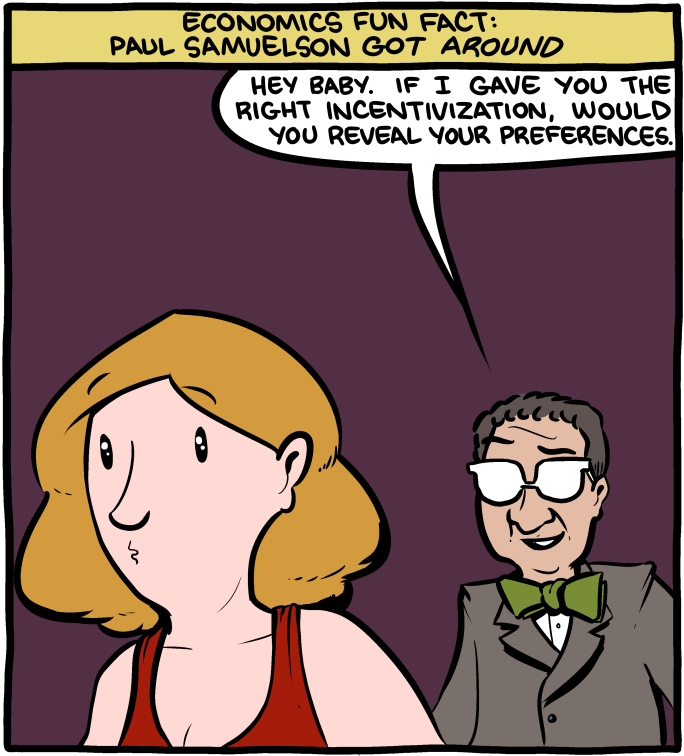
SMBC reckons Samuelson got around.


They've forgotten about Joseph Schumpter:
Early in life I had three ambitions. I wanted to be the greatest economist in the world, the greatest horseman in Austria, and the best lover in Vienna. Well, I never became the greatest horseman in Austria.
John Maynard Keynes was also rather prolific.

Friedrich Hayek moved to Arkansas so he could divorce his wife and marry his second cousin.*

Economists are interesting people.

* Jokes about ACT being fans of Hayek would be cheap shots. Whyte answered the question as any philosophy lecturer should.

I, for one, wish we could have an all-candidates debate in which each party leader is required to give a straight answer to each of the following:

  • You are standing at a railway switch. A runaway train is hurtling down the hill and will run over five people with certainty. If you throw the switch, it will divert to another track and will run over only one person. Do you throw the switch? Does your answer depend on whether the five people are wearing your party's or your opponent's t-shirt?
    • If you agreed that we should throw the switch, would you also support compulsory vaccination? Why not? You know that you're doing exactly the same thing here as standing by the switch, watching the train hurtle towards the five people, right? Except that, given the safety of vaccinations, it's more like a thousand people killed for every adverse reaction to vaccination.
      • If your answer, above, was that compulsory vaccination interferes with legitimate individual autonomy for too little public health gain, explain your stance on the regulation of alcohol, tobacco, marijuana and heroin. Does compulsory vaccination do more to violate individual autonomy than banning the private consumption of tobacco or marijuana, or than taxing the heck out of alcohol?
  • A young person lives in Temuka and moves to Auckland in search of a better life. The young migrant finds a far better job than would have been available in Temuka and is much happier than otherwise. He outbids a native Aucklander for a house, but only slightly. A person who lives in Auckland also, as consequence, gets a slightly worse job than she otherwise would have gotten. Should the government ban migration from the South Island to Auckland? 
    • Would your answer be different if the young person lived in East Timor instead? What moral theory allows you to distinguish between these two cases?
  • A man cheats on his wife without her knowledge; she is never aware that it has happened. Has he done her harm? If so, should adultery be banned? Why not?
    • A married couple fall in love with a third person. They live together as a family. They raise their children together. They wish their relationship to enjoy formal recognition to ensure easier survivorship rights in case of death and so that their children will be more comfortable in talking about their {Three Moms, Moms and Dad, Dads and Mom, Three Dads}. What harm would be done were they allowed formal legal recognition of their relationship? Why should polygamy be banned? What set of consistent moral principles leads to {allow adultery, ban polygamy}?
Feel free to propose other questions for the never-will-happen all-candidates' debate.

Friday, 28 February 2014

Bit of English

NZ Finance Minister Bill English is awesome. I love every last bit of this.
"With respect to so-called urban sprawl, I think that's a nonsense. If you're against urban sprawl and that means lower to middle income Kiwis can't buy a house and you can't build an apartment in the middle of Auckland for less than NZ$600,000, then that's too high a price to pay. And if it means driving up house prices in a way that wrecks the economy then that's too high a price to pay," he said.
"Funnily enough the people who are most worried about urban sprawl live in the middle of the city. They don't get to see it. How much time to they really spend out the end of the Western motorway or Botany? None actually. They think you should be able to walk to the countryside. Well...welcome to Gore. If you're really mad, that's where you should go. But they don't. They stay in Auckland Central," he said to laughter from the audience.
"What's actually happened is that the local authorities were keen for a denser city, but the inhabitants weren't, so they've jettisoned a fair bit of the densification aspect," he said.
"So if Auckland wants to grow now, it has to grow out because you don't want it to grow up. Now that's a fair choice, but please don't stop it from growing out as well, otherwise we'll get another few years of 15% house price growth and you get a real mess when it crashes," he said, adding the special housing areas agreed under the Housing Accord with the Auckland Council "do spread the city because the planning rules don't let you do anything else."
"We're indifferent as a government as to whether you grow up or out. But you said don't grow up, so we expect to help you grow out."
English said people making planning decisions in Auckland, Wellington and Christchurch needed to understand they were making decisions about New Zealand's largest asset class, where the decisions they make affect the whole economy, not just your neighbourhood.
"Of course there's tension there, but we are pretty determined to turn ourselves into an affordable housing market," he said.
"There's no obvious reason why little old New Zealand should be one of the most expensive housing markets in the developed world. It really puts pressure on our households. It's one of the reasons why we have interest free student loans, working for families, subsidised early childhood care and savings are low," he said.
High mortgage costs were a reason why the Government provided payments supplementing incomes costing billions, "and a lot of that is driven by planning decisions in this city."
When land use regulations are all messed up, everything else gets screwed up too.

Oz economist Leith van Onselen's right:
But while he pines for sound people on the Australian right, I wish that the New Zealand left could match the Australians. Here's Australian Council of Trade Unions economist Matt Cowgill on housing in Australia:
There's a trade-off at play here, one that can't be wished away or ignored. With a growing population, you can't restrict rising density in established suburbs, prevent sprawl on the urban fringes, and prevent housing from being unaffordable. Pick two out of the three. The urge to preserve historic neighbourhoods, the desire the conserve all the green bits around our cities, and the wish to maintain affordable housing are all noble impulses with which I sympathise. But, again, we can't have them all.
Which is pretty much the same thing that Bill English said. Sound economics, left or right, is on the same page on this stuff. Stupid land use regs hurt poor people while benefiting middle and upper class homeowners.

Here in NZ, we're stuck with the Council of Trade Unions' Helen Kelly.

Bill English, in the speech linked above, talked about selling off some of the Housing New Zealand stock of housing so that they could better match social housing to locational needs. It makes no sense to have a Housing NZ house in an expensive part of town when selling it off could fund social housing for three families instead. Here's English:
"In housing and other areas we will continue recycling taxpayer assets to free up money for reinvestment in areas where there is genuine demand," he said.
Later in the questions and answer session with the audience, he expanded on the plans.
"We actually don't need to own all those houses to help those people who need help,"he said, referring to the Government's partnership with the likes of the Salvation Army, the New Zealand Housing Foundation and IHC's Idea Services.
English said the Goverment wanted to assess a family's need for housing in an area close to jobs and schools, which was difficult to do with its existing stock of 60,000 to 70,000 houses. "You've got to stick them in a house that's empty," he said.
"That will mean growing the non-Housing Corp social sector and redeveloping the Housing Corp assets."
English said there were big tracts of Auckland such as Mt Roskill and Tamaki where "there's endless potential for supplying medium housing to the Auckland housing market if we redevelop those areas."
"But our top priority is to meet the needs of the people in the houses first, and then redevelop what we don't need in order to supply the market better, and there could be a lot of that happen."
Here's how Helen Kelly responded.
Pure partisan idiocy. Why oh Why is the NZ left so freaking dumb?

Wednesday, 26 February 2014

Alcohol Healthwatch Is Making Stuff Up, Again

Here's Alcohol Healthwatch in the New Zealand Herald.
Rising economic confidence and "aggressive" marketing techniques are the driving factors behind an 8.9 million litre rise in alcohol availability last year, says one concerned health organisation.
Latest figures from Statistics New Zealand, which compared figures over the last five years, show the total volume of alcohol available in New Zealand rose to 466 million litres last year - the equivalent of 2.1 standard drinks per person aged 18 and over per day.
It represents an increase of almost 9 million litres from 2012, according to Statistics New Zealand.
The total volume of alcohol available for consumption in New Zealand did increase last year. So too did population. We usually look at per capita trends rather than total volumes.

Go to Stats NZ's Infoshare service. I cannot link directly to the data series, because StatsNZ uses session codes that won't allow it. But the series you need is ALC005AA. Copy that into the search bar that I've linked to above. Then select all years all series. This is what you get when you port it into Google Docs to get graphs.

So, what can we see here? Per capita alcohol availability dropped substantially from 1986 to 1988, levelled off, dropped substantially from 1990 through 1996 (recall that the big liberalisation came '89), then bounced around a bit with a mild rise through 2010 followed by a mild fall. The average per capita figure for those aged 15+ was 9.4 litres over the whole period, was 9.2 litres over the period since 2000, and was 9.3 litres for the period 2003-2013. The 2013 figure was 9.2 litres. Eyeballing it, we've had a slight reversion after a substantial decline in consumption, followed by a levelling-off since 2005.

The Herald's citing Alcohol Healthwatch as saying that rising economic confidence and aggressive marketing are behind a rise in alcohol availability, using "total volume of liquid containing alcohol" as the measure. The volume of pure alcohol per capita is basically flat over the last decade, but with a mild decline from 2010 to present: the period coinciding with "rising economic confidence". And if alcohol marketing has gotten more aggressive over the last year, it's had no obvious effect on consumption. If we take Rebecca Williams at her word that the marketing's gotten more aggressive, then I guess we might start worrying less about aggressive marketing.

Let's continue. Here's more from The Herald:
However, there was concern that drinkers were moving to stronger types of alcohol as further analysis of the figures showed the percentage of beer, as a proportion of total volume available, fell from 81 per cent in 1996 to 62 per cent in 2013.
Wine rose from 16 per cent to 23 per cent, and spirits and spirit-based drinks such as RTDs rose from 3 per cent to 15 per cent in the same 17-year period.
Rebecca Williams, director of Alcohol Healthwatch, said the figures appeared to confirm fears around ready-to-drink (RTDs) beverages.
"One of the worries for us has been that the RTDs ... would be exposing those young drinkers to the spirit brands and the heavier spirits, and I think that is happening," she said.
"The spirits component has increased, wine is going up on a fairly steady basis, and the worry about the wine is that it too is actually quite a larger volume of pure alcohol [per drink], so we're seeing a shift to the heavier alcohol products."
Drinks such as wine were being marketed "aggressively" in outlets like supermarkets, as well as campaigns by drinks companies, which were competing heavily with each other, she said.
The figures could show a trend back up to peak levels in 2008.
"Seeing an increase this year, seeing the economy come back on line, all of those things to me will start to signal some concerns that we could be tracking back up again," she said, saying that "when people are feeling better [financially] they spend more on booze".
Williams is right on a couple of points. Beer has taken a declining share of total alcohol over the period since 1986, but with a very recent levelling-off. The StatsNZ series ALC016AA has the total litres of alcohol available per beverage category rather than per capita, but it's still useful for assessing relative market share across the categories. When we port it over to Google Docs, and with a bit of wrangling,* we get this:
Wine seems to have levelled off at a third of total alcohol since 2006 or so, spirits have risen markedly over the last decade, and beer's dropped. So Williams is right about that. But all of that needs to be read against the broad flatlined trend in per capita total consumption. She's painting the shift to potentially higher alcohol products as representing an increase in consumption of alcohol when per capita alcohol availability hasn't changed.

Further, is Williams suggesting that the beer companies don't market aggressively against each other? Didn't we hear a lot of outrage about aggressive beer promotion at the Rugby 7s? We can't just look at a change and blame aggressive marketing for those components that get a category increase when there's pretty similar marketing for the components that get a category decrease. My weekly supermarket flyers have more pages of wine ads than of beer ads, but there are plenty of ads for sales on slabs of beer too.

Because StatsNZ changed category definitions, we can only split out low and high alcohol spirits starting in 1995. Here's category shares from 1995 onwards:
When I look at this, I see pre-mixed, lower-alcohol spirits displacing beer rather than building demand for pure spirits. And, again, per capita consumption hasn't really grown much over the period.

Summing up, where Williams comes up with marketing- and economy-based explanations for increases in total alcohol availability and for category shifts, and worries that increased consumption of low-alcohol spirits is a gateway to harder spirits, we find instead:
  • No increase in per capita alcohol availability;
  • No plausible story explaining why marketing has been so effective for RTDs and wine and so useless for beer;
  • No plausible story explaining why improved economic conditions helped RTDs and wine but hurt beer;
  • No plausible story explaining why per capita trends in total alcohol availability show a mild decline from 2010 through 2013, the period of economic recovery, when they're using economic recovery to explain changes in total alcohol availability;
  • What looks like roughly constant market share for Beer + RTDs rather than RTDs being a gateway to proper whisky, though it's always possible that RTD drinkers will mature into spirits rather than shift to beer; either way, there's no increase in per capita availability. 
Let's then help the Herald out a bit by re-writing their first couple paragraphs for them.
The total volume of pure alcohol available per person in New Zealand remained constant this year. While there was an 8.9 million litre rise in the total quantity of alcoholic beverages available this past year, this increase is largely explained by a rising population combined with a shift away from spirits-based drinks, which have more alcohol per unit of total liquid, and towards medium-strength beer and wine, which have a lot more water with their alcohol. And, this category change mostly looks like noise given the longer-term trends.
While professional anti-alcohol advocacy groups, whose existence depends on shouting "Monster! Monster!" whenever a new alcohol stat comes out, blamed rising economic confidence and aggressive marketing for the increased total volume of alcoholic beverages, Statistics New Zealand noted that, "the volume of pure alcohol available per person aged 15 years and over (15+) was unchanged from 2012, at 9.2 litres per person." While anti-alcohol activists try to fuel the perception of crises by citing figures on the total amount of alcoholic beverage that's been available for consumption, it's best to look at statistics on per capita pure alcohol availability.
I wish that Monster-Shouting didn't sell papers.

Previously:
Update: Thomas Lumley reached a similar conclusion.

* The period prior to 1995 uses the discontinued series on total wine; from 1996 onward, I use the revised total wine series. It doesn't make much difference but lets me have a longer time series.

Self-control

I read the behavioural literature as a meta form of self-help. Here are some standard ways that people can screw things up; here are some heuristics they use that work on average but can yield failures when applied to the wrong domain; here are some strategies for applying the right heuristic at the right time and for avoiding applying the wrong one; here are some common spots where people need to be extra-vigilant to avoid making errors.

Gareth Morgan tweets a link to a write-up of the standard Wansink findings around food:
Sure, in field experiments, you can induce overeating by making people think that they've eaten less than they have (for example, by surreptitiously filling the bowl from below). But does that mean that they're irrational and always subject to error? Or might it mean that people eat until one of two conditions are met: satiation, or end of current portion? If the latter typically comes before the former, people stop eating at the end of the bowl. If the former tends to come before the latter, they'll leave some behind. What interest would a restaurant have in supplying you with more food than you'd really want when doing so might make you less likely to order dessert and will make you more likely to linger longer at the table?

The linked piece also takes a self-help approach to the findings: Try using smaller bowls or smaller plates; don't go for "value" deals if that isn't what you really want to eat.

And so Matt Nolan replied to Gareth:
Morgan replied,
This kind of line really bugs me; it reminds me of the kind of thing that non-economists will come out with when criticising economics. Imperfect information hardly seems to be what's driving food choices. And, perfect knowledge is hardly necessary to make precommitment viable. You just need to know that you often screw up particular kinds of choices.

Odysseus didn't need perfect information about just how lovely the Sirens' call was in order to have the sailors bind him to the mast; he just needed to know that the temptation had proved too tempting for many others. I've never played World of Warcraft, but that doesn't mean that I've erred in deciding never ever to start playing multiplayer online games. I definitely don't have perfect information about it - I've never played it! But I know that I'd find it hard to avoid spending too much time playing online games if I had the added pressure of friends wanting me to come help them on a raid. So I just don't play. Imperfect information has led me to consume what's likely too little gaming relative to an ideal: you don't need to assume perfect information to get precommitment.