Review of ParentonomicsAs with most things in life, it comes down to a cross-price elasticity. If you're a careful parent who's made sure that sugary and fatty treats are a complement to healthy foods rather than a substitute for them, which is to say that you'll allow them as an occasional reward for good behaviour rather than as a daily staple, you should welcome every bit of advertising on the kids' morning cartoons - it increases the price that kids are willing to pay for those treats and consequently the amount of good behaviour that you can extract from them in exchange. If you can control the supply. At least according to Melbourne Business School economist Josh Gans.
Dilbert creator Scott Adams tells us that having a working knowledge of economics is like having a mild superpower: it provides a pretty useful framework to help in understanding the world. Gans's latest book, Parentonomics (University of New South Wales Press, 2008), applies the economist's mild superpower to parenting - from the delivery room to school concerts. The results? Generally hilarious and often helpful.
Parentonomics is presented as a series of chapter vignettes written primarily to appeal to an audience of non-economists. Gans avoids economic jargon like "cross-price elasticity" - the tone far more Dave Barry than textbook. The informal narrative is bolstered by reference to empirical findings from the social sciences and intuitive explanations of the relevant theories. So we find that reasonable amounts of television viewing doesn't seem to have adverse effects on kids' school performance and that car seats for kids aged 2-6 don't really seem to add much safety over and above just wearing a normal seatbelt.
Parentonomics is at its best in chapters like "Toileting" where Gans applies economic reasoning about incentives in order to provide rewards for achievement of certain ... outcomes, then watches as the subjects of his regulatory regime alter their behaviour to obtain the promised reward in ways that meet the letter of the law rather than its spirit: when the child is rewarded for having a clean nappy when he wakes up in the morning, don't be surprised to find a pile of dirty nappies hiding behind the dresser. Other highlights include negotiating with infants and optimal punishment schedules for older children.
In other sections, Gans's economic applications are more observational than prescriptive: they help us to understand why things are as they are rather than help us in doing anything much about it. So Gans argues that, at a resort complex where his family frequently vacations, the folks who wind up paying for the "kids eat free" deals at the participating resort restaurants are the childless people going to the other restaurants: keeping the cheaper restaurants full of noisy kids helps induce others to pay more to go to the higher-end venues. Gans later wonders why airlines seem unwilling to make simple moves to make flights easier for families. Perhaps, following his earlier logic, it's that frazzled families as co-passengers also help make business class travel that much more enticing to the childless. I'm not entirely convinced by that argument, but I'm not sure that the counterarguments don't also cut against Gans's restaurant story.
In another interesting application of cross-price elasticity, Gans offers a blog, that provides interesting tidbits of economic analysis of parenting. I started following the blog about a year before Parentonomics came out; Gans started offering teaser bits from the book a few months ahead of the book launch. Some of the anecdotes and analyses that made it into the book also can be found in the blog, and of course the blog updates regularly with new material while the book does not. Is the blog then a complement to the book or a substitute for it? I find them rather complementary. Not least because it's a lot harder to take the blog to bed with you at night to read to your wife when the 11 month old is letting neither of you sleep.
Thursday, 16 January 2020
Parentonomics
My column for next week's Newsroom will go through a bit of econo-parenting. I wanted to check my earlier review of Josh Gans's excellent "Parentonomics", but found it had disappeared down an internet memory hole; it had been in the Christchurch Press in 2008. I've dredged it up from my Google Drive archives and am posting it here.


Wednesday, 15 January 2020
Minimum wages and employment
Stuff's Susan Edmunds asked me for comment on the employment effects of the latest round of minimum wage hikes. She chose the right quotes out of this more verbose missive I'd sent through, copied below.
“Minimum wage hikes always bring argument about the effects of those increases on jobs. MBIE regularly provides estimates of the number of job losses likely to be caused by different levels of increase; this time, MBIE expected that the increase to $18.90 would reduce employment by about 6,500 jobs, with some 242,400 workers overall being affected by the minimum wage increase. The employment reduction is not really an estimate of the number of people who might be dismissed because of the wage hike but rather will include jobs that are not created in the first place.Looking at the OECD table again, we were tied for fourth-equal rather than fourth outright - we're tied with Portugal. Above us are only France, Chile and Turkey.
New Zealand’s labour market remains very strong. Employment rates since 2016 have been at historic highs. I worry a lot less about the minimum wage hike causing problems in the current employment environment and a lot more about what it will do come the next economic downturn. New Zealand’s minimum wage, relative to prevailing wages, is very very high by international standards. The most recent OECD data, from 2018, had our minimum wage as the fourth-highest in the world, relative to median incomes, and the highest in the world when compared to average incomes. The effect of a minimum wage on employment depends on its ‘bindingness’ – how many workers would earn a lower wage but for the minimum wage. The closer the minimum wage is to the median wage or to the average wage, the more binding it is. And the more binding it is, the greater the expected effect on employment come the downturn.
So we then have to wonder whether minimum wage hikes are the best way of helping the working poor. To begin with, a lot of the increase in the minimum wage will be clawed back by the government for workers receiving Working for Families or other income-linked support. MBIE estimated that while a minimum worker receiving no other income support would see a 6.45% increase in take-home pay due to the minimum wage hike, an Auckland-based couple both earning the minimum wage while receiving Working for Families and the accommodation supplement would see only a 1.7% increase in take-home pay. And the minimum wage is not all that well targeted, if the idea is to make sure that people can afford to support a family. A lot of minimum wage workers are in higher-earning households, at least according to decade-old work by Gail Pacheco and Tim Maloney. That work is now grossly out of date, but Statistics New Zealand does not exactly make it easy to update those things. Enhancing Working for Families can be better targeted, and with less harm to employment come any downturn.”
Creating urban commons problems
If you weren't already familiar with the 9th Circuit ruling in City of Boise vs Martin, and you've been aghast at the stories coming out of San Francisco, you might want to read this LA Times piece by the Manhattan Institute's Stephen Eide.
On Monday, the Supreme Court announced it would not review City of Boise vs. Martin, a 2018 ruling handed down by the San Francisco-based 9th Circuit Court of Appeals. In Martin, the appeals court struck down prohibitions on sleeping and camping in public that the Idaho city had enacted to address homelessness. Boise’s ordinances did not pass constitutional muster, according to the 9th Circuit, because they inflicted “cruel and unusual punishment” on that city’s homeless population.It's well worth reading the whole thing. I hadn't known that New York is now spending over $3 billion annually on homeless services.
By allowing Martin to stand, the Supreme Court leaves local officials powerless to stop the expansion of homeless encampments. In many West Coast cities, the burgeoning number of tents have left sidewalks in some neighborhoods awash in trash, human waste and used needles and have led to outbreaks of infectious diseases such as hepatitis A and C and rodent infestations.
But as notorious as the homeless crises of Los Angeles and San Francisco are, the consequences of the Martin ruling are most ominous for cities like Boise.
Tuesday, 14 January 2020
The Age of Invention
If you haven't already subscribed to Anton Howes's weekly newsletter on economic history and innovation, you should. He aims to cover the causes of the British Industrial Revolution and the history of innovation.
I hadn't known that the length of a cricket pitch goes back to the length of a standard surveying chain, Gunter's chain, set in the 1620s.
And Howes explains how the 1720s "Bubble Act" preceded the South Sea Company's crash rather than responding to it:
I hadn't known that the length of a cricket pitch goes back to the length of a standard surveying chain, Gunter's chain, set in the 1620s.
And Howes explains how the 1720s "Bubble Act" preceded the South Sea Company's crash rather than responding to it:
Importantly, as a result of the South Sea affair, Parliament introduced major restrictions on new companies. The famous “Bubble Act” of 1720, for example, prevented the formation of any new joint-stock companies with transferable shares - the kind of basic corporate form that we take for granted today - unless specially incorporated by act of Parliament or by royal charter. Curiously, the restriction was not a reaction to the crash. The Bubble Act actually preceded it, having been created by the South Sea Company itself. In order to funnel more investor money into puffing up the value its own shares, it had used its political connections to get Parliament to essentially ban the creation of any stock-market competitors. But despite the short-term aims of the act, the restrictions remained in place for well over a hundred years. Many of the most capital-intensive innovations of the British Industrial Revolution, including the rise of factories and the spread of the steam engine, thus took place despite severe limitations on companies’ ability to form and raise funds. Elements of incorporation like limited liability - again something we take for granted today - would not be made widespread until the mid-1850s.A decade ago, this would have been a blog rather than a newsletter. Sometimes, technology regresses I suppose.
Monday, 13 January 2020
Unions, bagels, and the mob
It all started out as a set of bakers with secret knowledge of how to make bagels properly. It became a union, ensuring that the holders of the secret knowledge were the ones to profit from it - almost more like an old craft guild but with pickets.
And then the mob came in.
A fantastic story over at Grub Street. Strongly recommended; superb storytelling around a story that was great to begin with.
A snippet:
The excessive hours mandated in such environments were so brutal that in the late 1920s, bagel bakers, primarily immigrants from Eastern Europe, banded together in protest. The result — Union Local 338, under the umbrella of the Bakery and Confectionery Workers (B&C) International — offered a measure of professional leverage. Beginning in the 1930s, if one wanted to run a bagel shop in Manhattan, one had no choice but to employ union bakers. They were, after all, virtually the only men in town capable of making a proper bagel, not to mention exceedingly judicious when it came to imparting their wisdom. So comprehensive was this mandate that bakery owners were prohibited from manning their own ovens at the risk of costly and relentless picket lines outside their shops. (Picketing was the official response to virtually all major labor disputes. The union prevailed every time.)
Union Local 338 never grew much past 300 bakers, but the power it held was enduring. Membership was intentionally exclusive, based on the lineage-driven, old-world tradition of passing down a generationally honed craft from father to son. On this basis, acceptance was limited to the sons of existing 338 members (with the rare son-in-law and occasional nephew sliding quietly under the rope), a structure that retained an exclusively Jewish identity. Until American-born offspring began to turn over No. 338’s roster in the 1950s, the local communicated primarily in Yiddish, its correspondence and record-keeping entirely indecipherable to outsiders. The newspaper of record, the one read by bakers during their breaks, was the Yiddish-language daily Forverts — the Forward — which today publishes online in both English and Yiddish.
Under the union, bakers’ hours were soon strictly controlled, with wages rising to match those of high-end plumbers and electricians, plus paid vacations, life insurance, and pension plans. With a direct line between union members and their fathers who worked the benches before them, it was impossible to take such gains for granted. It also made concessions nearly impossible when it came to negotiating contracts.
Ultimately, it barely mattered to shop owners. In a thriving industry that by the mid-1960s was pumping out more than 2 million bagels per week to a market only just beginning to reach beyond New York City, they could afford it. With their industry grossing some $20 million per year, these men purchased homes on Long Island, drove fancy cars, and sent their children to prestigious colleges. It was a copacetic ecosystem, working out favorably for all involved.
Naturally, the Mafia wanted in.
Mining the landfills
I've been following Sierra Energy's waste-to-energy tech for the past year; it's pretty interesting.
Mike Hart presented on it here in Wellington late last year; his presentation is below.
I liked this bit from his most recent newsletter (I find a subscription link here), on waste reduction:
Mike Hart presented on it here in Wellington late last year; his presentation is below.
I liked this bit from his most recent newsletter (I find a subscription link here), on waste reduction:
Thirdly, if and when we reach the point where communities are using less and do not produce enough waste to power a FastOx gasifier, the gasifier can then be used to mine landfills. Landfills emit methane for 100 years and many of the landfills (open and closed) are not properly consented- they continue to leach into the ground and pollute the ground water year after year. Additionally, as the return on investment is commonly in just a few years, there is no economic loss once a community stops creating waste.A couple of years ago, I'd suggested that we should view well-managed landfills as storage sites for future recycling. The future is coming.
Monday, 6 January 2020
Re-thinking fees-free
Roger Smyth, formerly head of tertiary education policy at the Ministry of Education, writes over at Times Higher Education about New Zealand's fees-free policy:
Smyth's piece over at Ed Central is also well worth a read.
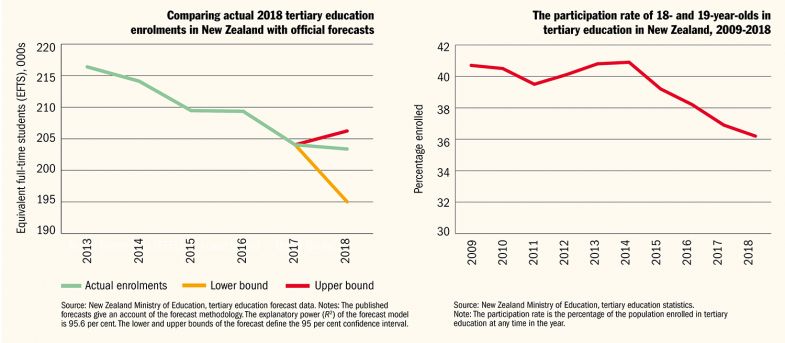
He also notes that if we take seriously survey results from Canterbury Uni, where 5.8% of students said that fees-free was critical to their decision to enrol (and we perhaps might think that an overestimate), it would still mean that taxpayers had to fund the fees of 47,000 students to enable 2,700 enrolments across the system in 2018.So how did the first stage in the fees-free policy work out in New Zealand?Let’s look at the 2018 New Zealand tertiary education enrolments data and compare them with the government’s forecasts for 2018. Those forecasts – based on enrolment trends up to 2017, demographic data and predictions about the labour market – took no account of the fees-free policy. This means we can compare the actual enrolments in 2018 with what was expected in the absence of the fees-free policy. From this, we can estimate the effect on enrolments of the policy change.
Student enrolments in New Zealand across time
The actual 2018 outcome is within the 95 per cent confidence interval for the forecast – within the margin of error. In other words, the actual result was in line with what would have been expected in the absence of the fees-free policy. That means there was no statistically measurable effect on enrolments from the change in policy. None at all.Another test of the impact of the fees-free policy is to look at the population aged 18 and 19 – the age group most likely to be affected – and to ask what happened to their participation rates. Figure 3 above shows the proportion of the population aged 18 to 19 who were enrolled in tertiary education over the past 10 years.The trend in the participation rate reflects the labour market. Youth unemployment remained relatively high in New Zealand in the years following the global financial crisis. But, as the youth labour market began to strengthen after 2013, the enrolment rate began to drop. Fees have much less effect on enrolments than employment factors. The tertiary participation rate continued to fall in 2018, despite the fees-free policy.If the government were to judge the success of the policy on how it lifted access to post-secondary education, it would have to give itself a fail grade. The report card might read: “Tried hard but made many basic errors.”
Smyth's piece over at Ed Central is also well worth a read.
So how should the government target its spending better? How should it address problems in access to tertiary education?An excellent 2018 report, by Ministry of Education researcher, David Earle, is the most comprehensive and rigorous study yet of access to tertiary education in New Zealand. It provides a blueprint for what not to do to address barriers to access.The study analysed participation in post-school education across an entire birth cohort, using Statistics New Zealand’s integrated data infrastructure, which links anonymised data from the government agencies managing the education, tax, welfare, migration, employment, health and justice systems – data on ethnicity, school performance, school truancy, socio-economic status (SES), parental education, income, occupation and criminal record….Applying statistical techniques to control for all these variables, Earle has worked out which factors are associated with risk of non-participation in tertiary education at Level 4 or above.Unsurprisingly, he finds that achievement and performance at school dwarfs other factors. But after controlling for school performance, some other factors also play a part. For instance, people whose parents have higher qualifications are more likely to enter tertiary education at Level 4 or above. Students who grow up in more deprived neighbourhoods are less likely to enrol, even once other factors are controlled for. Māori are less likely than the general population to go on to higher education, even if they have done well at school. People who use mental health services are less likely to advance to higher levels of education.However, many of the dozens of other variables tested in this study have no significant influence on participation in higher education once school performance is taken into account. These include parental income, truancy and family transience.The inference from Earle’s research is that interventions that target factors shown to be not statistically significant should be quietly set aside. For instance, given that parental income wasn’t found to be significant, interventions directed at lifting participation of young people from low-income families by reducing costs are not likely to work, given current student support policies. It’s no surprise that a financially-focused access initiative – like the current fees-free policy – had minimal effect on participation.What this suggests is that access initiatives should focus on lifting school achievement among those groups which the research shows are less likely to participate – those raised in low SES areas, Māori, those whose families have lower educational achievement. The University of Auckland’s StarPath programme, with its emphasis on improving school achievement through changing practices in lower decile secondary schools, is an example of an intervention that targets the right things.That’s a quite different form of intervention. It’s not as straightforward as removing fees. It may take longer. It might attract less notice and generate fewer votes. But it might just work.
Subscribe to:
Posts (Atom)