Tuesday, 3 November 2015

Manitoba taprooms

Things are improving in Manitoba:
It may be late to the party, but craft breweries are on the verge of exploding in Winnipeg.
Once a smaller market with just two local craft breweries (Half Pints Brewing Co. and Fort Garry Brewing Co.), the city is set to quadruple that number by the end of next year when at least six breweries or brew pubs are scheduled to open.
From the opening of Nicole Barry's Peg Beer Co. brew pub this winter to Tim Hudek's One Great City Brewing brew pub opening in April, Manitoba will go from being the only province without a brew pub to hosting two.
Executives from Calgary-based Big Rock Brewery were here this week, scoping out Winnipeg as a possible location for one of their new urban brew pubs.
Local veterans of craft breweries are embracing the competition.
...
The province began trying to expand the local market for craft beer last year by introducing growlers, a refillable beer container that sells Fort Garry and Half Pints beer at participating Liquor Marts. It plans to expand the program.
In May, the province announced it would allow for taprooms at these breweries, with a maximum of about 50 patrons, to sample beer. The brewery only has to provide small snacks.
The decision in May to allow taprooms and tasting rooms helped convince Tyler Birch to get involved in craft brewing. He hopes to have his brewery, Barn Hammer Brewing, opened by late April.
"There weren't enough breweries in Winnipeg and Manitoba," Birch said, while on break at the Brewers Association meeting.
"Craft beer in Manitoba is definitely going to change. Everywhere else you go, there are so many breweries, and everyone drinks local beer. We don't have that here, and I think as people start to see what we're doing, that will all change," Birch said.
So far, only Half Pints has expressed interest in opening a taproom, but Ron Lemieux, the minister responsible for MLL, hopes these new breweries will pounce on it.
Winnipeg, about 700,000 people, in a province of a bit over million people, is about to expand to 8 breweries.

NZ, population 4.6 million, has about 80 brewers as members of the Brewers' Guild.

It's only recently (well, 2011) that the regulations smartened up a bit (but not entirely). I'm not sure what's up with the restrictions on taproom serving capacity.

HT: Mom

Previously:

Monday, 2 November 2015

Cooperative smarts

Intelligence can affect income through more than a few channels. Smarter people have better health-related behaviours, so what looks like an income gradient in health might in large part be an intelligence gradient. Smarter people are more likely to go to and complete university degrees, so what looks like a return to education might in large part be a return to intelligence.

And smarter people are better at playing cooperate in prisoners' dilemma games. I'd had this hanging in my to-read file from a Marginal Revolution assorted-links post for a while and had missed the original paper when it came out. But here's the write-up from Pseudoerasmus:
Intelligence and Cooperation
In the workhorse model of (non)cooperation — the prisoner’s dilemma — two players are faced with the decision to cooperate or defect based on a matrix of 4 possible payoff combinations.
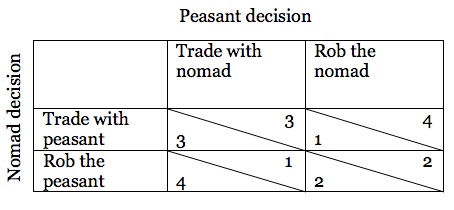
Suppose a sedentary peasant would end up with $4 (the loot + his own output), if he ambushed and robbed a passing horse-backed nomad, but only $3 if he traded goods with him. The nomad faces the identical decision: $4 with robbing, $3 with trading. If bothdecided to rob, then they would be left with $2 each.
PDIt’s set up so that each has a perfectly rational self-interest in robbing the other, but the trading world is clearly better than both-turn-to-robbery world.
It’s well known from simulations of “infinitely repeated” prisoner’s dilemma games that cooperation is best sustained when both players adopt some variety of conditional cooperation strategy: cooperate first, but then copy the other play’s earlier choice. [Axelrod] The gains to both parties are bigger in the long run if both parties behave like that. And, as we have already seen, real people do in practise show an instinct for conditional cooperation.
But Proto, Rustichini & Sofianos (2014) demonstrates that in a multi-round Prisoners’ Dilemma experiment with actual human participants and real money, the intelligent are much more likely to practise conditional cooperation.
In this experiment, subjects were first administered Raven’s Progressive Matrices, a test which measures fluid intelligence (i.e., not based on knowledge). They were also tested for risk attitudes and the Big Five personality traits. In the end, 130 participants were allocated to two groups — “high Raven” and “low Raven” — and the only statistically significant difference between the two groups was in fluid intelligence. The participants did not know how they were grouped. (Edit: Also relevant: “Participants in these non-economists sessions had not taken any game theory modules or classes.”)
Then within each group, different pairs of participants repeatedly played the prisoner’s dilemma — the maximum number of rounds was 10 but a computer decided whether to terminate the session after each round with a fixed probability. There were multiple sessions of these rounds of games.
fig2b
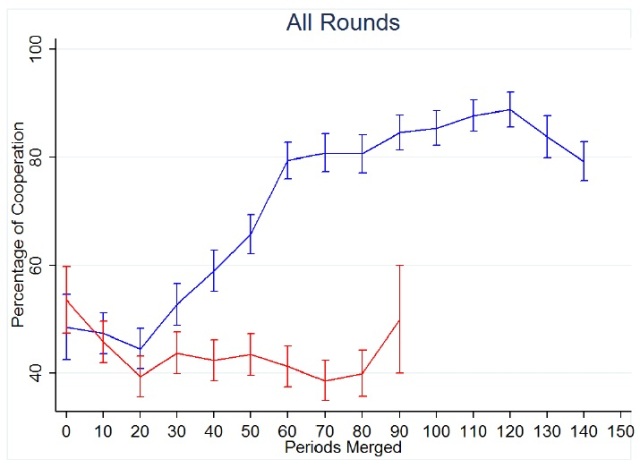
[Blue: high Ravens group, Red: low Ravens group. X-axis: each period represents 10 rounds; Y-axis: the fraction of players cooperating.]
The high Raven group not only diverged early from the low Ravens, but also sustained cooperation much longer. There actually wasn’t much difference between the two groups in the early rounds. The difference grew incrementally, in drips and drabs, but in the end, it was substantial. This suggests high Ravens learnt the optimal behaviour from the previous rounds better than the other group.
Proto et al. sliced and diced the data in various ways and found that:
  • reciprocation is much stronger with the smart: high Ravens are more likely than the low Ravens, to match prior cooperation with cooperation in kind, and punish prior defection with defection in kind;
  • reaction times — the time it took to decide whether to cooperate or defect — were shorter and declined faster for the high Ravens;
  • the only statistically significant difference in individual participant characteristics was fluid intelligence;
  • when the monetary payoffs were manipulated to make cooperation less profitable in the long run, the high Ravens were no more cooperative than the low Ravens — if anything, the low Ravens were slightly more cooperative !
But the most amazing result has to be this: “Low Raven subjects play Always Defect with probability above 50 per cent, in stark contrast with high Raven subjects who play this strategy with probability statistically equal to 0. Instead, the probability for the high Raven to play more cooperative strategies (Grim and Tit for Tat) is about 67 per cent, while for the low Raven this is lower (around 45 per cent).”
Understanding the benefits of working together in complex situations — which is what a repeated prisoner’s dilemma simulates — implicitly requires reasoning skills, the ability to learn from mistakes, the ability to anticipate, and accurate beliefs about other people’s motives.
The ethical implication: the intelligent are more likely to practise the Golden Rule, and this actually breeds trust; and the less intelligent are more likely to think they can get away with it, and this breeds mistrust. You only need intelligence to generate this difference. You can immediately see where social and civic capital might come from, at least in part.
The Proto et al. study replicates and extends a few earlier studies on intelligence and cooperation (Al-Ubaydli et al. 2014; Jones 2008). Moreover, it’s consistent with cross-cultural findings from Public Goods Games as described below.
The post also extols the merits of patience.

Risky tenants

Would landlords be like this if it were easy to kick out problem tenants?
Private landlords are shying away from renting to homeless youth even though the Christchurch City Council is promising to underwrite their rent.
Earlier this year, the council decided it would allocate $130,000 from its housing fund to underwrite the leasing of private rental properties for the homeless.
...
CMM executive director Jill Hawkey said despite the financial guarantees offered to landlords in regards to rent and repairs, many declined to allow them to rent properties that would be subletted to youth because they worried they would be noisy and annoy neighbouring tenants.
About 50 landlords had to be approached to get the two tenancies for young people.
...
Council housing taskforce chairman Cr Glenn Livingstone said some of the people helped by the project had been struggling on the streets for years.
"Because of this, moving into a permanent home is literally a life-changing event for them, opening up new opportunities for the future."
Rental housing was usually not an option for homeless people because of their credit rating, tenancy history, or lack of income to pay for bonds or rent in advance.
"From a landlord's point of view, there's just too much risk there," Livingstone said.
"But with the help of the project and the significant support provided by Youth and Cultural Development, the Methodist Mission has been able to help a number of young people and families to overcome these barriers and get a foothold in warm, secure and affordable rental housing."
Barriers to exit are barriers to entry: if you can't get out of a bad situation, you take a lot of care not to enter into one in the first place. The regulations that look really nice to protect people against bad landlords help to ensure the riskier tenants have a hard time getting a tenancy in the first place.

Evolved phobias, modern solutions

Clare Lehman points to data on Americans' phobias. Not so much the things that kill people today, but things our ancestors a hundred thousand years ago would have had to worry about:
Fortunately, Zach Weinersmith has the solution:

If you're interested, and you should be, SMBC's best-of religion and science comics are up on Kickstarter.

Friday, 30 October 2015

CURF and turf

Here's what you need to do if you want an anonymised 1% sample of the US Census.
  1. Go to Google and type US Census 1% sample, click on link to the Census.
  2. Download each of the state files from the FTP site and merge them yourself. Or just check things out for one of the states. Whatever you like.
  3. Start mucking about to test whether your pet theory is plausible.
Here's what you need to do if you want an anoymised sample of the NZ Census, or a Confidentialised Unit Record File (CURF) of any of big Stats series:
  1. Go to Stats NZ's site, here.
  2. Follow the instructions below:

Application process

CURFs can be accessed through the following process. Please contact us if you need help at any stage:
  1. Complete the CURF application form.
  2. Statistics NZ will assess the application and will ask you to provide further information if necessary.
  3. If the application is approved: 
    • the appropriate CURF licence must be signed by a person authorised to sign on behalf of the researcher's organisation 
    • each researcher who will have access to the CURF must sign the appropriate researcher undertaking 
  4. The CURF is supplied to the lead researcher.  

Assessment criteria

All access to microdata is at the discretion of the Government Statistician.
Consideration will be given to applications for CURFs that meet the following criteria:
  • The research is for a statistical purpose. 
  • The researchers have a proven history of research, or will be supervised by someone with a proven history of research. 
  • The researchers have the support of the organisation that employs them (eg, government department, university, or independent research firm).
  • The organisation supporting the research is based in New Zealand.
  • The researchers for the project using the CURF are based in New Zealand.

Methods of access

Once the application is approved, CURFs can be downloaded via secure internet access. Researchers must keep the CURF secure and ensure that the CURF is only accessible to approved researchers. Researchers can use the CURF at their workplace but data cannot be stored on a laptop, memory stick, or other portable device. All copies of the CURF data must be destroyed at the end of the research project.
CURFs are licensed for a 12-month period. The researcher can request a licence extension at the end of this period if further use is required.
Note that you can only use your CURF for the purposes set out in Schedule A of your application. So if there's some other hypothesis you wanted to check out, you need to clear it first.

If you have a hunch about something and want to see whether it's worth further checking out, America makes it easy. In New Zealand, you need to make application, wait, make sure you specified exactly what you might want to do with it, then buy a desktop computer because your laptop isn't good enough.

And the government wonders why NZ social scientists, funded by the government, rarely bother doing work on NZ data. It's a pain in the ass. Sure, it's possible. But you have to bear reasonable fixed costs to test whether an initial hunch is worth following up.

Earlier this week, I was reviewing one of our researcher's projects. They'd cited an interesting bit of American data. It would have been dead simple to check whether the same relationship bore out in the New Zealand data - just a couple of cross-tabs. But it would take all that rigamarole.

Why can America manage to provide its anonymised samples to anybody with a web browser while we have all of this?

Living wages - Wellington edition

Wellington Council's voted to require its security contractors to pay their employees at a higher wage rate.

David Farrar walks us through Council CEO Kevin Lavery's objections to what his Council has voted to make him do. In short, it is very likely illegal. Here's Lavery:
So my advice is simple – adopting the Living Wage for the security contract is a step too far. There is compelling evidence that you would potentially fail to meet your fiduciary duty to ratepayers. There is a serious risk that you would be acting beyond your powers. You would be purchasing the service for 19% extra without any corresponding improvement in service levels or productivity. You could also set a precedent for other contracts which would cost the Council tens of millions annually.  You would also be failing in your duty to me as a good employer. And you run the risk of tarnishing your reputation.  Could a responsible public body really make a decision against clear legal and officer advice only to be directed by a Court to reverse its decision? There is also a very real risk that your enthusiasm for expanding the Living Wage could undermine the good progress achieved with our own workforce. Remember that the WCC Living Wage adopted for our own staff and CCO staff has not been tested in a court of law. A successful judicial review on the expansion of the Living Wage to contractors may encourage further challenges on its adoption for our own workforce. A defeat here would have very serious consequences as the decision has already been implemented.
We should note further that extending the Council's mandated living wage to include all contractors skews the pitch against contractors, who might compete with council-owned suppliers on cost grounds. Mandate that everybody pay very high wages and contractors' cost advantages erode.

Previously:

Sideloading supermarkets

Suppose that there were a problem with kids drinking in a supermarket parking lot in Wellington.

Among the things that the police can already do about it:
Instead, the police are opposing the supermarket's liquor licence renewal. 

I suppose that eventually having a ban on all downtown alcohol sales barring pricey craft beers could help the police to keep their rostering costs down. 

* The default in NZ is that you are allowed to drink in public unless there is a ban in place on open liquor in those specific public places.

** The story notes that the police did have one blitz on public drinking in that supermarket. I doubt it would take many of these to stop the problem.