Showing posts with label endangered species. Show all posts

Thursday, 18 September 2014

I want to eat a weka

It's been more than five years since I first posted on Roger Beattie's felicitous "Eat them to save them" campaign. And I still am not allowed to buy a weka for dinner.

Roger is one of New Zealand's great enviropreneurs: the National Farming Review called him an Eco Anarchist. He loves the environment and sees the best way of saving it as ensuring that it's profitable to save it. Weka are endangered, but they're easily farmed and tasty. Why aren't we raising them for the restaurant trade and conserving an endangered species in the process? The Department of Conservation says no. They say no incredibly incoherently. But their "No" is what matters.

Roger features in Vice's "Munchies" column this week. Here's an excerpt.
How do you think we should be protecting endangered species?We need to change the legislation. We wonder why we’re losing 6 percent of our kiwi population per year. The Department is right in identifying the problem, but have the wrong solutions. A market solution is necessary. If private individuals want to do conservationist things, there should be no impediment. We farm native paua, plenty of people are propagating native trees—but certain native species can’t be farmed. No species that have ever been farmed have ever died out. Since man has been in New Zealand, we’ve lost 44 bird species because they were protected. If you’ve got the choice between something being protected and dying, and something being farmed and thriving, that’s not much of a choice.
What species do you want to farm first?In terms of sustainable farming, you have to have a species that is friendly and tasty. What I do know about is weka. Weka grow fast, they can be farmed with only a relatively small amount of capital, they eat a variety of food, and are cheap to grow and keep. We’ve bred hundreds of them and given them away. You’re not allowed to sell them without a permit. You’d end up in jail.
I'd love to see work on the economics of allowing the breeding and sale of jewelled geckos, or tuatara, for the pet trade.

Monday, 6 January 2014

Paretian cetacean

Others see problems, I see solutions.

Problem the first: Japan wants to keep subsidising a dumb inefficient national whaling industry. As best I understand things, nobody really wants to eat whale meat and the industry would have just died. But, the rest of the world backed Japan into a corner where it would be embarrassing to stop doing it because they can't stop it without being seen to have lost this fight. So they keep subsidising it, the whaling boats keep going out, and everybody keeps going ahead with confrontational opposition methods that guarantee that Japan can't just cancel the whaling subsidies. And so a bunch of intelligent animals that would prefer not being killed continue to be killed for no particularly good purpose.

Problem the second: A bunch of intelligent animals keep attempting to commit suicide on New Zealand beaches. These whales seem pretty determined. Often, after their would-be rescuers float them out to sea, they just go and beach themselves again. They really seem to want to die.

In the first case, we undertake costly efforts to kill whales that want to live. In the second case, we undertake costly efforts to prevent whales that want to die from killing themselves.

And so here is my proposed solution.

BE IT RESOLVED THAT, henceforth, New Zealand will allow Japanese whaling research vessels access to suicidal New Zealand whales. For an annual fee sufficient to ensure that the Japanese whaling industry remains uneconomical and in need of continued Japanese subsidy, the Japanese whaling fleet can harpoon suicidal New Zealand whales, haul them out to sea where we can't see what's going on, then do whatever it is they do to them. If we haven't sufficient diversity in suicidal whale species, other countries with similarly suicidal whales may wish to join in.

IN EXCHANGE, Japan promises to cease all other whaling, since they'd have at least enough whales here to play with. The research vessels will also try to figure out why whales are killing themselves.

New Zealand and other countries get an end to objectionable forms of whaling. Japan gets to keep its whaling industry. Whales that want to live get to keep living. Whales that want to die are allowed to give their bodies up for science instead of winding up on beaches.

Sure, we'd need a few safeguards. For example, the maximum harvest shouldn't exceed what's currently taken to reduce the incentive to drive whales to suicide. And anything that looks like "let's do wonky things with sonar to make whales want to kill themselves" should reduce the quota limit.

Any reason this couldn't work?

Update: KiwiPollGuy raises some really good objections in comments; he knows far more about Japan than I do. I'll clarify things a bit. First off, I hardly think that "stupid" is the only reason behind whaling. I expect that it's an embedded cultural practice that has value for Japanese people even if they don't eat whale meat. The idea of seaside villages cutting up whale meat likely has the same romantic connotations for folks in Tokyo as the image of tiny Newfie fishing villages has for folks in Toronto, leading to public subsidy of lifestyles that are no longer economically sustainable. Canada was able to get away from some of this in the last twenty years - I understand that the 12/40 rule is now gone. But I've a hard time seeing Japan stopping the subsidies when everybody's yelling at them to end whaling. It might not be the only binding constraint, but it would be among them.

I am arguing that you could, in theory, maintain that whole basic deal by flipping the whaling ships from killing whales at sea to harvesting suicidal beaching whales. But it could be impracticable. I'd expect that beached whales go pong after a few days, and it might be impossible for whaling fleets to get there that quickly. Maybe this could be changed by having Hercules aircraft with air-mobile whalers and kit, ready to land at the nearest airport, truck over, and start to work while the Nisshin Maru trundles on over. We could even package it as a win for Japan rather than a concession - they get to flense whales with our permission in our waters and, depending on logistics, perhaps even on our beaches. I can't see how this is worse than a DoC guy shooting the whales instead. A more substantial constraint would be if the tasty kinds of whales aren't the kinds of whales that tend to go suicidal - if somebody who knows about whales could weigh in on that, I'd update. I know pilot whales keep killing themselves, but have no clue about their relative tastiness. I also don't know which other species have suicidal tendencies.

But KiwiPollGuy may be right that the NZ left would never go for it - that eating whales at all, even the suicidal and would-be-dead-anyway ones, is taken as evil. That would mean that even if NZ got behind a reduce-the-harm version of whaling, we'd get protesters on the beaches interfering with harvesting the suicidal whales. I can't see it working out without having the Greens on board.

Monday, 18 November 2013

Hunt it to save it

I've no urge to go hunting elephants and so I wouldn't pay any positive price to kill one. I'd probably pay some positive price to avoid having to kill one. But it's good that some folks have a willingness to pay to do it. Why? It can help fund conservation efforts.

Elephants are endangered. But some local herds can be beyond their range's capacity to support the population. Active herd management then is needed. If you're going to have to cull some animals, why not get somebody who'd be willing to pay $40,000 or more to do it, and put the funds towards conservation efforts?

I don't know what kind of safari tour GoDaddy founder Bob Parsons was on, but I really really doubt that high profile folks make a habit of going on illegal safaris and then posing for pictures.
Assuming Parsons was on a conservation paid safari, tweets like the one above do harm. Rich people who'd be willing to pay money to shoot elephants stop doing it because of the reputation costs. The elephants still get shot, because active herd management requires it. But instead of being a profit source for the conservation folks, it's instead a cost.*

Feeling Good, Doing Harm. Again.

Meanwhile, the US is destroying a big stockpile of seized elephant ivory. Brendan Moyle would like some evidence that doing so does more good than harm.

Tyler Cowen's pretty sure it does harm: it sends a signal of increased scarcity and so boosts prices for poachers. He writes:
Bruce suggests the government announce it has created an artificial form of ivory, to lower expected prices and discourage future poaching. If they can get away with that lie, great. Otherwise, we all know the 2000 Kremer and Morcom piece entitled simply “Elephants”:
Many open-access resources, such as elephants, are used to produce storable goods. Anticipated future scarcity of these resources will increase current prices and poaching. This implies that, for given initial conditions, there may be rational expectations equilibria leading to both extinction and survival. The cheapest way for governments to eliminate extinction equilibria may be to commit to tough antipoaching measures if the population falls below a threshold. For governments without credibility, the cheapest way to eliminate extinction equilibria may be to accumulate a sufficient stockpile of the storable good and threaten to sell it should the population fall.
That emphasis is added. Sell it, not destroy.

The (gated) AER version of the paper is here. The Montclair State version is here. A few comments and responses are here.

In other words, our government is pursuing symbolic value but at the same time implementing the wrong incentives.
Previously: Eat them to keep them.


* You could build a second best case for the shaming's being efficient if policy around the conservation areas were messed up and they were killing too many animals and if the gains in the interval until policy were fixed outweighed the costs after policy were fixed and the hunters continued staying away.

Thursday, 2 February 2012

Hope for the weka?

Enviropreneur Roger Beattie has pushed for the right to raise and farm NZ protected weka for the dinner table. It's the best approach for conservation: while the Department of Conservation's funding depends on animals being endangered, a farmer's profits depend on his being successful at breeding and raising animals.

Meanwhile, exotic African animals are finding new hope in Texan game farms. Maybe if somebody can smuggle some weka out of the country and over to Texas, they'll be able to there start a commercial breeding operation.

Here's Roger tearing a strip off former Labour Conservation Minister Chris Carter. Shame National decided to keep Labour's policy on this, as on more than a few other issues.

Sunday, 3 July 2011

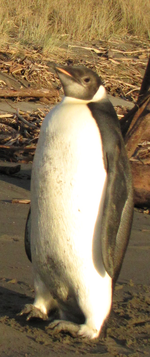
Darwin for Penguins

Taho Potiki on defective penguins:
I am no advocate of killing or maiming animals, cute or otherwise.

But a lost penguin such as the one washed up on the Kapiti Coast could have been left to its own devices to die naturally. The reality is the bird is either dumb or genetically flawed.

A Darwinian argument would be that a penguin whose homing mechanism failed as spectacularly as this bird's did, probably shouldn't breed. It is one thing to be concerned about whether the bird is going to carry diseases back to the Antarctic, but what about its defective DNA?

Instead we pour all sorts of resources into its medical resuscitation, including the use of a genuine, top quality surgeon usually reserved for operating on human beings who are often on long, long lists waiting for years for their rightful turn for important surgery.
I guess I'm a sad case, but I get warm glow from that the poor penguin was helped. And if Happy Feet becomes the new Shrek, the investment will likely pay off even if just measured in the consumption value of the drama.

Potiki's column is great fun though - do read the whole thing for his musings on eating penguin. And he's dead right about the bias towards charismatic megafauna. I'm not so convinced that that bias is a bad thing: if we like penguins more than we like snails, oughtn't we invest more in penguins all else equal? Yes, we'd do more for conservation by spending more on endangered species. But can't cute be in the social welfare function too?

New Zealand snails are terrifying when viewed close up.


And here's the Penguin chaser:

Saturday, 14 August 2010

Charismatic megafauna

And it seems we now have some evidence of bias in favour of charismatic megafauna (HT: Dutton).
Conservation researchers argue that only by being aware of our aesthetic prejudices can we set them aside when deciding which species cry out to be studied and saved. Reporting recently in the journal Conservation Biology, Morgan J. Trimble, a research fellow at the University of Pretoria in South Africa, and her colleagues examined the scientific literature for roughly 2,000 animal species in southern Africa, and uncovered evidence that scientists, like the rest of us, may be biased toward the beefcakes and beauty queens.

Assessing the publication database for the years 1994 through 2008, the researchers found 1,855 papers about chimpanzees, 1,241 on leopards and 562 about lions — but only 14 for that mammalian equivalent of the blobfish, the African manatee.

“The manatee was the least studied large mammal,” Ms. Trimble said. Speculating on a possible reason for the disparity, she said, “Most scientists are in it for the love of what they do, and a lot of them are interested in big, furry cute things.”

Or little cute things. Humans and other mammals seem to have an innate baby schema, an attraction to infant cues like large, wide-set eyes, a button nose and a mouth set low in the face, and the universality of these cues explains why mother dogs have been known to nurse kittens, lionesses to take care of antelope kids.
And here I'd always thought the manatees relatively charismatic. Opinions vary I guess.

I'd like to see how this affects government conservation funding, both for direct spending and for regulatory measures imposing costs on private parties. Perhaps Brendan Moyle knows.

Tuesday, 9 March 2010

That'll show 'em

Brendan Moyle has an excellent post up noting the rather big problems caused by the anti-whaling movement: long story short, it's turned whaling into a matter of national pride in whaling countries, triggering us vs them thinking rather than calm assessment.
So has the strategy of political and protest action succeeded? Is the fact that Japan now subsidies its whaling industry as a matter of principle a success? Is the fact that Norway continues to take hundreds of whales commercially a success? Is the fact that Canada told the anti-whaling movement to get stuffed and does it anyway a success? Is the fact that even anti-whaling countries still whale a success?

After nearly thirty years, it’s become increasingly obvious that the strategy of being a hardline, anti-whaling country fails the most basic litmus test. It’s not working to end whaling- it is a bad strategy that is failing.

Indeed, it may be counter-productive if this prompts Japan to support their whalers with subsidies and Japanese consumers are prompted to consume more whale meat as an issue of nationalistic pride. There’s a very good reason why most countries gave up whaling. The economics don’t really work. Converting an economic issue to a matter of principle, doesn’t seem to help whales out a lot.
Brendan goes on to argue that it's a waste of resources to try and save the not-endangered whales from whaling when there are plenty of endangered species.
Nearly a third of all amphibian and reptile species are estimated to be in serious risk of extinction. We are at a point where thousands of species are at much greater risk than minke whales. Yet the choice is to take those resources we have and put them into "stopping whaling". Trying to save a small set of species not actually threatened by whaling, and giving up on so many more species that are in more urgent need, isn’t the optimal approach. And the fact that this strategy to stop whaling has not succeeded in 30 years feels like a colossal waste of money.
Of course, that assumes that activist attention tends to improve outcomes for the target species. I'd been of the impression that it often did more harm than good, ensuring that property and market based solutions were politically impossible. Do the odds of weka meat farming being legalized go up or down if Greenpeace suddenly stops caring about whales and starts caring about weka?

Monday, 1 February 2010

Eat them to keep them

Roger Beattie's weka conservation efforts featured on Close Up tonight, followed by a short debate between Roger and DoC Director General Al Morrison. TV1 doesn't make embedding easy; the video is here. A write-up on it is here.

Apparently I'm not the only one who thought Morrison came off terribly. A call-in poll run during the show had 85% of viewers agreeing that we should be able to farm some of our endangered species.

Morrison had zero argument against Beattie: nothing but emotive appeals to how we don't want to be known as folks who only want to save animals to eat them. And he's the Director General.

For some intelligent discussion of the arguments against farming endangered species in NZ, check Brendan Moyle in the comments here. Moyle points out that they're not very good arguments, but at least they're comprehensible.

Something's wrong when someone like Morrison, who can't point to anything beyond a vague unease, gets the veto over someone like Beattie.

Previous installments on Beattie and endangered species here here and here.

Monday, 25 January 2010

Beattie on Closeup [updated]

Kiwi viewers should tune in tomorrow night (Tuesday) to Close Up on TV1 for a piece on Roger Beattie's weka farming and, I'm told, a debate between Roger and a DoC staffer on the merits of the commercial farming of endangered species. I'm guessing the clip will wind up on the Close Up site sometime after broadcast.

For more on Roger's work in saving the weka (for tasty eating sometime down the track), check my prior post here; for more on saving endangered species by farming and eating them, here and here.

Update: it looks like DoC has pulled out, so it's delayed for now....

Thursday, 3 December 2009

DoC disappointments

I'm not surprised that New Zealand's Department of Conservation continues to do its best to stymie Roger Beattie's efforts to farm weka for meat. Beattie has been breeding weka on his farm near Christchurch. The bird is endangered on the New Zealand mainland but plentiful to the point of being a pest on the Chatham Islands, where Beattie worked a long time back. And Beattie's had to fight DoC every step of the way in his private conservation efforts. Beattie's current plan:
Beattie believes conservation and business go hand-in-hand. He said if there was money to be made from an endangered species, it would never die out.

Beattie said DOC's control of bird species created a protracted permit process that strangled entrepreneurial enthusiasm.

If approved for commercial farming, Beattie planned to sell weka breeding pairs to farmers and lifestyle-land owners. He estimated the birds could return $2000 per hectare.

Beattie, who has about 30-plus birds, said weka bred prolifically in the right conditions, hatching up to three clutches of four or five eggs annually, with birds ready for the table at four months.

"There are a number of natural species we harvest and farm, and birds are no different," he said.
I am surprised that DoC's excuses are so, well, horribly lame.
DOC Canterbury conservator Mike Cuddihy said the proposal raised questions, and that there were no precedents. Buff weka were protected, yet extinct, in mainland New Zealand, but could be killed and eaten on the Chatham Islands, where populations were at pest levels.

"Buff weka have a curious juxtaposition of status between mainland New Zealand and the Chathams," he said. "Breeding for consumption in mainland New Zealand is something that goes beyond anything we have contemplated, and there are no precedents that I am aware of."
Why can't Roger sell breeding pairs of an endangered species that he's raised himself? Because it would "raise questions". The question it raises for me is whether DoC's opposition is largely based on not wanting to be shown up by a private entrepreneur. They may well not want that kind of precedent. After all, what would happen to DoC's funding if private folks were allowed to save endangered species?

Thursday, 25 June 2009

Save them by eating them

Boing Boing today points to the heartening story of the Mangalica pig, saved from the brink of extinction by a breeder rightly convinced that they could become a delicacy.
If you like ham, the Spanish food company La Tienda is betting you'll just love the meat from the Hungarian Mangalica pig, a rare breed that almost disappeared less than 20 years ago.

The distinctive Mangalica pig—known as much for its curly hair as for its fatty flesh—was saved so it can be sold and eaten.

At one time, only 198 purebred pigs remained in the world. Farmers preferred other breeds. "The corpulent Mangalica grows very slowly and cannot be kept in closed quarters. It is therefore poorly suited to modern industrial pig farms, and it has been gradually replaced by modern breeds," according to the Slow Food Foundation for Biodiversity in Florence, Italy.

The resurrection of the Mangalica has been the mission of Juan Vicente Olmos, the head of Spain's Monte Nevado ham company, and geneticist Peter Tóth, who tracked and purchased the last pigs from farms scattered throughout Hungary. After less than two decades of intense breeding, the Mangalica population has now increased one-hundred-fold, with 20,000 pigs living in Spain and Hungary.

If you're hungry for Mangalica ham, it’ll cost you, though. A nine-pound ham goes for $490.
Any endangered species that can easily be farmed and that tastes good seems up for salvation this way. I look forward to the day that New Zealand's Department of Conservation wakes up and allows weka farming. They look delicious.