- Joel MacManus tracks down the management-book origins of Prime Minister Luxon's favourite terms, from 'chunk it down' and 'big rocks' to 'gates of implementation' - which seems original to the PM.
- Portuguese rules create black markets in port. Now I'm wondering whether NZ accession to the crazy European naming rules mean our port producers will have to come up with a new name for it.
- Rules that make it hard for landlords to remove problem tenants lead them to discriminate against potential tenants perceived as being more likely to cause problems. Latest iteration: COVID-19 eviction moratorium rules in the US. NBER working paper; Reason piece by Ilya Somin.
- There've been a lot of stories around on loss of trust in media. Uri Berliner's from NPR is simply superb. I'd say it's must-read. Henry Cooke also good on the NZ angle.
- The InfraComm report on council debt limits is very good. Just finished recording a podcast with author Graham Campbell on it, along with Peter Nunns and our shop's Nick Clarke; should be up on the Initiative's website in due course. I should have remembered to congratulate them for their advice on Auckland light rail.
- $250 USD up front, never have cavities again. Checking into options to get it muled into New Zealand...
- I always used to tell my Econ 224 studies to be sceptical about assessments that rely heavily on existence value and option value. NZIER's case for rebuilding the Christchurch Cathedral hinges on existence value and option value of $8.9-$30.6 million per year, and an assumption that tourists will stay longer in New Zealand specifically to see the Christchurch Cathedral, and will spend up to $20.8 million per year during that extended stay. I'm .... sceptical. I used to present the students with a case for a 50-meter gold statue of me in Cathedral Square...
- Firms investing in R&D see employee departures to found start-ups when the new opportunity discovered as part of the research is too far from the company's main line.
Showing posts with label media bias. Show all posts
Showing posts with label media bias. Show all posts
Wednesday, 10 April 2024
Afternoon roundup
The afternoon's worthies, as I close the tabs from one of the many open browsers....


Thursday, 10 November 2022
Watching Mediawatch
Massey University's Journalism school put out a survey of the nation's journalists.
Mediawatch's story on it focuses on gender and ethnic diversity, as well as journalists' reports of taking abuse online, after an opening that casts things this way [updated to insert link that I forgot the first time round...]:
These days, there’s no shortage of the same sort of scepticism – and cynicism – among a group of New Zealanders convinced the media are biased and agenda-driven, even without any firm evidence.
Cranky claims of pro-government media bias have been amplified by increased public funding of media and journalism under this government, twinned with declining trust in the media and journalists as captured by opinion polls and surveys.
... One startling finding from the latest survey was that when journalists were asked whether "supporting government policy" was part of the role of reporting,10 percent agreed.
Does that not confirm the suspicions of critics who feel that the media isn't impartial and journalists are often biased?
“There's always going to be journalists that think their role is to change society and advocate for one thing or another," Hollings said.
"It may be that sometimes that aligns with government policy. But there's a difference between journalists actively propagandising for a particular point of view and doing the ‘watchdog role’ of asking difficult questions about something that's going on.
"They can often be mistaken for having an agenda when their agenda is really to find out what's going on – and not necessarily to push a political party. I think one is sometimes mistaken for the other and it's easy to label a journalist as being an activist who is, in fact, just asking difficult questions which some people don't like."
With that kind of opening, you'd expect that the survey either found no evidence of ideological or partisan bias among journalists, or didn't ask about it. Surely the claims are only 'cranky' if they aren't borne up by the evidence right?
They helpfully link through to the study at least, so you can check for yourself. And here's an interesting chart.
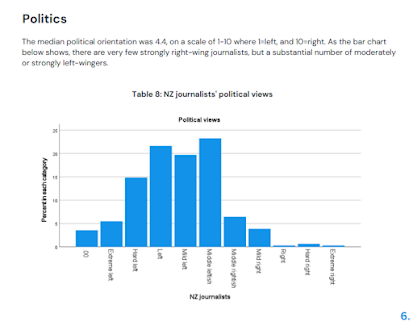
For some reason, RNZ's Mediawatch decided that this chart, showing that there are more self-identified extreme-left journalists as there are "Hard Right", "Right", and "Mild right" combined, and that "Hard left", all on its own, outnumbers everything to the right of "Middle leftish" by a massive margin, wasn't worth noting.
Probably just an innocent oversight by the always politically and ideologically neutral team at Mediawatch.
Friday, 30 April 2021
Streisand effect - Newsroom and Scott Morrison edition
This morning's news roundup from Newsroom editor Jonathan Milne included a warning about a speech by Australian Prime Minister Scott Morrison.
Milne writes:
One traveller we'd rather didn't cross the Tasman is the dismissive and disparaging populism expressed in a speech last night by Scott Morrison. At the United Israel Appeal NSW donor dinner in Sydney, the Australian Prime Minister said identity politics and the moral corrosion caused by the misuse of social media were forces seeking to undermine society.
“You are more than the things others try to identify you by in this age of identity politics," he said. "You are more than your gender, your sexuality, your race, your ethnicity, your religion, your language group, your age.”
Morrison said people who focused on those attributes, or divided along those lines, were undermining community, and also losing sight of who they were as individuals. “When they define each other by the boxes we tick or don’t tick – rather than our qualities, skills and character – we fail to see or value other people as individuals,” he said.
Morrison uses the rhetoric of homogeneous nationalism to mask his dismissal of minorities, and their intergenerational experience of disadvantage. Trump did it in the US, Bolsonaro in Brazil – and now it's filtering out to the fringes.
NZ Opposition leader Judith Collins is toying with it, describing the proposed Māori Health Authority as "segregationist" and blithely denying all the evidence that a Māori child born today (when all other factors are accounted for) is already behind the start line in the race of life.
No doubt Collins has an eye to the success of those overseas populists, and a memory for the success of Don Brash's iwi/Kiwi. But she and her front bench are better than that and (to be blunt) smarter than that. They have a broader view of the world than did Brash, and will understand that disenfranchising minorities is a disservice not just to them but also to the productive economy that she aspires to lead.
She would be wise to consider that in denying the scientific evidence on matters like Māori health, the only minorities she does empower are those cynically populist conspiracy theorists who are leading the charge against such scientific breakthroughs as 5G, Covid vaccines and climate technologies.
It sounded like a pretty awful speech, from that description. I wouldn't normally pay much attention to what the Australian PM has to say about things, but it made me want to know just how bad it really was.
When I read the thing, well, it really didn't look like a call for homogeneous nationalism. But you read it and judge for yourself. Thanks to Mike Reddell for the pointer.
Thank you very much. Please be seated. Shalom. It’s wonderful to be here with you all this evening.
I want to begin by acknowledging the traditional owners of the land on which we gather, the Gadigal and Bidjigal people of the Eora nation.
I want to acknowledge, also Steven has just mentioned, our veterans or any service personnel serving who are with us this evening and say thank you on behalf of our nation for your service.
To Steven and to Judy, your leadership of this amazing Keren Hayesod organisation, the UIA Board of Trustees, world board of trustees, is a testament to the esteem in which you are held globally by the Jewish community. Your leadership here in Australia and your family’s leadership here in Australia is in the pantheon of great contributors to our nation that have built this country and as a nation we are deeply grateful to you and for the wonderful work you are doing now.
To Lance Rosenberg, President of UIA Australia, thank you so much.
Jillian Segal, lovely to see you Jillian, President of the Executive Council of Australian Jewry. Thank you for your leadership.
To Ambassador Jonathan Peled, the Acting Ambassador of Israel, it is wonderful for you to be here tonight as you always are amongst the community, Your Excellency, and it is wonderful to be joining with you here this evening.
I’m joined by some of my colleagues here tonight. One of them I’m not joined by tonight is the Treasurer, Josh Frydenberg, you may know him. In fact, I suspect about seven of you are in text communication with him right now and that you didn’t initiate it. Josh is a dear friend and a great colleague and he is doing a tremendous job as he prepares for his next Budget.
But amongst all of that, there has been a passion project for Josh, which I want to acknowledge amongst the community here this evening. And that is the work that he has been doing to provide funding for Holocaust museums. Those we know of already in New South Wales, an outstanding museum and Victoria also. But the $20 million that we worked together to ensure was provided to support the museums in South Australia, Western Australia, Tasmania, Queensland and the ACT.
That is important but I’ll tell you what’s more important - that means across the whole country now, Holocaust education will now be taught across the curriculum. No better way to remember than by teaching your children and I want to commend Josh for his leadership.
To Stuart Robert, the Minister for a very long list of things, Employment, Workforce, Skills, and Small and Family Business, another great friend of Israel who is here tonight and you know Stuart very, very well.
Dave Sharma, the Member for Wentworth who is here, a former Ambassador to Israel, known to you incredibly well. Doing a wonderful job in the community.
And Julian Leeser, who is here with us, the Member for Berowra and Joanna, it is wonderful to have you here. I will talk a little bit more about Julian in just a second.
To everyone else who went to Sydney Boys High School who is here, I know there is a lot of you because I went to school with you. It is wonderful to be amongst friends.
Tonight I want to talk about a topic that I know is very dear to you. My father was a big believer in community. He was Mayor of Waverley, he was on the Waverley Council for some 16, 17 years and he taught me a lot about the importance of community. And he learnt it all from you because my father would tell me, if you want to understand community, understand the Jewish community, which he loved passionately and dearly.
And they cared for him at Wolper in some of his last months as my mother was recently cared for there. She is fine, by the way, she just had a back operation. But the care, the community of the Jewish community, has deeply impacted my family and my father taught me that.
And so I want to talk about a topic tonight that is dear to your hearts - community. Community of individuals, we heard it on the video, a nation of individuals.
Now, as some of you may know and as Steven has mentioned, I have been deeply influenced in recent years by the writings of the late Rabbi Lord Jonathan Sacks and Julian is responsible for that, because he has thrust Jonathan Sacks works into the arms of anyone who he can get a book into the hands of, rightly so and I am very grateful that he did.
On one occasion, he said because I was consuming this, that you’d better be careful, you might become Australia’s first Jewish prime minister. And I said, don’t tell Josh.
But his books Lessons in Leadership, Covenant and Conversation, and Morality, his last work, have given me a more textured understanding of Judaism, my own Christian faith and what unites us all as human beings. I shared some of these learnings with my own church community last week at the Gold Coast with Stuart Robert at their national conference.
In his works, Rabbi Sacks wrestles, a bit like Jacob, wrestles with the practical complexities of our modern pluralistic world and finds, through the tenets of his faith, as he did, a pathway to the common good.
At the heart of our Judeo-Christian heritage are two words.
Human dignity.
Everything else flows from this.
Seeing the inherent dignity of all human beings is the foundation of morality. It makes us more capable of love and compassion, of selflessness and forgiveness.
Because if you see the dignity and worth of another person, another human being, the beating heart in front of you, you’re less likely to disrespect them, insult or show contempt or hatred for them, or seek to cancel them, as is becoming the fashion these days.
You’re less likely to be indifferent to their lives, and callous towards their feelings.
Now, those of Jewish faith understand this. As Rabbi Sacks said, “The purpose of Judaism is to honour the image of God in other people.”
Reflecting the Psalmist: people who are fearfully and wonderfully made.
Such a beautiful idea. And one shared by many other faiths, including my own. Appreciating human dignity also fosters our sense of shared humanity.
This means that because we are conscious of our own failings and vulnerabilities, we can be more accepting and understanding of the failings and vulnerabilities of others.
True faith and religion is about confronting your own frailties. It’s about understanding your own and our humanity. The result of that is a humble heart, not a pious or judgemental one.
This has certainly been my experience. It has also been my privilege to appreciate the commonality of this view in deepening my ever connections with so many other faith and religious communities across Australia.
Christians from all denominations. The Eastern Orthodox faiths, Maronites, Catholics, Anglicans, and then of course Judaism, Hinduism, Muslims.
Seeing the dignity in others means we can see others as imperfect people striving to do their best.
And, you know, in a liberal democracy, there is no greater liberal democracy than the ones that are shared here and in Israel. Human dignity is foundational to our freedom.
It restrains government, it restrains our own actions and our own behaviour because we act for others and not ourselves, as you indeed do here this evening. That is the essence of morality.
de Tocqueville agreed. He said, “Liberty cannot be established without morality, nor morality without faith’. Hayek the economist said the same thing, “Freedom has never worked without deeply ingrained moral beliefs.”
Acting to morally enhance the freedom of others ultimately serves to enhance our own freedom.
So it is no surprise then that Rabbi Sacks concluded in his final work, Morality, “If you lose your own morality, you are in danger of losing your freedom.”
The implication here is very important.
Liberty is not borne of the state but rests with the individual, for whom morality must be a personal responsibility.
In Lessons in Leadership, he quotes distinguished American jurist Judge Learned Hand, to argue this point:
I often wonder whether we do not rest our hopes too much upon constitutions, upon laws, upon courts .. believe me these are false hopes. Liberty lies in the hearts of men and women, when it dies there, no constitution, no law can save it.
Freedom therefore rests on us taking personal responsibility for how we treat each other, based on our respect for, and appreciation of, human dignity.
This is not about state power. This is not about market power. This is about morality and personal responsibility.
Now, morality is also then the foundation of true community.
The place where we are valued; where we are unique; where we respect one another and contribute to and share one another’s lives. Where we pledge faithfulness to do together what we cannot achieve alone.
Sacks describes this as the covenant of community.
The determination to step up and play a role and to contribute as you are indeed doing this evening as part of this amazing organisation. Not leaving it to someone else, to another.
That is the moral responsibility and covenant, I would argue, of citizenship. Not to think we can leave it to someone else.
But there are warnings. Where we once understood our rights in terms of our protections from the state, now it seems these rights are increasingly defined by what we expect from the state.
As citizens, we cannot allow what we think we are entitled to, to become more important than what we are responsible for as citizens.
Teddy Roosevelt argued this more than a century ago in his famous ‘Man in the Arena’ speech. But I’m not going to quote the section that is most known. Arguing that going down this path of entitlements of citizenship, as opposed to the responsibilities, is a very dangerous one, and it indeed jeopardises national success in a liberal democracy.
He said, “The stream will not permanently rise higher than the main source; and the main source of national power and national greatness is found in the average citizenship of the nation.”
He said, “In the long run, success or failure will be conditioned upon the way in which the average man, the average woman, does his or her duty, first in the ordinary, every-day affairs of life, and next in those great occasional crises [and we know a bit about that] which call for the heroic virtues.”
Now together and individually we are each responsible for building and sustaining community, and we each have something unique to bring. Because community begins with the individual, not the state, not the marketplace. It begins with an appreciation of the unique dignity of each human being. It recognises that each individual has something to offer and that failure to appreciate and realise this, as a community, means our community is poorer and it is weaker.
In short, to realise true community we must first appreciate each individual human being matters. You matter. You, individually.
And in this context I would also argue we must protect against those forces that would undermine that in community, and I don’t just mean, as I’ve recently remarked, the social and moral corrosion caused by the misuse of social media, and the abuse that occurs there. But I would say it also includes the growing tendency to commodify human beings through identity politics.
We must never surrender the truth that the experience and value of every human being is unique and personal. You are more, we are more, individually, more than the things others try to identify us by, you by, in this age of identity politics. You are more than your gender, you are more than your race, you are more than your sexuality, you are more than your ethnicity, you are more than your religion, your language group, your age.
All of these of course contribute to who we may be and the incredible diversity of our society, particularly in this country, and our place in the world. But of themselves they are not the essence of our humanity.
When we reduce ourselves to a collection of attributes, or divide ourselves, even worse, on this basis, we can lose sight of who we actually are as individual human beings - in all our complexity, in all our wholeness and in all our wonder.
We then define each other if we go down that other path by the boxes we tick or don’t tick, rather than our qualities, skills and character. And we fail to see the value that other people hold as individuals, with real agency and responsibility.
Throughout history, we’ve seen what happens when people are defined solely by the group they belong to, or an attribute they have, or an identity they possess. The Jewish community understands that better than any in the world.
So my message is simple: you matter, you make the difference, you make community. And together with family and marriage and the associations of clubs and community groups, faith networks, indeed the organisations we’re here celebrating tonight, and so much more, they are the further building blocks of community on that individual, providing the stability and the sinews of society that bind us one to another.
And upon that moral foundation of community we build our institutions of state. Within that moral context we operate our market place.
To your great credit, this event is an affirmation that morality always starts with individuals seeing the dignity and need in each other and deciding to act. You are demonstrating by your own actions that morality can never be outsourced, because when it is we rob ourselves of that precious agency and we deny the strength and goodwill that comes from building community.
You matter. Community matters. In a democracy, it matters especially. It’s a tremendous source of strength and it’s why foreign actors seek to sow discord online, in many other ways, inflaming angers and hatreds and spreading lies and disinformation.
Of course, the right to disagree peacefully is at the heart of democracy, I’m not referring to that. But democracy is a shared endeavour, and the civility, trust and generosity, they are the currency that mediates our differences.
As I said to the Australian-Israel Chamber of Commerce in Melbourne a few years ago, in the aftermath of the Christchurch massacre which broke our hearts and tore our souls, what we need is not to disagree less, in a liberal democracy like Australia, we just need to disagree better.
I’ve been so incredibly heartened to see people from across the country show the best of us as a nation this past year. As Teddy Roosevelt said, those heroic virtues that were called upon at such a time.
Drought, bushfires, floods, cyclones, pandemic - Australians have found ways to support each other and stand with each other. Checking in on each other, keeping jobs there for your employees, volunteering, helping neighbours with their shopping.
Tonight I’ve spoken of Rabbi Sacks and I think his description of community could be well applied, I think, to the best of what we’ve seen in Australia over these past few years.
There’s another Jewish leader who’s also influenced me in recent times, and on this occasion it was Josh Frydenberg thrusting a book into my hand. And I know he’s had a big impact on Josh and I know, I would say everybody in this room. And that’s the Holocaust survivor 101-year-old Eddie Jaku.Eddie’s book “The Happiest Man on Earth” is a gift to us. I think he’s taking the title of what I might have called my book sometime. But it is a great gift to Australia. He is a great gift to Australia.
The book is a love letter to this country and I thank those of you who have come up to me tonight. As Prime Minister, not me personally, but just representing the Australian nation and saying your thanks to what Australia has meant to you and your family.
Of course Eddie’s story is harrowing but it’s also hopeful. Of life in the Nazi concentration camps. Of surviving Auschwitz, Buchenwald and the Holocaust. And of course losing his family. But never losing his faith in humanity. Finding friendship even amongst the absolute ruins.
And after the end of the War, Eddie found a home here in Australia where he was welcomed with open arms, as so many of you or your family have been.
Many of you know Eddie, because he’s guided tens of thousands of people through the Sydney Jewish Museum. Eddie says of our country, a land where opportunities abound. And it is.
Julian Leeser has made the wonderful point that Australia is one of the few places on earth where Jewish people have not suffered persecution.
We’re not perfect, no country is, but we do have much to be proud of. We are a liberal, free people, one of the oldest continuous democracies on the planet. We have an Indigenous heritage and a rich multicultural character, both adding a brilliance and joy to our national life and character. We seek to be a good neighbour in our family here in the Pacific, and a good citizen in the world, playing our part, doing our share of the heavy lifting, meeting global challenges. We stand as a sovereign and free nation in an increasingly uncertain part of the world. We value and strive to preserve a liberal world order where the strategic balance favours freedom, always.
And we stand by with like-minded friends, such as the Jewish people and the State of Israel, who is a great friend to Australia and we are a true friend of Israel. A country that is sovereign, that is independent and free. A modern state, born anew in an ancient homeland.
Australia is a proud and faithful friend. So friends, continue to stand by each other.
When President Rivlin visited Australia, he described Australia’s Jewish community as the ‘living bridge’ between our two countries and that is indeed what you are.
You have created a bridge that has enriched Australia beyond measure.
Though numbering only about one per cent of our population, Jewish Australians have made a remarkable contribution to our national life and our story.
You have sought to be a light unto the nations, performing the mitzvot or good deeds according to the Law of Moses.
Good citizens, good neighbours and good friends, who understand through their own faith and history and sufferings that life is not what you accumulate but what you give, what you contribute.
People like John Monash, Isaac Isaacs, Sir Zelman and Lady Cowen, Linda Dessau, Susan and Isaac Wakil, and Judy Cassab.
The amazing Sir Frank Lowy.
Isi Leibler, the late Isi Leibler, who we know passed away earlier this month, and our thoughts and prayers are with his family. He was a great blessing to this country.
My dear friends, my deputy leader and Treasurer Josh Frydenberg, another great contributor, as is Julian Leeser, making his mark.
So many outstanding Jewish Australians. So many stories of giving back.
That’s what you are doing tonight.
I know Steven is hoping the focus of that is giving. But you will, I know, because that has been your custom. To give and to give back.
In my church, we talk about blessed to be a blessing and that is what you’re doing here tonight. So being among you tonight, I’m deeply honoured to be here, I’m deeply grateful for your contribution to our nation.
I honour you as Australians, and as people of a rich heritage, a great culture and a tremendous faith.
I take to heart the words that you live out: “Pray for the peace of Jerusalem. May all who love this city prosper.”
So I conclude with the words of Eddie Jaku and his blessing to so many:
“May you always have lots of love to share, lots of goodwill to spare, and wonderful friends that care”.
Thank you and God bless you. Shalom.
If this is the new bar for beyond-the-pale right-wing nationalism as far as mainstream NZ media are concerned, well, I'm reminded of the conditions that allowed Fox News to go from zero to something like fifty percent market share in a couple years.
Tim Groseclose and Jeff Milyo came up with a brilliant measure of media outlet ideology in the early 2000s; they anchored it to the median voter's ideological preferences using think tank citations by congressmen, and by outlets, as intermediary.
This is what they found, in the era before Fox went kinda nuts.

Sure, Fox was to the right of centre - about ten points to the right. But it was closer to centre than most other news outlets. Out of 20 outlets, it was the 5th closest to centre, and everyone else sat to the left of the median voter. A vast section of Hotelling's beach had no hot dog vendors, so the folks setting up a hot dog stand just a bit away from everyone else's took half the market.
It's impossible to re-create the Groseclose and Milyo kind of analysis here. Leigh and Gans had a tough time of it in Australia - they had to look at partisan, rather than ideological, bias. And Oz has thicker media and think tank markets than we do. But I wonder how much of the beach here is left yearning for a hotdog.
Monday, 13 April 2015
Ideology and high demanders
Ideology could be what winds up killing Campbell Live, but it could save it too.
To recap: Twitter's been a-buzz with speculation that there some vast right wing conspiracy within TV3 that's out to get John Campbell. If it were true, I expect I'd be called up for comment on TV3 a lot more than the ... almost never... that happens now. Richard Meadows' take over at Stuff is likely the right one: it's just ratings.
But that doesn't necessarily mean that ideology doesn't matter.
Fox News went from zero percent market share to almost half the market in about two years because all the other media outlets sat a bit to the left of centre: a big chunk of the potential audience wasn't being served. On the other side, if you go a bit too far out in advocacy journalism of a certain bent, you're left with a tail of potential viewership consisting of a lot of people who don't seem much interested in watching live TV. I don't mean that in any derogatory sense - John Campbell seemed about the only person able to help anybody in a fight with EQC during the Christchurch quakes. But the crusading-activism television has a limited, albeit intense, audience.
And so being a bit too far on an ideological fringe can hurt viewership while ensuring a very deep and committed loyalty among those who do view and among those who are just happy it exists. That is not a model consistent with advertising-based funding, unless the committed viewership are also an especially advertising-targeted demographic. But it does sound like something that could be funded by an annual subscription fee among supporters.
I wonder why nobody who's launching petitions has instead considered trying a PledgeMe campaign. It wouldn't have to cover all of the costs of Campbell Live, just the difference between what MediaWorks would get from Campbell Live and what it would get from the better rating alternative.
Seems a more effective thing to try than internet petitions and speculations about whether the guy who owns the network is evil. I wonder how much each of the 60,000 petitioners would need to pledge to make this work.
To recap: Twitter's been a-buzz with speculation that there some vast right wing conspiracy within TV3 that's out to get John Campbell. If it were true, I expect I'd be called up for comment on TV3 a lot more than the ... almost never... that happens now. Richard Meadows' take over at Stuff is likely the right one: it's just ratings.
But that doesn't necessarily mean that ideology doesn't matter.
Fox News went from zero percent market share to almost half the market in about two years because all the other media outlets sat a bit to the left of centre: a big chunk of the potential audience wasn't being served. On the other side, if you go a bit too far out in advocacy journalism of a certain bent, you're left with a tail of potential viewership consisting of a lot of people who don't seem much interested in watching live TV. I don't mean that in any derogatory sense - John Campbell seemed about the only person able to help anybody in a fight with EQC during the Christchurch quakes. But the crusading-activism television has a limited, albeit intense, audience.
And so being a bit too far on an ideological fringe can hurt viewership while ensuring a very deep and committed loyalty among those who do view and among those who are just happy it exists. That is not a model consistent with advertising-based funding, unless the committed viewership are also an especially advertising-targeted demographic. But it does sound like something that could be funded by an annual subscription fee among supporters.
I wonder why nobody who's launching petitions has instead considered trying a PledgeMe campaign. It wouldn't have to cover all of the costs of Campbell Live, just the difference between what MediaWorks would get from Campbell Live and what it would get from the better rating alternative.
Seems a more effective thing to try than internet petitions and speculations about whether the guy who owns the network is evil. I wonder how much each of the 60,000 petitioners would need to pledge to make this work.
Wednesday, 29 June 2011
Ah, National Business Review, you crack me up
The National Business Review pointed last week to work by Andrea Ichino and Enrico Moretti on gender differences in absenteeism that seems utterly to vindicate Thompson's position. For readers abroad, a representative of the Employers and Manufacturer's Association was goaded in a TV interview into speculating about reasons for male-female wage differences. Among the more sensible and usual reasons - time out of the workforce, experience and so on - he noted some of his members had found higher rates of sick leave among female employees and speculated about whether menstrual cycles were to blame. [note: this is what I gather from an assortment of press reporting on the interviews, which I haven't seen]
You can guess what's happened since.
The National Business Review took the opportunity though of highlighting Ichino and Moretti's work suggesting that 28-day cycles in female sick leave are due to menstrual cycles and that increased work absence due to said cycles are responsible for a minor but significant part of the wage gap. The paper came out in one of the new AEA policy journals in 2009; here's an ungated working version. The paper's since been criticized by Rockoff and Herrmann; I'm not about to invest the time in sorting out who's right on this one.
But I love that somebody at NBR likely ran a Google Scholar search to see whether there was any lit to back up Thompson's ill-advised off the cuff remarks. That's a few notches above the rest of the media who just focused on the obviously correct point that you can't say what Thompson said in Thompson's position. Whether Thompson's remark was true is unfortunately second order relative to that some things just can't be said. I like that NBR took a bit of time to do some checking.
You can guess what's happened since.
The National Business Review took the opportunity though of highlighting Ichino and Moretti's work suggesting that 28-day cycles in female sick leave are due to menstrual cycles and that increased work absence due to said cycles are responsible for a minor but significant part of the wage gap. The paper came out in one of the new AEA policy journals in 2009; here's an ungated working version. The paper's since been criticized by Rockoff and Herrmann; I'm not about to invest the time in sorting out who's right on this one.
But I love that somebody at NBR likely ran a Google Scholar search to see whether there was any lit to back up Thompson's ill-advised off the cuff remarks. That's a few notches above the rest of the media who just focused on the obviously correct point that you can't say what Thompson said in Thompson's position. Whether Thompson's remark was true is unfortunately second order relative to that some things just can't be said. I like that NBR took a bit of time to do some checking.
Friday, 4 February 2011
Battling plutocrats
I've read a lot lately about how evil the Koch family is for using its wealth to try to affect policy. I've not read much about how evil George Soros is for using his wealth to try to affect policy. The Koch family spends its money trying to make sure folks know about law & economics and to help folks having their houses expropriated by local governments. Soros uses his to campaign for marijuana legalization and international democratic movements. Koch made his money in chemicals and oil; Soros made his in currency speculation.
Seems odd that everyone loves to hate on Koch and loves to love Soros. And seems especially odd that anti-Koch demonstrations get funded by Soros.
I like much of the work Soros does - especially his push for marijuana legalization. I'm less a fan of some of his other work, but I'd hardly think him evil for it. I've great admiration for the Kochs' work in advancing economic freedoms - especially through the Institute for Justice. I'm more skeptical that the Tea Party will turn out to be all that great a boon for freedom. Soros-funded anti-Koch rallies seem rather silly; the protesters, pawns of a different plutocrat, are even sillier.
Seems odd that everyone loves to hate on Koch and loves to love Soros. And seems especially odd that anti-Koch demonstrations get funded by Soros.
Palm Springs, California -At the front gates of the Rancho Las Palmas resort, a few hundred liberals rallied Sunday against "corporate greed" and polluters. They chanted for the arrest of billionaires Charles and David Koch, and their ire was also directed at the other free market-oriented businessmen invited here by the Koch brothers to discuss free markets and electoral strategies.Next we'll have an angry mob of Koch-funded Tea Partiers having at a gaggle of Soros-funded hipsters. Enough of these proxy fights between Koch and Soros. I think it's time for Fight Club. Pay per view, with profits to the winner's preferred charity. Vegas. I'll put $100 on Charles Koch at odds up to 2:1 (I pay $200 if I lose); 3:1 if it's David rather than Charles for the Koch side (relative youth). Any takers?
Billionaires poisoning our politics was the central theme of the protests. But nothing is quite as it seems in modern politics: The protest's organizer, the nonprofit Common Cause, is funded by billionaire George Soros.
Common Cause has received $2 million from Soros's Open Society Institute in the past eight years, according to grant data provided by Capital Research Center. Two panelists at Common Cause's rival conference nearby -- President Obama's former green jobs czar, Van Jones, and blogger Lee Fang -- work at the Center for American Progress, which was started and funded by Soros but, as a 501(c)4 nonprofit "think tank," legally conceals the names of its donors.
In other words, money from billionaire George Soros and anonymous, well-heeled liberals was funding a protest against rich people's influence on politics.
When Politico reporter Ken Vogel pointed out that Soros hosts similar "secret" confabs, CAP's Fang responded on Twitter: "don't you think there's a very serious difference between donors who help the poor vs. donors who fund people to kill government, taxes on rich?"
In less than 140 characters, Fang had epitomized the myopic liberal view of money in politics: Conservative money is bad, and linked to greed, while liberal money is self-evidently philanthropic.
I like much of the work Soros does - especially his push for marijuana legalization. I'm less a fan of some of his other work, but I'd hardly think him evil for it. I've great admiration for the Kochs' work in advancing economic freedoms - especially through the Institute for Justice. I'm more skeptical that the Tea Party will turn out to be all that great a boon for freedom. Soros-funded anti-Koch rallies seem rather silly; the protesters, pawns of a different plutocrat, are even sillier.
Sunday, 11 April 2010
Media manipulation
Suppose it came to light that the execs of one of the major networks had put the word down through the organization that all shows should be aiming to hit targets of "pro-corporate" messages in order to make their sponsors happier. Nothing pro any particular brand, mind you. Just general "Ain't capitalism great? Look at how rich we all are compared even to how things were a couple generations ago! Life is wonderful! Celebrate human achievement and the great folks who help to make it happen!"
I'd expect nonstop coverage on CNN of Naomi Klein's gang with the cameras waiting for spontaneous combustion. It wouldn't be met with kindly.
But how many of you had heard this one?
I'd expect nonstop coverage on CNN of Naomi Klein's gang with the cameras waiting for spontaneous combustion. It wouldn't be met with kindly.
But how many of you had heard this one?
In just one week on NBC, the detectives on "Law and Order" investigated a cash-for-clunkers scam, a nurse on "Mercy" organized a group bike ride, Al Gore made a guest appearance on "30 Rock," and "The Office" turned Dwight Schrute into a cape-wearing superhero obsessed with recycling.The last thing I'd ever want would be some government agency overseeing and banning this kind of thing. But it's interesting what kinds of media manipulation draws outrage and what kinds are, well, mostly ignored.
Coincidence? Hardly. NBC Universal planted these eco-friendly elements into scripted television shows to influence viewers and help sell ads.
The tactic—General Electric Co.'s NBC Universal calls it "behavior placement"—is designed to sway viewers to adopt actions they see modeled in their favorite shows. And it helps sell ads to marketers who want to associate their brands with a feel-good, socially aware show.
Thursday, 11 March 2010
Media bias
Aren't blogs terrible - just echo chambers where folks find news that fits their ideological slant rather than unbiased opinion.
Turns out that the mainstream media's no better. Gentzgow and Shapiro find that ideological language used in newspapers (death tax vs estate tax, for example) responds directly in a profit-maximizing way to the partisan makeup of the paper's local readership.
It's impossibly unlikely that enough folks ever would become truth-seekers that media bias will go away: newspapers have too high of fixed costs ever to cater solely to truth-seekers. Blogs may well be your only hope, contra the usual story. So long as you're a truth seeker. Go read some Overcoming Bias and repent. In the meantime, try to cultivate a shame function that's more strongly increasing in being accused of motivated reasoning than of disloyalty.
Turns out that the mainstream media's no better. Gentzgow and Shapiro find that ideological language used in newspapers (death tax vs estate tax, for example) responds directly in a profit-maximizing way to the partisan makeup of the paper's local readership.
In this paper, we develop and estimate a new measure of slant that compares the use of partisan language in newspapers with that of Democrats and Republicans in Congress. Our measure is computable with a minimum of subjective input, is related to readers’ subjective ratings of newspaper slant, and is available for newspapers representing over 70 percent of the daily circulation in the United States.So, stop pointing fingers at evil Rupert Murdoch or Ted Turner and look in the mirror. It's far more likely that YOU'RE the one to blame. Maybe you and I can self-deceive into thinking we only want (provide) unbiased information, and that we're of the enlightened few who really are truth-seekers. But it's bloody hard work. Heck, even our preferred choice of experts seems driven by our priors.
Combining our measure with zip code-level circulation data, we show that consumer demand responds strongly to the fit between a newspaper’s slant and the ideology of potential readers, implying an economic incentive for newspapers to tailor their slant to the ideological predispositions of consumers. We document such an effect and show that variation in consumer preferences accounts for roughly one-fifth of the variation in measured slant in our sample.
By contrast, we find much less evidence for a role of newspaper owners in determining slant.
It's impossibly unlikely that enough folks ever would become truth-seekers that media bias will go away: newspapers have too high of fixed costs ever to cater solely to truth-seekers. Blogs may well be your only hope, contra the usual story. So long as you're a truth seeker. Go read some Overcoming Bias and repent. In the meantime, try to cultivate a shame function that's more strongly increasing in being accused of motivated reasoning than of disloyalty.
Tuesday, 5 January 2010
Media watch
Radley Balko fisks the Washington Post's coverage of the DC cop who pulled a gun on folks having a snowball fight. Long story short: the Post was more than happy to reprint without question the Assistant Police Chief's assertions that the gun was never drawn despite one of their reporters having been on the scene at the fight and despite youtube video clearly showing the cop having pulled his gun. Bloggers and the City Paper get it right; Washington Post fails.
For all the "and then the adults took over" anti-new media sneer in Fisher's post (and hey, Fisher did write all of this in a blog post—so maybe he has a point!), the link for his "on the blogs" condescension actually goes the City Paper, which got the story right from the outset. The City Paper called Newsham, too. But instead of running with Newsham's denials as fact, that paper's reporters also viewed the video evidence posted around the web and talked to eyewitnesses—including the Post's own staffer, whom Zapotosky ignored.
Instead of turning his nose up at new media and social networking, Fisher should be asking himself whether, if it weren't for Twitter, YouTube, blogs, and alternative weeklies like the City Paper, the Post would have ever gotten this story right. Or whether the Post would have eventually given credence to Baylor's accusers had this happened not on a busy U-Street intersection teeming with wired gentrifiers, but in D.C.'s poorer, blacker Southeast quadrant, where confrontations with the police are more common yet less covered, and where corroborating video would be less likely. More to the point, if what Zapotosky did was "real journalism," how many other police misconduct stories might the Post have gotten wrong all this time because it merely deferred to MPDC flacks like Newsham?
Wednesday, 16 September 2009
Measuring media bias in Oz
Andrew Leigh and Josh Gans versus Andrew Norton on measuring media slant in Australia.
Leigh and Gans bring Groseclose and Milyo's method to Oz, but use public intellectuals rather than think tanks due to the paucity of the latter. Recall that the original Groseclose and Milyo method didn't benchmark to partisanship but rather to ideology: the US has ADA scores for representatives, so each representative is rank-ordered from liberal to conservative and an imputed ideological score is then given to each think tank. Robustness checks in Leigh and Gans include expert coding of front-page newspaper articles, both political and overall, and coding of newspaper editorials.
Norton says the ranking of intellectuals lacks face validity: that their left-right positions don't correspond to casual observation; moreover, public intellectuals tend to be ideological rather than party partisan so the method may not work.
I certainly don't know enough about Australian public intellectuals to know whether there's a lack of face validity in Leigh and Gans's ordering, nor do I know whether the public intellectuals tend to be party hacks or ideological hacks. But I'm pretty sure that Groseclose and Milyo were able to drop negative or reverse mentions from their analysis (things like a National MP saying, "Even Brian Easton agrees with X", for example) while Leigh and Gans weren't able to given their initial dataset. On first thought, so long as both sides tend to do this with equal frequency, it might just add noise to their estimates rather than much bias. On the other hand, I can imagine those reverse mentions happening a lot more for the tails of the distribution, which would greatly narrow the measured range of public intellectuals' opinions and could lead to a centrist-bias in the results. Leigh and Gans say that folks don't much cite public intellectuals for the purpose of bashing them (a truly negative mention), but I can imagine a fair number of the "Even prominent Labour supporter X agrees..." mentions. In the end, their robustness checks mostly give them the same answers: most papers are largely centrist in Australia - so I'm less worried.
One thing that they can't control for over their period is whether slight evidence of slant in favour of the Coalition government reflected incumbency bias or pro-Coalition sentiment. Presumably they'll be able to test for that in a replication after the next election.
Cool that Leigh and Gans have taken this on. I've told my classes that a New Zealand replication of Groseclose and Milyo is likely impossible given:
Measuring partisan slant rather than ideological slant seems possible using Gans and Leigh's method. Congrats guys.
Leigh and Gans bring Groseclose and Milyo's method to Oz, but use public intellectuals rather than think tanks due to the paucity of the latter. Recall that the original Groseclose and Milyo method didn't benchmark to partisanship but rather to ideology: the US has ADA scores for representatives, so each representative is rank-ordered from liberal to conservative and an imputed ideological score is then given to each think tank. Robustness checks in Leigh and Gans include expert coding of front-page newspaper articles, both political and overall, and coding of newspaper editorials.
Norton says the ranking of intellectuals lacks face validity: that their left-right positions don't correspond to casual observation; moreover, public intellectuals tend to be ideological rather than party partisan so the method may not work.
I certainly don't know enough about Australian public intellectuals to know whether there's a lack of face validity in Leigh and Gans's ordering, nor do I know whether the public intellectuals tend to be party hacks or ideological hacks. But I'm pretty sure that Groseclose and Milyo were able to drop negative or reverse mentions from their analysis (things like a National MP saying, "Even Brian Easton agrees with X", for example) while Leigh and Gans weren't able to given their initial dataset. On first thought, so long as both sides tend to do this with equal frequency, it might just add noise to their estimates rather than much bias. On the other hand, I can imagine those reverse mentions happening a lot more for the tails of the distribution, which would greatly narrow the measured range of public intellectuals' opinions and could lead to a centrist-bias in the results. Leigh and Gans say that folks don't much cite public intellectuals for the purpose of bashing them (a truly negative mention), but I can imagine a fair number of the "Even prominent Labour supporter X agrees..." mentions. In the end, their robustness checks mostly give them the same answers: most papers are largely centrist in Australia - so I'm less worried.
One thing that they can't control for over their period is whether slight evidence of slant in favour of the Coalition government reflected incumbency bias or pro-Coalition sentiment. Presumably they'll be able to test for that in a replication after the next election.
Cool that Leigh and Gans have taken this on. I've told my classes that a New Zealand replication of Groseclose and Milyo is likely impossible given:
- Party line voting makes ADA scores impossible, so we can't benchmark against median voter ideology.
- A paucity of think tanks makes the mapping impossible.
Measuring partisan slant rather than ideological slant seems possible using Gans and Leigh's method. Congrats guys.
Subscribe to:
Posts (Atom)