Friday, 8 April 2022

Academic freedom - survey says

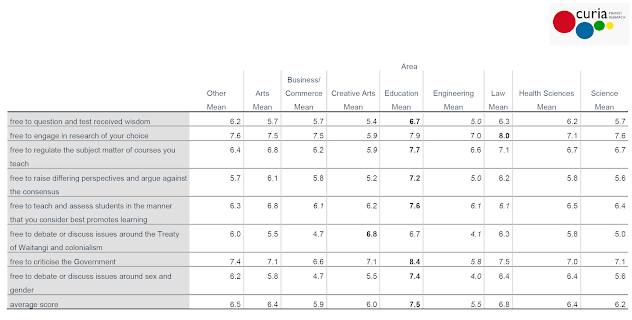
The Free Speech Union was kind enough to share the data from their survey of NZ academics on academic freedom. 

Their survey compared means across different questions, between universities, across academic ranks, and among academics of different age and gender.


I threw it into Stata.

The questions seemed to load onto a single factor - one factor had an Eigenvalue around 5 with the rest below 1. 

So I stuck it into a principal component model to get scores for each respondent for that factor. 

The nice bit with a PCF is that the predicted values on the factor are mean zero, standard-deviation 1 by construction. So the coefficients on all the different dummy variables can quickly be understood. A 0.5 coefficient on something means that something is associated with a half a standard deviation increase in the dependent variable. 

Higher scores here mean higher academic freedom.

Here are the results from a straightforward OLS with the principal component from the factor analysis over on the left hand side, and the kitchen sink on the right hand side. T-stats below coefficients; stars mean their usual thing.
 
Principal Component
Institution
Victoria University of Wellington
(Reference category)
Otago University-0.335
(3.42)**
AUT-0.516
(4.12)**
Massey University-0.380
(3.81)**
University of Canterbury-0.141
(1.33)
Auckland University-0.262
(2.51)*
University of Waikato-0.336
(2.74)**
Gender
Male
(Reference Category)
Female-0.103
(1.61)
Gender Diverse0.542
(1.90)
Field of Study
Arts
(Reference category)
Business-0.256
(2.33)*
Creative Arts-0.272
(1.36)
Education0.384
(2.63)**
Engineering-0.487
(3.51)**
Health Sciences0.104
(0.97)
Laws0.002
(0.01)
Science -0.123
(1.23)
Other Area -0.060
(0.48)
Rank
Lecturer 0.192
(1.78)
Senior Lecturer
(Reference Category)
Ass. Prof -0.099
(1.15)
Prof 0.160
(1.93)
Senior Management 0.145
(1.01)
Other -0.091
(0.82)
Age
Under 30 0.314
(1.77)
31-45
(Reference Category)
46-64 -0.315
(4.27)**
65+ -0.171
(1.89)
Constant 0.504
(4.27)**
R2 0.10
N 1178

Just a bit of fun - a quick and dirty run through the thing. 

Vic Uni comes out well. 

Rank doesn't do much controlling for age. Gender doesn't do much. 

Folks in Education seem to feel relatively unconstrained; whether that's due to academic freedom or to constraints that match their ideological preferences and so are non-binding is harder to tell. 


The Free Speech Union could do well in academia, given what other views there on academic freedom look like. 

Scurvy Dogs?

Dogs don't get scurvy. Guinea pigs do. And polar bears are more like lemons than limes are like lemons, on one important margin. 

Reality can be weird.

A fun imagined dialogue, where Forlich is right, but looks completely crazy, because reality can be weird.

Let’s imagine a version of history where the guinea pigs did indeed get lost in the Norwegian mail, so Holst and Frolich only tested dogs, and found no sign of scurvy. Let’s further imagine that Frolich has been struck by inspiration, and through pure intuition has figured out exactly what is going on. 

Frolich: You know Holst, I think old James Lind was right. I think scurvy really is a disease of deficiency, that there’s something in citrus fruits and cabbages that the human body needs, and that you can’t go too long without. 

Holst: Frolich, what are you talking about? That doesn’t make any sense.

Frolich: No, I think it makes very good sense. People who have scurvy and eat citrus, or potatoes, or many other foods, are always cured.

Holst: Look, we know that can’t be right. George Nares had plenty of lime juice when he led his expedition to the North Pole, but they all got scurvy in a couple weeks. The same thing happened in the Expedition to Franz-Josef Land in 1894. They had high-quality lime juice, everyone took their doses, but everyone got scurvy. It can’t be citrus.

Frolich: Maybe some citrus fruits contain the antiscorbutic [scurvy-curing] property and others don’t. Maybe the British Royal Navy used one kind of lime back when Lind did his research but gave a different kind of lime to Nares and the others on their Arctic expeditions. Or maybe they did something to the lime juice that removed the antiscorbutic property. Maybe they boiled it, or ran it through copper piping or something, and that ruined it.

Holst: Two different kinds of limes? Frolich, you gotta get a hold of yourself. Besides, the polar explorers found that fresh meat also cures scurvy. They would kill a polar bear or some seals, have the meat for dinner, and then they would be fine. You expect me to believe that this antiscorbutic property is found in both polar bear meat AND some kinds of citrus fruits, but not in other kinds of citrus?

Frolich: You have to agree that it’s possible. Why can’t the property be in some foods and not others? 

Holst: It’s possible, but it seems really unlikely. Different varieties of limes are way more similar to one another than they are to polar bear meat. I guess what you describe fits the evidence, but it really sounds like you made it up just to save your favorite theory. 

Frolich: Look, it’s still consistent with what we know. It would also explain why Lind says that citrus cures scurvy, even though it clearly didn’t cure scurvy in the polar expeditions. All you need is different kinds of citrus, or something in the preparation that ruined it — or both! 

Holst: What about our research? We fed those dogs nothing but grain for weeks. They didn’t like it, but they didn’t get scurvy. We know that grain isn’t enough to keep sailors from getting scurvy, so if scurvy is about not getting enough of something in your diet, those dogs should have gotten scurvy too.

Frolich: Maybe only a few kinds of animals need the antiscorbutic property in their food. Maybe humans need it, but dogs don’t. I bet if those guinea pigs hadn’t gotten lost in the mail, and we had run our study on guinea pigs instead of dogs, the guinea pigs would have developed scurvy.

Holst: Let me get this straight, you think there’s this magical ingredient, totally essential to human life, but other animals don’t need it at all? That we would have seen something entirely different if we had used guinea pigs or rats or squirrels or bats or beavers?

Frolich: Yeah basically. I bet most animals don’t need this “ingredient”, but humans do, and maybe a few others. So we won’t see scurvy in our studies unless we happen to choose the right animal, and we just picked the wrong animal when we decided to study dogs. If we had gotten those guinea pigs, things would have turned out different.

Thursday, 7 April 2022

Council carbon counsel

Me in today's Herald, on Council initiatives to reduce carbon emissions:

Inflation being central government's responsibility hardly means that local councils can just ignore it. Inflation affects everyone: households, companies, and councils. A council that ignored inflation would lose good staff by failing to keep up with wage increases, err in estimating project costs, and blow out budgets.

A superb council could help its residents by making sure its rules do not make it too hard for residents to adapt to rising prices. Easing zoning and consenting would help housing supply to respond to changes in demand, making the Reserve Bank's job easier, while improving housing affordability.

But it would be madness for a council to take on an anti-inflation mandate and try to combat inflation directly through local wage and price controls.

It would be worse than counterproductive.

The same is true for council-level policies for dealing with carbon emissions.

There's lots that councils should be thinking about. Resident demands for all kinds of stuff will change with rising carbon prices. But councils trying to target emissions, rather than respond to expected carbon prices, get things backwards.

There is risk that councils take climate consenting tools and use them to block housing in places under NIMBY pressure. A lot of the tools that Councils use to block urban growth have been being taken off them by central government; they'll pick up new tools like costly green-building mandates if they can. 

In Monday's Dom Post, I noted Canada's carbon dividend. It was lovely seeing Canada's Environment Minister remind everyone about the carbon dividend that would make 8 out of 10 households better off from his carbon tax increase. 

And went through again the case for carbon prices and carbon dividends, while still trying to disabuse people of some very serious widespread misunderstandings of what's going on in one bit of the Climate Commission's modelling. 

Economists tend to prefer relying on the Emissions Trading Scheme in the first instance and using other policies only when they address specific additional market failures.

Section 6.3 of the Commission’s report models what would happen under a $50 carbon price within the sectors currently covered by the ETS, if there were no restrictions on forestry conversions prior to 2050.

It shows that New Zealand can reach Net Zero by 2050 at the relatively low carbon price of $50/tonne. After 2050, there would be an increase in net emissions by 2065 “if there were no further forestry planting or policy changes.”

Many commentators have taken this section as suggesting that relying on the ETS would fail because of an increase in net emissions after 2050. Olivia Wannan notes that following that scenario “would violate the [Zero Carbon] Act, which requires all budgets after 2050 to also achieve net zero.”

But the scenario is simply a demonstration of the effects of a $50 carbon price in the sectors covered by the ETS. The modelling does not include the ETS’s cap on net emissions, and it does not allow carbon prices to change.


Tuesday, 5 April 2022

Wellington hates economists?

Auckland University's Robert MacCulloch says that Wellington hates economists. I worry he's an optimist.

Robert's starkest example is the absence of monetary policy expertise on the Monetary Policy Committee. It was viewed as a conflict of interest. 

It points to how things are perhaps even worse.

There are more than a few people employed in the public sector with the job title "economist" who have very poor training and whose main job is putting sciency-sounding words around things they think the Minister wants to do anyway. 

Real monetary policy experts would be a challenge on the Monetary Policy Committee.

Real economists elsewhere in the Ministries would also be a challenge. 

Basically, if you learn to say "Market failure justifies what my Minister wants" or "Amartya Sen shows that the Minister is right; he is nuanced, unlike those market fundamentalists who oppose the wishes of our enlightened Minister", or "We need to listen to more non-neoclassical non-neoliberal thinkers like Raworth and Mazzucato", you'll go far in economics roles in too much of the NZ public service. 

The Taxpayers Union has a chat with MacCulloch

Monday, 4 April 2022

How to RUC

This still doesn't sound like a plan for applying the government's petrol excise discount to Road User Charges:

Minister of Transport Michael Wood said he and officials were aware of the financial risk for transport coffers, if too much “stocking up” occurred.

“I don’t think many people will look to do that, but we do want to make sure there is some integrity built into the system,” Wood said.

Wood would not disclose exactly how RUC purchases would be controlled when the discount kicked in.

“Primarily, it would be about Waka Kotahi having the ability to audit and check after purchases have been made,” he said.

“We’d be looking at what is potentially excessive and unreasonable purchasing.

“If you have someone who purchased 5000 kilometres every three months, and suddenly they were wanting to purchase 25,000, that would obviously be an alarm bell, and we’d be wanting to empower Waka Kotahi to be able to deal with that situation.”

Audit and check what - that kilometres purchased were driven during the allotted time? They'll then need a mechanism for running odometer checks at either end of the discount period. 

Why both sides of the allotted time? Because people will be using expensive previously-purchased RUC during the discount period, and you'll need to weigh that up. If I purchase 50,000 km at the start of the period and wind up with 40,000 km unused at the end of the period, I could claim that I actually put on 50,000 km during the period - I'd just had a lot of km that had been sitting there unused at the start of the period. 

That sounds extreme, but I right now have about 5,000 km of RUC pre-purchased. I've 7,000 km on the odometer and RUC purchased to get me to 12,000 km. If I buy 5,000 km during the period and, at the end of the period, my odometer's at 12,000 km with RUC purchased up to the 17,000 km mark, that isn't me gouging the system, that's me buying a quantity exactly equal to my RUC consumption during the period. But there's no way of telling whether I actually had 5,000 in the bag ex ante without an odometer check at the start of the period.

Or maybe "to be able to deal with" just means "yeah, they can phone the purchaser up and verify that there's a plausible-sounding story around any higher-than-normal purchase, because enforcing anything in this will be a nightmare unless it's just impossible that the purchase was legit." 

It won't be an easy one to get right.

UPDATE: From Newsroom:

Transport Minister Michael Wood told Newsroom those purchasing discounted RUCs would need to “complete an online declaration form stating that they are only purchasing charges that they require for that period’’.

“Waka Kotahi will undertake spot checks of large or suspicious purchases and, where appropriate, take enforcement action.

“Enforcement action could include the charging of unused road user charges at the non-reduced rate,’’ Wood said.

Those diesel users who have charges remaining on their vehicles will also be able to apply for a credit.

“They will be able to purchase what is referred to as an overlap licence. Typically when purchasing a RUC licence, the start distance of that licence will continue from the end of the previous RUC licence.

“However, with an overlap licence, the RUC licence begins from the odometer reading on the date of purchase, with the unused distance automatically credited towards the new licence,’’ Wood said.

Most people who choose this method will have to purchase a top-up for the new licence due to RUCs only being able to be purchased in 1000km units.

“This top-up will be at the discounted rate," Wood told Newsroom.

Legislation will be introduced into the House on Tuesday, and passed under urgency, to allow and enforce these changes ahead of the discount period starting.

So when this comes in, an honest person in my position would apply for the overlap licence, truthfully report the current odometer reading, purchase the amount of RUC they expect to use over the next 3 months, and get a RUC label that combines the amount just purchased with the prior stockpile for a new "paid up until XXXXX km" notice.

A dishonest person would understate their odometer's current position and overstate the amount they were likely to use over the next 3 months, so that their new licence could cover a lot of driving after the three months, or not bother applying for the overlap at all and just hold the new licence.

One fairly simple thing they could do would be to print the discount-period RUC licences on different coloured paper, so there could be some worry that a traffic stop could involve an odometer check if you were still running that permit after the period had lapsed. If your discount-odometer licence had you good through 100,000 km and your odometer only had 20,000 km on it two months after the discount window, it would be pretty obvious that you owed the difference on 80,000 km. 

But if the only penalty is that you wind up paying full price for kilometres that you'd have wound up purchasing and using anyway, sometime, it seems a bit of a one-way bet. Heads you get cheaper RUC for a longer period. Tails you get some cheaper RUC, and you've purchased RUC earlier than you might otherwise have for the rest of it. If you win, 1/3 off the cost of a pile of km. If you lose, you've brought forward a bit of spend - and that could matter a bit if RUC doesn't move up with inflation as quickly as it should. 
Morning roundup

Today's closing of the browser tabs is also a bit of an inbox roundup. A lot of these wind up being from BusinessDesk's excellent news summaries.