Showing posts with label pandemic. Show all posts

Thursday, 16 November 2023

Afternoon roundup

The tabs!

Friday, 10 November 2023

Afternoon roundup

The end-of-week closing of the browser tabs

Tuesday, 26 September 2023

Afternoon roundup

The tabs. There are too many.

Friday, 18 August 2023

Afternoon roundup

Some of the worthies as I attempt to get the tabs down to a more manageable level...

Thursday, 23 February 2023

Afternoon roundup

Oh the tabs. 

Wednesday, 15 February 2023

Large gatherings and Covid

I do love a good natural experiment. And this is a neat one
Social distancing is important to slow the community spread of infectious disease, but it creates enormous economic and social cost. Thus, it is important to quantify the benefits of different measures. We study the ban of mass gatherings, an intervention with comparably low cost. We exploit exogenous variation in the number of National Basketball Association and National Hockey League games, which arises due to the leagues' predetermined schedules, and the sudden suspension of the 2019–2020 seasons. We find that, among clusters of counties that are adjacent to sports venues, each additional mass gathering increased the cumulative number of COVID-19 deaths by 10.3%.

Some places had games scheduled between 1 March and 11 March, other places didn't. Play was suspended 12 March. So they compare places that happened to have scheduled games in early March with places that didn't. 


Monday, 13 February 2023

Afternoon roundup

The worthies from the tabs:

Thursday, 17 November 2022

Afternoon roundup

The worthies, as I try to stop Chrome from crashing and crashing and crashing...

Tuesday, 15 November 2022

MIQ v3

Marc Daalder at Newsroom points to the government's contingency plans should it wish to again stand up an MIQ system at the border

Unfortunately, it looks an awful lot like the old system. Government would contract with hotels to provide facilities, scaling up to provide 6000 rooms over 8 weeks. 

We'd put up a sharply different alternative in the winter of 2020. In that setup, government would flip from contracting for rooms to certifying and auditing standards-compliance while providing vouchers to support the costs of MIQ stays for those whose stays the government wished to subsidise. The hotels could contract with government, or other providers, for security and other services. But the government would be sharply monitoring standards and compliance.

Under that flipped system, government would be within its proper role and comparative advantage, while the private sector could handle what it does well. There'd be no need for government to set priority categories or manage queues. It would just require that anyone boarding transit to New Zealand present evidence of a booking at an authorised facility. The facilities could manage their own bookings. Hotels know how to do that. Governments don't. And the system could expand to meet demand when it needed to, so long as there was willingness to pay for it. 

It seems unlikely that MIQ v3 will be invoked. Or at least the situations that would warrant it would seem to simultaneously require a renewed lockdown where we wouldn't otherwise be able to tell whether the new variant had already gotten here. And there seems little chance that the government would do that where they won't even look back again at mask requirements during surges in cases. But whatever MBIE's put together now will also be the playbook if some new disease crops up requiring it. 

I can kinda get why the government didn't want to shift to my proposed system in July 2020. They were scared of breaking anything. But now we're looking at setting a system for future events. There's time to not screw it up. They've screwed it up anyway. 

Add it to the list of things that will need to be attended to by some future better incoming government. 

Also mildly amused in thinking back on all the Labour brainworm people who thought I was some kind of death merchant in 2020 for proposing a workable better system that wasn't Labour's system. I'm now the only one wearing a mask at public events, while they're all drinking Ardern's let's-all-get-Covid kool-aid. And my system still makes more sense.

Thursday, 3 November 2022

Life expectancy and health outcomes

There's a literature on everything, so I expect someone's already done this. I'd be keen to see the result if someone has.

There are almost-certainly piles of disorders that are particularly damaging when you're older rather than younger, and where there are apparent differences in effect by ethnicity after correcting for age. 

I know that the Ministry of Health here has pointed to differences in Covid outcomes by ethnicity in multivariate analysis correcting for age but there will have to be lots of other ones.

There are two ways of thinking about age. You can think about it as years since birth. Or you can think about it as percent of expected life expectancy already expended. Same as how you can think about your fuel tank as how many litres of fuel you've used since you filled up, or as what percentage of the tank is left. 

Suppose that life expectancy at time of first birthday varies by ethnicity for whatever mix of environmental and genetic reasons. Fuel tanks vary in size. If you're counting litres of fuel used since the tank was full, there will be very different amounts left in the tank depending on the car. 

And suppose further that the true effect of some disorder on health outcomes depends on your remaining life expectancy before the disorder hit rather than your time since birth. Basically anyone who's at 95% of their life expectancy is going to have a rougher time with the illness regardless of whether that 95% mark hits at age 67 or age 80. 

If that's the underlying process, if you run a regression with health outcomes on the left-hand side, and age-in-years and ethnicity on the right-hand side along with whether someone catches the disorder, you're going to lump effects into ethnicity that might not really belong there for this particular disorder. 

It'll be true that a greater proportion of people with this ethnicity at that age die of the disorder, but the ethnicity variable will be a mix of underlying differences in mortality risk by ethnicity plus disorder-specific risks.

I'm not trying to criticise the MoH work here. I'm just wondering where this kind of thing has been considered in the literature. Do age-ethnicity interaction terms sort it out by allowing the effect of age on health outcomes to vary by ethnicity? MoH throws in a "hospital-registered co-morbidity" variable that will catch some of the 'effectively old for physical age' effect but wouldn't get all of it.

I just keep remembering that old Robert Fogel work looking at the health status of US Civil War enlistees, where the 50-year-olds of the 1850s were hitting the health problems of today's 70-year-olds. It'd be true to say that 50-year-olds of that era were at far higher risk of dying from heart attacks. But they were also way closer to end of expected life expectancy. So it wasn't just that heart attacks were worse then - it was that life expectancy was lower, people effectively aged more quickly, and something like a heart attack is worse when you're more run down. 

Other not-so-fun bit from that old NYT piece on the Fogel work, that could also be relevant these days:

Dr. Almond had a problem with the studies. They were not of randomly selected populations, he said, making it hard to know if other factors had contributed to the health effects. He wanted to see a rigorous test — a sickness or a deprivation that affected everyone, rich and poor, educated and not, and then went away. Then he realized there had been such an event: the 1918 flu.

The flu pandemic arrived in the United States in October 1918 and was gone by January 1919, afflicting a third of the pregnant women in the United States. What happened to their children? Dr. Almond asked.

He compared two populations: those whose mothers were pregnant during the flu epidemic and those whose mothers were pregnant shortly before or shortly after the epidemic.

To his astonishment, Dr. Almond found that the children of women who were pregnant during the influenza epidemic had more illness, especially diabetes, for which the incidence was 20 percent higher by age 61. They also got less education — they were 15 percent less likely to graduate from high school. The men’s incomes were 5 percent to 7 percent lower, and the families were more likely to receive welfare.

The effects, Dr. Almond said, occurred in whites and nonwhites, in rich and poor, in men and women. He convinced himself, he said, that there was something to the Barker hypothesis.

Friday, 14 October 2022

Testing times

Remember late 2021 and early 2022 when there were ... problems ... in getting RATs and when the government was requisitioning them?

Chris Bishop had been asking about one company's attempt to get RATs into the country

407 (2022). Chris Bishop to the Associate Minister of Health (08 Feb 2022): Regarding the rapid antigen tests from Kudu Spectrum for the "Orient Gene RAT", did Kudu Spectrum send a letter to the Government regarding rapid antigen tests in January 2022, if so, on what date was that letter received, who received the letter (by job title, if appropriate), and what did it say?

Hon Dr Ayesha Verrall (Associate Minister of Health) replied: I am advised the Ministry of Health has no record of receiving a letter from Kudu Spectrum in January 2022. However, two emails were received from Kudu Spectrum, on 4 and 12 January 2022. These emails related to Kudu Spectrum’s application for approval of the Orient Gene rapid antigen test which was subsequently authorised by the Director-General of Health on 20 January 2022.

This is also my response to Written Parliamentary Question 581 (2022).

He followed up with an OIA request for those emails and has passed it along. I'll copy it all below here, followed by the cover letter response.

Kudu Spectrum was trying to import Orient Gene Covid-19 RATs. They're ubiquitous now, but Medsafe was being Medsafe and slow. 

Emails into MoH weren't being dealt with properly or noticed. 

Kudu's first email, of 4 January, to Michelle Perera at MoH and to Ian Town, Chief Science Advisor at MoH, and to a redacted person, were initially ignored. It was summer. 

Kudu followed up on 12 January, noting they'd received no answer, and that they'd be seeking legal advice if they didn't get an answer - they wanted to bring in the tests because there were shortages of RATs and lots of businesses wanted them. 

On 13 January they were told that it was unlawful to import the tests until Medsafe got around to stamping the forms, which was expected to happen within two weeks. 

Lest we forget how crazy that period was. 

I've munged the email addresses of individuals in the correspondence chains here that they not be hassled because of the OIA release. 


Monday, 5 September 2022

Medsafe delenda est

The solution is still really really obvious. If two trustworthy regulators have approved a medicine or vaccine, have it automatically approved in New Zealand. Let Medsafe have a veto lever it can pull in extraordinary cases, but don't let them pull it very often. It has to be for extraordinary cases, not just because they hate the loss of control.

FDA processes already mean that vaccines run behind the curve, trying to catch up to variants. Layering more on top of that just means that government can and will always blame the pharmaceutical companies for not getting applications in, when there's little point for any of them to prioritise doing paperwork for a tiny country at the far end of the world when there are bigger markets to serve first. 

Astrid Koornneef, the director of the National Immunisation Programme at Health NZ/Te Whatu Ora, told Newsroom on Friday that Pfizer has yet to apply for either its BA.1 or BA.5 vaccine to be used in New Zealand.

"Medsafe is working with Pfizer on their plans to submit data to New Zealand on variant vaccines. This is expected to happen over the coming months," she said.

"Medsafe will be assessing this data as a priority once received."

Koornneef didn't answer questions about whether the Government's existing contracts with Pfizer cover these new vaccines or whether another agreement would have to be inked.

"Our agreements with Pfizer remain commercially sensitive and confidential, as are all our purchase agreements for Covid-19 vaccines. However, we have well-developed relationships in place with a range of vaccine manufacturers and continue to monitor progress in this space, including the development of potential new versions of vaccines as they emerge."

Pfizer did submit an application to Medsafe in August for its Covid-19 vaccine to be approved for children aged six months to four years. Currently, the vaccine is only authorised for those aged five and up.

The application is being assessed as a priority, Koornneef said, but there are many steps before a decision to use is made by Cabinet.

"Provisional approval by MedSafe is only the first step in the process. Subsequent steps include seeking Covid-19 Vaccine Technical Advisory Group science and technical advice, followed by a recommendation for consideration by the Director-General of Health."

Thursday, 1 September 2022

Test to exit

It's great that Emily Harvey and Dion O'Neale have done the modelling work on test-to-exit from Covid isolation. It's crazy that policy and advice has been this bad for this long.

Recall that, way back in May, testing expert Anne Wyllie pointed out some problems in how MoH was doing things. At the time, MoH was advising people to ignore positive test results if they'd completed their seven days of isolation. But they had absolutely no evidence in support of that advice. They had looked at the average duration of infectiousness, and simply concluded that if you were above that average period, then your positive was likely false. It really was that stupid, because Ministry of Health really is that stupid

MoH updated the advice, somewhat, to say that a negative test was not necessary to leave isolation. Requiring a test to exit would have been a policy decision that would have had to have been made up the chain somewhere. But it is just crazy that they didn't say, for example, "While a negative test result is not necessary for ending self-isolation, it is strongly recommended. Those who continue to test positive are likely to still be infectious. Leaving isolation while positive, even after 7 days, puts others at risk." That would not have been a policy decision requiring higher-ups to decide something. They would have just been doing their job in providing the best possible advice. 

But that was too hard for Ministry of Health, somehow. And so bad advice has been up there for months. And because not enough people know that the Ministry of Health is utterly incompetent, they rely on the Ministry's advice. Employers who don't know better may encourage people to come back to work, following the letter of the guidelines. Schools may tell students to come back, not knowing that they're putting the rest of the class and the teacher at risk. 

The worst of all possible worlds is when government advice is viewed as authoritative but is actually terrible. It would be better that no advice were given. 

Harvey and O'Neale put up the modelling showing that 5 days of isolation, combined with test-to-exit, results in fewer overall days in isolation. Safe people spend less time needlessly in isolation; risky people are less likely to put others into isolation. 

Blogging has been far lighter than usual because Castle Crampton has been Plague Palace. The Boy tested positive on Friday evening. The rest of us tested positive Saturday afternoon. Whoever gave it to him might not have given it to him had they had to test to leave isolation. But people just follow the irresponsible Ministry of Health advice, because they believe that they can trust government. 

I've spent a fair bit of time sleeping. Hopefully back to office next week, but taking it easy, and regardless of government advice, nobody's leaving this house without a negative test. Because it would be irresponsible of us to put others at risk. 

The Ministry of Health is so incomprehensibly bad.

Tuesday, 2 August 2022

Afternoon roundup

Another long-overdue closing of the browser tabs:

Friday, 29 July 2022

Making work

The wage subsidy scheme in 2020 made a lot of sense. It kept workers attached to firms through lockdown, so everything could restart quickly in May. 

When we'd talked with officials about it around that time, we'd noted that while it seemed great as temporary response to lockdown, it shouldn't be extended to prop up tourism/hospitality over the longer term. The sector would have to adjust, and propping-up would otherwise create zombies.

RNZ reported this week on the Jobs for Nature programme still being used to prop up tourism firms in South Westland. 
South Westland businesses involved in a Jobs for Nature programme where the government pays their staff to work on conservation projects, are determined to find a way to keep it going after the funding runs out. As well as helping to keep the businesses afloat during the Covid disruptions, more than 70,000 hours have been spent trapping, weeding, maintaining tracks - and even finding an endangered bat species. The government has committed $3.78 million to the scheme and that'll end in June next year. At a recent hui at Fox Glacier many of the more than forty business who've signed up for the progamme agreed that it's done much more than simply keeping them afloat until tourism in the region rallies.  Kathryn speaks with Rob Stewart from Skydive Skydive Franz Josef and Fox Glacier, Dale Burrows from Franz Josef Wilderness Tours and Wayne Costello from DoC.

You can listen to the whole interview to hear Kathryn Ryan very impressed by the government's helping to keep these companies afloat. I'm sure Nine-to-Noon has run interviews with employers unable to find staff. I find it weird that nobody connects these things. 

If unemployment were really high, maybe the case would be different.

But the effect of the programme currently is to prop up firms that are no longer viable and that cannot attract capital or credit to tide them through until tourism numbers might increase again while putting scarce workers onto Jobs for Nature projects. 

Those projects may well deliver environmental benefits. But if any cost-benefit assessment was ever done on those, and I'm not sure any were, it would have been in the context of labour being in surplus, rather than desperately scarce. Nobody thought this was a good idea before the pandemic brought expectations of high unemployment, right?

Running job creation schemes, at current unemployment rates, and at current measures of the output gap, is a mistake. 

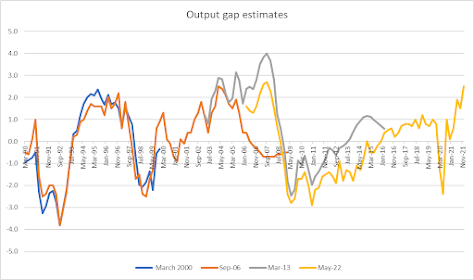
I was curious what the output gap from the latest Monetary Policy Statement looked like in historical context so I threw this together to get a longer time series. Each line is the output gap provided by a different MPS. In some cases, the MPS provides a forecast, so neat to see how the measure panned out relative to the forecast. In other cases, revisions to GDP or to the output gap forecasting measure makes for differences between the lines.

Current levels of the output gap aren't unprecedented. And gaps on the lower side are worth avoiding. But it certainly doesn't look like a time for running make-work schemes. 


Monday, 25 July 2022

Tobacco end games

The latest round of proposed tobacco rules amount to prohibition. 

If not in two years, when low-nic rules come in that might be low enough to be de-facto prohibition, depending on where the Government sets the levels, then a few years later when the effects of a 1 January 2009 cut-off birth date for cigarette purchases works its way through. 

By the late 2030s, you'll have the absurdity of store clerks checking whether a purchaser is 28 or 29 - one will be allowed, and the other prohibited. 

And at that point there seem reasonable odds that the absurdity either has the whole regime thrown out (the better case), or full prohibition extended to all ages. 

If the low-nic rules do not amount to full prohibition, then the sinking lid on tobacco outlets will wind up mattering. The government proposes licensing tobacco retailers with a view to reducing the number of licensed outlets. 

If only very low nicotine cigarettes are allowed, then the sinking lid won't matter. Few people would want to buy very low nicotine cigarettes. But if the cap on nicotine content only prohibits the highest-strength cigarettes, then the right to sell cigarettes will be a valuable commodity. 

Basically the structure would provide local monopoly rents to local retailers, constrained by whatever mail order options remain allowed. If licenses transfer on sale of outlet, they'll capitalise into the price of licensed venues - like alcohol licenses in parts of Australia. If they expire on the sale or transfer of an outlet, they'll discourage some otherwise-efficient changes in ownership - similar to a stamp duty. 

None of it seems a particularly good idea as compared to giving more support for flips to vaping, legalising alternatives like snus, and sharpening the distinction between vaping and smoking in the regulations. Vaping is generally prohibited in places where smoking is prohibited; it should be allowed in more places where smoking is not. 

The current set of proposals risks strengthening the already growing illicit market, at a bad time. If people flip now from high-tax real cigarettes to illicit cheap real cigarettes, to avoid very low nicotine cigarettes, it will be less likely that they flip from there over to vaping. Illicit cigarettes don't carry over a thousand dollars in excise per kilo. 

I still like one additional option for reform. 

It's currently illegal to smoke in places like bars and restaurants - and to vape there. I think, in both cases, it should be up to the owner's discretion. But government isn't keen on that.

It's currently legal, but expensive, to provide ventilation and air filtration in bars and restaurants to reduce Covid risk. Few venues compete on that margin: Wellington's Hashigo Zake is one. Government is reluctant to regulate for better air quality, presumably because they do not want to be seen to be loading regulatory costs onto hospitality outlets - many of which will be on the verge of teetering anyway. A wave of bankruptcies following regulation would not be a great look, if that were the result.

But if a venue is able to clean the air to a standard that keeps Covid risks to trivial levels, the marginal cost of also cleaning smoke and vape plumes out of the air will not be high. If regulation allowed a venue the option of catering to smokers and vapers, if they met an air quality standard that also kept out Covid, that could be interesting right? Instead of loading a new cost onto businesses, it would be offering them an option they currently don't have. 

What argument could people have against that latter option? If the air is clean, the air is clean. The only risk is the risk of 'renormalisation', which seems a bit silly relative to the benefits of Covid-free indoor air. 


Thursday, 21 July 2022

Petrol excise holidays and inflation

The extended petrol excise holiday is bad for a lot of reasons. But we shouldn't pretend it fights inflation. 

It results in a CPI level that is a bit below where it would have been, for the period that it is in place. Year-on-year changes in CPI are our going target measure for inflation. 

So think about things a bit harder.

Suppose the holiday is made permanent and land transport funding is permanently shifted from a user-fee basis to a general-tax-revenue basis. When the one-year anniversary of the petrol excise holiday comes around, we will again be comparing CPI figures that are set on like-for-like basis. The effect of the holiday in muting the underlying trend will be gone. 

Or suppose instead that the holiday ends in December. Come the March quarter, we'll be comparing a no-subsidy petrol cost CPI quarter 2023 with a no-subsidy petrol cost CPI quarter 2022, so we get a one-off jump from the prior quarter's artificial depression of the inflation figures, then we'll get an artificial jump in measured inflation when we start comparing a no-subsidy petrol cost CPI June 2023 quarter with the with-subsidy 2022 June quarter.

In either case, the Reserve Bank has the same job in fighting underlying inflation. It should look through the road use charge changes in either case, except to the extent that it flows through into other prices - and even that will be transitory. 

My column in Newsroom this week, reminding that RBNZ in 2010 helped keep inflation expectations anchored by posting inflation projections with and without the effects of the 2010 GST increase. 

While the petrol excise holiday does affect headline Consumer Price Index results, it does not really affect the inflation that the Reserve Bank should care about in setting monetary policy. The Consumer Price Index will be somewhat lower than it would have been for a bit longer. But inflation remains largely unaffected.

Consequently, we should look through the effects of the policy when looking at headline inflation. And if we do, then you need to look back 34 years, to March quarter 1988, to find a higher inflation figure.

When considering the petrol excise changes, it's helpful to reflect on the GST increase in 2010. In 2010, John Key’s National government increased GST from 12.5 percent to 15 percent. Overnight, on 1 October, the price of everything went up. Something that had cost $112.50 on 30 September would cost $115.00 the next day.

But was the move inflationary?

The Consumer Price Index would certainly be higher than it otherwise would have been. For one year.

Annual inflation is the percentage change in the CPI compared to the same quarter in the previous year. So long as each quarter’s CPI was compared to a CPI figure before the GST increase, annual inflation would look higher than otherwise. But by December 2011, inflation would be measured against a baseline with a higher GST rate.

So unless something else changed, the GST increase would not affect ongoing inflation.

The Reserve Bank worried about whether that ‘something else’ might matter.

Monetary Policy Statements in 2010 talked about the potential for the CPI increases to pass through into wage increases, which could affect ongoing inflation figures. At the same time, energy began facing a carbon price in the Emissions Trading Scheme, which would also affect headline CPI. And a sequence of hefty tobacco excise increases began.

So the Reserve Bank checked with industry to see whether those CPI increases were feeding into wage settlements, and they checked against surveys of inflation expectations. They also looked at what happened in the last GST increase.

They saw little cause for concern, noting that “monetary policy would act to offset any pick-up in medium-term inflation expectations.”

But the Bank also provided important assistance in keeping inflation expectations anchored.

The December 2010 Monetary Policy Statement provided measures of both CPI and projected future CPI. One forecast included the effects of policy changes that affected CPI; a second stripped out those effects.