Friday, 1 April 2022

Rushing Emission Plans

It looks like the Ministry for the Environment is running a rather hasty process in setting the Emissions Reduction Plan. 

This week's column over in Newsroom:

Submissions on the draft plan had closed four months ago, but none of the submissions were yet available on the relevant website. So I asked the Ministry for the Environment where I may find them.

The ministry’s response was rather worrying:

"Consultation on the draft Emissions Reduction Plan resulted in over 10,000 submissions being made, and our team is currently reviewing each of these submissions to incorporate what we have heard into the ERP as part of the ongoing policy work on this significant document.

"The ERP is due to be published in May, and we are aiming to publish a Submission Analysis Report shortly afterwards to capture the submissions we received. We will endeavour to give you a heads up when we have a confirmed date for the release of that report."

While the final plan will be published in May, the relevant decisions must be made well before that date.

That only a summary of submissions would be made available, and only after the plan had been published, suggested a very rushed process.

Compared with other legislation and regulation, the Emissions Reduction Plan has complexity and consequences where substantive submissions would add more value than is usually the case.

Submissions from affected sectors could reveal detail critical to any successful plan, self-interested special pleading, or a complicated mix of the two requiring judicious treatment. Hurried treatment of submissions would be a mistake.

On making inquiries around Wellington, we were told that sector-level decisions were close to being finalised or had already been finalised.

A good process would have submissions considered well before plan finalisation. But inquiries around Wellington suggested that plan finalisation had to run in parallel with analysis of submissions because of the tight timelines and the volume of submissions.

It makes for a risky process. If a submission providing critically important detail is not unearthed until much of the plan is finalised, it would be too late to fix things.

Wednesday, 30 March 2022

Paths to 2050

Government legislated for net-zero by 2050. That's a target - a destination. Not a path for getting there.

Economists are broadly of the view that prices can guide us to that target. Set a declining cap on the ETS to get to net-zero and let prices and anticipated prices provide the signal of the best path to take. Prices adjust; the cap binds.

There's fiddly stuff around how the legislation works. Government wants to hit annual emission budget targets and that makes things more complicated. You can buy and store credits, and redeem them whenever you want. 

But none of that really matters if what you care about is a sharply declining net emissions path to 2050 and maintaining net-zero thereafter. Take net current emissions. Put a dot on the chart. Set net emissions to zero at 2050. Draw a line between the points. I don't care whether you want to make it linear, concave, convex, whatever. Take the area under the curve above the x-axis. Announce "This is the total volume of credits that the government will auction between now and 2050, and here's the annual path for our auctions. Do what thou wilt."

Does it matter then if somebody buys a pile of credits now to use later? No. The area under the curve is the area under the curve, and the binding cap binds. If you overshoot the annual emission budget in one year it will necessarily be because you've undershot it in another year. Actual redemptions will wind up either being concave, convex, linear or whatever as emergent property. The total volume is fixed. The shape that the curve in redemptions takes will be driven by a big complicated mix of stuff that the government is best not worrying about. It'll reflect expectations around tech and cost changes over the period. 

People tie themselves up in knots about how maybe the ETS has a soft cap because credits can move from year to year. But none of that affects net emissions between now and 2050 unless government does something stupid like increase the volume it puts up to auction in later years in response to current stockpiling. 

There are tons of potential paths between here and 2050. I'm sure not wise enough to be able to say "This! This is the best path! And here is the number of doctors we will need each year from now until 2050, and the number of bakers, and the number of bus drivers...." 5-year plans don't work and 30-year plans will be even worse. Set the target and let people choose their paths to get there. 

Olivia Wannan has a column up. She casts me and Matt Burgess as being on one side, with all the environmentalists on the other. 

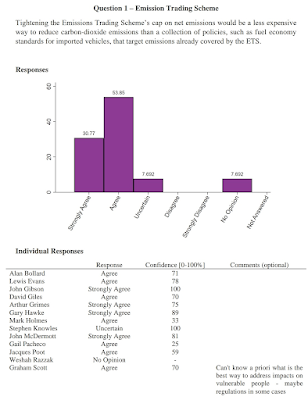
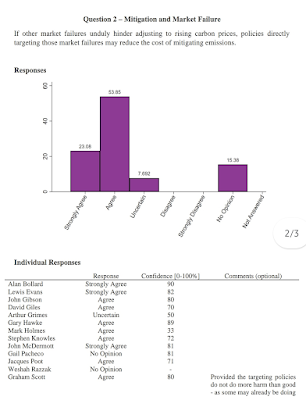
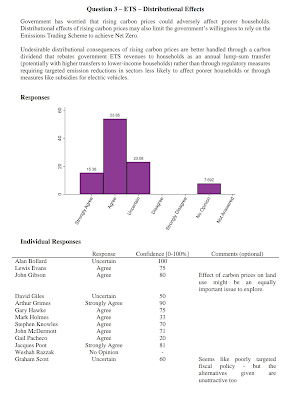
Of course, the survey of economists within the past month had nobody really disagreeing with us. Use the ETS to deal with carbon; if there are other policy objectives, use other policy instruments to deal with them; use a carbon dividend to offset distributional consequences. 


There is one bit where I'm really kicking myself for not having explained it more clearly. 

It just hadn't occurred to me that people wouldn't see this. And I wonder whether there is a bit of artfulness worked into the Commission's workings.
Burgess uses the commission’s work to argue “existing policies already have New Zealand on track to deliver net-zero emissions by 2050”. Therefore, further efforts to tackle gross emissions may be unnecessary and expensive, he argued.

However, in the commission’s scenario, achieving net-zero in 2050 isn’t permanent. By 2065, planted forests would come up for harvest and net emissions would spike up.

This would violate the Act, which requires all budgets after 2050 to also achieve net zero.

 ... Asked about the option to front-foot gross emissions cuts to prevent the bump from 2065, Crampton says that the country could – at that point – decide its cheapest available option. This could be further gross emissions cuts, more trees, or new tech such as carbon removal.

“It seems a mistake to require substantial reductions in gross emissions now and over the next decade, in case of reductions in forestry sequestration a half a century from now…. [It] is a large bet that none of the technologies under development will wind up being able to sequester carbon at any reasonable price.”

You can't have an upward bump in net emissions after 2050 if a binding cap at net zero is maintained. Prices might go up, but net emissions wouldn't. Every tonne of emissions has to be met by a surrendered credit, and that credit will represent a tonne of removals.

Under the Commission's modelled scenario, they must either be fixing the price to maintain $50 after 2050, with the cap adjusting, or the cap must be gone. The bump from 2065 can't happen if net-zero in the ETS is maintained. Prices would go up instead. 

I suspect that there's a bit of artfulness in the definition for Figure 6.4 (described in Section 6.3), where emission projections are made from 2050 "if there were no further forestry planting or policy changes", in a scenario where carbon were $50/tonne. 

If nobody specified that the ETS cap continues after 2050, then net emissions would go back up if you assume that a policy change would be required to maintain the cap from 2050. I think the more natural assumption is that the net-zero cap is maintained after 2050. 

I have a query in with Climate Commission checking this. It would be a bit on the nose to claim that relying on the ETS isn't enough because of bounce-back after 2050, if that bounce-back is due to an assumption that the ETS cap stops holding after 2050. 

After 2050, so long as the ETS binding cap is maintained and the government is no longer auctioning credits, net-zero is maintained. You don't get an upward spike in emissions. You'd get price movement. And the anticipation of price movement would drive investment and other activity ahead of the price movement.

If you want a guarantee that net-zero is maintained after 2050, legislate to maintain net-zero after 2050. Surely that makes more sense than forcing through a bunch of industrial policy in the next 5-10 years. 

UPDATE: I have had this confirmed. The work at Figure 6.4 only models the effects of a $50 carbon price. The ETS isn't really in this scenario. It's just seeing whether a $50 price drives things to net zero or not if a lot of tree planting is allowed, and how much tree planting that might be. The upward blip after 2050 can happen because there is no cap on emissions in that scenario - just a $50 carbon price. If you maintain a cap at net zero, you will have net zero. Obviously. Because a binding cap binds. This should be obvious to anyone who understands this area. 

RUC rebates - how would you do it?

Drivers of diesel vehicles pay their share of road building and maintenance costs through road user charges, levied per kilometre driven, with higher charges for bigger and heavier vehicles.

When the government announced a petrol excise holiday in response to rising fuel costs (a silly policy), it obviously hadn't thought through how to apply it to Road User Charges.

If you were the poor official tasked with making this work, how would you do it? 

The complexity isn't in that there are lots of different charges for different-sized vehicles - you can sort that out with a calculator.  

The complexity rather is that:

  • Drivers buy RUC in advance of using it, generally in increments of 500 or 1000 km;
  • You can buy large amounts of RUC. There's *some* limit on it to prevent stockpiling against future levy increases, but as best I can tell, I could go and buy 99,000 km of RUC right now;
  • Cars and trucks transfer ownership;
  • Amount driven varies considerably across people and vehicles, and potentially over time as well.
All of this was obvious when the government did its too-typical government thing and just announced the policy without having worked through any detail. Normal process followed by better governments will first canvass the Ministries for advice about how to do the thing, put up options, consult with affected stakeholders to see what they've missed, update the options, and pick something that won't be completely terrible. 

It's pretty obvious they didn't do any of that.

So, if you were the official told to sort this mess out, what could you do?

The simplest first cut that would work for most vehicles would just base it on average monthly kilometres driven between Warrants of Fitness. Odometers get checked at WoF. New cars can go a couple years between WoFs though. 

So announce that every diesel vehicle will get free RUC based on average monthly kilometres travelled between the last WoF and the next one, after the next WoF odometer check. Whatever the percentage reduction in petrol excise was, apply that percentage to average monthly kilometres driven, multiply by 3, award the RUC at the end of the period.

But that can be a long way off for some vehicles. So you'll need to make provision for that. Say that diesels can go into a VTNZ or other WoF location for an odometer check and immediately be awarded RUC based on the average kilometres driven per month since the prior odometer check (so long as that was at least a month earlier). And you'll have to pay those centres for doing the odometer checks and filling in the paperwork. 

And then it starts getting complicated.

The petrol excise holiday is free money, not free petrol. So you'll have to give an option for a cash-out in lieu of a RUC award. Some people might prefer having the cash; others will be planning on selling the vehicle before they'd use the RUC. But you're going to need some payment mechanism and that's going to be harder than just figuring out how to put free RUC onto a licence. 

Some vehicles will have changed ownership since the last WoF. Was the odometer checked when it was sold? The owner will claim that the car got a lot less use under the prior owner and so the average will be wrong. What do you do with that? They might not be lying. 

Still others will claim that their vehicle is used very intensively during the period that coincides with the petrol excise holiday, and not much during the rest of the year. Many of them will be lying. But some could be telling the truth - and you just won't hear much complaint from those who don't use their car much during that period and really use it during the rest of the year. 

In both those cases you're then going to need to let them go and get their odometer checked to establish a baseline, then get checked a second time. The queues at the odometer checks might get long. And you're going to have to pay twice for the checking. 

All of that sucks. For the simple case where people are happy just to get free RUC after their next WoF, it's pretty easy. But there will be plenty of people who aren't. And for them, you're likely going to need some odometer checking system, and a way of paying people out. 

But other options aren't great either.

If you let people buy RUC at a discount they can just buy tons of it to use later. Petrol is expensive to store. Unless you've got a giant farm tank kicking around, you're going to spend more on jerry cans than you'd save in excise discounts. And storing it in other containers would not work out well. You can't just stick it into an old milk jug and hope you have reliable petrol that hasn't leached out (or had plastic leach in) months later. But RUC - that's just a piece of paper. 

You could limit the amount that people are allowed to buy during the period, but how do you know how much somebody really needs to drive? You can't base it on prior driving history either because needs may have changed. It would sound simple to just look at the total amount of RUC previously purchased, figure out the average monthly amount used, and give a discount on buying a 3-monthly amount and no more - but you'll hit into all of the problems around people with idiosyncratic usage and then you either have to tell them to lump it, or set up all of the odometer checking stuff. 

Anyway. Jo Moir put the questions to Minister Wood, and got an answer entirely consistent with that the government put zero thought into this stuff before announcing it was going to do it. 

Last week Transport Minister Michael Wood confirmed RUCs would be cut across all 85 vehicle classes by 36 percent between late April and late July, allowing time to implement the changes.

“I want to assure road user charges payers they will get three months of reduced rates, even with the later start date. The complexity of road user charges means that a few more weeks are required to put the reduced rates in place,’’ Wood said.

For two weeks Newsroom has put questions to Wood’s office asking how the Government will stop diesel users from rorting the discount by stocking up, and whether people who had bought RUCs prior to the discount period would be compensated.

The only response Newsroom has received to date is that “agencies are currently working through the implementation of the announced RUC changes and any flow-on implications’’.

Wood’s office told Newsroom last Wednesday, and reiterated on Monday, that the minister is expecting further advice in the coming days.

Whoever in the Ministry has been stuck having to square this circle, because the government went off and announced something that couldn't obviously be made tractable, deserves a beer. 

Ardern told Newsroom the Ministry of Transport and Waka Kotahi knew the Government wanted to find a way to offer relief and weren’t caught on the back foot when the announcement was made.

She insisted the delay was simply a case of working through a complex problem and communicating it to diesel users and the trucking sector as quickly as possible.

For those needing to purchase more RUCs ahead of late April it remains to be seen whether they’ll receive all the 36 percent discount, and when it will back-date to.

No new advice on how to overcome the issues with the diesel discount was presented to ministers at Cabinet on Monday.

What a mess. They should have just announced a carbon dividend. 

FWIW, we bought a diesel back in November. We're a one-car family; waiting 2 weeks for a new alternator to show up for our old Honda Odyssey wasn't great. So we got a Mazda CX-8. Our first diesel and our first encounter with the RUC system. 

It's all pretty straightforward, but I really didn't like the risk of running out of RUC before the next batch of RUC showed up in the mail, so I bought 5000 km worth of it - shortly before the excise holiday was announced. 

I will buy as much RUC at a discount as is permitted by whatever system they set up. But I'd really not want to have to drive somewhere to get an odometer check. Ugh.
Tuesday, 29 March 2022

Biofuel mandates

Biofuel mandates never made any sense. Critiques of American biofuel mandates go back decades, arguing that creating the ethanol to blend takes more energy than you get out of the stuff at the end. 

New Scientist ran a column a couple of weeks ago arguing that biofuel mandates should be abolished, now, as part of the response to war in Ukraine. It's one way of quickly getting more land into food production, and out of value-destroying biofuel production. 

It is an odd time for the New Zealand government to reaffirm that it wants a biofuel mandate.

The Prime Minister says the Government's planned biofuels mandate will help create long-term stability in the fuel market, something she says recent price volatility has shown a need for.

None of that makes much sense. Cutting a small bit of petrol or diesel out of a fuel mix, to add in something that's a heck of a lot more expensive, might very slightly reduce price variability of the finished product if biofuel costs are less volatile than global fuel costs, but at a price that hardly worth paying. It's like saying that you avoid price volatility in aluminium by requiring that silver be added to aluminium foil. 

Biofuel mandates are bad to start with, but they're doubly-silly when transport is in the Emissions Trading Scheme. If carbon prices rise sufficiently, maybe biofuels will become a cost-effective way for fuel companies to avoid having to buy as many costly carbon permits. Biofuels then get brought into the system when it makes sense to bring them in. Mandating it forces things, regardless of cost-effectiveness.

A lengthy snip from the New Scientist piece below. 

The war in Ukraine has already caused food prices to shoot up as global markets anticipate a loss of wheat and maize exports from one of the world’s largest producers of these crops. But Europe and the US could more than compensate for the loss of Ukraine’s exports by diverting crops destined to be made into biofuels into food production instead. This would bring food prices down and help prevent a major global food shock.

On 9 March, Ukraine banned most food exports to try to ensure that its people don’t go hungry as Russian forces invade.

Food prices were already at the highest levels for 40 years, says Matin Qaim at the University of Bonn in Germany. This is for many reasons, including poor harvests because of extreme weather driven by global warming.

Quickly increasing the supply of food crops is difficult. But a large proportion of food crops aren’t eaten but converted to biofuels. Globally, 10 per cent of all grain is turned into biofuel, says Qaim.

In the US, a third of the maize grown is converted into ethanol and blended into petrol. Around 90 million tonnes is used for ethanol, nearly double the 50 million tonnes exported by Ukraine and Russia, says Qaim.

In the European Union, 12 million tonnes of grain, including wheat and maize, is turned into ethanol, Qaim says, around 7 per cent of the bloc’s production.

The EU also produces large quantities of biodiesel. It turns 3.5 million tonnes of palm oil alone into biodiesel, says Qaim. “That’s almost the amount of sunflower oil coming out of Ukraine and Russia.”

Governments have the power to change this, says Ariel Brunner at Birdlife International. “Because the biofuel market is entirely driven by subsidies, you can unplug it literally with the stroke of a pen,” he says.

If the US and Europe were to decrease their use of ethanol made from grain by 50 per cent, they would effectively replace all of Ukraine’s exports of grain, Tim Searchinger at Princeton University has calculated in response to a question from New Scientist.

“This is one of the few really quick things we can do,” says Brunner. “We are literally burning a hell of a lot of food.”

One country has already done just this. On 11 March, the Czech Republic ended its mandate requiring ethanol to be blended with petrol. It did this to reduce the costs of fuel rather than food, but Brunner is calling for other countries to follow suit.

“It absolutely would make a difference. It would begin to relieve prices immediately.” says Jason Hill at the University of Minnesota in St Paul. “It would also send a signal that can be acted on immediately by farmers. Northern hemisphere farmers are deciding now what to plant.”

The US Environmental Protection Agency has the power to waive the requirement to blend ethanol into fuels, says Hill. “The EPA could very quickly send a signal that ethanol is not needed.”

Temporarily halting biofuel mandates wouldn’t be popular with farmers. The powerful agrobusiness lobby in the US is currently demanding the opposite, that biofuel production is increased in response to the rising oil price, says Hill.

The government's biofuels factsheet notes that more than 60 countries have biofuel mandates. They'll have to cut the Czech Republic from the list I guess. 

Science funding

Michael Cameron at Waikato has a great post up on the state of social science research, the government's Green Paper on research funding, and an old report I'd missed from Superu's David Preston. 

Probably the key thing that stands out from this report (aside from the fact that it is clearly a parting shot from Superu, which funded the report), is the highly political nature of social science funding. For example, Preston notes the problems associated with multi-sector research institutions that sit outside of core government services:

While this position outside of government proper gives the institution more independence, it also makes the entity more vulnerable to unfavourable reactions from the government of the day. This is especially so if it is providing advice or information on politically sensitive issues. The government cannot do without its core government departments, but it can do without particular advisory bodies or research institutions.

A related example is the closure of the Social Policy Journal of New Zealand, which had been set up and run by the Social Policy Agency, part of the Department of Social Welfare:

No official reason was ever given for the closure of the Journal. However, informal sources commented that an article about to be published included information which indicated that a statement made by a Minister was inaccurate. Publication of the issue was delayed until public interest in the topic died down and it was decided to cease publication of the Journal, apparently to avoid future difficulties with Ministers.

The development indicates the difficulties of maintaining the ability to publish research findings within a politically sensitive environment in a government department.

All of this suggests that social science research institutions are always in a precarious position, reliant on short-term funding sources and beholden to the political whims of government. Preston summarises the various reviews of social science research that have been undertaken since the 1970s (of which there have been many). One common theme across those reviews is the need for a social science research institution with a sufficient level of baseline funding to maintain core research activity. Preston uses the example of the Brookings Institution from the U.S., which admittedly is not funded by the government, but has had a lasting impact on policy development and is generally well respected.

I take as conclusion that the NZ Initiative should be about four times bigger than it is, and that Motu could be a little bit bigger too. 

Friday, 25 March 2022

The supply of specialists

Monday's column hit on regulatory barriers to entry in medicine that really look like cartel-enforcement mechanisms. Westpac had this note in 2016:

Industry sources had several concerns about competition or the lack thereof in provision of healthcare and social support services, and about differing standards set for public and privately contracted providers of these services. 

One of the chief concerns was the cost of specialist care in New Zealand relative to many other countries, and the incentives specialists had to work in private healthcare rather than public healthcare, which exacerbated the problem. Some laid the blame at the door of the specialist colleges, which set the standards required before a specialist could practice in New Zealand. 

While acknowledging the importance of ensuring standards were sufficient to keep patients safe, there was concern that colleges acted as gatekeepers to limit the supply of specialists in New Zealand. This all but guaranteed that those who made it through the process earned high salaries. This monopolistic supply (increasingly requiring a fellowship on top of other qualifications) was having such an effect that some thought New Zealand now had an oversupply of GPs. Many people went part way toward becoming specialist before dropping out because the requirements had just become too restrictive, even though they were capable of practising at specialist level. There were immediate impacts on public healthcare provision due to cost pressures and time delays, yet the DHBs we spoke to appeared to believe there was no way around this hurdle.

HT: David Norman 

Thursday, 24 March 2022

Afternoon roundup

The closing of the browser tabs, so the poor thing can reboot, brings some worthies: