Showing posts with label NZAE. Show all posts

Thursday, 25 May 2023

Reader mailbag - on circular economies

My column for this week in Newsroom, jointly authored with Otago Uni's Dennis Wesselbaum, goes through the findings from the latest survey of New Zealand's economists.

The survey asked NZAE members whether they were familiar with circular, doughnut, and mission-based economics. It asked whether inclusion of those concepts has improved policy analysis, and whether increased focus on those approaches would improve policy analysis. It finally asked whether those concepts should be included in the core curriculum of economics.

Respondents from academia found these concepts to be of very limited value. Respondents from within government either found the concepts to be helpful, or were uncertain about them. 

For example, here is the pattern of responses to question 3, which reads: 
"Economic policy would be improved by placing greater weight on [each of Doughnut Economics, Mission-based economics & the Circular Economy], even if it meant less analyst time and capability was available for other types of analysis."
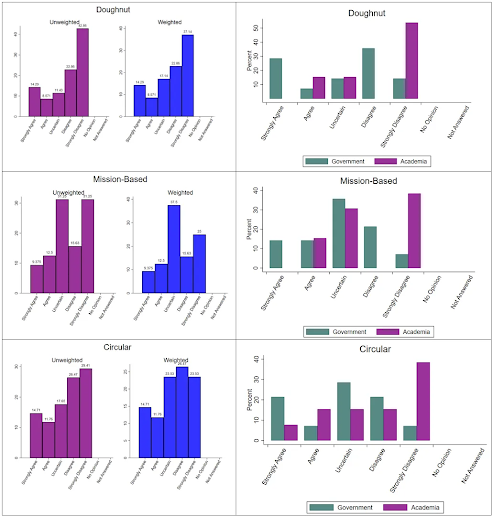

The modal academic strongly disagreed that any of these improved analysis. The same was not true for government-employed economists.

I have, for some time, worried about the apparent disconnect between New Zealand's academic economists and people employed as economists by the Ministries in Wellington.

Government-employed economists seem to have picked up an awful lot of trendy-sounding things that resonate with Ministers. They rarely talk with academics. And many have no clue or do not care how far they have strayed from the academic consensus. 

It is a problem. 

A lot of angry people in the Newsroom comments section told me how evil I am to be neoliberal and such. But the more useful comments I heard back were via email.

In one case, the correspondent had had no clue that circular economics was anything other than mainstream. Because it's all they'd heard in policy discussions. 

In another case, a Mayor provided this dispatch from a meeting over the past year, edited slightly to anonymise the response. 
It reminded me of a meeting I was at XXXX weeks ago, the aim of which was to discuss regional policy making to deal with the effects of climate change. A number of the sessions were reasonably sensible until we came to a session on "Food Security". The presenter talked for an hour on all the things we should be doing in the future to make sure we and our communities would not starve. We had ideas such as cutting large farms into smaller farms so that more people would be able to grow their own food. We had the (food) productivity growth that would follow more people putting their scraps into their worm farms and so on and so.
 
I waited for a discussion of food chains, markets, supermarkets, growing food at scale so that large numbers of people get to choose what they eat, the wonders of our internal transport mechanisms - and I waited and waited. And waited. It never happened.  These presenters were meant to be planners and I despair. By comparison a donut economy sounds like something I might actually eat and enjoy.
There is an awful lot of woo infecting policy. Normally it's the economists who insist on rigor to stop this. That failsafe is not nearly as safe, in Wellington, as it ought to be. 

And unfortunately the Government Economics Network, whose purpose should be to upskill government-employed economists, mainly seems to highlight heterodox approaches that have less support among mainstream economists but are convenient for rationalising policies that Ministers prefer. 

When I taught Econ 224 at Canterbury, Econ & Current Policy Issues, I included a few things as defence against the dark arts - stuff I thought the kids needed to know so they could bat back woo when they encountered it. 

I wouldn't put any of these three surveyed items in the core. But it would be great if some of our principles classes could remind students that we have an entire field of environmental economics. It isn't that economists don't care about the environment, as fans of circular stuff seem to believe. It's that we want solutions that work. Environmental economics is rigorous. Other options are not. 

Thursday, 10 March 2022

Let the ETS do its job

This week's column in the Dom Post and Stuff papers covers the results of the second Expert Economist Survey

A snippet:

New Zealand’s emissions trading scheme (ETS) has improved considerably over the past few years. Through the 2010s, the ETS was a lot more like a low carbon tax set at $20 per tonne.

Now that there is a real and declining cap on net emissions, the price of carbon has risen to $80 per tonne. The carbon charge in a litre of petrol rose accordingly, from about $0.05 to about $0.20.

A lot of Wellington officials support adding policies on top of the ETS. They argue that doing so can force emissions to reduce more quickly.

But when policies target sectors covered by the ETS and those sectors purchase fewer carbon permits, more permits are left for others to buy instead.

And while it is true that the government could take that opportunity to cut the ETS cap more quickly, it could cut the ETS cap more quickly and at less cost to the country as a whole without regulating fuel economy.

We asked whether our expert panel agreed or disagreed with the following proposition: “Tightening the ETS’s cap on net emissions would be a less expensive way to reduce carbon-dioxide emissions than a collection of policies, such as fuel economy standards for imported vehicles, that target emissions already covered by the ETS.”

Thirty-one per cent strongly agreed with the proposition, 54 per cent agreed, and the rest were either uncertain or had no opinion. No surveyed economist disagreed.

But that hardly means that economists see no role for complementary policies. Complementary policies can have an important role to play if there are complementary problems to solve.

The ETS puts a price on carbon that deals with the market failure we would otherwise have in carbon emissions. If other market failures unduly hinder adjusting to rising carbon prices, policies directly targeting those market failures may reduce the cost of mitigating emissions. Seventy-seven per cent of our surveyed experts agreed, and none disagreed.

So it is not that economists are opposed to regulatory activity per se. It is rather that those policies need to be appropriately targeted at real additional market failures.

To take an example, if you thought that an $80 carbon price hurt biodiversity because of pine tree planting, the solution would not be to tweak the ETS settings to ignore carbon sequestered in pine forests.

The solution instead would be a subsidy for planting native forests, or a charge reflecting the biodiversity cost of additional pine tree planting in places where more pine trees caused demonstrable harm.

Finally, we asked our experts to choose between two options for dealing with the harms that rising carbon prices can impose on poorer households.

The Government has been trying to target emission reductions in sectors that might be less likely to affect poorer households while also providing subsidies for electric vehicles.

But the Government has another option. It planned on selling 19.3 million ETS credits this year. At $80 per tonne, that would raise enough money to give every family of four a carbon dividend of more than $1200.

Our experts agreed that a carbon dividend is the preferred option: 15% strongly agreed, 54% agreed, 23% were uncertain, and 8% had no opinion.

The full results are up over at the NZAE page.

Wellington has been trying to gaslight me for too long, trying to make me think that I'm the crazy one for continuing to think that the standard lessons I taught at Canterbury, the same standard core micro that's taught everywhere, is now somehow all wrong. The Survey is a nice sanity check for me. I'm not mad; the Ministries are madhouses. 

Wednesday, 8 June 2016

Asymmetric Information

The latest issue of the NZAE newsletter, Asymmetric Information, includes Bryce Wilkinson's excellent critique of the Treasury's recent 'Living Standards' framework, along with a reply from Girol Karacaoglu. 

Bryce writes:
Yet high quality fiscal and regulatory analysis is difficult. For a start, politically powerful or influential spending and regulatory advocates might not welcome it. It is also difficult technically. The mainstream technique for analysing both regulatory and fiscal proposals is cost-benefit analysis.4 Treasury is the custodian of that methodology in the public service.5

Given these gatekeeper roles Treasury can’t expect to be widely liked, but it should aspire to be respected. It should not confuse the two.

Yet the Living Standards Framework does appear to want to be all things to all people. It proposes evaluating spending and regulatory proposals from five ad hoc perspectives–their contributions to economic growth, equity, sustainability, reducing risk and enhancing social infrastructure.

The framework apparently leaves it open to spending and regulatory interests to cherry-pick amongst the five pillars and within them, deciding for themselves which pillar best serves their purposes in a particular case. It gives no disciplined guidance to Treasury officers or anyone else as to how to choose between, say, competing concepts of equity, or how to assess trade-offs between the pillars. 6 Nor is there an international literature to look to for guidance.
Girol's reply follows.

You can read the Living Standards working paper here if you're particularly keen. Bottom line seems to be that if you assume a bunch of external costs from activities and that the living standards framework can internalise those external costs, then the living standards framework is a good thing. For example, if we assume that clean tech requires skilled workers, then you might not have enough investment in education if environmental quality is valued. For more such insights, but with a lot more math, you can read the paper.

Asymmetric Information also includes a regular feature profile of a local economist; I'm interviewed in this month's newsletter. So you can read that too if interested.

Wednesday, 26 June 2013

More Glaeser

Eric posted yesterday on Ed Glaeser's upcoming Condliffe Lecture at the University of Canterbury. Some of you have if the talk will be videoed, given that you are not based on Christchurch. Absent any technical hitches, the talk will be posted on YouTube as part of the University's What If series of public lectures, a week or so after the talk.

But if you are based on Wellington, you can go one better. Why not register now for the annual conference of the New Zealand Assocation of Economists, which is taking place at the Amora Hotel in Wellington next week--Wednesday July 3 - Friday July 5. Ed is giving a keynote address at 4:00 on Wednesday. Other keynote speakers are Maurice Obstfeld of Berkeley, John Riley of UCLA, Mardi Dungey of U. Tasmania, and John Quiggin of U. Queensland (best known in the blogsphere as one of the authors at Crooked Timber).

Quite apart from the keynote addresses, the conference will also feature TVHE's Matt Nolan, who is presenting a paper and also participating in a panel discussion on the Open Banking Resolution, along with  Ian Woolford from the Reserve Bank and Bank critic, David Tripe; and I will be presenting my work on Do Catches win Matches. Groping to Bethlehem's and Association Vice President, Bill Kaye-Blake, is not giving a paper this year, but he will be at the conference.

The full conference web site including the link to registration and the programme is here. I hope to see as many of you there as possible.

Monday, 16 July 2012

Conference Wrap Up

The annual NZAE conference is now gone and I can turn my hand back to blogging. I am hardly a disinterested observer, so I won’t comment much on the conference itself—James and Bill have already done so, anyway, in a more timely manner. A few random thoughts occur, however.
  • It was great to see Matt at the conference; having a dedicated roundtable on blogging seems to have worked as a Trojan Horse as he is now promising to submit a paper next year.
  • Next year, I should try and jig the schedule so that I don’t have another commitment on at the time that James is presenting. Despite his attending the past three conferences (at least), I have not had the opportunity to see him present. It is not a deliberate snub, James.
  • Finally, I was interested in Berk Ozler’s comments on the academic culture in New Zealand at his Development Impact blog, following his participation in the blogging session at the conference: Berk says that
For those of you not familiar, the discussion at a typical seminar or conference presentation [in New Zealand] goes quite differently than it would in an academic setting in the U.S.: the audience generally avoids interrupting the speaker and the questions and the discussion are very polite.
I think Berk is right about the culture of the NZAE conference, and that is something we like to encourage. It is a broad-church affair bringing together economists with a range of backgrounds from the academic, government and private sectors, and polite, constructive interactions are an important part of that. But I am hoping we can get Berk up to give a seminar at Canterbury, where we can try to replicate the culture of a U.S. academic setting, :-)


Tuesday, 8 May 2012

NZAE Annual Conference

Blogging from me has been very quiet this year, owing to a combination of it being my more intensive teaching semester and working on the 2012 annual conference of the New Zealand Association of Economists.

So in lieu of a regular post, let me use this forum to shill for the conference. It is being held in Palmerston North from Wednesday June 27 - Friday June 29. Early-Bird registration closes on Thursday so be in quick. To register, go to the conference website here and follow the link to on-line registration.

Followers of New Zealand economics blogs will find some familiar material. I packaging up some of my tax posts into a paper; Eric will be talking about minimum wages; and Sam Richardson of Fair Play and Forward Passes, will be talking about some of his work on over-egging the economic benefits of sports stadia and the like. James Z from TVHE, and Bill-Kaye Blake from Groping Towards Bethlehem are also presenting papers. Finally, we are also featuring a round-table discussion on the impact economics blogs, featuring all the above authors plus Matt Nolan of TVHE. Berk Ozler from the World Bank, who blogs at their site, will lead off the session with a paper quantifying the impact of economics blogs.

It would be great to meet followers of the blogsphere in PN.

Tuesday, 12 July 2011

A post about serious issues

After haranguing TVHE’s Rauparaha at the recent NZAE conference for TVHE’s lack of recent activity, Rauparaha has shamed me by posting about the conference while I have been a.w.o.l. from blogging. So here, belatedly, is a report.
As a member of the organising committee, I can’t pretend to be an unbiased commentator on the quality of the conference, but I thoroughly enjoyed myself, and I hope others did too. I found that the range and quality of papers was very high. Maybe the incentive effects of having some $6,500 of prizes for best papers and posters to give away is having some effect. The downside is that there were many cases where I would have liked to have been in two places at once. Fortunately, most of the papers that were presented can be downloaded from the association’s website. One paper that I could not get to but that looks really good was the winner of the inaugural New Zealand Economic Policy Prize, KiwiSaver: An Initial Evaluation of the Impact on Retirement Saving, by Grant Scobie, David Law, and Lisa Meehan. There was also a session of outstanding papers in Land and Natural Resources, but that session was on at the same time as Eric and Des O’Dea were presenting in the “costs to society” session. That session was packed out, probably as people were expecting some entertaining exchanges between Eric and Des, but they were in complete agreement.

For the second year in a row, I was talking about electricity markets, but as this is a post about serious issues, I’ll describe that paper in a separate post. Next year I plan to be back on the more interesting area of an economic analysis of cricket.
Speaking of next year, the 2012 conference is going to be in Hamilton (June 27-29). I believe this is the first time we have gone to Hamilton—certainly it is the first time for a while. It will be interesting to see if we can maintain our recent high participation rates In the past couple of years, we have had very good representation from academia (at least, from the South Island universities) and from economists in government agencies, but less involvement from the private sector. We survey conference participants after each conference to find out what they liked and what we could do better, but it would also be nice to get feedback from those who don’t attend. If you are in the private sector and are not a regular attendee at our annual bun fight, what would entice you to come along?

Monday, 27 June 2011

More Shameless Advertising (UPDATED)

I noted here that the annual New Zealand Association of Economists annual conference was coming up (Wednesday to Friday this week at the Amora Hotel in Wellington). The final progamme is here.Tim Harford is leading off with the keynote address at 9:00 on Wednesday morning. It is possible to register on-site at the Amora Hotel, for either a single day or the full conference.

Also, as a first this year, Canterbury's Economics Department is hosting a function for former staff, alumni, and friends, at the Amora Hotel at 7:00pm on the Wednesday. This is in association with the conference but not part of it, so people not registered for the conference are welcome to attend. We don't have a good database of our former students, and so have not been able to contact all of them. So, dear friends and alumni, if you read this blog but have not been directly contacted about this event, we do love you and would love to see you there!

If interested, go the facebook link and click on "I'm Attending". And if you are a facebook user, go to our facebook page, and click "like". We hope to use this page as a way of maintaining contact with alumni and friends.