In 2012, US psychologist Jonathan Haidt rose to fame with the publication of his book The Righteous Mind: Why Good People are Divided on Politics and Religion. In its review, The New York Times called Haidt’s book “a landmark contribution to humanity’s understanding of itself.” It has since gained widespread praise from commentators left, right and centre (see here).
Both Foreign Policy and Prospect Magazine have listed Haidt on their respective rankings of the world’s Top 100 public intellectuals.
Haidt has since published extensively on threats to academic freedom and the polarisation of political debate on campus. His latest book (with Greg Lukianoff) is titled, The Coddling of the American Mind: How Good Intentions and Bad Ideas Are Setting Up a Generation for Failure.
The New Zealand Initiative is proud to support Jonathan Haidt’s first visit to New Zealand.
This will be a rare opportunity to meet one of the world’s most original thinkers in New Zealand. Haidt’s work in moral psychology has deep implications for many of our global and domestic political debates.
Tickets are available here. There will also be a much smaller Wellington event with Initiative members.
This week's column at Newsroom takes another look in at the problems at Treasury. A snippet:
'We're doing something about it'
Treasury’s response notes that Treasury has now put in place a work programme focused on economic capability, including training and developing existing staff and recruitment for economists.
But in the 2019 recruitment round for graduate analysts, while ten of fifteen had at least some background in economics, only four had at least Honours-level training in economics or finance. The recruitment process did little to distinguish candidates with an undergraduate minor in economics as part of another degree from those candidates with a Masters or Honours degree in economics.
And Treasury does not have any comprehensive way of tracking staff capabilities. It simply does not know if it is losing more trained economists than it is hiring. One wonders how Treasury would ever be able to tell whether it had succeeded in lifting its economics capabilities.
'Focus on the core business'
This matters. While a wide range of skills are required in policy analysis, Treasury’s unique role as lead economics advisor to the Government requires having substantial depth of economics capability. Treasury has to be able to apply a rigorous economic ruler across proposals coming from the other Ministries and to provide sound economic advice to its Minister and Cabinet.
That advice need not always be decisive, but it should always be reliable. And while that advice could often annoy Treasury’s stakeholders in other Ministries, they should not have reason to question Treasury’s competence in producing it.
Keeping all the stakeholders happy would be impossible. But doing a good job in Treasury’s core business is not. Treasury should focus on it.
I've been able to get a few things clarified by Treasury, with a few more yet to come under OIA. The blinded recruitment process for graduate analysts, at least for the most recent year, worked as follows.
Team managers told HR that they needed economists. So HR took all the applications and put them into two piles. Into the first pile went any application from someone with a minor in economics, a major in economics, an Honours degree in economics, a Masters in economics, and so on. Into the second pile went anybody without at least a minor in economics.
Then they ran a points sieve over the two piles. If you had a Masters in economics, you got 20 points. If you had Honours, you got 15 points. But there were points for a pile of other things as well. Strong Maori competence provided points. A pile of other things provided points, like their statement of interest in working at Treasury. Strong volunteer work gave 10 points. "Accolades" could give up to 10 points.
And then the highest ranked candidates would be able to get an interview.
See the problem? It's potentially a very flat payoff curve for training in economics, above a minor in economics, depending on how many points were available in all the other categories.
Getting a minor in economics is easy. There are thin routes through to a minor with next to no math and little theory. At Canterbury currently, that means Principles of Micro, Principles of Macro, a semester of intermediate microeconomics, one other 200-level paper, and one 300-level paper.
Honours and Masters is different. You have to take the more rigorous papers all the way up (or at least if you want to make it through with any decent grades), then do the more serious graduate coursework.
So I now have another OIA in checking on the points and categories. But it basically looks like HR there thinks economics can be picked up on-the-job by anybody with a minor in economics, so there's not much point in hiring folks with proper training.
Some teams, like the macro forecasting team, could put in more rigorous requirements for their group. But anybody not specifying that might be surprised by what HR considers to be an economist.
Thirdly, I would stress a four-year full-time honours programme as the minimal "professional preparation for economists". I have in mind one which, in terms of depth of specialization in technical economics, falls between the level of the M.A. and Ph.D. courses recommended by H. R. Bowen, especially in the degree of theory, mathematics, statistics and economic history required.19 Obviously, this would violate the "depth and breadth" criterion of some teachers.20 But, unlike Professor Holmes, I believe this pedagogic conflict is real rather than potential and that a more effective solution than the "B-B variant" might be realised through the "Knight's Move". This consists in allowing students who have a first degree in the sciences and technology to sit, after a year's preparation, for a preliminary examination in economics equivalent to the Stage III level, say, in Macro and Micro economics, International Economics, Econometrics and Economic History, and then march straight into the Honours or Master's programme. True, such a scheme favours the Beta-plus and the more mature students, especially those with a substantial core of "Q" work behind them. However, a four-year Honours programme or the "Knight's Move" should give students a reasonably firm intellectual foundation for their own post-graduate professional development.
Emphasis added.
I hope that the OIA comes back showing I'm wrong. But Treasury's HR department being blind to the difference between a minor and Masters could explain at least some of the rot there. It cannot explain why the Chief Executive has allowed it to happen, but it can explain the hiring outcomes in the graduate cohorts, and it can explain why Treasury sees no need to track the outflow of trained economists relative to hiring.
I've also wondered how Treasury's Board has allowed this to happen. Any corporate board seeing these kinds of results would not be happy with the CE.
Yesterday, by complete coincidence, the Treasury and the New Zealand Initiative each announced a new addition to their respective Boards.
Livia Esterhazy has been Chief Executive Officer of WWF-New Zealand since May 2017. She has a strong professional background in marketing, brand and communications, including senior leadership roles with Clemenger BBDO (Managing Director 2015-2017), Assignment Group (Managing Partner 2012-2014) and Saatchi & Saatchi (General Manager 2009-2012). Her career has also included management positions with Kiwibank and the Commonwealth Bank of Australia. Livia Esterhazy is on the Board of Wellington Trails Trust and is a previous member of the Advertising Standards Board.
The New Zealand Initiative welcomes entrepreneur Stephen Jennings, CEO and Founder of Africa’s largest urban development company, Rendeavour, onto its Board of Directors.
“It is an honour to have Stephen join our Board,” said Roger Partridge, Chairman of The New Zealand Initiative. “Our mission is to create a more prosperous New Zealand for all New Zealanders. Jennings is a visionary international business leader and will bring valuable insights to the Initiative’s work.”
“I am delighted to be joining The New Zealand Initiative Board. The Initiative’s methodological, fact-based approach to policy is ideally placed to improve public understanding on many of the key challenges and opportunities facing New Zealand,” said Jennings.
Jennings is one of New Zealand’s most successful entrepreneurs. For more than 20 years, the Taranaki-born economist and investor has been living and working in emerging markets. A pioneer of capital markets in Central and Eastern Europe and Africa, he is responsible for more than $200 billion worth of investment into these regions.
As the leader of Africa’s largest urban development company, Rendeavour, Jennings now helps build city-scale developments in some of the fastest growing cities in Kenya, Ghana, Nigeria, Zambia, and the Democratic Republic of Congo. The developments include homes, offices, industrial areas, schools and hospitals and allow residents to live and work within their community without the burden of commuting across already congested cities.
Despite his long international career, Jennings has always maintained great interest in New Zealand. He shared his views on the future of New Zealand’s economy at a dinner lecture hosted by the Initiative in 2016.
It's awesome that Stephen's on board with us.
Stephen Jennings' dinner address is embedded below.
It was great fun. Vic had the affirmative and did a fantastic job with it. Canterbury won, partially because the affirmative wasn't able to show it would be enforceable without substantial offsetting harms.
Matt Nolan, of TVHE fame and who's finishing up his thesis on inequality, was one of the the panellists after the debaters had finished; I was the second. I've copied my speaking notes below, but delivery varied a bit. I think the debate was videoed; I'll update this post with it when it's available.
You might have come in tonight scratching your heads a bit
about tonight’s moot. The proposed policy is obviously absurd: a far more
intrusive extension of the state into people’s lives than most people would
ever consider appropriate.
I’m Head of Research with the New Zealand Initiative. I
proposed tonight’s moot because it gets to something more fundamental about
inequality than we usually talk about in public debates.
We see a lot of newspaper stories about ever-rising income
inequality. As Matt’s explained, and as we show in a report coming out later
this year, inequality in measured income rose in New Zealand in the late 80s
through mid 90s, partially because of real changes in wages and salaries, and
partially because measured income inequality in the early 1980s didn’t include
the company cars that some people got and other people didn’t. But, depending on the measure, it’s been flat or declining since then. Poverty remains a real
issue. But inequality – there seems to be less there there.
If you track New Zealand Herald headlines with the word
inequality in the title against the data on inequality – there’s no basis in
the data for the changes in reporting. But it is following international
trends. I think we have imported American narratives that might suit their
data, but do not suit ours. I also wonder how much of the domestic concern with
inequality is driven by dysfunctional Auckland housing markets: when Council
makes it really hard to get new housing built, we get bidding wars for existing
housing that fuel both xenophobia and resentment of those who might outbid you.
But the failure of inequality to rise here hardly means
there is nothing to worry about. There are a lot of things to worry about.
But leaving that to the side, there are two broader worries,
one of which motivated tonight’s moot.
First, inequality is about more than just earnings
potential. Status is about a lot of different things. Those of you watching the
Olympics will have noticed that there is huge variation in natural talents,
partially a product of training and hard work, partially due to lucky genetic
endowments. Some work really hard to make the most of the talents they are
given; others don’t; and still others, like me, could never, no matter what,
compete on that kind of stage. I caught a great Bill Murray tweet suggesting that a normal person be put into the mix in each Olympic event to show just how far these superhumans are from the rest of us. But it is strange how that would make us more greatly laud the winners, when doing the same thing with natural talents leading to higher earnings would have many instead damn the most able.
Imagine that, before you were born, you were
given a choice: you could have no sporting talent but business skills that
would ensure high earnings, or you could be an Olympic athlete with more limited
earnings potential but huge recognition for your abilities, or you could be a
musician who never earns much at all but has a hugely successful love life. If
people vary in how attractive they find the different options, trying to
equalise earnings without thinking about the other margins doesn’t necessarily
help equality in overall happiness.
Previously, when couples were less alike, kids across
different couples would be more alike. Kids wind up looking like the average of
their parents, with a bit of pull towards the mean. When the highly educated
with strong earnings potential marry each other, whether or not they wind up in
work or in the home, the kids of different households not only start out with
very different starting points – and not just for the income reasons that
people usually point to.
It is right and important that society, whether through government or through charitable efforts, mitigate some of the effect of poor luck of the draw when it comes to baseline ability – and work hard to make sure that everyone has access to the best education possible so that starting disadvantages are not compounded.
Increasingly assortative
pairings means that people have less opportunity to interact with others with strongly
differing backgrounds. This is again pretty obvious in America, where urban
liberals lack of interaction with, and consequent disdain for, the cultural
norms outside of those places helped fuel the Trumpist backlash. Just because I
generally share those urban liberals’ views doesn’t mean I don’t see the
problem here.
This will become more important if New Zealand follows
American trends toward like being more likely to marry like.
Urban Kiwis are fewer generations away from the paddocks than are their American counterparts, and that helps maintain a certain egalitarianism of respect, but that won't last forever. We already are seeing strong pushes to legislate and regulate against the lifestyle choices of those outside of the urban elite. You hear it in trendy Wellington cafes, where well dressed rich folks drinking high calorie mochaccinos speak with disdain about how others drink Coke or eat at McDonalds. It's an inequality of respect.
Poverty is real and important. When it comes to inequality, I think we need a renewed egalitarianism of respect for the choices others make about what is best for them. The more cocooned we are in bubbles away from those who make different choices than we do, the more hesitant we should be to cast judgement.
Khyaati and I have had a lot of fun writing this one.
The basic idea: national-level policy change has gotten too hard for the same reason that it's often a bad idea. One size doesn't fit all. If we tweak local government financing so that they share in increases in tax revenue their districts send on to central government, they'll have a stronger and direct stake in encouraging growth. They'll also be best placed to identify the regulatory or policy changes that could let them best pursue growth. At the same time, if pressure for policy changes comes from the local governments whose residents stand to benefit, that makes it easier for central government to give it a go. Smaller trials allow for a bit more boldness in policy change. If something works well, it can be rolled out more broadly; if it doesn't, the failure's been confined and can be rolled back more easily than if it applied to the whole country.
I hope to see you on the 19th. You might want to sign up sooner rather than later. We put up the invitation on Friday afternoon and fifty seats were gone by the end of the day.
And, when the report's available, it'll be up here too.
The Numeracy Project, as it was called, had some really great elements. Rather than simply rote learning facts, students would also build their understanding of why six by nine is 54 and alternative strategies for figuring it out. Those alternative strategies can really help when trying to multiply larger figures beyond the twelve-by-twelve that those my age had to memorise.
But something went wrong in the implementation – or at least in some schools. There is a lot of school-by-school variation in New Zealand – and this is a good thing. But some schools took the Numeracy Project a bit too literally. Rather than complementing the times tables with the additional strategies, they threw out the rote learning part.
Patterson's report suggests this too great a lean against rote learning lies behind some of New Zealand's recent poor maths scores. Kids who have to spend time working out six by nine use up mental capacity that then is not available to take the next steps. Those who memorised it can move quickly to the next step in applying their answer.
Far from a call to abandon modern teaching practices in favour of rote learning, Patterson's report argued simply that the pendulum has swung too far. We need both rote learning and understanding. The report also recommended measures to help parents ensure that their kids' teachers are ready to really apply the more modern mathematics teaching methods which require greater teacher numeracy than teaching simple rote memorisation.
While the Initiative's Twitter stream filled with the usual attempts to pigeon-hole our recommendations into the Kiwi Twitteratti's ideological view of the world, our email inbox filled up with supportive messages from teachers, university lecturers, and maths tutors who agree that New Zealand kids really deserve better.
The role is Wellington-based. We're looking for a good all-rounder, with strong economic and empirical skills, who'd initially take on a project looking at education but expand more broadly from there.
We want somebody who's got a fire in the belly for good policy. It's not a civil service position: we want someone who, after taking an evidence-based assessment of the world, jumps into the fray to explain how and why policy needs to change. You need to be able to write clearly and quickly for a general audience, as well as to be able to engage with the Wellington wonk community.
These are the the kinds of research reports we produce, to give a sense of the kind of work you'd be doing.
Our 2-year research plan has work streams in localism & local government, education, and inequality, poverty & welfare.
We're non-partisan, evidence-based, and committed to a more free and more prosperous country. Come help out.
If you're in Wellington on 16 April, do join us for a fun evening. Chris Bishop, David Clark and James Shaw will be debating the Case for Economic Growth. I'll lead off with a brief discussion of the report, then we'll find out what the politicians make of it.
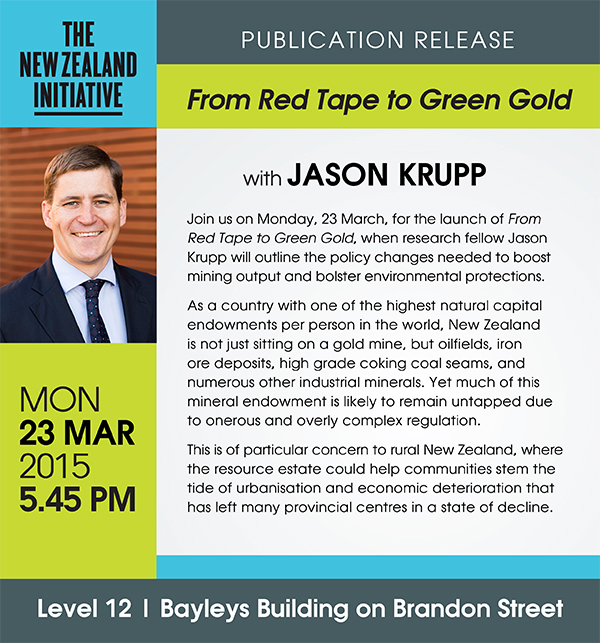
Those in Wellington might wish to join us on Monday night for the launch of Jason Krupp's report on regulatory reform in mining.
Jason shows that we're well inside the production-possibilities frontier: we could get both more mining and better environmental outcomes with a few regulatory changes.
We moved to New Zealand over a decade ago because I reckoned it the world’s least mad country: the Outside of the Asylum. It tops my informal ranking on this important metric.
It’s been a week of many alternative rankings and a couple of judicial decisions that threaten our coveted “Outside of the Asylum” status.
Expats rank New Zealand as the best place to raise a family, albeit with more constrained economic opportunities than elsewhere. The HSBC’s “Expat Explorer” is well worth checking out.
In another international ranking this week, the World Economic Forum ranked New Zealand 13th in the world on a Gender Gap Index. Checking the index sub-components, it is a bit odd that New Zealand ranks below Belize, Ecuador, Guyana and Mongolia on women’s “health and survival” and below Rwanda and Bangladesh on women’s “political empowerment”. Further, New Zealand ranked second in Asia-Pacific to the Philippines. Statistics New Zealand reports that 233 people left here for the Philippines in the year ended September 2014 and 3646 moved in the opposite direction; perhaps migration choices provide us a somewhat more informative ranking.
Finally, UNICEF notes that New Zealand is roughly middle-of-the-pack when it comes to changes in child poverty rates. Child poverty rose in 23 of 41 countries and fell in 18. New Zealand’s 0.4 percentage point drop in child poverty rates places it 16th out of 41, despite national headlines here suggesting the country has done terribly. If the government is successful in encouraging increased housing supply, our ranking on this measure should rise: poor families will have more to spend on food when the rent goes down.
Most important for me remains our world-leading “Outside of the Asylum” ranking. As the rest of the world goes mad, we generally don’t follow along. Two court rulings this week might jeopardise that status.
First, as Rodney Hide noted in last week’s National Business Review, the courts decided that if you choose a religion that precludes you from doing your job, your employer just has to deal with it. I’m still pondering what new religion I might develop to best take advantage of the new legal situation while Oliver considers the modifications to his beliefs that might counter such opportunism.
Second, the courts have decided that normal supply, demand, and marginal productivity should not determine wage rates but rather some judicial assessment of which jobs, across wildly different industries, require comparable skills. We will have gone utterly mad if this ruling stands on appeal.
Ultimately, the metric that matters most is whether you’d be happier living anywhere else. In a world with freer immigration, it would be easier for everyone to say, as I do, that they couldn’t be happier anywhere else.
Last week the New Zealand Initiative joined the chorus of approval for Finance Minister Bill English’s fifth budget. And rightly so. The budget confirmed that the threatened “decade of deficits” has been averted by careful fiscal management, to the envy of New Zealand’s OECD peers. Unlike his counterpart across the Tasman, Bill English could be forgiven for performing a pre-budget speech jig.
But while we may have become the envy of our Australian neighbours, New Zealand’s medium term growth prospects are hardly stellar. Over the five-year forecast period, New Zealand’s average real gross domestic product growth is forecast at only 2.8 per cent, well below the rates our economy achieved for much of the 1990s.
The forecast growth is even more miserly when compared with many of our neighbours in the Asia Pacific region. Singapore’s forecast for real GDP growth of nearly 3.5 per cent over the next five years makes New Zealand’s prospects look a little pedestrian.
There are many big issues for our policy-makers to tackle:
New Zealand’s international ranking in educational achievement has fallen. Up to 30 per cent of primary school students are not meeting national standards in literacy, with significantly lower rates for Maori and Pasifika students.
Nearly 8 per cent of the population is dependent on some kind of welfare benefit, and that’s not including superannuation.
In a global context, New Zealand could certainly do better. Our ranking is poor in the OECD’s FDI Regulatory Restrictiveness Index.
Productivity is another issue, as New Zealanders work about 15 per cent longer than the OECD average to produce about 20 per cent less output per person.
We believe new thinking is needed in these areas.
In our first two years we have developed solutions to assist our policy-makers tackle the housing affordability crisis, address the very real concerns many of our parents and schools have about teacher quality, and respond to the alarming decline in New Zealand’s international attractiveness as a destination for foreign investment. We have been pleased with the receptiveness of politicians on both sides of the House to our ideas.
As our organisation has developed the strength and depth of its research team, and with the appointment of Dr Eric Crampton as our new Head of Research, we have the confidence to tackle a broader range of issues. Yesterday the Board of the New Zealand Initiative approved an ambitious plan for our team to develop research-based solutions to many of these issues.
We will be looking at compact cities, demographic change and the housing market, examples of teaching excellence, New Zealand’s natural resource opportunities, the case for economic growth, New Zealand’s fiscal future, improving numeracy and maths teaching methods, examining the scope for social bonds in New Zealand, and the effects of household saving policies. And these are just some of the projects we will aim to tackle over the coming years.
We are confident we will come up with innovative thinking in all these areas. If our policy-makers listen, we will see our Kiwi economy really fly. Watch this space.
I'll be helping out with many of these projects when I come in at NZI, then, I expect, helping to shape new project proposals.
I am very pleased to announce that I'm moving to Wellington to serve as Head of Research for the New Zealand Initiative. I'll begin there in August, with precise timing depending on our sorting out moving from Christchurch.
I'm really looking forward to working with the team there. In addition to the great set of projects they have lined up, I'll have scope to help shape future research. Loyal readers at Offsetting may see some minor interruptions in service while we move house, but blogging will continue - this time as part of the job description.
I'll miss my friends in Christchurch and the Department here terribly. But some opportunities are too good to miss.
The New Zealand Initiative is the successor organisation to the New Zealand Business Roundtable, Roger Kerr's think-tank, and the New Zealand Institute, David Skilling's. It's going to be a lot of fun. And, I hope I'll there be able to do just a bit more to help keep New Zealand the best place in the world to live.
The New Zealand Initiative names Dr
Eric Crampton as new Head of Research
Dr Crampton’s
international academic experience will grow the Initiative’s reputation
as New Zealand’s leading business think tank
Wellington (May 19) – The New Zealand Initiative today announced that
Dr Eric Crampton has been appointed as its new Head of Research. Dr Crampton,
a senior lecturer at the University of Canterbury and author of the popular
economics blog Offsetting
Behaviour, will take up his new position in August.
Dr Crampton will lead the Initiative’s research team to develop
recommendations for New Zealand’s most pressing public policy questions.
The Initiative’s Executive Director Dr Oliver Hartwich said: “We are
delighted to have secured Dr Crampton for this new role. His economic
expertise, his international experience and his ability to effectively
communicate complex ideas will help to grow The New Zealand Initiative’s
output and influence.”
Dr Crampton is a Canadian-born economist, who obtained his Ph.D. at George
Mason University (Fairfax, VA) under Professor Tyler Cowen. He was a visiting
fellow at ZEI at Bonn University (Germany), and has been a lecturer and
senior lecturer at Canterbury University since 2003. Dr Crampton’s work
and publications have covered a wide range of public policy topics, including
public health, competition law, and the analysis of political systems. His blog
Offsetting Behaviour
is among New Zealand’s top-20 blogs and recommended by the American Economics
Association in their ‘Resources for Economists’ list. He also edits The Dismal Science for
The Royal Society’s SciBlogs initiative.
Dr Crampton’s appointment underlines The New Zealand Initiative’s goal to be
the country’s leading evidence-based public policy think tank.
Dr Hartwich said: “The New Zealand Initiative is all about developing robust
and fresh ideas to make New Zealand a better country. Dr Crampton shares this
vision and we look forward to his contributions to public policy debates.”
About the New Zealand
Initiative
The New Zealand Initiative is an evidence-based think tank and research
institute, which is supported by a membership organisation that counts some
of the country’s leading visionaries, business leaders and political thinkers
among its ranks.
Our members are committed to developing policies to make New Zealand a better
country for all its citizens. We believe all New Zealanders deserve a
world-class education system, affordable housing, a healthy environment,
sound public finances and a stable currency.
The New Zealand Initiative pursues this goal by producing well-researched
reports and hosting high level conferences and events. For more information
visit www.nzinitiative.org.nz.
For more information contact:
Ben England
Communications Officer
The New Zealand Initiative
Ph +64 4 494 9109 ben.england@nzinitiative.org.nz