Monday, 13 February 2023

Afternoon roundup

The worthies from the tabs:

Revisionist Uber histories

Uber drivers have initiated collective bargaining in NZ.

BusinessDesk reports on it, along with a bit of revisionist history from the union:

"Uber muscled into our country in 2014 without a second thought about employment law or the rights of the people working for them, and drivers are long overdue some agency in their lives."

Recall that Uber 'muscled in' on NZ's archaic taxicab regulations, not on our labour laws. Before Uber, drivers had had to sign up with one of the small number of companies providing 24-hour dispatch. Not exactly a scenario that's friendly to drivers. 

Remember too that Uber has to compete for driver-partners with other ride-share companies, and with existing cab companies. 

Bill Rama, an Uber driver and First Union delegate, said drivers were paid on average less than the minimum wage, and only for about 50% of the hours they work. He said the company also took no responsibility for the safety of its drivers or its passengers.

We've had an incredibly overheated labour market. Does it seem likely that Uber's forcing people into sub-minimum-wage work? 

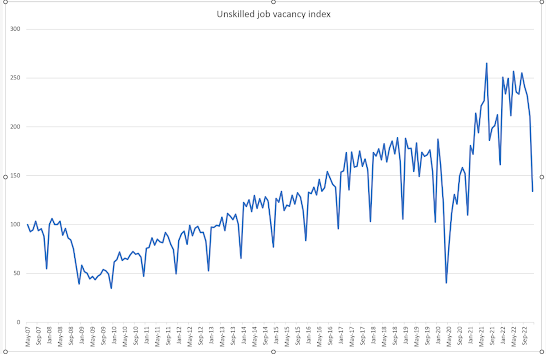
Here's MBIE's job vacancy index for unskilled work.


If Uber was able to keep driver-partners through the 2021-22 period when the thing was hotter than it had ever been, doesn't that kinda suggest that those drivers weren't being exploited?

Thursday, 9 February 2023

Insufficient biofuels

This is closer to right than most pronouncements on it but it's still deeply wrong.
Climate Change Minister James Shaw said he supported the move, and he and Woods had now been tasked with quickly finding a way to fill the big hole in the budget.
“This is why we have a carbon budget right, is to say, when we make these choices, actually, we've got to plug the gap somewhere else,” he said.
"The most straightforward thing that we could do is to tighten up the ETS [emissions trading scheme] unit supply, so you simply take it out that way. But there may be other policy interventions that we could make as well.”
A biofuel mandate is neither necessary nor sufficient for a reduction in net national emissions. 

If you ran the mandate without cutting the cap, you'd just shift where emissions happen. If you ran the mandate while cutting the cap, you would reduce net emissions while also shifting where emissions happen. But it's the cutting of the cap that's both necessary and sufficient, all on its own. A biofuels mandate just shifts the location of emissions, regardless of whether you cut the cap.

So yeah, Shaw's right that you could cut the cap to reduce emissions. But there's no 'hole' created in anything by cutting a biofuels mandate. Compared to a counterfactual in which we'd have had a mandate, we get a few more emissions in transport, a few fewer emissions everywhere else, and a lower overall cost of getting down to net zero. 

Any 'hole' from not having a biofuels mandate is like the hole you make in a T-1000 if you shoot it. The thing fills itself in all on its own. More emissions in transport? There'll have to be fewer emissions somewhere else. That's how the ETS works. 


Want to stop T-1000? You don't do it by shooting at transport, or shooting at power generation. You do it by cutting the cap steadily over time to hit net zero. 


Wednesday, 1 February 2023

Cost of living absurdities

Peaches come from a can.

They were put there by a man.

In some factory in Greece.

When they made their little way

out to brighten a Kiwi’s day,

they got hit with a 34% punitive anti-dumping duty.

Prime Minister Hipkins made the cost of living the government’s number one priority. So I checked which anti-dumping duties are still in place.

Anti-dumping duties rarely make sense. The theory is that a foreign company will sell here, below cost, for long enough to drive Kiwi competitors out of business, and then jack up prices. 

It’s more than a bit bonkers. Consider coated steel from Korea – a kind of steel used in roofing. From 1 January this year, imports from one Korean company were hit with a renewed 12.6% punitive tariff, and two other Korean companies are subject to smaller tariffs. 

Under anti-dumping theory, they were selling steel here below cost to drive the Kiwis out of the market, so they could profit when those Kiwi competitors went under. But a quick Google search finds 998 suppliers of the stuff across 55 countries. The 997 other suppliers would be the ones to benefit. 


And, of course, if it really were being sold here below cost, anyone, including Kiwi steel producers, could put up a shed and store tonnes of it for later resale. 

Inflation is high and the government says we’re in a cost-of-living crisis, with groceries and building materials front and centre. But those Korean companies’ roofing steel, along with galvanised wire from Malaysia and China, are hit with anti-dumping duties. So you’re protected from affordable building products. Doesn’t it warm your heart? Tariffs are love. 

And consider the peaches. Everyone loves canned peaches. The '90s band The Presidents of the United States of America even wrote a song about them. I ripped it off to lead this post. 

In May last year, the Government reimposed antidumping duties on preserved peaches from Spain. In December, they started investigating Chinese peaches. And the peaches from Greece? 34% duty. 

Meanwhile, the Commerce Commission’s been investigating why groceries and building materials are so expensive. And the government is subsidising petrol while taxing peaches. 

So I’ll end with another bit of theft from the Presidents. 

Government lingered last in line for brains

And the one that it got was sorta rotten and insane.


Tuesday, 17 January 2023

Contrasting Banks

Recall that the Reserve Bank of New Zealand's Monetary Policy Committee does not allow those with an ongoing research interest in macro/monetary from serving as external members of the committee. They've considered it a conflict of interest.

The Bank of Canada has appointed Prof Nicolas Vincent as an external deputy governor. 

Vincent will begin his two-year term in March, filling the void left by former deputy governor Timothy Lane, who retired in September. The Bank of Canada launched a search for an outsider to bring a different perspective to the Governing Council in August 2022, as the central bank confronts one of the most challenging economic environments it has ever faced.

Vincent “is an accomplished scholar and teacher, with deep expertise in macro and microeconomic research in areas such as inflation and price dispersion, firm dynamics, inequality, house prices and household finance,” governor Tiff Macklem said in a press release. “I have no doubt that his broad knowledge of monetary economics combined with his keen interest in public policy will be invaluable in helping the Bank navigate the policy challenges ahead.”

In this new role, Vincent is expected to bring his own perspectives to the policy making process, providing a check on groupthink as he’ll have no direct ties to the institution. He will be responsible for helping with monetary policy and financial system stability decisions, and will join other deputy governors in communicating the Bank of Canada’s consensus-based policy decisions.

Vincent will balance this role with his job as a professor of economics at the HEC Montreal, serving as deputy governor on a part-time basis. This wouldn’t be his first time in a policy focused role, as he started his career at Department of Finance in 2000 before becoming an assistant professor at the HEC.

The Bank of Canada's press release also highlights the value of deep expertise in relevant research areas.

The Board of Directors of the Bank of Canada today announced the appointment of Nicolas Vincent as the Bank’s new external, non-executive Deputy Governor for a term of two years, effective March 13, 2023. Mr. Vincent’s appointment, which is the result of an open external search process, fills the vacancy created by the departure of Timothy Lane in September 2022.

“I am delighted that Nicolas Vincent is joining the Bank’s Governing Council and I am looking forward to working with him,” said Governor Tiff Macklem. “He is an accomplished scholar and teacher, with deep expertise in macro and microeconomic research in areas such as inflation and price dispersion, firm dynamics, inequality, house prices and household finance. I have no doubt that his broad knowledge of monetary economics combined with his keen interest in public policy will be invaluable in helping the Bank navigate the policy challenges ahead.”

The Bank changed the fourth Deputy Governor position to an external, non-executive Deputy Governor role to bring diverse perspectives into its consensus-based policy-making process and to ensure the Bank’s executive team has a streamlined and effective distribution of management responsibility. In this role, Mr. Vincent will be a member the Bank’s Governing Council, which is responsible for decisions with respect to monetary policy and financial system stability. Alongside other members of Governing Council, he will also be responsible for communicating with Canadians about the Bank’s consensus-based policy decisions as well as its ongoing assessment of the outlook for the economy and inflation. In keeping with the nature of this role, Mr. Vincent will work with the Bank of Canada in a part-time capacity and will maintain his affiliation with HEC Montréal.

Mr. Vincent is a professor of economics in the Department of Applied Economics at HEC Montréal and co-chair of the Business Cycles and Financial Markets research theme at CIRANO (Centre interuniversitaire de recherche en analyse des organisations). He has been a visiting faculty member and researcher at numerous institutions, including Columbia Business School, INSEAD, the Banque de France and the Kellogg School of Management.

Born in Trois-Rivières, Quebec, Mr. Vincent received a Bachelor of Commerce degree in applied economics from HEC Montréal, a master’s degree in economics from Queen’s University and a PhD in economics from Northwestern University.


Wednesday, 11 January 2023

Circular hydrocarbons

Want to make hydrocarbons part of the circular economy? Terraform Industries has a whitepaper. 

Basic deal: use solar to power kit that sucks CO2 out of the atmosphere. It'll also pull some water out of the atmosphere while it's at it. Turn the water into hydrogen and oxygen. Then make CH4 (or any desired hydrocarbon) with oxygen and some surplus water as waste product. 

They're aiming at an all-up carbon sequestration cost of USD$43/T. 

Tuesday, 10 January 2023

Afternoon roundup

Easing back into the office after a summer break and already the tabs have multiplied.

Today's worthies: