Thursday, 31 August 2017

Northport zone?

A couple of years ago, Khyaati Acharya and I put out a report arguing for policy trial areas. We called them "Special Economic Zones", but they weren't really like the little enclaves you'd see in parts of Asia. Instead, it was a way of devolving powers or regulatory responsibility down to local councils that had demonstrated a capability of handling them, along with a financial incentive mechanism to make it in Councils' interest to go for projects that would be both in their interest and the national interest.

For example, you could imagine an urban-focused RMA being applied to the Auckland area, along with tied funding lines that would rebate to Auckland Council a portion of the above-forecast tax revenues remitted from Auckland to central government. Or an investment zone for the Wellington area that would suspend the Overseas Investment Act for the greater Wellington area (no high country estates here), allow all kinds of investment, and provide a similar financial incentive for Wellington to play ball.

And a key principle of the thing was setting out success criteria in advance, and allowing the roll-out of successful zones to other councils wanting similar treatment. Every zone, in principle, had to be extendable to the whole country. So if you proposed a GST-free zone, that sure couldn't be rolled out to the whole country because then tax revenues would disappear.

Winston Peters' proposal doesn't really fit any of that:
Peters' new push

However, NZ First leader Winston Peters wants legislation to move the port's container operations to Whangarei's Northport by the end of 2027 if he in a powerful negotiating position with either main party after the end of the election.

He told the NZ Herald he would stop imported cars clogging up the city's wharves by the end of 2019 and free up Captain Cook wharf ahead of the America's Cup.

Mr Peter's plan would create a "special economic area" near Northport, which would be duty-free, GST-free and tax-free.

The ambitious plan would involve upgrading the Auckland to Northland rail line, including a new rail spur to Northport and KiwiRail has put the cost at billions of dollars.

As the council is the port's owner it is doubtful it will be railroaded into moving the port soon. Mr Goff favours the Firth of Thames for a new port in 20-30 years time, but Transport Minister Simon Bridges has already poured cold water on the idea saying the council would need to overcome funding, environmental and cultural issues. The cost of a new port has been put at about $5 billion and the government says it would not fund it.
A Northport tax-free zone would be highly distortionary. It couldn't be extended more broadly. There's a case for entrepot zones in areas handling lots of international transshipment, so that goods don't attract tax/duty unless they clear through to the other side of the zone - that makes it easier to handle international shipping and flipping containers from one boat to another without having to get customs involved. It is almost inconceivable that New Zealand could provide that kind of hub service given its location. Are ships going to go thousands of kilometers out of their way to hub here when they could just go to Singapore? I don't get it.

I'm very open to the idea that Auckland port could be moved; it seems ludicrous that the city's best real estate is tied up in unloading cars (would still need to see the CBA on any particular proposal). But the SEZ proposal ... I'm not convinced.

I prefer Peters' proposal to cover tourist costs by punting some of the revenue that central government collects from tourists down to the councils bearing substantial infrastructure costs in accommodating them to Labour's tourist tax idea though.

Naming things after politicians

Colby Cosh writes on the perils of naming things after politicians in a world in which standards change. 

I didn't know that Ontario has 10 schools named after Sir John A MacDonald. 

You should read the whole thing, but I enjoyed this snippet:
I personally think it would be terrific if we stopped naming things other than pub toilets and landfills after politicians, but maybe that’s just me. A politician’s contribution to the world is never certain, never too safe from appropriate revision or justified dissent. To me, it seems less deferential and creepy to honour artists, scholars, and innovators who definitely added to the happiness or knowledge of humanity, and especially if they did it in a way that went mostly uncompensated.

I would certainly name any number of schools after Walter Chell, the man who mixed the first Caesar, before I would name one after a prime minister. Sadly, naming schools after bartenders is not the usual rule where I live. But we follow another pretty reasonable one: we typically name new public schools after highly regarded schoolteachers.

Wednesday, 30 August 2017

We don't know how lucky we are in New Zealand: craft beer edition

Today's installment of The Outside of the Asylum covers some of the things in Manitoba that might have driven you to drink, and the barriers there to getting a decent drink.
Americans could get beer from other parts of Canada more easily than Manitobans.

Other regulations made it near impossible for craft breweries to emerge. Half Pints led the charge for craft brewing in Manitoba. When they wanted to expand their home-based brewery to a more commercial size, they phoned the provincial regulator, who just laughed and hung up.

Manitoba has been liberalising its rules since 2013, but the rules are still archaic and complicated by New Zealand standards. The rules are such a mess that the Manitoba government has had to consider subsidising small brewers to get the industry going. Ronald Reagan’s quip about government sums up Manitoba rather well: “If it moves, tax it. If it keeps moving, regulate it. And if it stops moving, subsidise it.”

New Zealand’s regime, by comparison, is pretty sane. But keeping it that way requires vigilance.
A lot of the piece is on how great it is that it's easy to go from home brewing - or even home distillation (legal here) - into commercial distribution. Because it's easy, there's a great craft beer scene, with new brewers and distillers turning up faster than I can keep track.

It was a bit funny then that, over on The Spinoff's Facebook comments, somebody reckoned I was giving a Lion Breweries line.

The standard bootleggers and baptists model says that the big guys should want systems that lock up the whole market for a couple of big players and make it impossible for new entrants, while making it look like the regulation is done for reasons other than turning the industry into a cozy cartel.

New Zealand's system keeps all the players on their toes. It is worryingly easy to imagine an alternative where the big players strike an implicit deal with the Sellman-types to put strong restrictions on where things can be sold (knowing that it won't do much to sales) and restrictions on distribution and production that lock up a (slightly) smaller market for two big players.

I love that I live in a country where businesses learned in the 80s that the only winning move in that kind of game is not to play.

Here's Bruce Yandle explaining Bootleggers & Baptists.

Tuesday, 29 August 2017

We don't know how lucky we are: unarmed constabulary edition

The third installment of The Outside of the Asylum over at The Spinoff lauds New Zealand's unarmed constabulary as compared to the kinds of excesses that Radley Balko has been documenting in America. 

A snippet:
Balko contrasts SWAT strategies – no-knock drug raids in the middle of the night – with Winston Churchill’s (possibly apocryphal) quip, “Democracy means that when there’s a knock on the door at 3 a.m., it’s probably the milkman.” Culosi’s case attracted a reasonable amount of media attention, partly because people don’t expect peaceful, unarmed, middle-aged optometrists to be shot and killed by police for answering the door.

But police in America shoot and kill people all the time: 991 in 2015 and 963 in 2016; 2017 is on track to match those figures. Police officers are rarely charged; those charged are rarely convicted. While crime dramas feature situations where the best course of action for police really is using deadly force, they rarely feature cases like Culosi’s. Or Brian Claunch: a double-amputee, in a wheelchair, in a group home for the mentally ill, shot in the head by police because they found his pen threatening.

If the instructions on the side of a packet of toothpicks (see chapter one) are a sign of a civilisation gone mad, what should we think about American policing?

New Zealand has so far remained outside of the American policing asylum. From 1941 to 2015, police in New Zealand shot and killed 29 people. Adjusting for population size, police here take about 37 years to kill as many people as American police kill every year.

This is largely due to New Zealand’s unarmed constabulary. When police do not have immediate access to firearms in situations they view as threatening, they must use other methods while seeking armed assistance – if it is necessary.
I still love Police Commissioner Mike Bush's statement, after an officer was shot and there were calls again to arm the police:
The death of Senior Constable Len Snee was deeply felt by police officers of all ranks, all over the country. Our data on risk has been improved under my watch and it shows police frequently deal with people with weapons.

In Len’s case, the weapon was a gun. This has, quite rightly, led to public discussion about whether all field officers should be routinely armed. The majority of commentators say ‘no.’ That is in line with the public feedback Police received when we consulted on the Policing Act 2008; it’s also in line with the sentiments of police officers themselves.

Being unarmed is a unique and cherished feature of the policing style adopted by New Zealand Police – a style for which we are held in high regard internationally. Routine arming of the police would not erase this style of policing, but it would make the job of being a community police officer considerably more difficult…

So our strategies rely on officers’ good judgment. They are trained to identify risk and if they encounter an armed situation, to withdraw, cordon and contain until appropriately armed officers can be deployed. If the situation is equivocal, they have arms at ready resort with which to equip themselves.

This tactic has worked very well for over 40 years.

International evidence gives me no cause to think it is outdated. Literature on police experience and practice points to a high risk that officers can have their own weapons turned against them, having been overpowered in otherwise innocent situations.

There is also concern about the number of officers shot because they didn’t want to fire their weapons. People tend to join the New Zealand Police because they want to help people, not shoot them. 
But there are worrying signs on the horizon. The asset forfeiture rules that, in America, have driven perverse outcomes have gotten worse here - and could yet push in the same direction.

And there's the ongoing mess of police interfering in local bar and bottleshop licence renewals, and the joint mess of policy being happy to ask banks to 'voluntarily' produce records without a warrant and the banks just handing it over (and not the first time, though it's unclear when this newly revealed instance happened - it could have been around the time of the first one). Would happily flip my accounts over to whichever bank took a stronger line on only handing stuff over to the police if they were legally compelled to do so.

For those so inclined, The Spinoff's comments sections are over on Facebook [First installment; second installment; third installment]. Folks there seem to have liked the first two installments more than the third. Oh well.

Monday, 28 August 2017

Cursed policy wishes

I had fun in last week's column at the National Business Review. Our Executive Director really wishes that elections would be about policy rather than personality stuff. I get nervous when elections are about policy.
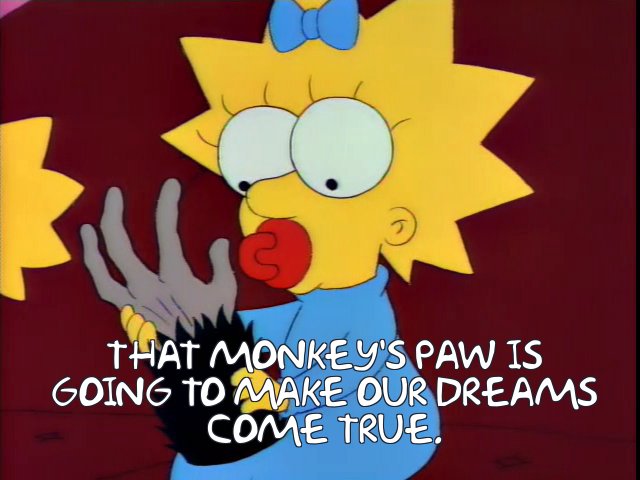
Our executive director at the New Zealand Initiative, Oliver Hartwich, has always had a strange antique monkey’s paw on his desk. I never thought much of it – perhaps a bit creepy but maybe it’s normal for Germans.

But, not long ago, I swear that one of the fingers on that paw curled inward.

And so I naturally started worrying about tax policy.

You see, that finger curled not long after Oliver had been fervently wishing, again, that the election turn away from personalities and sideshows to focus on policy.

That paw’s curled finger looked ominous.

And then election policy announcements started getting a little strange.
Then I go through some of what we got, when politicians started talking policy. I conclude:
But the scariest part of the whole thing is that Oliver doesn’t really have a cursed monkey’s paw. I made that part up. More accurately – I stole it from an old folk tale.

A couple asked the paw for £200; their son was killed in an industrial accident and the company paid them £200 compensation. They then wished their son’s return but thought better of it on hearing something shambling in the darkness towards their door. Their last wish sent it away.

Politics itself is the cursed paw. Voters wish for things they think they want, politicians promise to deliver and what comes out at the end is often as horrifying as that unseen thing that shambled in darkness.

Be careful what you wish for in elections. It can be hard to wish it away.
You can catch the whole thing here. ($)


Friday, 25 August 2017

GST and wealth

I thought it was common knowledge that implementing or increasing a consumption tax is a de facto wealth tax.

Suppose you saved $100,000 and expected to be able to fund $100,000 worth of consumption from that saving. If a 10% consumption tax comes in, you can fund 10% less consumption from that saving. The real value of that saving is then 10% lower than it was the day before the consumption tax came in. If that consumption tax then increases to 15%, the real value of the savings drops further.

It gets a bit more complicated if you bundle changes in consumption taxes with changes in other taxes. The 2010 tax shift did a few things simultaneously:
  1. It provided an across-the-board income tax cut AND increase in benefits that was matched by an increase in GST. This part was neutral across incomes: you pay less in income tax on next year's earnings (or receive more in benefits), but pay more in GST when you spend from next year's income. The two wash out for those earning and spending in New Zealand.

    Those who spend in New Zealand and do not earn in New Zealand - tourists - wind up funding more of the government's budget. The GST switch was, in this respect, a tourist tax. Unfortunately, it's a tourist tax where the revenues accrued to central government while the costs of accommodating tourists through upgraded infrastructure largely fall on local government. Keep in mind that the overall incidence will be a bit more complicated, but GST loads some of the burden of providing government services onto tourists. The more the overall tax system relies on GST instead of income tax, the bigger this effect (well, within reasonable bounds). 

  2. It also provided a real tax cut at the top. People on the left who prefer higher levels of government spending should restrict their anger to this part. Part (1) above was neutral, except for the increased tax on tourists. If you think that the overall shift made the tax system less progressive than you'd prefer, focus on adjusting things on this margin rather than messing around with GST. 

  3. The increase in consumption tax reduced the real purchasing power of accrued savings. If I planned on withdrawing $10,000 from a savings account next year to fund consumption, I would be able to buy fewer things with that withdrawal. Same goes for using a reverse mortgage to eat my house in my retirement. Before the tax change, I would have paid 12.5% GST on things I purchased, so would have been left with $8,750 in after-tax expenditure; after the tax change, I would pay 15% GST on things I purchased, so I would be left with $8,500. The real purchasing power of my stock of wealth dropped by 2.5%. The GST increase was then, effectively, a wealth tax. This will matter especially for older cohorts running down their capital in retirement: the increase in NZ Super payments compensated for the GST on NZ Super payments, but not for the reduced value of any accrued wealth.

  4. If your wealth is held in assets that pay taxable interest or dividends, then the tax on the returns to that wealth dropped because of the reduction in income tax. The real value of your stock of wealth dropped, because of (3) above. But the real value of the flow of earnings from your accrued wealth will depend on your marginal tax rate. If you were previously paying less than the top marginal tax rate, then this effect is a wash, for reasons stated in (1). If you were previously paying the top marginal tax rate, then you get a real tax cut on the flow of your dividend or interest earnings. The net effect between (3) and (4) will then depend on the extent to which you're living off the earnings from your savings, or eating the capital. 

  5. There were other base-broadening changes that disproportionately affected richer folks. They're complicated, and harder to turn into soundbites than the leftie "But poor people spend all their money and don't take foreign holidays where they don't pay GST on their expenditures (and I'll conveniently ignore the increase in tax paid by rich foreign tourists)", but they're still real. 
So what to make of the whole she-bang? John Creedy and Penny Mok ran some microsimulations to look at what the changes would be expected to do to labour supply and income distributions. They found increases in hours worked because of the cuts in income taxes, and basically zero change to income distributions. Like, folks can shout "the tax change was regressive, the tax change was regressive" all they like, but here's what Creedy and Mok found:

Caveat: it's ex ante microsimulations rather than ex post work. But it's the best guess I've seen about the overall effect. Since there was basically no change in the Gini coefficient in after-tax incomes between the two systems, it didn't really affect the overall progressivity of the tax system. 

So, some bottom lines:
  • It is stupid to hate GST for being regressive. In the first place, it's better to think of GST as being neutral over consumption over the life-cycle. That's what the Tax Working Group said too - maybe a bit regressive over current income, but neutral over life cycle in consumption. But that's the minor point. The major point is that GST is part of a tax system. Combining GST with a progressive income tax allows you to achieve any level of progressivity that you damn well want - with the added advantage that tourists pay GST but don't pay income tax. This isn't some right-wing-economist thing, it's a maths thing. At least at current margins. You could imagine pushing it far enough that the lowest income tax rate would have to go negative to compensate, but we're not anywhere near there. 
  • It is stupid to hate the 2010 GST/Income tax shift as being regressive. See Creedy & Mok, above. The overall effect looks pretty flat. 
  • It is not stupid to object to the part of the cut in the top marginal income tax rate that went beyond maintaining neutrality and did provide a real tax cut at the top. That's a point of fair debate around how progressive the overall tax system should be. You could have run the 2010 changes but with a smaller cut at the top and still have a better tax system than we had in 2009. I like the overall package they put through in 2010, but whether the top marginal tax rate should be 33% or 35% - that's more of a value judgment about what tradeoffs are worthwhile. If you think the tax system should be more progressive overall, do it by increasing income taxes at the top end rather than messing up GST.
Update: Mike Reddell, in comments, reminds me that the depreciation changes more than offset the drop in the company tax that also came in 2010. I didn't really hit on the company tax changes here since the imputation regime means that that just flows through into changes in the accompanying tax credits and then folks getting dividends wind up paying at their marginal rate anyway. But it would affect foreign beneficiaries of distributions who aren't able to use the tax credits. But, it's more than offset anyway by the depreciation changes. 

Thursday, 24 August 2017

We don't know how lucky we are: tax edition

The second installment of my piece on The Outside of the Asylum is up at The Spinoff. It covers tax and airport security. A snippet:
America’s patchwork of state-level sales taxes are even worse. Every state can apply its own unique taxes. This is not limited just to deciding the rate of taxes, but also the definitions of what is and is not taxable. Some states apply sales taxes to candy but not to other foods, and different states have different definitions of what counts as candy. Wisconsin’s Department of Revenue even issued a 1,437-word memo explaining which types of ice-cream cakes, or slices thereof, are taxable or untaxed

The mess is just as bad at the federal level, where free tans at video-rental stores are taxable but not tans provided as part of a health club membership. A simple enough (albeit ludicrous) 10% tax on tanning services proved anything but.

The economic consequences of a system riddled with bread-deciders and jam-deciders and ice-cream deciders and tan-deciders can be staggering. Taxes become far less efficient not only because of the holes riddled throughout the system, but also the legal costs of producers trying to convince courts that their product is exempt rather than taxable.

When there are experts aplenty whose livelihood depends on complicated, messy and incomprehensible tax systems, with large penalties for anyone getting things wrong, it is difficult to make the tax system less complicated, messy, incomprehensible and punitive.

New Zealand’s GST is uniquely, and admirably, clean. It applies broadly. Every producer has an incentive to report honestly because they also report the GST they paid to their suppliers on every item when claiming GST on their inputs.

Were New Zealand to exempt healthy foods from GST, we would well be on the slippery slope. It is one of those things that sounds really easy, but would be an utter disaster in practice

What counts as healthy? Not only does the medical evidence keep changing, but there would also be a string of boundary cases needing adjudication. If beans are healthy, what about frozen beans? Beans in a can? Beans in a can with pork fat and sauce? How much pork fat and sauce before it is taxable? What if we use Jamie Oliver’s recipe and fly him in to say it’s good?

Even worse, think through the consequences of tax exemption.
The Spinoff also runs comments sections on their serialisation on Facebook. I'm not on the Book of Faces, but had a gander using the Initiative's account. If you're on the Book of Faces and are interested in such things, their thread on the first installment (published Saturday) is here; thread on the second is here.