Saturday, 26 October 2019

Justice and a grifter

Viewed one way, justice has been met.

Viewed another way, a serial and malicious grifter has been able to use the legal system and new cultural norms at very low cost to impose substantial costs on others.

Jessica Yaniv is a transgendered Canadian woman who bullied aestheticians, often migrant women, with threats of legal action if they refused to wax her scrotum.

The Human Rights tribunal came to what I think was obviously the right decision:
"Self-identification does not erase physiological reality," said Jay Cameron of the the Justice Centre. "No woman should be compelled to touch male genitals against her will, irrespective of how the owner of the genitals identifies."

The ruling also found that Yaniv engaged in improper conduct by misleading the tribunal, by being untruthful, and by engaging in extortionate behaviour and scurrilous attacks.

It was also noted that she brought most of her 15 complaints against women described as "not white," while expressing racial animosity on social media and in her testimony.
Yaniv appears to have used Canada's antidiscrimination framework to threaten and extort people she didn't like. A $2,000 payment to each of three respondents seems... light.

I do my best to stay out of the trans-wars. But I would hope that Yaniv's actions would be condemned by all sides.


Friday, 25 October 2019

Careful what you wish for: tech and democratic accountability

It will not be wonderful when every country is able to issue global take-down notices.
 A lot of folks at NetHui seemed to yearn for a world that would very quickly lead to this.

Ruling out doing anything about 99.83% of the world's emissions


The Zero Carbon Bill requires the government to focus on domestic mitigation opportunities. But the rest of the world provides 99.83% of the world's emissions. Does it seem likely that all of the very best opportunities for mitigating emissions will be found here at home? We risk ruling out doing far more good than we otherwise could.

A snippet:
I don't know if anyone ever really believed manufacturing televisions in New Zealand made sense.

Controls in place until New Zealand's reforms prohibited importing fully assembled televisions, to encourage manufacture and assembly in New Zealand. But it resulted in nonsense practises guaranteed to make televisions more expensive.

New Zealand businessman Alan Gibbs famously found it profitable to have Japanese television manufacturer JVC disassemble televisions and ship the parts to New Zealand for reassembly.

If what you cared about most in the world was making sure that Kiwi families could afford televisions, banning or severely restricting trade was hardly the right solution.

So why does the Government's proposed Zero Carbon bill, meant to address the biggest environmental challenge of our time, shackle New Zealand into only pursuing those carbon emission reductions achievable here at home?
...
The Bill requires that New Zealand's emissions budgets be met, "as far as possible", through domestic measures.

There is obviously a lot more that can be done domestically to help reduce greenhouse gas emissions. New Zealand's Emissions Trading Scheme can, should, and likely will be strengthened. The ETS should be comprehensive across all sectors. As carbon prices increase, households and businesses will adjust in the same way that they do with any other change in relative prices.

But as carbon budgets become tighter, domestic low-hanging emission-reduction fruit start being eaten up. Each subsequent tonne of emission reductions becomes more expensive than the one that came before it.

And while spending massive amounts per tonne abated can be worthwhile if it is the only and best way of avoiding catastrophic climate change, it makes far less sense if there are cheaper opportunities out there to reduce emissions.

Does it make sense for New Zealanders, collectively, to invest a lot of costly effort in the next million tonnes of emission reductions in New Zealand if, for the same kind of commitment, we could back projects abroad that did twice as much good, or 10 times as much good?
I'll now be appearing fortnightly in the Fairfax papers, so keep an eye out for me there.

Setting the marker for January - the wealth report

Every October, Credit Suisse puts out its report on global wealth. It's not perfect, but it's a decent best guess about global wealth and its distribution.

And every January, Oxfam comes out with a The Sky Is Falling And Inequality Is Terrible gloss on the Credit Suisse figures. If you were teaching a How To Lie With Statistics course, the Oxfam reports would provide excellent fodder.

So, a few highlights from the Credit Suisse report, so we don't forget them come January when the Oxfam report comes out.

The report is here.

First up, New Zealand's place in the global wealth inequality figures.


(And here's a static version in case the interactive doesn't work)


There are 172 countries with a Gini coefficient on wealth. New Zealand's Gini (in red) is the 37th lowest.

Among the countries with more wealth inequality than New Zealand, in order starting with countries closest to us: Portugal, Iceland, Spain, France, Switzerland, Canada, Austria, Finland, Ireland, Norway, Denmark, the US, Sweden and the Netherlands.

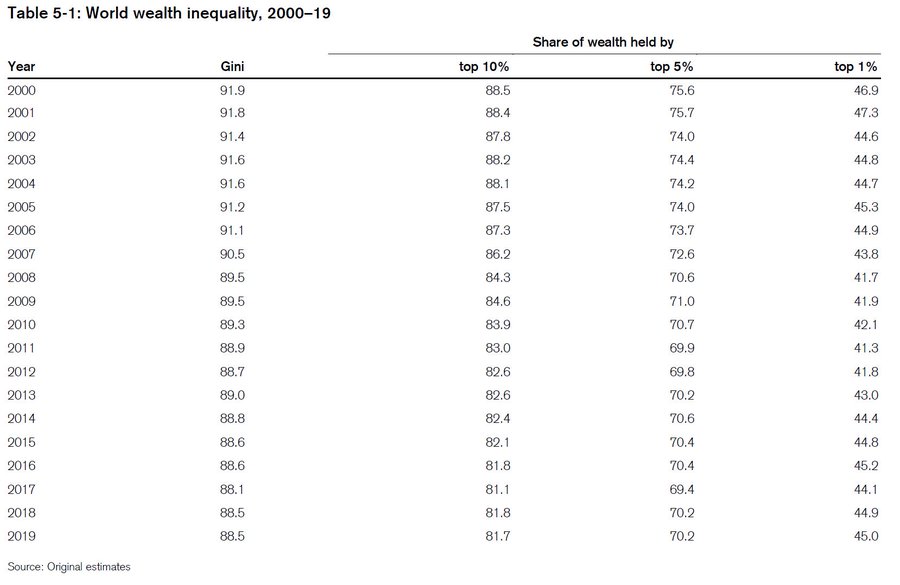
Global wealth inequality has been dropping, more or less, since 2000.


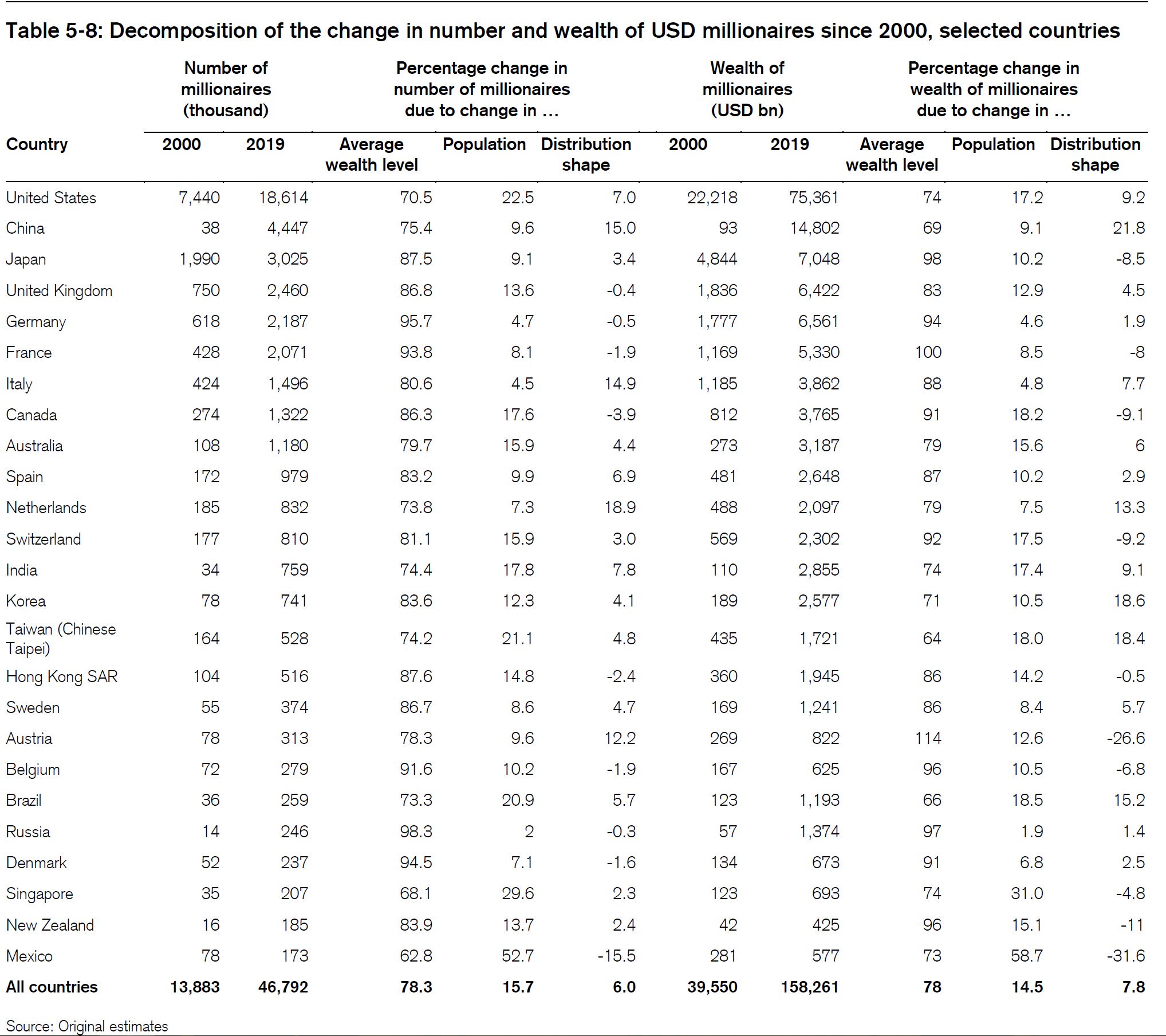
And they also decompose changes in the number and wealth of millionaires. You can get more and wealthier millionaires if all incomes rise, if population increases, or if the shape of the underlying distribution changes to favour millionaires. Here we see that since 2000, changes in the shape of the distribution have resulted in our millionaires having less wealth than otherwise. 


And this year's Gini is down on last year's as well. 

If I were Oxfam and wanted to put up a scare story about inequality out of this, but one grounded in the numbers rather than just being fantasy, I'd look hard at how much of the measured reduction in inequality is driven by changes in housing wealth. Recall that housing is a substantial part of the wealth portfolio of those in the middle wealth deciles, and that increased houses prices do more to boost wealth in the middle than at the top. But there can be strong disparities between homeowners and non-owners. That's a story of anticompetitive housing regulation set by councils under incentives set by central government rather than one about evil rich people and the need for income redistribution. 

Thursday, 24 October 2019

Afternoon roundup

The worthies on a much-belated closing of the browser tabs:

A version of antitrust I could support

I can see plenty of reasons why antitrust law is not applied to policies and regulations that restrict competition or create cartels, but it's hard to see good reasons why antitrust law is not applied to policies and regulations that restrict competition or create cartels.

I argue for parallel treatment (ungated).

There are plenty of areas that would be eminently worthy of ComCom investigation, presumably through its new(ish) market studies remit. Basically, that lets ComCom run a study of a market to see whether there's restraint of competition or cartel stuff going on.

Here are a few areas where regulation and policy stifles competition and/or creates cartels:

  • Building materials supply regulation in conjunction with council risk-aversion on building consenting caused by councils facing joint-and-several liability. Makes it very hard to import building materials approved for use in trustworthy, comparable places like Seattle, Vancouver and Tokyo. 
  • Land use regulation at council level that encourages land banking and stymies competitive land supply, and the incentives set by central government that make those regulations optimal from the perspective of local government. There is absolutely no good reason for Auckland Council's processes around road naming. The cost and delay imposed by the rule that adds months of capital holding costs seems deliberate. Why isn't the person who came up with that under Commerce Commission investigation? 
  • Rules mandating that pharmacies be owned by pharmacists
  • Separate New Zealand certification regimes for all kinds of stuff when we should just be recognising that things good enough for other comparable places are good enough for here too. I heard one story the other day about how ovens need to go through separate NZ certification; just being certified for use in Australia somehow isn't good enough. There's gunk like this all over the place.  
  • Some of our phytosanitary rules. Go on and convince me that rules around importing hop plants here are set for any reason other than protecting the Hop board. Is it true that they own the IP on the only varieties allowed in? 
  • The government protects the medical cartel from foreign competition by making it very hard for doctors in good standing in places like Canada to come and hang up a shingle here as GP. If you want to do it, you'll have to spend months under supervised practice in a hospital here first. Even if you've had a successful practice in Canada for ages. How many of our problems in getting rural GPs would be done away with if Canadians sick of miserable winters moved into semi-retirement as part-time GPs here? 
That's a short starter. 

I am not optimistic that it will ever happen. The government and its subsidiary arms are the biggest cartel around, and will not brook the application of its own investigation apparatus to itself. Kinda like that thing where the police get to ignore any findings of the Independent Police Conduct Authority. The State does not like to constrain itself. 

But just imagine how much regulatory quality would improve if an independent commissioner over at the Commerce Commission could launch investigations into the anticompetitive effects of regulations at the different Ministries (hi MBIE), with the ability to issue orders nullifying regulations where the anticompetitive effects dominated any likely benefits of the regulations. 

It's also fun to think about the potential application of the criminal cartel rules for officials who knowingly put in place regulatory regimes that act in restraint of competition without adequate safeguards that the benefits of those rules dominate the anticompetitive effects. 

Monday, 14 October 2019

The Bank's Bully Pulpit

This is bad.

The article is good. But the situation described is very bad.

Here's Kate MacNamara on Orr and the RBNZ.
It would be an open process, the bank said, welcoming all views. But that characterisation was soon at odds with the governor's behaviour.

Numerous parties involved in the submission process described a pattern of behaviour by Orr of belittling and berating those who disagreed with him.

Orr has penned his critics letters and threatened to broadcast them. He has confronted submitters on the sidelines of industry conferences. Sometimes he called them up at odd hours to tear a strip off them for their views.

There is reason to believe that his pointed criticism has diminished the range of parties willing to participate in the debate.

At least one corporation that submitted views at an earlier stage in the capital review (before Orr was governor) decided not to participate this time. The company is not in the banking business, though like most it cares what bank services are offered and at what price. But it ultimately decided it wasn't worth wading into such troubled water.

Non-bank lenders similarly withheld their views. Sources say they feared being singled out for other consequences (one non-bank lender active in New Zealand is owned by an insurance company, an area of business that is also under scrutiny by the Reserve Bank).

It is worth pausing here to consider Orr's position.
I have heard these stories as well.

And here's the governance failure:
Orr's chequered behaviour is not something on which the Reserve Bank chairman, Neil Quigley, is prepared to act.

"I have not received a formal complaint from any party about the governor's interaction with them," he said. "The Board has full confidence in Adrian Orr's leadership."
Might those who would make formal complaints trust that their identities would be kept confidential, or that the particulars of any complaint would not identify them to Orr? Remember that Orr can destroy any of the companies he regulates at the stroke of a pen.

Meanwhile, over at Michael Reddell's blog, ex-RBNZ's Geof Mortlock (or at least someone writing under that pseudonym), comments:
None of what we are seeing with Adrian Orr surprises me in the least. It is precisely what I had expected when he was appointed as governor. The problems so clearly revealed now for all to see were very much evident to me and many others when Orr was deputy governor and head of financial stability in the period 2003 to 2007. He created a sense of panic when there was no need for it. He engaged aggressively with Australian banks when mature, adult dialogue would have been far more effective and appropriate. He facilitated and abetted an aggressive and petulant fight with APRA, RBA and Aussie Treasury over trans-Tasman regulatory issues rather than seeking to resolve them in a considered, intelligent manner. He engaged aggressively with staff and routinely bullied them. He created a deep level of stress in the RBNZ among staff that contributed to the departure of some key people. I can attest to what it was like working with him. I and others departed the RBNZ because of the severe impact he had on morale and because of concerns over mismanagement of issues and because of the appalling culture that he and others created in the RBNZ. Bollard presided over much of this, either unaware or unconcerned, and did nothing to address the matter from what I could see.

Now that Orr is governor, his unsuitability for the job is evident for any impartial observer to see. The lack of judgement, unsuitable temperament, lack of maturity, inadequate knowledge of the issues and a serious failure to intelligently address the policy issues are all obvious to anyone who cares to look at his performance.

Sadly, the RBNZ Board seems to lack the competence or mettle to do anything about it. Its recent annual report was a pathetic effort at exercising meaningful scrutiny over Orr. Even more sadly we seem to have a minister of finance who is asleep at the wheel and either turning a blind eye to Orr’s appalling incompetence in handling the tasks entrusted to him or who is happy to see Orr playing an overtly political role that is totally inappropriate for someone holding office as governor.

It is time that the people with authority over Orr did something about his conduct, statements and handling of policy issues. The RBNZ’s credibility is at stake. And serious policy outcomes are under threat. Robertson and the Board need to take action to address the Orr problem.
I understand that, inside the Bank, there is a view that opposition is grounded in interested objection to the heightened capital requirements.

For my part, I don't care what the capital requirements are so long as the underpinning analysis is adequate and the process makes sense. That process would have to involve a real consultation period after the full cost-benefit analysis of the proposed regulation is published.