Showing posts with label idiocy. Show all posts

Friday, 1 March 2024

The Uncompetitive Urban Land Markets Theory of Everything

The Housing Theory of Everything has one of those wonderful self-explanatory titles. A good title matters. The recent and thorough essay explains how the anglosphere’s unnecessarily expensive housing affects, well, everything. Or at least almost everything.

Zoning makes it too hard to build houses where people want to build. Urban containment policies block new subdivisions, so downtown land no longer competes with land further out for developers’ attention and for residents. Land prices then inflate across the whole urban land market. Zoning that blocks new townhouses and apartment towers in places where people want to live further worsens scarcity and affordability.

It's at the root of a host of pathologies.

People aren’t left with much to live on after housing costs; inadequate housing causes misery.

The most productive cities could be even more productive if more people were allowed to live near each other. Bans on density are then taxes on productivity improvement, with existing landowners reaping the rewards. Those bans also make it harder than it should be to reduce carbon emissions.

The essay is superb. And it has been influential.

I’ve heard it cited by both Labour and National MPs, which shouldn’t be surprising as it explains a whole lot about New Zealand.

Uncompetitive urban land markets are at the core of the problem. Current practice requires council plans to demonstrate that they have zoned for about twenty percent more housing supply than expected demand. But expected demand will depend on whether housing is affordable, and tight zoning means unaffordable housing. 

Me over in Newsroom this week. 

I riff on a chat I'd had with Kevin Counsell on our podcast series about the economic consultancy reports that developers have to put up showing that there's massive excess demand if they want to get a building consent. 

A new supermarket then has to prove that there is so much excess demand that the new supermarket will not impinge on existing competitors’ viability.

And maybe that kind of outcome sounds great to the kinds of people who get involved in town planning. There’s already a supermarket, why should there be another one unless there’s enough customers for it?

The result is the neutering of competition, and substantial harm to consumers. If an existing business is seriously underperforming, a new entrant provides a service by driving it out of business. Even the threat of that kind of entry provides competitive discipline.

However, in New Zealand, that kind of entry would have a hard time getting a resource consent. The government likes to wring its hands about poor productivity performance while, at the very same time, making it almost impossible for new competitors to drive unproductive incumbents out of business.

Last week, I chatted with NERA director Kevin Counsell for the Initiative’s podcast series. When councils require evidence that a new development provides overwhelming benefits, someone has to write the economic analysis. Counsell writes a lot of the reports demonstrating whether there would be sufficient demand.

It isn’t just supermarkets. Consider potential entrants who need land at the edges of town.

In 2022, the government set a National Policy Statement on Highly Productive Land. That statement sets a very high hurdle if anyone wants to do anything other than farming on the 14% of the country that is classified in the top three soil categories.

Most of that protected land is dairy and sheep paddocks. Converting it to any other use requires proving a substantial benefit from that conversion.

Counsell has been working on a proposed new industrial park outside of Morrinsville. The National Policy Statement on Highly Productive Land requires that there be substantial benefit before anyone can build anything on a paddock.

How can you demonstrate substantial benefit? You have to prove that there is huge demand for the new use. The dynamic benefits of competition in forcing everyone to strengthen their game aren’t enough. They would be harder to prove in any case. Entrants wind up having to show that there is excess demand given current supply.

The effect is harshly anticompetitive. If a group of existing businesses organised in a smoke-filled room to block a new competitor’s entry, they could face criminal cartel prosecution. But resource management provides even stronger protection against competition whenever resource consents are required.

I titled this column ‘The Uncompetitive Urban Land Markets Theory of Everything’, but it’s never easy to tell whether a columnist’s draft headline will survive. The uncompetitive urban land markets theory of everything subsumes the housing theory of everything. Just about everything wrong in housing is downstream of uncompetitive urban land markets. But the same processes that block new housing also block new supermarkets, new commercial premises and new industrial parks. 

Go listen to the podcast. Our resource consenting systems entrench anticompetitive effects by making it difficult to set a new competitor unless the incumbent's existing rents are above a threshold, and dynamic Schumpeterian competition is largely blocked. 

Maybe, just maybe, if the government is worried that NZ markets are often less competitive than they'd like, and if they're also worried that the country's less productive than it should be, it could have a look at this?

Maybe would-be competitors shouldn't have to produce reports like this?

I swear a good third of government activity is creating giant problems, not noticing that they caused the problem, then running endless inquiries about the consequences. 

Wednesday, 27 September 2023

Damned if you do...

Imagine that investigative journalists found that car manufacturers were earning really high margins on EVs and low-emission vehicles. 

The headlines write themselves. Car manufacturers gouging customers who want to help the environment. Surely the gallows would be too good for them!

Fun counterfactual.

Now imagine instead that car makers earned hardly anything on their EVs while competing for market share and instead were gouging the bad people who drive bad cars that use bad fuels. 

They'd be praised for it right?

Right?

Car companies are spending almost four times more advertising large, gas-guzzling vehicles than small cars, despite publicly pledging to combat climate change.

...

Tim Welch, a senior lecturer in urban planning at the University of Auckland, said part of the push towards SUVs and utes was the profit margin, which was much higher when compared to a typical sedan, or an electric vehicle.

The car manufacturers are going to be damned by Radio New Zealand no matter what they do. 

If they earned high margins on EVs, they'd be damned for gouging. 

If they instead earned higher margins on utes, they'd be damned for advertising those models instead of praised for having far lower margins on EVs. If Welch is right about the margins anyway.

Monday, 27 June 2022

They didn't know. That's why they couldn't answer.

Newsroom's Jo Moir had been frustrated that Minsters at press briefings wouldn't give a straight answer on how the fuel tax holiday would apply to diesels.

The simplest explanation seemed almost certain to be the correct one: they didn't have any clue, because they'd given officials no time at all to think about it. It was a politically driven policy, not one that made any darned sense. It was a knee jerk response to the combination of rising fuel costs with the war in Ukraine, and declining polling numbers. 

Why would you ask officials' advice if the ones who'd have to implement it were likely to tell you the policy was just stupid and shouldn't be undertaken?

So I figured that nobody had bothered asking NZTA for advice about it. They'd be the ones stuck figuring out how to apply the fuel tax holiday to diesels, which pay Road User Charges rather than excise - for the obvious reason that the per-litre cost they impose on roads is far more variable than is the case for petrol vehicles. Petrol vehicles don't vary all that much by weight. Diesels span the range from tiny mini trucks to enormous transport units. And NZTA would likely point out all the difficulties in applying it to RUC.

Their response was fulsome. A hefty amount of correspondence about costing and then applying the road use discount - which began just before 3 pm on the Sunday afternoon before the government announced the policy. NZTA wasn't asked for advice. They were just asked to cost it. 

It was my column in Newsroom last week. I should have blogged it earlier - sorry. I also threaded the timeline from the hundred-odd pages of released correspondence. You can read the full OIA results if you like: their letter of response which includes a restatement of my request; their first set of documents covering the Sunday and Monday; and, the second set of documents where they start working things through after the announcement

This really is how the way the OIA should work - rather than getting tons of blank pages withheld as free and frank advice. We here get to see exactly how policy is made under the Labour government, and what officials have to do in the background.

From the conclusion to my column - but please do read the twitter thread laying out the entire timeline so you can judge it for yourself. 
A diesel subsidy equivalent to the petrol excise discount could have been simpler. But the press release from the Beehive had already announced a cut to road user charges, before anyone had had time to think about it.

So we wound up with a high-trust system and many potential stockpiling issues.

NZTA did an admirable job, under circumstances that should not be faced except under real emergency.

There was no emergency that required inventing policy on less than 24 hours’ notice to officials, forcing them to work past 11pm on a Sunday night.

There was only a political emergency caused by Labour’s drop in the polls, resulting in a ruined weekend for officials, extensive and imperfect backfilling of details afterwards, and theft from the Covid fund to cover road costs.  

It is a terrible way to run a country.

Jo Moir followed up with the Minister, who claimed officials had been given more than 24-hours notice. It's likely he'd chatted with the Ministry of Transport - which is supposed to be the policy shop. But NZTA would have to run implementation on it, and would be far more able to see the obvious problems in applying it to RUC. And they started work on the thing about 20 hours before the cabinet meeting, and 25 hours before the policy was announced.  

We're heading into some worse economic times. I do not expect it will lead to better policy. Rather the opposite. 

Tuesday, 29 June 2021

Subsidy incidence: EV edition

It's pretty standard drill in intermediate micro to work through some tax incidence questions. 

The general point is to remind students that it doesn't matter whether the government says some tax has to be paid by the business or by the customer, or whether it has to be paid by the employer or the employee. The burden of the tax depends on relative elasticities of supply and demand; the statutory incidence really doesn't much matter in determining the economic incidence.

The extension to subsidies is obvious - the same drill applies. 

And I guess that supply of used electric vehicles in Japan is relatively inelastic. NZ's announced EV subsidy scheme, yet to come into effect, is bidding up prices there. 

Turners' subscription fleet was made possible with a grant from the Government's green transport fund. But used EVs were becoming more difficult to source from Japan, Hunter said. "In terms of pricing, the vehicles in Japan have all gone up for the amount of the subsidy – $3450."

Robert Young, director of New Zealand's biggest used car importer Nichibo Japan, agreed prices had gone up, though not by quite as much. He said the market had been "perverted" by the subsidy, and New Zealanders would see that as the new EV and hybrid stock was shipped over from the Japan used car auction houses.

He estimated about half the $3450 subsidy would end up off-shore, benefiting the auction vendors in Japan and the UK as well as new car manufacturers. More would go to GST – meaning Kiwi EV buyers would pocket only about one-third of the subsidy.

"This policy is more about political run-scoring than achieving its objective," Young said. "It will drive up new and used car prices for New Zealanders and increase the age of the national fleet which reduces road safety. 

The funniest part is Minister Wood thinking he can do much of anything about a bidding up of auction prices of used cars in Japan.

But Transport Minister Michael Wood said the Government was keeping a close eye out for any attempts to take advantage of the subsidy.

“The new and imported used vehicle market is very competitive and I’m sure anyone attempting to distort market pricing will be called out," he said.

"I have asked my officials to keep a close eye on the market as the Clean Car Discount gains momentum. Over the lifetime of the policy, it will help make cleaner cars more accessible to Kiwis.”

Suppose that you were the official tasked with 'doing something' about higher used car auction prices in Japan. Where would you even start?  

Thursday, 2 August 2018

More on that 'new' study on alcohol and pregnancy

I'd posted yesterday on some new work being reported by Radio New Zealand on drinking during pregnancy.

I didn't know where that work had been published because it's the rare New Zealand media outlet that will ever link to a journal. So I went to the older Superu work with which I was familiar. The numbers in the reporting looked very similar to the old study, so I figured it was safe to look to the old study's numbers on the more detailed breakdowns of heavier and lighter drinking. There's a sharp difference between heavy drinking during pregnancy and having a drink or two per week, and the media stuff I'd seen was all on the prevalence of any drinking rather than getting into that detail.

I'd figured that the new work must have been using an updated version of the Growing Up In New Zealand data - maybe a new wave of mothers had entered the dataset.

And then the Science Media Centre pointed me to the new study, out last Friday at the New Zealand Medical Journal. The nine-author piece uses the same dataset as the Superu study. The main analysis is very similar to the Superu study. It does not cite the Superu study but rather presents itself as new work.

Both studies present the raw stats and the proportion of women falling into the different consumption buckets at the different stages of pregnancy.

Both studies run some multivariate analysis using logistic regressions to get characteristics associated with different levels of drinking at different stages of pregnancy.

Superu includes some neat transition probability matrices that the new NZMJ piece didn't.

I have some difficulty in seeing the contribution provided by the new 9-author NZMJ piece given the existence of the 3-author Superu piece of three years ago.

And the NZMJ piece by Fiona Rossen, David Newcombe, Varsha Parag, Lisa Underwood, Samantha Marsh, Sarah Berry, Cameron Grant, Susan Morton, and Chris Bullen did not cite the prior work by Superu's Jit Cheung, Jason Timmins and Craig Wright.

Some questions we might then wonder about:
  • How does it take nine authors at Auckland University to replicate part of the work undertaken by three authors at Superu three years ago?
  • Did none of the nine authors know about the prior Superu work? Are any of those authors part of the Growing Up In New Zealand team? It may matter - I'm pretty sure that access to that study's data is by application, so somebody had to have authorised Superu's access three years ago. It isn't a public dataset where it's plausible that work could be undertaken that the data provider wouldn't know about. This one's locked up
  • If none of the authors and none of the referees at the NZMJ knew that this work had already been done by Superu, what does that say about standards of that journal?
I have let the journal editor know about the problem, and to their credit they're following it up (I apparently wasn't the first to note it to them either).

I wonder what the outcome will be.

I find it remarkable that the referees chosen by a local field journal in one of their areas of specialisation (go and count the number of alcohol articles that the NZMJ publishes by the public health crowd) did not catch the prior Superu work. 

Thursday, 26 November 2015

Inside The Asylum

I'd cited iPredict as an example of New Zealand's cherished "Outside of the Asylum" status. While other countries did stupid things banning socially useful prediction markets, either at behest of gambling interests or because of anti-gambling politicians, or the bootleggers-and-baptists combination of the two, New Zealand was sane.

Simon Bridges just killed iPredict. The because is potential money laundering. But that's just the proximate cause. The ultimate cause is absolute Vogon-scale bloody-minded bureaucratic idiocy. Applying bank-style money laundering regs to a tiny non-profit with minuscule financial turnover -and that was always a dubious proposition for the University in the first place - that could never do anything but kill the thing. And it takes absolute Vogon-level bloody-mindedness to do that.

Idealog has the best write-up on it.

Can somebody set "Oh Freddled Gruntbuggly" to music? We might need a new national anthem.

Monday, 21 April 2014

Social costs of Easter

It's not just how much chocolate we're eating, it's how we're getting our Easter eggs. From the Herald:
The Egg Day Out was held across three locations in Auckland on Good Friday. It was organised by the Equippers church and sponsored by Cadbury. A thousand eggs were to be dropped at each location from a helicopter for children to "hunt" and gather. All went to plan at the city and North Shore locations but in Manukau at the Vodafone Events Centre air traffic control prevented the chopper from flying over the site and the eggs were scattered by hand.

Equippers pastor Wilhem Schaafhausen told the Herald he had expected up to 5000 people to attend at each site, but on the day about 30,000 showed up. He said one of the problems at the event was the behaviour of many parents.

"A lot of kids were getting hurt ... parents were just running in and running over the kids. I was like 'oh my goodness' and my volunteers were blown away by the behaviour of the parents," he said.

...They described other parents as greedy and abusive and said they were trying to get as many eggs as possible. Yvonne Pokotai-Ratana took her daughters to the event with some friends and their own kids. She said an adult set upon her younger daughter Yves to take any eggs she had collected.

"There was a point where the adults weren't allowed to access beyond, only the children. But arrogant adults ignored the commentator," she told the Herald.

"When the egg drop started the crowd of kids and adults rushed up the hill - most of whom I saw were adults being rough to others around them just to get the Easter eggs. My 7-year-old's face was scratched by an adult and she didn't even have an egg. Other children walking past were crying or even hurt."

A woman posted on the Facebook page that she ended up in the accident and emergency department with her young son after an incident at the event.

"Thanks for the A&E visit for my 3-year-old [after] getting pushed by adults and his fingers getting trampled on after egg ripped out of his hand," she wrote to organisers.
We know that chocolate is addictive. And look at the lengths to which even adults will go when chocolate-crazed. Events like this encourage precisely this kind of behaviour: a chocolate free-for-all. Clearly we need to ban free-chocolate events. But that isn't enough. Our obesity problems combined with this kind of mayhem point strongly towards tougher regulations on access to chocolate and chocolate minimum pricing. We need many hundred-thousand-dollar grants to the University of Otago's and University of Auckland's public health departments examining binge chocolate eating. They'll surely find that we're in a deep crisis and that More Must Be Done. We could establish Chocolate Healthwatch to send out anti-chocolate press releases every Easter and Halloween.

Or maybe we could instead start recognizing that there are just some real jerks out there and deal with the more general jerk problem. It would be ridiculous to start some anti-chocolate campaign on the basis of this weekend's event; it would be rather more appropriate to have parents go through their videos of the event, find the adults who were behaving like this, put their pictures up everywhere, and shame them for their loutish, awful behaviour. Would that we could take an individual responsibility approach more broadly.

Wednesday, 22 January 2014

Making an ass of the law

From the Classification Office's Board of Review's* recent decision regarding "Into the River", a teen-lit book.* Not just any teen-lit book - the one that won last year's New Zealand Post Margaret Mahy Book of the Year prize and topped the Young Adult Fiction category.
The book's plot:

The novel is centred on Te Arepa Santos, a boy from a fictional village on the East Coast of the North Island in New Zealand/Aotearoa. He wins a scholarship to a boys’ boarding school in Auckland, and the transition is difficult. He forges friendships, finds enemies, and discovers that his Maori identity is discounted and a disadvantage. He endures the bullying that comes from this, as well as that meted out to new boys, and sees what happens when that bullying goes too far. There are confusing encounters with sex and a growing understanding of intimacy, the use of drugs, peer pressure, deep racism, grief and death.

Decision summary

The Film and Literature Board of Review noted in its decision that the book contains themes of bullying, underage casual and unsafe sex, drug taking and other matters that people may find offensive and upsetting. The Board considered that the book is likely to educate and inform young adults about the potentially negative consequences that can follow from involvement in casual sex, underage drinking, drug taking, crime, violence and bullying. The Board also considered that the book serves a useful social purpose in raising these issues for thought and debate and creating a context which may help young adults think more deeply about the immediate and long term consequences of choices they may be called upon to make.

However, there are scenes in the book that are powerful and disturbing, and in the opinion of the Board run a real risk of shocking and disturbing young readers. Whilst those aged 14 and above are likely to have a level of maturity that enables them to deal with this, those below the age of 14 may not. The Film and Literature Board of Review classified the book as objectionable except if the publication is restricted to persons who have attained the age of 14 years. The Board also requires that any further publications of the book carry the same descriptive note as the present publication, reading "parental advisory explicit content".

What does this decision mean?

The Board of Review decision replaces the one by the Classification Office. It is illegal for anyone, including parents and guardians, to supply Into the River to anyone under the age of 14. [emphasis added]
I can understand rules barring sale of potentially disturbing books to youths. I wouldn't necessarily support those rules - it would depend on the book - but I could understand them. Barring parents, who know more about their children than the New Zealand Censor ever will, from giving a book to their child? I'm having a much harder time than usual in avoiding expletives in this post. I usually only have to delete two or three. This time, well, it was more. Our insane classification system has made it illegal for a parent to provide to his 13 year old the book that won "Best Young Adult Fiction" prize last year. Sure, the judges at the prize competition noted that the book was aimed at kids aged fifteen and up. But kids vary considerably in maturity - this totally has to be a parent's call.

I doubt that any parent has ever been prosecuted under this provision. But it's laws like this, that make criminals of all of us, that make an ass of the law.

How much of an ass? Here we go. Let's start with age-restricted film categories. RP means that you can only watch with a parent or guardian if you're under the stated age. We'll leave those to one side. All those decisions were just "Hey, we think that kids under this age shouldn't be watching this stuff, but it's up to you as parents", and that's totally cool. And I could even imagine it being helpful. But let's look at only the ones where it is illegal for a parent to give the kid a copy of the BluRay and watch it with him, if the child is below the stated age.

Illegal to supply to your child if your child is under the age of 13:
  • Various discs from various seasons of:
    • South Park
    • Heroes
    • 24
    • The Vampire Diaries
    • House
    • Bones
    • WWE Wrestlemania
    • VEEP
    • Breaking Bad
    • The Bible
Illegal to supply to your child if your child is under the age of 16:
  • Various discs of various seasons of the blu-ray editions of:
    • Entourage
    • South Park 13th season: 
      • Season 12 Disc 3 was ok for 14 year olds: it is R13. So if you have ALL the South Parks, you need to check EACH DISC OF EACH SEASON to make sure that you're not being illegal by lending a disc to your 14 year old. Some are OK, some aren't. BUT THEY ALL AIR UNEDITED ON FREEVIEW. 
      • Same problem with Heroes. Season 3, Disc 4 is R13. Season 3, Discs 1, 3, and 5 are R16. 
    • Fringe
    • Game of Thrones
    • Always Sunny in Philadelphia
    • Breaking Bad
  • Hot Tub Time Machine (Extended version)
  • Bruno
  • Slumdog Millionaire (!?!!?)
  • The Shining
  • Hansel & Gretel, Witch Hunters
These ones are illegal to supply to your child if your child is under the age of 18:
  • Various discs of various seasons of:
    • American Horror Story: Asylum
    • Boardwalk Empire
    • Weeds
    • Walking Dead
    • Game of Thrones
    • Breaking Bad
    • True Blood
  • The Replacement Killers
  • Payback
All of these have the red Restricted labels:
Red means restricted
R(age): It is illegal to sell, hire, show or give a film or game with an age restricted label to anyone under the age specified. If something has one of these labels it can only be supplied to people of and over the age shown on the label. A parent, shop or cinema is breaking the law if they supply an age-restricted item to someone who is not legally allowed to access it. You will see these labels on films, games, DVDs and a few music recordings, magazines and books.
Fortunately, fewer books hit the Restricted ratings, likely because the Classification Office rates books only really when people send them books to be rated.

Currently restricted books include:
  • 100 Most Infamous Criminals (R13) 
  • Into The River (R14) 
  • Mytho-poeikon (R16)
    • GoodReads review here including folks saying things like "appeal to all age groups" and "loved this book in my early teens" and "I was fascinated with this book as a child")
  • The Big Book of Urban Legends (R16)
  • de Sade's One Hundred and Twenty Days of Sodom (R18)
  • The Long Hard Road Out of Hell (R18, Marilyn Manson's autobiography). 
A bunch of other art books are R18, including Mapplethorpe. A bunch of books on growing opium and marijuana are also R18.

And there are a pile of other books that aren't kiddie porn that are, nevertheless, illegal even for adults to possess.

I can see some point to the existence of a classification body. If we want kiddie porn to be illegal to possess, then somebody has to evaluate whether or not some photograph or video is really of a child under the age of 18. And there can be a case for standard ratings to help parents in deciding whether some film is really suitable for the whole family. But the law here is a complete ass. Any parent who screws up and watches the BluRay version of the wrong episode of South Park with their 15 year old instead of watching it on FreeView is subject to a fine of up to $10,000 or up to three months in prison (see section 126). And if your kid's doing a school project on drugs and you give him a copy of the wrong book on how to grow marijuana: up to 10 years in jail.

Some Kiwi criminals listed below. Somebody please protect me from them.

* Update: to be clear, the Classification Office listed the book as M; the obnoxious decision below is from the Board of Review.

Tuesday, 8 October 2013

Heritage Costs

We need to fix how we handle heritage buildings in New Zealand.

The current rules let Heritage Boards designate buildings and effectively make them untouchable. The burden of providing the heritage amenity falls on the owner of the building. Where the building then cannot earn any kind of commercial return, there are problems.

I've suggested an alternative structure where we run heritage protection as an on-budget Council expenditure. Have each Council decide how much money they're willing to put into heritage preservation, perhaps have Central provide a matching grant, and open it up to further voluntary contributions from the public. Then, have the heritage boards decide how and where they want to spend the money - paying building owners for the amenities they provide. This would force some consideration of the cost of providing some heritage amenities and focus preservation efforts on where they're most cost effective.

Today's Environment Court ruling runs in the opposite direction. Here's Radio NZ:
The Environment Court has ruled the Harcourts Building on Lambton Quay, which is just 17% of building code, cannot be demolished.

The owner appealed when the Wellington City Council rejected his application to pull it down.

Property Council Wellington president Ian Cassels says the parties disputing the demolition proposal need to come together and find a solution, rather than leaving the building as it is.

...The building's owner Mark Dunajtschik says the category A listed heritage building is not commercially viable and he wants to replace it with a new building.

He won't be spending any more money on what he calls a lost cause.

"It will be demolition by dereliction. It will crumble sooner or later. It won't be in my lifetime but it will crumble and it will be just (a) very derelict building on Lambton Quay."

Mr Dunajtschik says he will cordon off the building for safety reasons.

In the judgement obtained by Radio New Zealand, the Environment Court agrees the building does have significant seismicity issues and can't be rented out, but says that does not justify its demolition.

...A Wellington City councillor says she's delighted with the decision.
Iona Pannett says the ruling is great news for heritage in Wellington.
"It's an absolute win for heritage post Canterbury. Of course people are increasingly concerned about public safety in earthquake prone buildings but basically the court has found that the heritage values are very important and the building needs to be preserved.

...Iona Pannett says councils and central government need to work out a way to help building owners strengthen heritage buildings.
Wellington, frankly, terrifies me. In the absence of either liability rules that would induce building owners to make buildings safe, or effective and timely enforcement of rules that would protect pedestrians and drivers from collapsing buildings when Wellington gets its big earthquake, we're going to have a lot of people die. And not just die - die in a way that could have been prevented, ex ante, in cost-effective fashion. People dying is always tragic. Deaths in earthquakes are somewhat unavoidable. But deaths caused by regulatory structures that force that little value is placed on human life, or that prevent a building owner from tearing down a building very likely to kill a pile of people in a quake, are worse than tragic - they're stupid. 

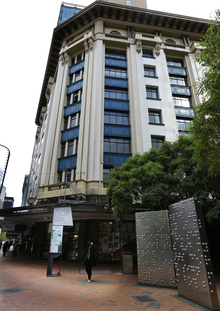
Harcourts Building on Lambton Quay.

When I look at the Harcourts Building on Lambton Quay, it looks pretty, but I just can't see the picture above without seeing bodies crushed under that beautiful high masonry.


Christchurch three years ago. Even two-story buildings can impose substantial risk out through the middle of the adjacent street. I'm not going to go searching for images that have body parts sticking out from under bricks and fallen unreinforced masonry. But, Wellington, you're going to see them on Lambton Quay if the fault opens up between now and the 30-year limit for fixing these kinds of things.

Heritage amenities are important. There's decent reason for subsidising their provision. But I sure know I wouldn't be able to sleep at night if I were the one who stood between the Harcourts building and the bulldozer.

I'd thought that Wellington's minor quake earlier this year would have encouraged sensible thinking up on the North Island.

Update: It's worse than I'd thought. Via Homepaddock.

Previously:

Tuesday, 3 September 2013

Tiki tours and useful idiots

Back during the Cold War, Western intellectuals were given guided tours of the Soviet Block and sent home to heap praise on the wonders achieved by Stalin. They were collectively called "useful idiots": too dumb to see through the Potemkin villages raised, but useful for internal and external state propaganda.

Last week, Liberty Scott started posting and tweeting on Gareth Morgan's motorcycle tour of North and South Korea. He pointed to numerous instances of Morgan's appearance being used in North Korean state media helping to legitimise the regime.

When I visited the DMZ on a USO tour back in 2007, we were given really strict instructions by the American military. Do not smile at the other side. Do not point. Do not do anything that the North Korean agents on the other side could photograph and print in their newspapers as "Westerner points to the Glorious North, admiring the wonders of Juche." I'm not generally all that keen on "do as I say" regs, but these ones made a lot of sense. One of the world's most evil regimes was staring back - literally, guys with binoculars and big-lens cameras - and I was publicity-shy.

But maybe playing the regime-supporting shill while there was needed so that he could have some chance at seeing what was going on.

Matt Nolan at TVHE yesterday pointed to Gareth Morgan's comments on his tour. Morgan wrote:
Having passed successfully through the demilitarised zone Gareth explains to the world’s media why the West’s “beat-up” view of North Korea is completely wrong.
Gareth and Jo and their group were free to set their own route through North Korea, witnessing at first hand the lives of ordinary North Koreans.
What they found surprised them – a people who were poor, yes, but wonderfully engaged, well-dressed, fully employed and well informed. In Gareth’s view, what North Korea has achieved economically despite its lack of access to international money has been magnificent.
He and Jo support active steps towards providing greater opportunities for ordinary Koreans from North and South to interact together – a goal of leaders from both North and South Korea. Hopefully, with enormous interest from the world media, this trip will be the catalyst for such a change.
Unbelievable. I'd thought that he was going to come out claiming that starvation works wonders on reducing feral cat numbers; this is worse.

Maybe there was some case for the tour somehow facilitating better North-South talks. Unlikely, but not impossible. But that the West has a "beat-up" view of North Korea? They have freaking concentration camps! Morgan's next tour could perhaps hit a few of those off-piste highlights. Morgan found the North Koreans with whom he spoke wonderfully well-informed; it's problematic even asking what that means in a place where preference-falsification is a necessary survival characteristic. As Xavier Marquez wrote:
There is a terrific story in Barbara Demick’s Nothing to Envy: Ordinary Lives in North Korea (pp. 97-101), which illustrates both how such control mechanisms can work regardless of belief and the degradation they inflict on people. The story is about a relatively privileged student, “Jun-sang,” at the time of the death of Kim Il-sung (North Korea’s “eternal president”). The death is announced, and Jun-sang finds that he cannot cry; he feels nothing for Kim Il-Sung. Yet, surrounded by his sobbing classmates, he suddenly realizes that “his entire future depended on his ability to cry: not just his career and his membership in the Workers’ Party, his very survival was at stake. It was a matter of life and death” (p. 98). So he forces himself to cry. And it gets worse: “What had started as a spontaneous outpouring of grief became a patriotic obligation … The inmiban [a neighbourhood committee] kept track of how often people went to the statue to show their respect. Everybody was being watched. They not only scrutinized actions, but facial expressions and tone of voice, gauging them for sincerity” (p. 101). The point of the story is not that nobody experienced any genuine grief at the death of Kim Il-sung (we cannot tell if Jun-sang’s feelings were common, or unusual) but that the expression of genuine grief was beside the point; all must give credible signals of grief or be considered suspect, and differences in these signals could be used to gauge the level of support (especially important at a time of leadership transition; Kim Il-sung had just died, and other people could have tried to take advantage of the opportunity if they had perceived any signals of wavering support from the population; note then the mobilization of the inmiban to monitor these signals). Moreover, the cult of personality induces a large degree of self-monitoring; there is no need to expend too many resources if others can be counted to note insufficiently credible signals of support and bring them to the attention of the authorities.
Even if Morgan was away from his handlers, everyone is a handler. That's the point of a totalitarian regime. Any disclosure can get you and your family sent to a concentration camp because somebody else will have purchased an indulgence by dobbing you in. And the safest course is making yourself believe the things you have to say.

Compare Gareth Morgan's visit with a couple other recent Western visits. Here's Neil Woodburn's travelogue. Here's what Curtis Melvin did while visiting North Korea, and subsequently. Melvin's mapping project would let Gareth Morgan check to see which prison camps he missed along his tour. Liberty Scott's update has some useful recommended readings as well.

Tuesday, 23 July 2013

Can consequences this foreseeable really be unintended?

Imagine this as an intermediate microeconomics exam question. Suppose the government were to bar firms taking government contracts from paying their highest-paid employee more than three times what they pay to their lowest-paid employee. What consequences might you expect ensue?

Here are a few, for starters:

  • There would be a rapid shift towards outsourcing of tasks performed by lower-paid workers. An economic consultancy company would hire a temp service to provide secretarial services and would contract with a janitorial services provider rather than have secretaries and janitors on staff. A construction company would have a rather tougher time - they'd be more likely to split into several component parts all selling services to a central agent who contracts with the government. So there could be a shoveling services company, a truck driving company, and a project management and procurement company. You'd have fairly flat payscales within companies, but large differences in salaries across companies. This would be inefficient, but it would likely be the best they could do given the rule.
  • Universities running consultancy arms for contract research by academics would have to run those as more explicit external shells. The government throws millions of dollars at the University of Otago for ban-everything studies under HRC grants. If they can't disguise the hourly rates in the contracts to make it look like the researchers are just putting in tons of hours, they'd have to put the contracted lecturers and profs onto part-time contracts with the University, where salary scales would range from the guys who mow the lawns to the people who teach brain surgeons how to be brain surgeons, and have a separate consultancy company where everybody earns a lot. 
    • If we think that Universities are under contract for government already in the whole teaching-students business, then they'd just have to run the same outsourcing arrangement suggested above. Or, think of it this way: would YOU want to have your brain surgery conducted by somebody trained by somebody earning three times what you can make mowing lawns? 
  • Now suppose that the policy were more comprehensive than I've suggested: they also work hard to look through these kinds of contractual setups and bar firms from putting in tenders for government contracts where it looks like they've done this.
    • It would be almost impossible to police. Some companies already find it optimal to contract with a professional maintenance services company rather than do things in-house; others like doing things in-house. Who's to say which organisational decisions were motivated by the rule and which derived from other considerations?
    • If they could do it, then you'd effectively have the end of government contracting-out for services except on very minor scale. The whole thing seems designed to kill private-public partnerships like:
      • Having specialist companies tender to construct roads rather than having some Ministry of Public Works do all the construction for the government (and losing the efficiencies of competition and private tendering);
      • Contracting in external experts for assistance rather than keeping a bunch on government staff. This sucks in a small country where you might need particular kinds of experts only infrequently.
That's just a start; other very foreseeable rather bad consequences are left as an exercise for the reader. For starters, think about incentives to acquire human capital.

Nobody would be daft enough to suggest such a thing though, right? Nope.
The Government should stop giving contracts - and knighthoods - to companies that pay their bosses more than three times their lowest-paid workers, an economist has suggested.
Who? Maybe some crank consultant? Nope. The University of Victoria at Wellington's Geoff Bertram. 

I caught this over the weekend but hadn't gotten around to blogging it; glad to see David Farrar and Matt Nolan caught it too. Matt only thinks Bertram's being "reasonably disingenuous"; I'm less charitable. 

To advocate policies like this, as an economist, and to pretend that a great big bucket of awful wouldn't ensue pretty directly, is worse than disingenuous. Bertram gets to grandstand about what a caring guy he is, let his followers believe that horrors wouldn't ensue, and just trust in that no government would be batty enough to implement the policy. This kind of policy advocacy smells more of charlatanry than of economics. I really really hope that the Herald has quoted him incorrectly as I can't believe that any economist could seriously think this a desirable policy. Care about inequality all you want, but the appropriate levers are tax and redistribution policy, not wage mandates.

If Bertram weren't misquoted, I've a few questions for him.
  1. Salary differences within government are often well in excess of the 3:1 ratio he recommends. The Prime Minister doesn't make a lot of money in the grand scheme of things, but he makes well over three times the lowest-paid government worker. Even if the lowest government salary paid anywhere in the system were $40,000, that would constrain the highest salary to $120,000. The Prime Minister earns $419,000. I expect a substantial part of the higher echelons of government earn well in excess of $120k. The base salary for a backbench Member of Parliament is $144k. Should we extend his preferred 3:1 rule to all of government, or just to contractors? 
  2. If he only wants it to apply to contractors, on what basis does he make that distinction?
    • Note that, if it applies only to contractors, the main large effect of the rule would be to end outsourcing of government work. We'd have a massive expansion of the civil service and an end to what benefits come from competitive tendering. I would put 20:1 on that Bertram's rule, in this interpretation and if enforced, would have this consequence. It is so obvious an effect that it kinda has to be something that the policy proponent wants to have happen. So, Geoff, if this is how you want it, why didn't you just call for a ban on outsourcing and an expansion of the civil service?
  3. Private hospitals provide services under contract for government. This would end pretty quickly under Bertram's rule if it applied only to contractors. But suppose it's comprehensive and applied also to government hospitals. Geoff, do you prefer:
    1. That the people who cut the grass, and the cashiers at the cafeteria, get salary increases so that nobody is earning less than a third of what the country's top brain surgeons earn? This may have consequences for the overall health budget and the overall quantity of services that the health system can provide. Or,
    2. That the people who fix the brains get pay cuts so that none of them earn more than three times what the people who cut the grass earn? This may have consequences for the quality of brain surgery. 
I weep for the quality of thought on the left in New Zealand. Australia gets Andrew Leigh. We get, well, this.

Wednesday, 29 May 2013

It is forbidden except where it is compulsory

It's illegal to run a cartel in most western countries. Government have great big agencies whose whole job is to look out for price-fixing, other forms of collusion, or mergers that do more to promote monopoly than to enhance efficiency. I'm an antitrust skeptic, but I know that isn't a majority position in economics.

Canada is no exception on antitrust vigilance. And, it looks as though things have been getting tighter. Where I'd previously understood Canadian competition law as weighing equally producer and consumer surplus and allowing activities that reduced consumer surplus if they were sufficiently efficiency-augmenting, it looks now like they're putting more weight on effects on competition per se.

Here's one summary of Canadian cartel regulation. Cartels are illegal. Arrangements with competitors to control supply, allocate territories, or fix production, are punishable as an indictable offence with up to a 14 year prison sentence and up to a $25m fine. 

So cartels are pretty illegal.

Except where they are compulsory.

A group of Manitoba fishermen formed a voluntary co-op and tried to sell their fish to a processing plant in Chicago. What happened next? [HT: Mom]
Court was told that the WWM co-op, which represents about 300 fishers in the areas of Duck Bay, Lundar, Ashern and Lake Winnipegosis, had obtained a licence in December 2010 to sell fish to the U.S. independent of the Freshwater Fish Marketing Corp. so long as it wasn’t competing with the monopoly for customers.
The co-op found a customer in Chicago, a fish processing plant, but unknown to the co-op, the processing plant was then re-selling the co-op’s fish to another customer in New York, which happened to be an existing customer of the Freshwater Fish Marketing Corp.
Court was told that the co-op was instructed to stop selling to the Chicago processor but continued to do so and its license was subsequently revoked in June 2011.
The co-op decided to continue selling to the Chicago processor, which resulted in one of its shipments being seized in July 2011.
Stevenson and the co-op were originally charged with three counts of selling without a licence but the other two charges were stayed once they pleaded guilty to the one charge.
They got $2000 fines for trying to break the government-enforced cartel.

Look back at the anti-cartel legislation.
Section 45 - conspiracy
Section 45 provides that:
  • every person commits an offence who, with a competitor of that person with respect to a product, conspires, agrees or arranges:
    • to fix, maintain, increase or control the price for the supply of the product;
    • to allocate sales, territories, customers or markets for the production or supply of the product; or
    • to fix, maintain, control, prevent, lessen or eliminate the production or supply of the product; and
  • every person who commits an offence under the above-mentioned subsection is guilty of an indictable offence and liable on conviction to imprisonment for a term not exceeding 14 years or to a fine not exceeding C$25 million, or to both.
Section 45 is a criminal offence and, as such, to obtain a conviction, the prosecution has the burden of proof to establish the offence ‘beyond a reasonable doubt’.
So one part of the government throws people in jail for forming cartels while the other part of government fines people for not being in the cartel.

Canada, you're schizophrenic. Seek therapy.

Tuesday, 28 May 2013

Objectionable publications [Updated]

Two years ago, the New Zealand Police tried to have banned a few issues of NORML's "High Times" magazine. As I had a short piece in one of the relevant issues critiquing the ludicrous New Zealand Drug Harm Index, I would have been a contributor to a banned publication, had the Censor's Office decided to give the police what they'd wanted.

Individuals knowingly in possession of objectionable materials can receive up to five years in prison.

Among the books banned by the New Zealand Censor as Objectionable (or under classifications brought over from prior censorship tribunals, including "indecent", "unconditional indecent") are:
  • A Guide to Growing Marijuana in Cool Climates
  • Indoor Marijuana Horticulture
  • Indoor Marijuana Cultivation
  • Inside Linda Lovelace (available from Amazon here)
You can search the Register of Classification Decisions; alas, they run everything through a back end that precludes direct linking to decisions. 

The Office has been reviewing some of its old classifications; "Bloody Mama", which had been banned by the Indecent Publications Tribunal in 1971, is now listed as "unrestricted". I expect that if you were in possession of something that was banned in 1971 and has not been revisited, you might ask that it be re-examined; I don't know the extent of the legal risks. 

The banned book list includes a lot of titles that indicate they would be of interest to the homosexual community, to the S&M community, to growers of marijuana, and books whose titles suggest incest or paedophilia. 

If you search on "Fanny Hill", a 1748 book (Wikipedia), you'll find a film classified R18 (1984), a book classified Indecent 18 (1965), an audio recording deemed not indecent (1975), a book deemed indecent (1981), and various others ranging from R16 to indecent. I have absolutely no clue whether, in New Zealand, it is legal or illegal for me to go to Project Gutenberg and download the text of Fanny Hill. Drilling to the Gazette decision, it looks like a specific edition of the text was banned because of accompanying photographs; there is no indication of that the pictures were of minors.* The 1965 decision restricted possession to those over the age of 18; I expect that that is the decision that continues to hold for the text.

There are approximately 1300 titles which are ‘objectionable’ (banned) in New Zealand. Approximately 1225 were classified as indecent by the Indecent Publications Tribunal (IPT) in the period 1963-1994. The remainder are decisions of the Office of Film and Literature Classification (OFLC).

Unless a more recent decision has been made on any title, a classification decision is still in force. For example a book banned by the IPT in 1963 will still be banned, unless the edition is sufficiently different to constitute a new publication.

Most books which have been ‘banned’ deal with weapons and drug manufacture and other criminal acts, dog fighting and the sexual exploitation of children and young persons. It is likely a number of older titles if they were classified today, under current legislation, would still be classified as ‘objectionable’. This is because of the activities that these books support.
A couple of months ago, Ronald Clark was jailed for downloading Japanese anime cartoons. Now Clark was hardly a harmless guy: the Daily Mail reports he had prior convictions for indecently assaulting a teenaged boy. And maybe a guy like that should have a ban on possessing manga as part of his post-release conditions if the psychologists reckoned, for this individual, that they were more complement than substitute for actually hurting kids. But it seems a bit 'inside the asylum' that you can be arrested for bringing Japanese comic books into the country, despite that absolutely nobody was harmed in their production.

Why bring this up?

The Government is increasing the penalties for being in possession of objectionable publications. Nobody's going to defend those who produce child pornography. And even those who view those produced images or films do harm by increasing demand for those products; some argue that viewing such films or pictures adds additional harm by re-victimising the subject even where the subject never knows it's happened.** But not all people convicted as being in possession of objectionable materials are either producers or consumers of actual child pornography.

Here's The Press:
Most than 400 people had been convicted of the offence of having objectionable material between 2004 and 2011, most of which where sexual images of children.
Of these, only 33 per cent were jailed. ''That is totally unacceptable and I think we need to deal with it and this is what this bill is all about,'' Ms Collins said.
''I'm telling the judges that we're changing the law so that they can get tougher and of course they are bound by sentencing guidelines.''
Now here is the Bill. Everything in the General Policy Statement talks about the evils of child pornography.
A key purpose of this Bill is to implement the Government's post-election action plan to increase penalties for producing, trading, or possessing child pornography. The Government's objective is to ensure that sentences for child pornography offences reflect the seriousness of the offending and send a strong message that the exploitation and abuse of children will not be tolerated.
To achieve that key purpose, and otherwise improve objectionable publications and indecency legislation, this Bill—
  • increases maximum penalties for possession, import, export, supply, distribution, and making of objectionable publications – which include child pornography publications:
That's all well and good, but "which include" is a bit broad. Looking further into the preamble, we find:
Clause 6 amends section 131A, which relates to offences of possession of objectionable publications, knowing or having reasonable cause to believe that the publications are objectionable. The current maximum available penalty for an offence against section 131A(1) committed by an individual is imprisonment for a term not exceeding 5 years, or a fine not exceeding $50,000. The amendment increases that maximum available term of imprisonment from 5 years to 10 years.
Clause 7 inserts a new section 132B, which contains a presumption of imprisonment for certain repeat offenders. New section 132B applies (new section 132B(1)) only to an offender who—
  • has been convicted of and is to be sentenced in respect of a specified publications offence committed after the commencement of new section 132B (the repeat offence); and
  • before the conviction for the repeat offence was entered, had been convicted of 1 or more specified publications offences committed before or after that commencement.
A specified publications offence (new section 132B(2)) is one against a provision specified in section 132A(1)(a) to (e) if the publication that was the subject of the offence does (to any extent) any or all of the following things (specified in section 132A(2)(a) to (c)):
  • promotes or supports, or tends to promote or support, the exploitation of children, or young persons, or both, for sexual purposes:
  • describes, depicts, or otherwise deals with sexual conduct with or by children, or young persons, or both:
  • exploits the nudity of children, or young persons, or both.
Again, look at the "any or all". This looks to include Japanese comic books if the judge thinks that reading manga promotes child exploitation. And it might include 1748's Fanny Hill, depending on which decision of the Censorship Office you want to run with  if you have an illustrated edition.*

I'm no lawyer, but this doesn't look like the "Outside of the Asylum" kind of legislation for which I thought we here aimed. Hopefully the Select Committee will fix things so you can't get 10 years in jail for looking at comic books. And gawd help you if there are any instructions for growing marijuana somewhere in the comic's text.

* UPDATE: It is impossible for me to link here to the Gazette decision of 5 February 1981, but the text suggests that it was a specific issue of Fanny Hill that included a series of photographs that was banned. There is no indication in the decision that the photographs were of children. Here is the text:
A sample copy of Fanny Hill was imported commercially and seized at Auckland in September 1980. As the importer has disputed forfeiture the Customs Department has referred the publication to the Tribunal for classification, prior to the commencement of condemnation proceedings pursuant to the Customs Act 1966.
Fanny Hill is a paperback publication, supposedly based on the original classic by John Cleland. Samples of these writings have been selected from the original book, and used in conjunction with a series of photographs which place considerable emphasis on sexual activities, to give an impression that the paperback is an accurate precis of the original classic. In fact, there appears to be little relationship between the text and the photographs, even though the photographer has dressed his models in period costume. In view of the nature of the publication, there is a distinct lack of honesty of purpose. Accordingly, though the original classic is not indecent, we classify this edition of Fanny Hill as indecent.

So the original .txt should not be viewed as indecent. Wouldn't it be nice if the database search said as much!

Update 2: The Censor's Office has confirmed that the one illustrated edition is the one that is banned. However, the Censor's Office also does not know which edition that is. The only thing they know about it is what is in the Gazette. So if you have some pre-1982 illustrated version of Fanny Hill, it may or may not be the one deemed objectionable by the Censor in 1981. If it is, then you can go to jail for a decade. If it isn't, enjoy!

** It being impossible to discuss the pros and cons of such a view without risking being fired, I will abstain.

Monday, 20 August 2012

Socialising private costs

What's a good way to make sure that smokers cost other people money? Make it illegal for private health insurers to charge smokers more. Seems a particularly stupid policy, but Australia's going for it.
Private health insurers have failed in a push to charge smokers higher premiums. While the federal government triumphed over big tobacco this week, the Minister for Health, Tanya Plibersek, said smokers should not be penalised with higher premiums - and people should pay the same regardless of the state of their health. She ruled out allowing the health funds to charge smokers more.

Private insurers - led by NIB - are interested in the idea and argue it is the next step the government could take to reduce rates of smoking.

''We should be able to offer a discount for good healthy behaviour like not smoking and exercise,'' the chief executive of NIB, Mark Fitzgibbon, said.
The Australians have a pretty extensive regulatory apparatus around "private" health insurance; see Robson et al for a recent analysis. I'd suggested in the introduction to that issue of Agenda that whatever goals are sought by community rating could better be achieved by providing transfers to individuals based on the exogenous parts of their individual risks and letting insurers set actuarially fair premiums: poorer and less healthy people are given money to help them buy insurance, but incentives to make efficient investments in your own health are maintained.

Once you've banned insurers from charging differential fees for smokers, all kinds of anti-smoking policies can have second-best cases supporting them; first best would just let insurers set fair premiums. Government creates the "market failure", then supplies the interventions that partially offset the failure. And everybody gets to shout about how markets are terrible because absent intervention, everybody else has to share the costs imposed by smokers.

Saturday, 30 June 2012

If a store opens in Wanaka, should anyone in Auckland care?

Members of Parliament representing Dunedin, Waikato, Hutt, Ikaroa-Rawhiti, Mana, Mangere, Manukau East, Manurewa, Mt Albert, Mt Roskill, New Lynn, Palmerston North, Port Hills, Rongotai, Te Atatu, Te Tai Tonga, Wellington, West-Coast, and Wigram think so. And so MPs for Hamilton West, Hunaua, Ilam, Invercargill, Maungakiekie, New Plymouth, Tamaki, Taupo, and Whangarei. And a bunch of List MPs living nowhere near Wanaka.

New Zealand prohibits stores from opening on Easter Sunday, Good Friday, half of ANZAC day, and Christmas Day. Unless you're in an exempt category.

Jacqui Dean, MP for Waitaki, which encompasses Wanaka, put up a bill that would have allowed shops in Wanaka to open on Easter Sunday. The Warbirds over Wanaka biannual event most typically runs over Easter. Thousands of tourists come to Wanaka to see the show and are legally prohibited from shopping for two of the days they are there.

Parliament shot down the Bill on first reading after National allowed a conscience vote while Labour, the Greens, and NZ First block-voted against it.

Particularly egregious in the Hansard:
  • Rajan Prasad, Labour, questioning whether there's any evidence that the bill would see people spend more. Tens of thousands of people show up in Wanaka for the Warbirds show and are legally banned from shopping, except at those places already exempt. 
  • Darien Fenton's complaints about Christians who might be forced to work on Easter Sunday. Surely every religion has its own special day. And what of Festivus? And if anybody forces me to work on the Feast of Maximum Occupancy, I'm not going to be happy. 
There were more sensible critiques, like that there should be more general legislation allowing individual local councils to make their own decisions about Easter trading. But surely if the people in Waitaki thought this a particularly bad idea, they'd have a really good way of expressing their discontent in 2014: voting out the local MP who pushed through the bill. And surely an MP who wants to be re-elected would have canvassed for local support before introducing the bill.

The trading bans that coincide with Christian holidays seem particularly odd in a country where the Census tells us those reporting no religion outnumber any Christian denomination. When we first arrived here, we were really surprised by the ban: we headed up to Nelson for a holiday over Easter long weekend, booking in at a backpackers and planning on buying groceries as needed. But everything was a ghost town. City centre was empty. We only found out afterwards that it was because the shops were all prohibited from opening. 

I can understand wanting to have Easter and such as statutory holiday, where employers must provide employees extra compensation if they want to be open. But complete bans are nonsensical. 

If ACT were a liberal party, they'd have had an MP in the House speaking in support of the Bill and demanding it be extended more broadly. Hansard doesn't list John Banks as having voted.

Wednesday, 13 June 2012

Small fixes for Christchurch

Without a time machine, we can't go back and revisit Christchurch Council's complete and utter failure after the September 2010 earthquake to ease up on land supply constraints so that the market could have responded after the February quakes by supplying places for people to live. It is completely nuts that Christchurch property values are now above their pre-quake 2007 peak given the massive reduction in the amenity value of living in Christchurch; it reflects that demand wasn't cut by nearly as much as supply and that the combination of regulatory barriers to supply and real time-to-build problems have more people left homeless by the quakes who want houses than there are available houses in Christchurch.

What can we do in the interim, given the very real world constraints of:
  • Very limited Council capacity;
  • Very real infrastructure constraints that can put limits on extensive brownfield densification;
  • Time to build even if we moved right now to whatever the perfect zoning rules might be?
John Fountain, my colleague here at Canterbury, has been trying to help square the circle. How? John has a house in Governor's Bay that's larger than he needs. He wants to build a flat into the house. But it is against Council regulations to put in a flat. Christchurch Council has made it illegal for John, and people like him, to help to make more housing available quickly. Yes I am shouting. More people should be shouting. I'm surprised we haven't seen bricks going through planner windows. I'd certainly never condone such behaviour, but I'd understand.

Here's John, who's more typically Canadian in tone:
There are a few nice features of the new Christchurch City temporary accommodation scheme that permits the construction of an “accommodation unit”. An accommodation unit is  “a structure of no more than 150m² in gross floor area for the purpose of providing temporary residential accommodation. The unit may include facilities normally associated with residential accommodation such as a kitchen, living area, bathroom, toilet and bedrooms. Accommodation unit may also include a campervan or caravan.” There is a fast tracking system for getting pre construction advice and approval in 3 to 5 days  – for free. Of course all building consents need to be in place…but this isn’t necessarily a big hurdle for a well designed and well constructed unit.
The problem is that  “earthquake related” accommodation units are surrounded by a host of ancillary use constraints and regulations that strangle the (apparent)  intentions behind the scheme …: eg whatever faciltiies are constructed  must be temporary,  one-storey,  relocateable,  used only for accommodation by and for   households directly dislocated by the earthquake, and removed when their temporary need has dissipated or when CERA instructions say so or when CERA is disbanded four years away in April 2016.
John then slowly walks through how it's unlikely to be in any property owner's financial interest to build a flat into their existing property if it has to be pulled out four years later.

And, worse, the regulations require that the units accommodate specific persons who are earthquake-displaced. The thing about housing is that even if you accommodate somebody who isn't specifically earthquake-displaced, you're still making room for the displaced person to go where that newly accommodated person otherwise would have been. The first big tick-box on the Council consenting check-list requires you to indicate whether your flat would accommodate somebody whose house was destroyed, who's displaced because of reconstruction, who's displaced because of land remediation, or who's displaced because of risks posed by adjacent structures. You can't use it to accommodate somebody who's moved into town to run a big construction crane even though building something to accommodate that guy frees up a space for an earthquake-affected person elsewhere.

So John reckons he could, for about $110k of his own money, put in a 70 square meter 2-bedroom unit at his place that would rent out for about $300 per week. That makes sense if he can pay off the investment over a term longer than 4 years, and if he doesn't have to pre-specify, before he even builds the freaking thing, who'd live there and guarantee it would be an earthquake-affected person.

It would be very easy for Council to ease up on the current draconian regulations to let people permanently build self-contained flats into their existing properties. These would be dispersed around the city; you wouldn't expect to have large effects on trunk infrastructure. Council wouldn't have to spend anything - just get out of the way. Here's John again:
So…what do we conclude: willing buyers , willing seller but the transactions that would help alleviate accommodation shortages for the next few years are effectively stymied by inadequate regulations . Multiply this 1000 fold and you’ll see why “temporary”  inadequate approaches to zoning regulations – ones that don’t challenge the existing order – are a real bottleneck for dealing with rental accommodation shortages.
The plain fact is that the new  temporary accommodation orders, while well intentioned, simply avoid the underlying regulatory problems that limit the development of small scale private investments that could do plenty to alleviate our city’s accommodation problems. It’s just old wine in a new wineskin  – CERA and the city managers say we’ll facilitate something for you but then enclose it in a shrink wrap agreement that precludes it being used!
The temporary accommodation order itself would have been redundant had the zoning and development regulations been tweaked to permit residential activities to have secondary suites, as in Vancouver and many other Canadian municipalities – something that I am arguing in my other posts..
Here's John on how this kind of solution works in Vancouver. Here's more from John on secondary suites. Here's where John hit the kitchen "stumbling block" for developing a flat on his property.

Is there any plausible negative effect of allowing this kind of subdividing that outweighs the benefits? Why does Christchurch Council make it illegal for my colleague to help ease Christchurch's very real housing shortage? We have an earthquake-Czar who's supposed to be able to ride roughshod over Council stupidity to get things done. This is worth getting done. It would open up a pile of new rental properties that are currently in scarce supply, and it would do it faster than building new.

Every other city in the country should be looking hard at its existing set of regulations and weighing up just how much fragility they've built into their systems in case of sudden and devastating reductions in housing supply.

Update: See also John's post here that points to a City of Vancouver study on secondary suites.