Showing posts with label social norms. Show all posts

Thursday, 11 May 2017

Bad Bus Equilibrium

I don't see any way of fixing this one, but maybe you do.

Current Wellington bus rules have cheaper fares for students for a reduced class of carriage: if the bus is full, full-fare passengers get to sit and students get to stand.

That's all fine, but the resulting equilbrium isn't. Students clog up the path near the rear exit of the bus. Empty seats are behind them. Adults queue up in front of them, unable to reach the empty seats. And then the driver sometimes breezes past bus stops because, from the driver's perspective, the bus is full.

There are ways of solving it, but none of them work:

  • Simplest would be a norm where adults sat at the back first, kids sat at the front first, and then kids start yielding to adults (starting near the back door) as the bus fills up. I don't know how you get there from here. Also, some adults would resent having to walk past the kids. I wouldn't because efficiency, but others might. 
  • If high school kids weren't idiots, they would get out of the way by sitting in closely adjacent seats, let the adults move to the empty seats at the back, then resume their prior position. And we would all have ponies too.
  • If kids had to yield to adults on request rather than having to stand if there are adults unable to take a seat, that could simplify things - and especially if adults were sensible and made the request of kids at the back first. But it would conflict with Kiwi politeness norms around asking them to yield their seat, which then in a politeness-jamming equilibrium with the kids standing anyway to avoid having to be asked to yield, and we're back where we started from. 
File under "Trivial but sad and likely non-remediable imperfections of a world that's still rather good on the whole". Or First World Problems. But it was frustrating watching the usual mess unfold from the back of the bus this morning. 

In related Helpful Efficiency Tips for a Better World: unless you have good reason not to, always choose the seat that is currently most difficult to reach when entering a room or bus if the table/room or bus is likely to be close to capacity. Your sitting in any other place means somebody else has an even more difficult time of reaching the currently most difficult to reach seat. 

Tuesday, 15 April 2014

Nominalism

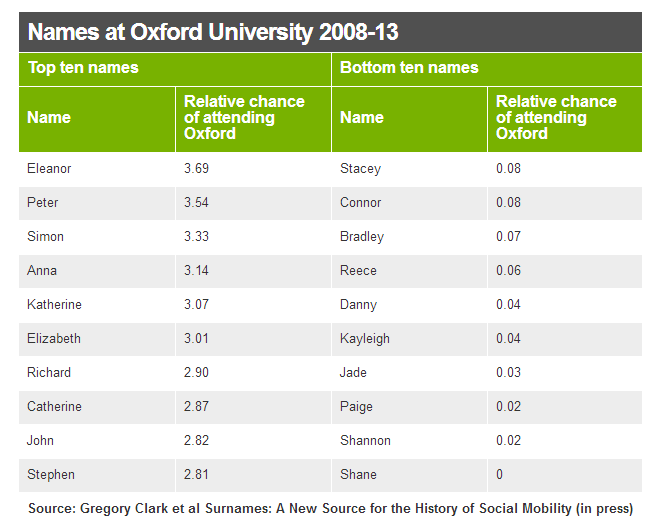
An Eleanor by any other name might be as smart, but would have worse odds of winding up at Oxford. A snippet from Greg Clark's work on names and surnames:*
It isn't that the name itself is particularly powerful, or destructive; rather, the sorts of people who wind up naming their daughters Eleanor are very different, on average, from the sorts of people who wind up naming their daughters Kayleigh. From the BBC piece:
However, there is no evidence that it's the names causing such a marked discrepancy, rather than other factors they represent, Clark says. Different names are popular among different social classes, and these groups have different opportunities and goals.

"That's something that's emerged in modern England that didn't exist around 1800," he says. When he re-ran his study, but this time looking at students attending Oxford and Cambridge in the early 19th Century, he found the correlation between names and university attendance far less marked. First names simply weren't the social signifiers they are now.

What's happened since then is a move towards unusual, even unique, names. Before 1800, Clark says, four first names referred to half of all English men. In 2012, according to the Office for National Statistics, the top four names (Harry, Oliver, Jack, Charlie) accounted for just 7% of English baby boys (and the picture was much the same in Wales).

Similarly in the US, in 1950, 5% of US parents chose a name for their child that wasn't in the top 1,000 names. In 2012, that figure was up to 27%.

As late as the 18th Century, it wasn't uncommon for parents to call multiple children the same name - two Johns for different grandfathers, for example. Now parents increasingly look for unique names or spellings of names. As Jean Twenge points out in her book the Narcissism Epidemic, Jasmine now rubs shoulders in naming lists with Jazmine, Jazmyne, Jazzmin, Jazzmine, Jasmina, Jazmyn, Jasmin, and Jasmyn.
Our baby-naming algorithm, which wound up choosing Eleanor for our girl, started with a domain of names in the top 1000 from 1880 to 1930 in the US, then eliminated any names that were in the top-100 any time in the last three decades. So you rule out the made up stuff while also ruling out having too many classmates with the same name. But we're the kind of people who would choose that kind of algorithm.

I especially liked the BBC piece's pointing to Figlio's work on names. It's pretty common for researchers to use audit studies to test for racial discrimination: they send out otherwise-equivalent vitae, but put a 'black-sounding' name on some and a neutral one on others. They tend to find a penalty for having a black-sounding name. The problem with these kinds of studies is that they simultaneously test for black-sounding and for class-linked names: instead of testing black versus white, they're effectively testing lower-class versus upper-class names. Here's Figlio:
This paper investigates the question of whether teachers treat children differentially on the basis of factors other than observed ability, and whether this differential treatment in turn translates into differences in student outcomes. I suggest that teachers may use a child's name as a signal of unobserved parental contributions to that child's education, and expect less from children with names that "sound" like they were given by uneducated parents. These names, empirically, are given most frequently by Blacks, but they are also given by White and Hispanic parents as well. I utilize a detailed dataset from a large Florida school district to directly test the hypothesis that teachers and school administrators expect less on average of children with names associated with low socio-economic status, and these diminished expectations in turn lead to reduced student cognitive performance. Comparing pairs of siblings, I find that teachers tend to treat children differently depending on their names, and that these same patterns apparently translate into large differences in test scores.
I wish that audit studies instead used a cross-cutting method that would test Da'Quan against Dwayne and Cleetus instead of just against Peter. Put it into a 2x2 matrix with race on one axis and class on the other.

First names may just be signals, but "just signalling" hardly means unimportant. If you're economising on time while going through the resumes or university applications, and if a Cleetus is less likely than a Peter to know which fork to use at the important dinner with a client or donor, well, a Cleetus would have to be better than a Peter to get a second look. Because parents who have some minimal social capital expect this to be at least somewhat likely to be true, they make different naming choices than those who don't.

Colby Cosh is right:
The separating equilibrium separates.

I'd tell you to avoid giving your kids dumb names, but if you're reading this, you almost certainly already know it.

* I really need to get his book. The interview teasers have been very tempting.

Previously:

Tuesday, 4 February 2014

Lockean Parking

In the Lockean framework, private property can be appropriated from the commons through the mixing of labour. If you mix your labour with the untilled soil, leaving as much and as good yet for others to till, then that tilled soil is yours. You have homesteaded it.*

And so we come to parking spaces in snowy places. Normally, you appropriate a parking spot by putting your car into it. All available spots are up for grabs. Because cities refuse to charge market-clearing prices for parking, there's excess demand that's solved by first-come-first-served queueing.

But suppose you've had a snowstorm. None of the parking spaces are available because they're all snowbanks. When you shovel out a spot, you have homesteaded it. At least a little bit. You've mixed your labour with the uncleared snow and have some ownership right to that space, at least for a little while. Standard practice in many North American cities then allows the clearer of the space to own it and to signal ownership by the leaving of an appropriate marker. A chair, a road cone, a barrel - something big enough to say "Hey, I cleared this spot. I know you could move the barrel and take my spot, but you'd be a total jerk if you did."

The Boston Globe tells me [HT: @BKDrinkwater] that this practice has even been recognized in official city practice [I don't know if it's a bylaw.] If the city declares a snow emergency, you can set out a marker owning a space for 48 hours after the end of the snow emergency. So you get a limited homesteading right. But the city's practice doesn't put in a homesteading requirement.

And so we can get problems where the state comes in to enforce a pre-existing social norm through official practice. What if you declare a snow emergency, and it doesn't snow? By the city's rule, you can then appropriate any old parking spot without having mixed your labour with it. Or can you?
[Mayor] Walsh said he supports the concept of the earned spot. “If you use manual labor to get your car out, I think for 48 hours, a couple days, you can have it,” he said. But last week, after the forecast fizzled, Walsh said “there was clearly no need for saving spaces after that storm.”
Still, many did, especially in South Boston, where residents report being locked in by the system: Whether they agree with the idea or not, if they don’t put one out for themselves — even with no snow on the ground — it would simply mean they have no place to park. So people like Ivaska [earlier dubbed Captain Cone] and a man named Dan Bothwell went on a tear around the neighborhood, tossing everything they found in a parking spot. “I call it my Winter Olympics,” said Bothwell, 37.
“People say to me, ‘Why do you get so mad?’ ” he said. “I say, ‘Because it’s not a South Boston parking issue, it’s a common sense issue. If you get 12 inches and you shovel your spot, you get it for a day. But everybody hates people who abuse it, yet they won’t be an adult and move the cone if they need to park. If something happens to your car, you go to their house.’ ”
The situations can get famously tense. Already this winter, punches have been thrown and nail guns used to shoot out tires. “I hope I’m wrong, but I honestly believe something bad will happen to someone soon. It’s out of control.”
The mayor said that he sees no problem with people moving markers from spots if a person has not shoveled — “That’s not an earned spot,” he said — or if they’re past the 48 hours, and he has a particular peeve with people who put them out before the first flakes fall.
“You can’t put it on blacktop,” he said. “To me, that’s not grounds for saving a space. That’s not how I grew up.”
The streets are empty now, but storm fever will arrive again, and so will the early space-savers. Captain Cone is not betting on common sense.
I love the induced prisoner's dilemma. I also love that it takes an entrepreneur to initiate the revolution. Everybody fears retribution so nobody wants to be first mover against the norm-breaker, and because everybody else fears that the game unravels, they all put out space savers. Until Captain Cone comes around, pushing everybody back to the better equilibrium.

You could likely write a political economy masters thesis on social norms around this issue: how the institution evolved in different cities, how it interacts with city practice - whether parking wardens leave the cones there or biff them, and what happens when code conflicts with norm.


* Cat has homesteaded nothing [very mildly NSFW].
Saturday, 9 November 2013

Class etiquette

I'd joked about the class-entrenching function of etiquette a couple of years back.
Etiquette rules, like the downward fork tines rule, that deliberately hobble the person making the display have a signalling value: it's the peacock's tail. Folks who've been able to spend hundreds of hours practicing how to eat in a deliberately hobbled fashion are then able to demonstrate finesse in that form of eating. Everyone else at the table will recognize them as being from the leisured class, whose parents either had sufficient servants to spend time drilling that technique into the children, or who invested that time in lieu of other pursuits in early adulthood. Either way, you're demonstrating that you've had time and leisure to spare. ...

If you could deduce etiquette from logic, it wouldn't be etiquette. If it's not a costly signal, it can't induce the separating equilibrium that keeps the farm boys like Scott and me from having airs when dining with our purported betters.

Down with the tyranny of etiquette and its oppressive class-entrenching function! Up with efficiency! Ecraser l'Infâme! Join me in the revolution! All you have to lose are your chains!
It isn't really a joke. Not knowing which signals need be sent and which are just purposelessly costly is costly. Here's Tressimc (HT: +Althea Parker-Wood)
In contrast, “acceptable” is about gaining access to a limited set of rewards granted upon group membership. I cannot know exactly how often my presentation of acceptable has helped me but I have enough feedback to know it is not inconsequential. One manager at the apartment complex where I worked while in college told me, repeatedly, that she knew I was “Okay” because my little Nissan was clean. That I had worn a Jones of New York suit to the interview really sealed the deal. She could call the suit by name because she asked me about the label in the interview. Another hiring manager at my first professional job looked me up and down in the waiting room, cataloging my outfit, and later told me that she had decided I was too classy to be on the call center floor. I was hired as a trainer instead. The difference meant no shift work, greater prestige, better pay and a baseline salary for all my future employment. 
This is one reason a fair few welfare-to-work programmes provide some basics about interviewing: explicitly telling people what others already know.

Friday, 15 June 2012

Exam security

Canterbury takes its invigilated exams pretty seriously.

Students in our big 100-level exams have to leave all of their materials at the front of the room save a pencil, pen, ruler or non-programmable calculator (as needed for the exam). Hats have to be left at the front of the room. We arrange students through the room in a checkerboard; we know where each student is seated so we can check scripts later on if we suspect somebody's copied from a neighbour. Two invigilators stalk the room throughout. We leave a blank row after every second row of students so the invigilators can get up to any student who's asking a question, or who is peeking a bit too often up a shirt sleeve.

What are the key features of this set-up?
  • Students can't tell where they'll be seated before entering the room. They'll likely be seated near somebody with an alphabetically close last name, but they can't tell where in the room they'll be.
  • Students can't easily smuggle answers in; the only materials they're supposed to have in front of them are the ones they have to have, though we'll usually allow a water or drink bottle.
  • Students don't have access to the blank exam booklets, which vary colour from year to year and, occasionally, by whatever the lecturer happens to have had in his older stock. It's not always easy to predict what the colour of the exam booklet cover will be, so it's harder to smuggle in one that has notes inside.
  • Invigilators can approach any student from an oblique angle; as they can be behind a student, it's hard for a student to tell when he's being watched.

Turns out that those measures would thwart most of the exam hacks that students taking this government cybersecurity course tried when they were instructed to try to cheat on the exam. The quiz asked them to write the first hundred digits of pi. Some of the hacks were very nice, but students didn't have to try all that hard given the reasonably lax exam setting.


Here's the working paper: Embracing the Kobayashi Maru. What did the students try?
  • Variants of encoding the answer onto materials they were allowed to bring into the exam with them: textbooks; the back of name tags that always sit on desks; notebooks; course schedules; post-it notes; food; coffee cup sleeves; random materials that might be in a pencil case; hidden in a watch bezel; bringing in a pre-completed answer sheet hidden among other papers.
  • Variants of hacking the exam room: writing on ceiling tiles; writing the answer on sheets of paper in the pile that the invigilators were likely to distribute on request for blank papers; hiding the answer within the computers on the desks;
  • Hacking the grader's or invigilator's laziness: Memorize the first ten digits, then provide random numbers.
Most of these won't work given our processes. To what sorts of attacks could we still be vulnerable? Security through obscurity is a pretty poor solution and I'm sure our students are more creative than I am anyway. So here are a few potential options:
  • Notes written on or around drink bottles or coffee cup sleeves;
  • Notes hidden on one's person and accessed in the privacy of a toilet stall, especially if you've drawn the lucky straw and both invigilators are of not-your-gender;
  • Small notes written on erasers or taped inside the sleeve of a programmable calculator;
  • Small notes hidden inside pencil cases if the invigilator isn't strict enough on the "pencils and pens only" rule;
  • A note hidden under a pony-tail or in dreadlocks.
Options are near limitless for variants on open book or open notes exams; fair systems would let students either bring in anything (completely open book) or restrict students to bringing in only one or two sheets of paper of specified size. Otherwise you're just encouraging students to encode notes on the cover or in the text of the book.

Perhaps I should include a "Please cheat on this question" question in the midterms next semester. Academic misconduct and a visit to the proctor for cheating on other questions, but only a zero on that question if caught cheating on it with bonus points for demonstrating the hack afterwards; then we'd have a better list of things for which to watch out for subsequent cohorts. But as I'm not even sure it's a good idea, it's pretty unlikely that I'd be able to convince the various "Powers That Veto" that it's all that hot.

No exam system will ever be hack-free. It's important to set a strong anti-cheating norm, demonstrating that students could reasonably expect to be caught if they try so they don't expect to be disadvantaged if they don't cheat. Our processes probably do more to encourage honesty by showing that we care about honesty and setting the right expectations than by thwarting the most determined of exam hackers.