Thursday, 31 March 2016

The UBI and the political constraint

I walk through the basics on universal basic incomes over at The Spinoff. After explaining Milligan's impossible trinity, I note the political constraint that I think blocks Gareth Morgan's proposed UBI. Morgan's proposed UBI would leave some very poor families worse off:
More importantly, though, while relatively low basic benefits could make the system affordable, they would not be politically stable. There would be pressure to layer a benefits system on top of the UBI, or to increase the UBI. It does not seem plausible that any government would be able to withstand the likely months’ long John Campbell campaign that would, every day, highlight a different family whose benefits were cut under the shift to a UBI. We would quickly have a welfare system layered on top of a UBI, increasing the costs while eroding the UBI’s benefits.
I could imagine pushing a button for a low UBI replacing existing income support programmes, combined with generous tax credits for contributions to charities that work to plug remaining gaps. But that button doesn't exist, and even if it did, it wouldn't be politically stable. You would have, every night, John Campbell featuring some family that has been made worse off. Because that is what John Campbell does, and because there is a market for those stories. Even if charitable support programmes were ramping up and would be more effective in the long run, the political constraint would bind. And then we wind up with UBI plus existing welfare.

Over at The Sandpit, I note a few additional problems that John Gibson raises:
[Gibson] then goes through five rather important potential unintended consequences of income transfer schemes, mostly looking at things in developing countries:
  1. Transfers targeted to types of need encourage Tullock-style competing for aid. He notes a programme in Brazil targeting poor families with kids wound up resulting in less weight gain per month for the targeted kids; the families feared that if their kids grew well, the transfers would stop.
  2. If being in formal work means you pay taxes to support protection schemes targeting those outside of formal work, then you get distortions towards informal work;
  3. Transfers to targeted rural households generate localised inflation that hurts non-targeted households;
  4. Programmes can erode existing informal safety nets where people rely on each other and family during tough times. The effect of programmes is then a bit harder to judge where the effective beneficiary is the person who would otherwise be supporting the recipient of aid.
  5. Programmes likely affect household composition, and consequently undermine targeting. He gives the example of the expansion of old age pensions in South Africa: adults with low skills wound up moving in with pensioners.

Learning from Canada: Refugee edition

Most of the time, I'm lauding how New Zealand gets things right that Canada messes up. The GST, no agricultural subsidies, low tariffs, parallel importation, open internal labour markets and lack of trade barriers between Otago and Wellington - NZ has a lot going for it.

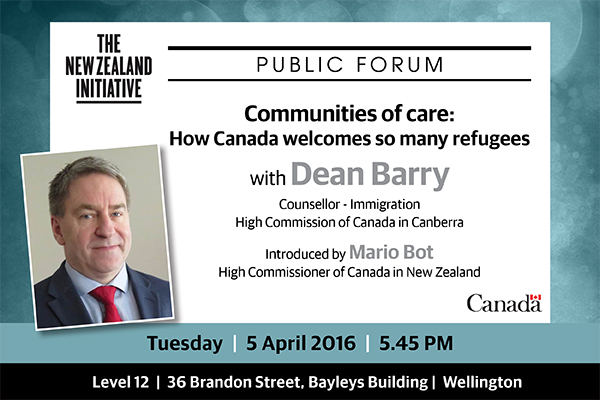
But Canada has something important to teach us on refugees. And so I'm very happy that The Initiative will be hosting Dean Barry, Counsellor on Immigration with the High Commission of Canada in Canberra. He'll be with us next Tuesday evening to explain how Canada has been able to respond quickly to accommodate many more Syrian refugees than New Zealand has dreamed possible. 

Canada's population is about 7.5 times New Zealand's. Since November 2015, Canada has welcomed 8,981 refugees through its private sponsorship channel alone. If we put that into New Zealand terms, by population, that would be about 1,200 - almost double what New Zealand will accept over the next two and a half years. And that's in addition to the 15,000 refugees who have arrived through the sponsorship of the Canadian government. 

The event invitation is copied below; please do RSVP as spaces are limited


Canadian and New Zealand responses to last October’s refugee crisis could not have been more different.

Kiwis who wanted to help Syrian refugees did admirable work in preparing for those refugees that New Zealand did accept. But they also had to expend a lot of effort to convince the government to allow more refugees to come. Even when community groups had homes ready to welcome refugees, they needed to convince the government to open the door to let them in.

While Kiwis wanting New Zealand to accept more refugees lobbied the government to increase the refugee quota, Canadian groups could simply raise funds to bring more refugees to Canada. And every time that Canadian groups proved they were able to support another refugee, the Canadian government opened the door. As of 8 March 2016, that door has opened 8,960 times.

The New Zealand Initiative is very proud to host Dean Barry, Immigration Counsellor with the Canadian High Commission in Canberra. Barry will explain how the Canadian refugee sponsorship regime works, how refugees benefit from private sponsorship, and what lessons Canada has learned.

The Initiative believes in practical, evidence-based solutions to public policy problems. And the Canadians here just might be on to something. We hope you will join us.

About the speaker
Dean Barry has worked with the Government of Canada for 14 years, with positions at Industry Canada, Public Safety, the Canada Border Services Agency and Citizenship and Immigration Canada. He is currently posted to Canberra, Australia as Counsellor – Immigration at the High Commission of Canada. In this assignment, he is responsible for a wide range of reporting and liaison activities that cover a broad range of policy and operational areas, from managed migration to systems modernization to passport policy. He is accredited to the Commonwealth of Australia, New Zealand, Republic of the Fiji Islands, the Kingdom of Tonga, the Republic of Vanuatu and Samoa.   


Tuesday, 29 March 2016

IPUMS envy

A couple weeks back, I couldn't get NZ Census data going back earlier than the 1996 Census.

I'd then asked one of The Initiative's researchers, who's better on Stats NZ data than I am, to see whether he could find data going farther back. He couldn't. Stats replied that age breakdowns of income data, like the stuff I was doing in the post linked above, would only be available in hard copy publications from past censuses, or as a customised data job.

Meanwhile, IPUMS sends out the following email to its users:

Dear IPUMS user,

We are excited to announce new data available from IPUMS-USA:
  • A new 5% public use microdata file for 1960. This collaboration with the U.S. Census Bureau provides an improvement upon the previous 1% file for 1960. The new data contains more detailed geographic information. You can read more about the 1960 project on our website.
We will be exhibiting at the Population Association of America (PAA) 2016 Annual Meeting in Washington D.C. next week. Visit booth 512 to talk data with us.
You can download a 5% Public Use Microsample of the 1960 US Census via the IPUMS website.

In New Zealand, there's a Confidentialised Unit Record File for the 2013 Census, but nothing for prior censues currently listed. And getting access to a CURF is a bit trickier than getting access to the US PUMS.

Monday, 28 March 2016

Disqus issues

I apologise for some ongoing technical issues with Disqus.

A while back, Disqus stopped playing nice with the mobile version of Offsetting. Those comments have been going into the standard Blogger comments rather than into Disqus, and so aren't seen on the desktop version of the site - and vice-versa.

Over the past few days, Disqus seems to have been knocking out comments entirely. Some, I can see in the admin back end at Disqus, but I cannot get them onto the main page. Others seem to have disappeared entirely.

I hope you'll bear with me as I try to figure out how to fix this.

Update: I'm trying this patch, which forces Blogger to use the .com version of the page rather than setting country redirects. Seems I'm not the only one with this problem.

Thursday, 24 March 2016

Risky diagnoses

When you're cautious in taking sexual risks, you help both yourself and your partners. The former effect can be purely selfish optimisation. The latter could be due to other-regarding preferences in relationships where you care about the other person, or just a positive externality.

Why does this matter? Consider what happens if more HIV testing is funded. If you're behind the veil and don't know about your status or your partner's, prudence dictates some caution. If you're tested, you know your status but don't necessarily know your partner's. If you're tested and wind up being negative, then the returns to prudence are higher, as you know with certainty that you aren't already infected so you can make things worse, but you might also think that the risks you've taken so far are safer than you'd thought. And how much weight people put on the risk they impose on partners is hard to tell: if you find out you're positive, you either reduce caution if partners' utility doesn't weigh heavily, or increase caution if others' utility counts.

And so what people do on getting a test result is an empirical question.

Enter Erick Gong. He finds that ..., well, scratch that. I'll just quote from his introduction as it's rare to see this kind of clarity in academic writing. Bottom line: if you're going to fund free testing, couple it with funding for anti-retro virals so that when people find out they're positive, they do less harm to others.
I use data from the Voluntary Counselling and Testing (VCT) Efficacy study conducted in Kenya and Tanzania, which randomly assigned people into HIV testing and followed up with them six months later (The Voluntary HIV-1 Counselling and Testing Efficacy Study Group,2000). I construct a measure of people's beliefs about their HIV status before getting tested using questions on the baseline survey. To measure risky sexual behaviour, I use biological markers that are not susceptible to self-reporting bias. Data are collected on newly contracted infections of gonorrhoea and chlamydia (henceforward known as ‘sexually transmitted infection’ or ‘STI’) that occur during the study.5 An STI only results from unprotected sex with someone who has an STI and serves as an objective measure of risky sexual behaviour. The random assignment of testing enables me to identify the effect that HIV tests have on sexual behaviour conditioned on prior beliefs of HIV infection.
My findings suggest that HIV tests have the largest effects on risky sexual behaviour when test results provide unexpected information to an individual. I find that people surprised by an HIV-positive test (i.e. those who believed they were at low risk for HIV before testing and learn they are HIV-positive) have a 10.5 percentage point increase in their likelihood of contracting an STI compared to an HIV-positive control group who had similar beliefs of HIV risk but were untested at baseline.6 I interpret this increase in contracting an STI as an indication that those surprised by an HIV-positive test increased their risky sexual behaviour – an unintended consequence of testing. I estimate that these types on average increased their number of new partners by about 2.4 over a six-month time frame. People surprised by an HIV-negative test (i.e. those who believed they were at high risk for HIV before testing and learn they are HIV-negative) have a 5 percentage point decrease in the likelihood of contracting an STI compared to an HIV-negative control group with similar beliefs of HIV risk but were untested at baseline.7 This decrease in the likelihood of contracting an STI suggests that those surprised by HIV-negative tests decrease their risky sexual behaviour. Both of these results indicate that when people make decisions about risky sexual behaviour, self-interests dominate altruistic preferences. People who discover they are HIV-positive no longer have any incentive to practice safe sex (i.e. ‘nothing to lose’), while those who learn they are HIV-negative face greater incentives to avoid risky behaviour. Finally, when HIV test results agree with a person's beliefs of HIV status, the effects of testing on STI likelihood are not statistically different from zero. This is consistent with an economic model where the behavioural responses to HIV tests are greatest when they provide unexpected information.
I use the empirical results described above and combine them with a simple epidemiological model to simulate the short-run effect of rolling out HIV testing in an urban setting. While this exercise inherently requires a set of strong assumptions, and hence the results should be interpreted with caution, it does address an important policy question. I use the distribution of beliefs of HIV risk and actual HIV status from the Demographic Health Surveys in Kenya, Mozambique and Zambia – all three countries faced with a generalised HIV epidemic. I find that in the cases of Kenya and Zambia, testing leads to declines in new infections, while testing leads to an increase in infections in Mozambique. However, when ARVs are provided at an earlier stage in the infection, testing leads to large reductions in HIV infections in all three countries. Since ARVs greatly reduce the infectivity of HIV-positive individuals, the aggressive provision of ARVs can mitigate the risks posed by HIV-positive individuals who increase their risky sexual behaviour after testing.8
The other particularly interesting bit: surprise negatives yield reductions in risk-taking.

I'd missed this when it came out in 2015. I thank Ole Rogeberg for the pointer.

Wednesday, 23 March 2016

Otago Public Health, again.

Otago Public Health just advances from strength to strength, doesn't it? Here's their latest groundbreaking research. In an online survey of smokers, they find that smokers don't like cigarettes that have been made especially ugly. And so they recommend that cigarettes be required to be ugly.
Professor Hoek says the team tested reactions to images of four cigarette sticks that either featured printed warnings or had unattractive colours, such as yellow-brown and green.
“We found that smokers were significantly less likely to choose the test sticks and found all significantly less appealing than the status quo — a white cigarette with a brown filter tip,” she says.
A “minutes of life lost” graphic that went from one minute near the tip up to 15 near the butt had the strongest aversive effect relative to the other sticks tested.
“Requiring cigarette sticks and rolling paper to feature such a graphic, or to be produced in dissuasive colours, would likely increase the impact plain packaging will have on those who smoke, while also deterring others from taking up smoking,” Professor Hoek says.
We've long left the "we only want to provide information so smokers know the risks" world. When the goal is eradication, all policy bets are off.

Here are some other potentially fruitful lines of online survey research for Otago to somehow turn into peer-reviewed journal articles, in journals happy to accept that kind of thing:

  • Noxious odours added to cigarette paper to make people less tolerant of nearby smokers: which particular smells would smokers and those who know smokers find most repellent? Skunk, sulphur or body odour? How much would surveyed smokers cut back their smoking if they expected to smell like a skunk for the next three days?
  • What does an online panel of smokers think about exempting those who are smoking from laws against common assault? By how much would it reduce their smoking if they knew they could legally be punched or kicked while smoking? 
  • Following up on those two last bits of research, are there complementarities between letting non-smokers assault smokers, and making cigarette smoke even more repellent to non-smokers? How severe of assaults on smokers are justifiable before the public health costs of smoker injuries outweigh the long-term costs of smoking? And should the public health system really even pay for the medical costs incurred in justifiable assaults on smokers?
  • Turning designated outdoor smoking areas into hunting preserves for the greatest game: how much money for anti-smoking campaigns could be raised by letting non-smokers pay to hunt and shoot smokers? And what would be the savings to the public health system if smokers were shot before they got cancer? This research surveys an online panel of self-professed "rich eccentrics" who expressed a willingness to pay to hunt people, and an online panel of smokers to see how many would continue smoking if they were only allowed to smoke while in the game preserves. The paper estimates the amount of money that could be raised for anti-tobacco research if the government were not total tobacco-lobby neo-liberal shills who refused to allow progressive policies like hunting smokers despite the government's stated goal of a smokefree New Zealand by 2025.

Inputs and Outputs: Soda Tax edition

My flight back from Auckland over the weekend, cramped into a window seat with a large individual in the middle seat and nobody at all in the aisle seat, had me thinking again about soda and fat taxes.

I simply don't buy most of the fiscal externality arguments (costs to the public health system) for soda taxes. Yes, those who are obese have higher current medical costs than thinner folks. But thinner folks on average live longer and, on a lifetime assessment, cost more in some foreign studies. I've not seen domestic work on it.

But more importantly, for the fiscal externality argument to be anything other than just a transfer, we'd need to show that people actually change their consumption because we have a public health system. Remember that economists care about externalities to the extent that they change behaviour. If they don't, it's just a change in the identity of who pays the bill for something. If the number on the bottom of the bill doesn't change, it's not the kind of externality that causes problems.

And, again, if "the activity costs the health system money" is sufficient basis for tax and regulation to change behaviour, it is easier to list all of the things that shouldn't be taxed or subsidised than it is to list all the things that should be. Books probably shouldn't have a fat tax or be subsidised. Wait, no. Subsidise exercise books, tax cook books for desserts, subsidise healthy cook books. I'm having a hard time thinking of things that don't have effects on health and that consequently wouldn't draw some health tax or subsidy.

Catherine Rempell over at the Washington Post makes the most sensible case around this stuff I've yet seen; she takes the economics seriously. If you want to reduce obesity for some reason, and people have different ways of becoming obese or of getting thinner, then taxing inputs like sugar is a bad way of changing outcomes. The general rule in economics is to target outcomes rather than inputs if it's the outcome you care about. Is the outcome that the health people really targeting just sugar consumption? Or is it being healthier and thinner? If it's the latter, then a soda tax is silly.

After going through all the reasons soda taxes are unlikely to work (elasticities are overestimated; people substitute to other sugars), she hits the nut of it:
Instead of arbitrarily singling out one category of bad foodstuff for taxation — and the categories of bad foodstuffs will always be somewhat arbitrary — a more effective route to reducing consumption of excessive sugar or calories might be a universal, graduated sugar or calorie tax.

But even that still doesn’t quite seem fair or, for that matter, efficient. After all, a calorie tax would also hit people who consume more calories because they are very active, like marathoners. Besides being regressive, a tax on calories or sugar would also effectively, if unintentionally, make it more expensive for trim people to exercise.

In other words, a lot of inputs go into determining whether a person is obese. Taxing some of those inputs distorts the relative prices of those inputs, but it doesn’t necessarily change the desired output: obesity rates.

Which raises the question: Why not just target the output, rather than some random subset of inputs? We could tax obesity if we wanted to. Or if we want to seem less punitive, we could award tax credits to obese people who lose weight. A tax directly pegged to reduced obesity would certainly be a much more efficient way to achieve the stated policy goal of reducing obesity.

Of course, “fat taxes,” even when framed as weight-loss tax credits, seem pretty loathsome. Why is . . . unclear.

Maybe it’s because they’re regressive (but so are soda taxes). Maybe it’s because it sounds like we’re shaming fat people (but arguably so does any policy aimed at reducing obesity). Maybe it just feels unfair to tax people based in any way on their genes, which, like diet and exercise, can also be an determinant of weight.

But if we assume it’s impossible for obese people to lose weight by any combination of inputs they do have control over, it’s hard to simultaneously argue that making one of those inputs more expensive could lead to some nationwide weight-loss miracle. Pop goes the pop-tax rationale.
Emphasis added.

Waiting on someone to claim that she's an industry shill, as that seems to be the favourite NZ argument against anybody who's not drunk the sugar-tax kool-aid.

There are two possible counterarguments against Rempell.

First, if all of the following are true, then a sugar tax can be second-best:
  1. Reducing sugar consumption is the most effective way of improving healthiness for a very large proportion of the people who are targeted;
  2. The target population is responsive to prices on inputs;
  3. The target population is immune to information campaigns in a particular way. So if you tax people based on some measure of BMI or body fat, and tell them "The best way to cut your annual fat tax bill is to reduce your sugar consumption, they have to reply "I really want to reduce my annual fat tax bill and be less fat, but I do not believe you about sugar and there's nothing you can do to convince me." 
There's another way they can be immune to the evidence: "I am happy the way I am, and I enjoy eating the things I eat even though I know they make me fat. Stop preaching at me. Here's my $100 contribution to your stupid stupid campaign to make me be other than I am." In that world, both fat taxes and sugar taxes are evil, not helpful.

If all three of those are true, then taxing the input can be a second best way of achieving the outcome. Taxing outputs works where people have different ways of producing the output and can come up with their best ways of doing so. If we assume that people are too dumb to do that, and that reducing sugar consumption really is a magic bullet, then tax the input.

The other way Rempell can be wrong is if sugar really is simply worse than other things.

If you believe the "Sugar is toxic" people, then obesity isn't really the outcome target. Obesity is one way that having eaten too much sugar manifests, but there are all the skinny people who drink sugar walking around like sleeper agents, oblivious to bad stuff until sugar sneaks up and kills them. Then sugar consumption is the outcome variable that should be targeted independently of obesity. I think it's ludicrous, but some people believe it, and have wrapped that kind of story into generalised anti-corporate conspiracy theories where anything is bad that can have a Big put in front of it.