Tuesday, 26 February 2019

The Midwives have a history

The College of Midwives really doesn't like research suggesting the shift to midwife-led maternity care caused problems.

A decade ago, while I was at Canterbury, Andrea Menclova did some work showing worsened maternity outcomes with the change. The College sent a nasty letter to Seamus, our then Head of Department. Seamus entirely backed Andrea of course - as did we all. But that project then went into the file drawer; Andrea was a fairly new hire in a new country and wasn't then up for that fight.

Now Andrea's been here longer, is Associate Prof, and is reminded of that incident by an excellent piece by Michelle Duff going through another similar case.

Andrea writes, in an email distributed more broadly and which she is happy for me to share:
My name is Andrea Menclova and I’m an Associate Professor of Economics at the University of Canterbury. I was very pleased when Diana Sarfati and Ellie Wernham published their paper on the NZ lead maternity carer system. I find it appalling how they have subsequently been treated and this bullying behaviour from the College of Midwives needs to stop.

I myself wrote a paper reaching similar conclusions as Sarfati & Wernham in 2008. I presented it at a few conferences/in academic seminars. After a presentation at the Centre for Health Economics Research and Evaluation in Sydney, my Head of Department received a letter from the College of Midwives ‘warning him’ that I do research of poor quality (with many of their points completely uninformed) and asserting that: “there is a clear agenda and conflict of interest which is not stated”. At that point, I had only been in New Zealand for less than two years and had no connections in the LMC system or the NZ healthcare system more generally, had received no funding to conduct the study and had no a-priory views on maternity care. The College of Midwives have never contacted me directly. Like Peter Crampton at Otago, my then Head of Department (Seamus Hogan) fully supported me and defended academic freedom. Still, I can very much relate to Peter Crampton’s assessment that researchers attacked so aggressively by the College of Midwives then feel “beaten up and traumatised by the experience”. That’s not okay.  
I have refrained from saying much on this one, as Andrea hadn't previously wished to be identified in this.

But her work was one of the reasons that we felt it exceptional value to pay for shared care with an obstetrician for the birth of our two children. Her work wasn't more broadly distributed because of the bullying by the midwives association. 

Monday, 25 February 2019

Looking-glass productivity

Over at the NBR (ungated), I get annoyed at the persistent Wellington tendency to get productivity backwards. Government's role isn't to run studies figuring out which firms are productive, which ones aren't, and to then try to arrange for the one to teach the other. Government's role should be figuring out and removing the barriers to entry and the barriers to competition that keep business away from the productivity frontier. 

A (lengthy) snippet:
Some folks take the wrong lesson from intermediate microeconomics – or never took the course in the first place. I worry that too many of them staff Wellington’s bureaus.
Every decent second-year university paper in microeconomics teaches students there are two equivalent ways of getting to efficient outcomes but one of them is much easier to implement.

Imagine an omniscient and benevolent central planner existed who knew our abilities, the productive capabilities of every firm in the market and exactly what each of us values. That benevolent planner could ensure efficient outcomes where no one could be made better off without making someone else worse off in the process. It is hard to do things that way because the knowledge the planner would need to make those decisions is impossible for the planner to obtain.

Fortunately, the welfare theorems in every intermediate microeconomics course show us that, if competitive markets are working well, we get there automatically. Prices coordinate individuals’ plans, so we wind up at the same kind of solution that the benevolent planner would have chosen. There is no need for a bureaucracy to figure out which firms are the most efficient at teaching the others how to work better as the discipline of markets takes care of it.

All of that left me rather irritated during the Productivity Commission’s “Productivity Hub” seminar last week on productivity in construction.

Housing New Zealand and BRANZ had commissioned work to review the literature on the productivity of housing construction before scoping future work on estimating the productivity of New Zealand’s housing construction sector.

It’s a big topic that matters. There have been conflicting studies on whether construction productivity has been stagnant or improving, and whether there is a long tail of low-productivity firms in the sector. Housing New Zealand is set to embark on a substantial bit of house building and will want to build the most houses possible on its budget.

Economic modelling

The work proposed using New Zealand’s administrative data to find the construction industry’s productivity frontier. Firms producing the greatest output value for their combined sets of inputs define the frontier in this kind of stochastic frontier analysis work; firms using the same amount of inputs to produce less overall value are inside the frontier and are considered less productive.

The seminar focused on important technical issues like the merits of Cobb-Douglas as compared to translog functional forms and the merits of stochastic frontier analysis over conventional linear regression techniques in figuring out which firms are most productive.

But I was getting itchier and itchier over the course of the seminar – as were a few others. It was not the researcher’s fault at all – she proposed taking the right approach to the question as defined. The problem rather was the framing of the question and its policy consequence.

Trabant efficiency

Imagine going back in time to 1982. You’ve been hired by the East German government to examine the productivity of the country’s automobile construction sector. You’ve been asked to use the latest statistical techniques to figure out which of Trabant’s suppliers are working efficiently and which are not. The government wishes to do this so it can send experts into the efficient plants to figure out what they are doing, so they can help the less efficient suppliers to get up to speed.

Stochastic frontier analysis was not really available then but that was hardly the main problem. Even if they got every one of the Trabant plants, and their suppliers and their suppliers’ suppliers running as efficiently as the most efficient East German plant, they would have mis-specified the problem. They would still have a Trabant at the end of the production line, and the value of a Trabant was less than the value of all of the bits of plastic and metal and rubber and labour that went into producing those things – and it certainly ran less well than the Volkswagens produced across the border in West Germany.

Instead of commissioning a study that might figure out which plants are efficient, tearing down the Berlin Wall and allowing free trade would let markets figure it out. Efficient plants might survive; inefficient ones would put their machines and workers to better use elsewhere.

New Zealand reached a similar conclusion about its local automotive industry during the reforms of the 1980s and 1990s. Economist Steve Landsburg talks about the Iowa car crop. Growing corn, selling it to Japan, and getting cars back, is a more efficient way of building cars than a lot of ways America has tried. New Zealand’s paddocks, forests and office towers provide our car crop more efficiently than did the Petone plant.

The construction productivity work specified the problem back to front but was hardly the first to do so. An academic study might point out which firms seem more productive than other firms but it can be easy to get those things wrong – especially when New Zealand’s construction firms have operated within a system designed to stymie construction productivity.

Regulations nest

Zoning has never allowed building to any reasonable scale, so the industry developed for smaller scale developments and bespoke projects. A broken land use planning system has given us a construction industry that may be relatively efficient within that system but it is not the one needed for the scale of the task at hand.

A nest of regulations and perverse incentives in council consenting makes it difficult to use far less costly but higher-quality construction materials from trustworthy places like Vancouver or Seattle or Tokyo. Costs here are consequently much higher; productivity is the ratio of the value of the outputs to the value of the inputs. Building houses costs (very roughly) twice as much here as it does in Texas, leaving land costs aside.

And competition from foreign suppliers is hampered not only by the Overseas Investment Act but also by the morass of local regulation that local firms have learned to navigate but foreign firms have not.

Seeing the productivity problem as one of finding the most efficient firms and cajoling the others to behave more like those Stakhanovites  (Soviet Union workers who took pride in their ability to produce more than was required, by working harder and more efficiently)gets the problem back to front. It is trying to work the welfare theorem from intermediate microeconomics the wrong way around.
I think the NBR's editors added the definition of Stakhanovite. I didn't know that was no longer a term I could assume commonly known. Alas. 

Thursday, 21 February 2019

Tax Working Group

The Spinoff asked for a few words on today's Tax Working Group report. They're here, and copied below.
The Tax Working Group’s proposed capital gains tax would exclude the family home, making for a more politically saleable tax but one which makes far less economic sense.

Not only would it provide incentives to invest in the family home instead of other assets, it also has the potential to encourage couples to ‘divorce’ for tax purposes to be able to exempt two houses rather than just one. If you’re laughing, note that family friends back in the United States would divorce and remarry semi-regularly for tax purposes. They’d have a small party each time they did. Good luck to IRD in policing that.

It would also provide a strong tax incentive to pass the family farm along to the kids rather than sell it, even if the kids aren’t all that interested in farming. Because passing it on rather than selling it allows any capital gains tax to be deferred. We can expect complicated tax arrangements to make selling to the kids to fund the retirement look a lot more like inheritance.

And it hardly applies only to homes. KiwiSaver and other investment portfolios will feel the pinch. While Sir Michael Cullen’s group is certainly right that those assets are disproportionately owned by those on higher incomes, the effect of the tax is far more complicated.

Because the tax would be assessed on nominal investment gains rather than inflation-adjusted gains, the real effective tax rate on investment portfolios could be very high indeed. And the effect of that on business access to capital for investment will have flow-on effects throughout the economy.

Since the group proposed exempting the New Zealand Superannuation Fund from capital gains taxes, the fund would be at a strong advantage over private investors when bidding for assets. One might wonder how long it would be until the Super Fund winds up owning much of the economy.

But I’m sure that others will write many more column inches on the real-world difficulties of trying to bolt a capital gains regime onto a tax system that has, for the past 30 years, evolved around the absence of one. There’s a reason prior tax working groups concluded that it is, on balance, too messy to be worth the effort and that there were strong dissenters within this latest group.

Let’s look instead at some of the less-expected features in the report.

The Tax Working Group recommends shifting towards environmental taxation. In principle, this has a lot of merit. Taxes that correct underlying distortions provide a double dividend. Not only do they raise revenue, but they also improve overall economic efficiency if they’re done well.

The group recommended strengthening the Emissions Trading Scheme and having it shift, in effect, to being more like a tax by having the government sell more of the permits over the longer term. That recommendation should be supported if implemented well.

So too should its recommendation to use congestion charging to help fund the roads – it makes a lot more sense, and is far more equitable, than measures like the Auckland petrol levy that fall very heavily on poorer families with less fuel-efficient cars.

The group also recommended using taxes to improve water quality if the government isn’t able to find better ways of dealing with the problem soon. It suggested water taxes and taxes on fertiliser as potential measures.

Making sure that water users face the cost of that use is important, but tax is a blunt instrument. A tonne of nitrogen fertiliser has very different effects depending on where it’s used. And water taxes have a hard time recognising regional differences in water scarcity. Water should surely be more expensive in Canterbury than on the West Coast, but the government would have a hard time finding the right prices. A cap-and-trade system like the Emissions Trading Scheme is more appropriate.

Other suggestions, like hunting for reasons to justify increasing existing waste levies, or giving tax preference to buildings constructed to tighter environmental standards, might give the appearance of doing good for the environment but seem destined to be a boondoggle if pursued.

Friday, 15 February 2019

Breaking the pharmacy cartel

I wish that government spent even half as much time looking at how its existing regulatory structures create cartels as it did in the rest of its antitrust enforcement.

The Herald reports that a new entrant has finally started shaking things up in pharmacy, reducing costs to consumers. They get the framing entirely backwards, focusing on reduced earnings among the Chemist Warehouse's nearby competitors.


I wish they'd open an outlet in Wellington so I could have a look. Here's a dumb small example of what things are like here. I occasionally have minor heartburn. In North America, I'd buy a big bottle of Tums antacid. It'd take me a year to go through the big bottle. Now they sell them there in even bigger bottles: 330 tablets for $13.44 - $0.04 per tablet. Add on exchange rates and GST and you're still under $0.07 per tablet. The things are also great as placebo when a child is malingering. 


Here's what you can buy in New Zealand. The cheapest per-unit is a tiny little pack of Quick-Eze. They taste rubbish. And they're $0.15 per tablet. 


Every single thing in NZ pharmacies feels like a giant rip-off. My wife and son are lactose intolerant. Here's what lactase should cost: 9 cents US per tablet (9000 lactase units per tablet) - about 15 cents NZD with GST. Here's what it does cost: 76.5 cents per tablet - five times what it should cost. If you need a couple of these things to eat an ice-cream cone, New Zealand adds about 40% to the cost of an ice cream cone for the lactose intolerant - at least for those who haven't worked out ways of getting them imported. 

It would have been nice if the reporter at the Herald had compared prices at the new discount pharmacy warehouse; I'm curious. 

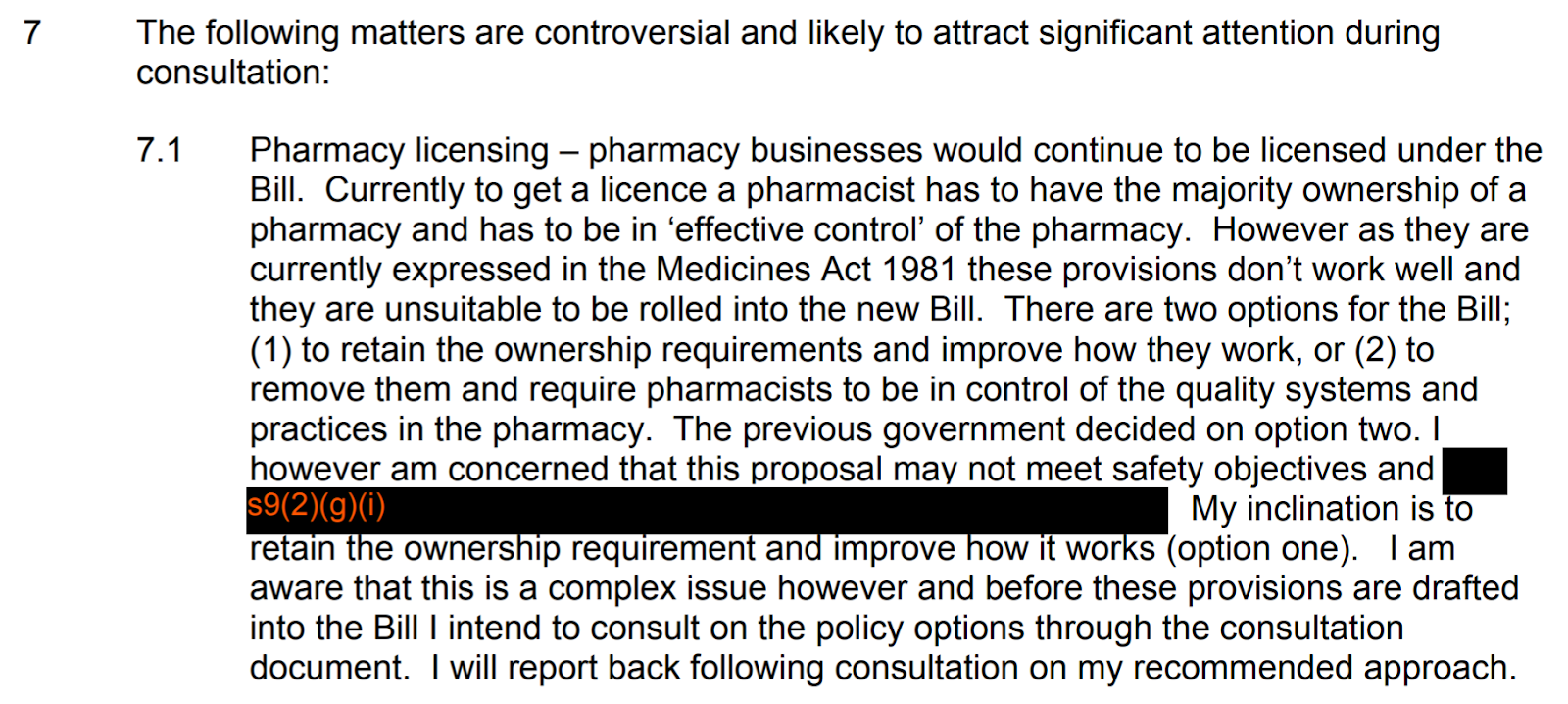
Anyway, why has it been so hard to get decent prices on anything pharmacy in New Zealand? The government screwed up the whole industry, forcing everyone to pay too much for everything, by putting in a rule saying that every pharmacy must be 51% owned by a pharmacist. I don't know how Chemist Warehouse has solved this problem: it's not easy to find one person, who happens to be a chemist, who has the capital to put up to build something like that. Maybe there are interesting ways around it with a clever debt structure. 

The prior National government was looking to get rid of the rule in changes to the Therapeutic Products Regulatory Regime. The pharmacists didn't like it. 

The Bill as currently drafted, and currently under consultation, seems to leave the ownership question open. Or at least I can't find any requirement in it that pharmacies be owned by pharmacists, but I can find a requirement that the responsible persons for the licence have qualifications as determined by the rules - with the rules not specified. I think that's because Minister Clark has left it open. But he does provide some discussion in December's background paper:


The pharmacists' organisation raised a pile of concerns about market concentration in the absence of the rule, but remember that the point of competition law is to improve outcomes for consumers, not to prevent concentration per se. The current model delivers terrible prices for New Zealand consumers - and especially for those consumers least able to route around the current mess by importing the products they need.  

There is absolutely no good reason to require that the person owning a pharmacy be a pharmacist. There are good reasons to require that dispensing be done by a pharmacist. 

The government is taking submissions through 18 April. If you think submitting makes any difference, here's the link.

That the criminalisation provisions in current New Zealand competition policy do not apply to regulators who create cartels continues to frustrate me. New Zealand has a lot of small-market problems that make things a bit less competitive automatically. But everywhere people think they see cartels or anticompetitive activity - dig a little to find the regulatory apparatus blocking competitors' entry.

Tuesday, 12 February 2019

Reader mailbag - supermarket zoning edition

From today's reader mailbag:
Hi Eric,

Why not make supermarkets a permitted activity in any Rural zoned area?

Then another chain could be developed with a lower cost base as they wouldn't be paying retail zoned land prices. Large supermarkets could sit on the outskirts of most cities and towns in NZ with minimal effects. Huge dairy factories and timber mills are permitted activities - why not a supermarket?

There are Aussies chains avail - only Woolworths is here. Also Aldi and Lidl - though they only need quite small sites

One tiny change to the RMA and you could knock food prices down by 25% I reckon. Westfarmers would be here in a heartbeat - they own Bunnings.

Graeme Farr
I thought Aldi was starting to look at New Zealand. But in-town zoning does seem a substantial barrier to entry. In Christchurch, Raeward ran a very nice big supermarket just outside of town by the airport.

Are there currently barriers to putting up supermarkets on rural zoned land? I expect there would be transport infrastructure needed, but there's a lot of rural land on highways. 

Graeme notes the price difference between identical products in New Zealand and Australian supermarkets. A lot of that will be differences in warehousing and transport costs between the two countries, so I'd be surprised if prices came down by quite as much as advertised. But that's not a reason not to open things up. 

Let's make a polling deal

Inland Revenue has admitted it was wrong to ask for New Zealanders' political persuasions in a survey they are carrying out for the Government on the eve of the release of a crucial tax reform report.

The taxman is researching the public's views on globalisation and fairness in the tax system. Questions had included where respondents sit on the political spectrum, prompting questions of whether taxpayers are funding sensitive political polling.
It would be bad if IRD were doing this kind of polling to help its political masters to sell whatever tax changes might be coming, but that's not the only possible interpretation.

We can also imagine scenarios where the political masters wanted changes that IRD knew to be a bad idea, that the politicians thought were popular, and that IRD wanted to be able to demonstrate were not only bad policy but also bad politics. "See? It isn't just rich pricks and right-wingers who hate this particular part of your tax package which we've also told you is a terrible implementation issue. Would you please now consider not doing this?"

I have zero inside line on this one, but it's not unimaginable.

Perhaps, as penance, IRD could just release the polling data for all of us to play with. It would be super awesome to have the full results. And then there'd be no worries about whether they were doing secret political polling for Labour - the results would be up for everyone to play with.
Around 1000 people are being asked questions about their views on Inland Revenue, whether they are generally trusting, believe what they read in the media, pay too much tax or whether public services should get more funding.

A question on where respondents sit on a left/right political spectrum threatens to skirt the department's legal obligation for political impartiality.

Polling experts said the results could give politicians valuable insight on how different demographics view the tax system
I for one would love... hmm. I'll try OIAing the full results.

Monday, 11 February 2019

Counting jobs

I really really hope that somebody in the bureaus is running proper probity over whatever Shane Jones is up to in the Provincial Growth Fund. Because every time we hear news on it, it's just a bit off. 

Here's Jason Walls in today's Herald:
Numbers published on the Ministry of Business, Innovation and Employment (MBIE)'s website show more than 10,000 jobs are expected to be created as a result of Provincial Growth Fund (PGF) announcements made last year.

Of that, 7000 – almost 70 per cent – are estimated to come from just one project: The East Bay of Plenty Regional Development Project Implementation.

This project was allocated just under $240,000 for "funding a position to manage and report on 65 key economic development projects".

That 7000 jobs estimate is based on a feasibility study provided to the Provincial Development Unit, which oversees the PGF, by the Ōpōtiki District Council.
It isn't nuts to run forecasts of expected employment from projects that haven't yet gotten started, but this kind of accounting doesn't seem right.

And this seems just a bit off as well, from the head of the Provincial Development Unit:
The day after Goldsmith said just 54 PGF jobs had been created, the Provincial Development Unit issued a press release which said "job creation does not happen overnight" and that more than 10,000 jobs may be created as a result of all the PGF investment approved to date.

Speaking to the Herald, the head of the Provincial Development Unit Robert Pigou said the statement was only released to provide "clarity" around how the PGF was structured.

He said he was not able to say how many jobs had been created because of the PGF last year, as he "did not have that detailed information yet" but said it would be higher than 54.

"We're working with the [PGF] applicants because many of them are just starting to get into that employment phase [of the projects]."

The 10,000 jobs expectation is based on the estimates of the PGF project applicants, a Provincial Development Unit spokesman said.

"When applicants outline their project, they include an estimate of the number of jobs to be created both directly through the project and indirectly, as a result of the investment."

For larger scale projects, such as the $40 million to expand the TranzAlpine service, financial modelling by an independent economic firm has been used.
I would expect Shane Jones to advertise numbers based on the job creation estimates provided by folks seeking grants from him; he is a retail politician.

I would expect a neutral and impartial public service to be a bit more sceptical about claims made in those applications and not use them to tally up big numbers to put on the Ministry's website. And that makes me a bit nervous about what the heck is going on over there more generally.

It’s always been a mistake to try and sell this stuff on short-term job creation numbers. The point of the fund, as I’d understood it, was to get infrastructure and other bits in place for longer term development in the regions. There are better and worse ways of trying to do that – a pile of loans to business that no commercial outfit would take a punt on isn’t a great idea, but getting better infrastructure in place so that regions that don’t have a strong enough economic base can have a fair go – that’s not crazy.

So I think it was silly to advertise this stuff as aiming at lots of jobs quickly.

That said, it is a bit odd to count as current benefits the estimated increase in jobs that might transpire if a bunch of other projects that haven’t yet been funded all panned out as well as expected by the folks pitching the projects. I haven’t seen the underlying studies, but if the Herald’s description is accurate – it’s an odd way to do things. It’s fine to base expected numbers on projections from studies, but we might have expected the basis to be a bit stronger than that.

I also really hope that there are sufficient checks in place in the bureaus vetting these projects and approving them, making sure that none of them would cause problems for any of our international agreements around subsidies, and making sure that there’s sufficient probity around the projects.