Showing posts with label National Business Review. Show all posts

Tuesday, 10 March 2020

Kiwisaver divestments

I really wish there were some way to leave Kiwisaver. The government's proposed changes to it introduce political risk I find to be entirely too great.

And, it's for something basically futile: trying to reduce greenhouse gas emissions by divestment.

I go through it in last week's print NBR; an ungated version should be on our website tomorrow is here.

Some snippets:
The government has crossed a bright-line rule in its proposed changes to Kiwisaver.

Its proposal to require default funds to divest of any fossil fuel stocks is incredibly unlikely to have any direct effect on greenhouse gas emissions.

To the extent it does, it will only be by reducing returns for investors who stuck with the default funds. Even in that case, it is doubtful to be cost-effective. The government could do more by working through the Emissions Trading Scheme.

And it sets bad precedents for political interference in Kiwisaver investment.

If that were not bad enough, it also means writing climate policy could be done on-the-hoof in response to political demands rather than after careful assessment to ensure our collective efforts to reduce greenhouse gas emissions do the most possible good.

Climate change is too important to address with half-baked initiatives, and retirement savings are too important to become political footballs.

Let’s take each of these in turn.

The government is laudably working to strengthen the emissions trading scheme (ETS). Under the strengthened scheme with a binding cap, there will be a comprehensive and rising price on carbon which will incentivise innovation.

As American economist Alex Tabarrok puts it, a price is a signal wrapped in an incentive. Anyone able to reduce greenhouse gas emissions at a lower cost than the current price in the trading scheme can profit by reducing their emissions and selling the resulting credits – or avoid purchasing costly credits. That ensures the lowest-hanging fruit are the fruit first picked, rather than reaching first for the apples higher up the tree.

Divestment mandates, by contrast, are unlikely to have any direct effect on global carbon emissions. The only direct way they might is by raising the cost of capital for fossil fuel industries, increasing the hurdle rate for new investment projects. That cannot happen unless the mandates push down returns for the funds making those divestments. But as those funds divest, other investors will be attracted to invest by slightly higher returns.

In other words, the mandates push against price signals whereas a carbon price works with price signals. 
I then go through the silliness of basing council consenting decisions on greenhouse gas implications of the project, where those gases are already accounted in the ETS.
We need to be establishing precedents that carbon mitigation measures are properly costed.

Government needs to know the cost per tonne of emissions avoided by different measures so that we can focus on the areas where the most good can be done. Instead, we have a politically driven initiative unlikely to do anything to reduce emissions.

The precedent for Kiwisaver is also destructive. It ignores the entire economic rationale for the investment scheme and invites future depredations.

The behavioural economics underpinning Kiwisaver holds that default options can matter. They are ‘sticky’ – people can be slow to switch to the option they really want. Setting default options to line up with most people’s preferences reduces those switching costs. If most people wind up opting into a retirement scheme eventually, at fairly high cost, why not switch the default?

A wide variety of ethical investment funds are already out there, each catering to different preferences. Mindful Money provides a helpful tool for people choosing a fund which best matches their ethical preferences. But how many people really want to opt into them? Switching the default will only increase switching costs rather than reduce them.

And where the precedent is established for forcing default Kiwisavers into funds matching the ethical preferences of the government of the day, it is easier to justify further changes with changes in government. Mandates requiring that funds prioritise domestic investment are far too easy to imagine.

Friday, 13 December 2019

Revisionist RBNZ history

A couple years ago, the Initiative surveyed its members [update: and, Roger reminds me, a pile of other businesses - about 200 in all!] about their experiences with their regulators. It was less about whether they were happy with the outcomes that obtain, but whether the officials they deal with know the landscape, can make decisions - that sort of thing. It was a broad survey of our members about the regulators they deal with. 

The result was a report released early last year. I was a bit surprised that the RBNZ showed up poorly in its role as prudential regulator. Overall, it looked like proper governance boards mattered in regulator performance; Roger Partridge, the report author and our Chair, recommended that the RBNZ look to its governance structure.
Accordingly, we recommend that:
  1. The board governance model should be adopted for all independent regulatory agencies in New Zealand, including the Commerce Commission and the RBNZ.
  2. For the Commerce Commission, this should be achieved by:
    • reshaping the commissioner role so it is largely a governance (or board member) role, with substantial decision-making power delegated by the commissioners/board members to the commission’s CEO; and
    • broadening the skills set of the commissioner/board members of the commission to include members with industry expertise.
  3. For the RBNZ, this should be achieved by:
    • legislative reforms that make the RBNZ governor accountable to the RBNZ board for the exercise of prudential regulatory policymaking and decision-making power; and
    • broadening the skills set of the RBNZ board to include more banking and insurance expertise.
The report was released just as Governor Orr was coming in; the results couldn't possibly reflect on his Governorship.

He welcomed the report at the time. Here's Hamish Rutherford from April 2018:
Adrian Orr, the new governor of the Reserve Bank, has written to the chief executives and chairs of New Zealand's banks alerting them to a damning report fed by their anonymised comments.

An improbable star of New Zealand finance, Orr, 55, started in the role on March 27, arriving at a central bank which he acknowledges is under fire.

"This place is a diamond, but it needs significant polishing in places," Orr said in an interview in the Reserve Bank headquarters.

"We need to think much harder about how we behave, how we roll, how we explain, how we do things. That's a cultural challenge for the bank."

A survey by think tank the New Zealand Initiative, released on April 13, drawing responses from "some of New Zealand's largest financial institutions" had most respondents claiming the bank's consultation and engagement was poor.

Respondents did not believe management was well-respected, did not find staff constructive and most said the bank did not learn from its mistakes. Verbatim comments from the survey would make for difficult reading for Reserve Bank staff.

"RBNZ [staff are] completely divorced from the reality of how things are done," one told the survey. Another described the bank as "archaic", adding that entrenched officials "don't get challenged".

Written by NZ Initiative chairman Roger Partridge, a former executive chairman of leading law firm Bell Gully, the report gained limited attention in the days after its release.

But Orr has decided to amplify the message, acknowledging the bank's reputation is below what he believes it could be.

As well as posting the comments of the report on the Reserve Bank's internal intranet, Orr had written to bank bosses with the message that: "Hey, this doesn't print well. We hear you. We need to do something about it."

He expected that writing the letter and making public statements would elicit "free, unsolicited advice about how this place can do better".

His letter to the chairs of New Zealand's banks will mean he has written to former prime minister Sir John Key, who is now chair of ANZ New Zealand, alerting him to criticisms that Key probably be familiar with.

The approach of the bank to contact with both the media and the organisations it regulated had been "highly transactional," Orr said.

"It needs to be more strategic, about building that reputation, targeting the things we want to be world best at, letting other things go."
We were really happy with that response; it seemed exactly right. It was encouraging.

And so I was a bit surprised to have these comments of Orr in interview with the NBR's Tim Hunter passed along to me. Subscribers might find it here; I'm on the wrong side of the paywall.
“When I turned up as governor [in March last year] and I walked into this vacuum, the first thing I received was a NZ Initiative report on how we don’t ring, we don’t write, we don’t come to see you, we don’t explain ... this damning report where they’d interviewed eight people.”

The report was the NZ Initiative’s Who guards the guards report from April last year, which found fault with the RBNZ’s governance.

“I felt the bank had almost become a free hit and it was fine just to criticise or throw things at the bank,” Orr. said

“So I deliberately removed the ‘free’ component of that to say ‘well hang on, if you say that, expect to be questioned’.

“We are humans behind this concept called the central bank. You can’t just abuse us. It’s hashtag not ok.

“That we wanted to be open, accessible, and not put up with abuse, came as the biggest shock to the usual customers or the usual behaviour.”
Orr's historical revisionism was a bit surprising, since he was in print last year saying the exact opposite of what he's now saying. He had seemed sincere last year in his welcoming of the report.

The survey overall (lots of members over lots of regulators) was rather broader than "8 people". The number of people who Roger surveyed who deal with the Reserve Bank on prudential regulation won't be huge, sure, but the population of people in the banks who deal with prudential regulation and interface with the Reserve Bank is not vast; our survey went to those on point. A survey of 2000 random-draw members of the public would have been bigger, but utterly useless.

Orr has been far less a fan of our criticisms of the process around the changes in the bank capital requirements, where we have strongly urged that there be a consultation round allowing for testing of the Bank's cost-benefit assessment - which was only published along with the final regulations with no opportunity for such testing.

I've also been critical of the Bank's taking on too many objectives as part of its prudential regulation.

I don't know whether any of that's caused any change in views of our report released last year.

It feels like a revisionist history though, and it's a bit disappointing that the NBR didn't notice the change.

Monday, 1 July 2019

Regulatory icebreakers

Not too long ago, Canada’s Northwest Passage was effectively unnavigable. The ice was simply too thick for sailing ships to make it through during the too-short summers.

And while Netflix’ excellent miniseries The Terror brings an additional supernatural element to the horrors of being icebound on the Royal Navy’s Arctic expeditions of the mid-1800s, the reality was awful enough.

It took more modern icebreakers, and global warming, to make the route more viable.

And for one part of the global regulatory pack-ice, it took Uber.

Imagine, if you will, a heavily armoured icebreaking cargo ship designed to plough through the Northwest Passage. Once the path through the ice is cut, other ships can follow more easily. The icebreaker will get its cargo through first but at a much higher cost per container than the ships that follow in its wake. The armour and the fuel to push through the ice do not come for free.

Over the past decade, Uber has been breaking a lot of regulatory ice.

Most here will remember Uber’s 2016 Parliamentary hearings. Uber’s Richard Menzies had to explain to a Parliamentary committee, some members of whom may have gotten just a little too accustomed to chauffeured services, that there was no risk of someone trying to flag down an Uber as though it were a taxicab. The cars could only be hired using an app on a phone.

Perhaps because our MPs so badly embarrassed themselves in those hearings, New Zealand wound up with workable regulations. It would have been hard for Parliament to recover from a second demonstration of technological incompetence.

But New Zealand is only one country in a big world. And most other countries start with far worse policy than New Zealand. Their pack-ice is thicker than ours.
I go through some of the regulatory ice-breaking that Uber has undertaken, and note the work yet necessary in sorting out reclassification risk.

I conclude:
Principles-based regulation establishing safe harbours against reclassification risk for those providing greater benefits to contractors seems a useful path forward but the path to get there is not free and clear. It takes an icebreaker.

In other areas we talk of first-mover advantages. That is not the case when we think about icebreakers. Breaking the ice is something of a public good. It is a difficult job, and I expect the terrors of trying to make Uber’s model work in France were only slightly less terrifying than being icebound in the Northwest Passage.

But once the ice is broken, anyone can follow. In those cases, there is some merit in being a fast-follower – unless someone is willing to pay an awful lot to have their container be first through the passage. Those of us along for the ride might raise a glass from time to time to the icebreakers.
An ungated version will be up on the Initiative's site in due course and will be linked at that point [Update: it's here].

Thursday, 18 April 2019

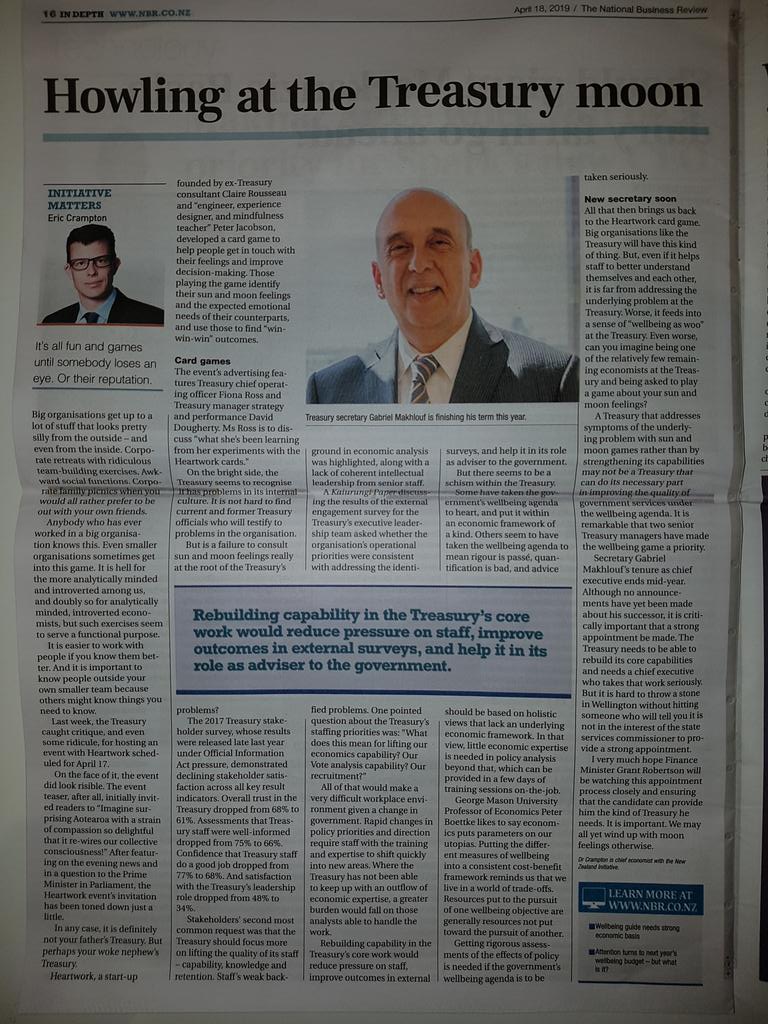
Howling at the Treasury moon

I like the headline that The National Business Review put on this week's column. It isn't online yet; I've a few snippets below:
Big organisations get up to a lot of stuff that looks pretty silly from the outside – and even from the inside. Corporate retreats with ridiculous team-building exercises. Awkward social functions. Corporate family picnics when you would all rather prefer to be out with your own friends.

Anybody who has ever worked in a big organisation knows this. Even smaller organisations sometimes get into this game. It is hell for the more analytically minded and introverted among us, and doubly so for analytically minded, introverted economists, but such exercises seem to serve a functional purpose. It is easier to work with people if you know them better. And it is important to know people outside your own smaller team because others might know things you need to know.

Last week, Treasury caught critique, and even some ridicule, for hosting an event with Heartwork scheduled for 17 April.

On the face of it, the event did look risible. The event teaser, after all, initially invited readers to “Imagine surprising Aotearoa with a strain of compassion so delightful that it re-wires our collective consciousness!” After featuring on the evening news and in a question to the Prime Minister in Parliament, the Heartwork event’s invitation has been toned down just a little.

In any case, it is definitely not your father’s Treasury. But perhaps your woke nephew’s Treasury.

...

But is a failure to consult sun and moon feelings really at the root of Treasury’s problems?
After going through the declining capabilities in economics at Treasury, often canvassed here, I hit some of the implications:
All of that would make for a very difficult workplace environment with a change in government. Rapid changes in policy priorities and direction require staff with the training and expertise to shift quickly into new areas. Where Treasury has not been able to keep up with an outflow of economic expertise, a greater burden would fall on those analysts able to handle the work. Rebuilding capability in Treasury’s core work would reduce pressure on staff, improve outcomes in external surveys, and help Treasury in its role as advisor to government.

But there seems to be a schism within Treasury.

Some have taken the government’s wellbeing agenda to heart, and put it within an economic framework of a kind. Others seem to have taken the wellbeing agenda to mean rigour is passé, quantification is bad, and advice should be based on holistic views that lack an underlying economic framework. In that view, little economic expertise is needed in policy analysis beyond that which can be provided in a few days of training sessions on-the-job.

George Mason University Professor of Economics Peter Boettke likes to say economics puts parameters on our utopias. Putting the different measures of wellbeing into a consistent cost-benefit framework reminds us that we live in a world of trade-offs. Resources put to the pursuit of one wellbeing objective are generally resources not put toward the pursuit of another. Getting rigorous assessments of the effects of policy is needed if the government’s wellbeing agenda is to be taken seriously.

All that then brings us back to the Heartwork card game. Big organisations like Treasury will have this kind of thing. But even if it helps staff to better understand themselves and each other, it is far from addressing the underlying problem at Treasury. Worse, it feeds into a sense of wellbeing as woo at Treasury. Even worse, can you imagine being one of the relatively few remaining economists at Treasury and being asked to play a game about your sun and moon feelings?

A Treasury that addresses symptoms of the underlying problem with sun and moon games rather than by strengthening its capabilities may not be a Treasury that can do its necessary part in improving the quality of government services under the wellbeing agenda. It is remarkable that two senior Treasury managers have made the wellbeing game a priority.

Secretary Gabriel Makhlouf’s tenure as Chief Executive ends mid-year. While no announcements have yet been made about his successor, it is critically important that a strong appointment be made. Treasury needs to be able to rebuild its core capabilities and needs a Chief Executive who takes that work seriously. But it is hard to throw a stone in Wellington without hitting someone who will tell you it is not in the interest of the State Services Commissioner to provide a strong appointment.

I very much hope Minister Grant Robertson will be watching this appointment process closely and ensuring that the candidate can provide him the kind of Treasury he needs. It is important. We may all yet wind up with moon feelings otherwise.


If all of that's too depressing, here's some Ozzy Osbourne to help. 

Bark at the moon.


Update: here's an ungated link; here's a gated link.

Monday, 25 February 2019

Looking-glass productivity

Over at the NBR (ungated), I get annoyed at the persistent Wellington tendency to get productivity backwards. Government's role isn't to run studies figuring out which firms are productive, which ones aren't, and to then try to arrange for the one to teach the other. Government's role should be figuring out and removing the barriers to entry and the barriers to competition that keep business away from the productivity frontier. 

A (lengthy) snippet:
Some folks take the wrong lesson from intermediate microeconomics – or never took the course in the first place. I worry that too many of them staff Wellington’s bureaus.
Every decent second-year university paper in microeconomics teaches students there are two equivalent ways of getting to efficient outcomes but one of them is much easier to implement.

Imagine an omniscient and benevolent central planner existed who knew our abilities, the productive capabilities of every firm in the market and exactly what each of us values. That benevolent planner could ensure efficient outcomes where no one could be made better off without making someone else worse off in the process. It is hard to do things that way because the knowledge the planner would need to make those decisions is impossible for the planner to obtain.

Fortunately, the welfare theorems in every intermediate microeconomics course show us that, if competitive markets are working well, we get there automatically. Prices coordinate individuals’ plans, so we wind up at the same kind of solution that the benevolent planner would have chosen. There is no need for a bureaucracy to figure out which firms are the most efficient at teaching the others how to work better as the discipline of markets takes care of it.

All of that left me rather irritated during the Productivity Commission’s “Productivity Hub” seminar last week on productivity in construction.

Housing New Zealand and BRANZ had commissioned work to review the literature on the productivity of housing construction before scoping future work on estimating the productivity of New Zealand’s housing construction sector.

It’s a big topic that matters. There have been conflicting studies on whether construction productivity has been stagnant or improving, and whether there is a long tail of low-productivity firms in the sector. Housing New Zealand is set to embark on a substantial bit of house building and will want to build the most houses possible on its budget.

Economic modelling

The work proposed using New Zealand’s administrative data to find the construction industry’s productivity frontier. Firms producing the greatest output value for their combined sets of inputs define the frontier in this kind of stochastic frontier analysis work; firms using the same amount of inputs to produce less overall value are inside the frontier and are considered less productive.

The seminar focused on important technical issues like the merits of Cobb-Douglas as compared to translog functional forms and the merits of stochastic frontier analysis over conventional linear regression techniques in figuring out which firms are most productive.

But I was getting itchier and itchier over the course of the seminar – as were a few others. It was not the researcher’s fault at all – she proposed taking the right approach to the question as defined. The problem rather was the framing of the question and its policy consequence.

Trabant efficiency

Imagine going back in time to 1982. You’ve been hired by the East German government to examine the productivity of the country’s automobile construction sector. You’ve been asked to use the latest statistical techniques to figure out which of Trabant’s suppliers are working efficiently and which are not. The government wishes to do this so it can send experts into the efficient plants to figure out what they are doing, so they can help the less efficient suppliers to get up to speed.

Stochastic frontier analysis was not really available then but that was hardly the main problem. Even if they got every one of the Trabant plants, and their suppliers and their suppliers’ suppliers running as efficiently as the most efficient East German plant, they would have mis-specified the problem. They would still have a Trabant at the end of the production line, and the value of a Trabant was less than the value of all of the bits of plastic and metal and rubber and labour that went into producing those things – and it certainly ran less well than the Volkswagens produced across the border in West Germany.

Instead of commissioning a study that might figure out which plants are efficient, tearing down the Berlin Wall and allowing free trade would let markets figure it out. Efficient plants might survive; inefficient ones would put their machines and workers to better use elsewhere.

New Zealand reached a similar conclusion about its local automotive industry during the reforms of the 1980s and 1990s. Economist Steve Landsburg talks about the Iowa car crop. Growing corn, selling it to Japan, and getting cars back, is a more efficient way of building cars than a lot of ways America has tried. New Zealand’s paddocks, forests and office towers provide our car crop more efficiently than did the Petone plant.

The construction productivity work specified the problem back to front but was hardly the first to do so. An academic study might point out which firms seem more productive than other firms but it can be easy to get those things wrong – especially when New Zealand’s construction firms have operated within a system designed to stymie construction productivity.

Regulations nest

Zoning has never allowed building to any reasonable scale, so the industry developed for smaller scale developments and bespoke projects. A broken land use planning system has given us a construction industry that may be relatively efficient within that system but it is not the one needed for the scale of the task at hand.

A nest of regulations and perverse incentives in council consenting makes it difficult to use far less costly but higher-quality construction materials from trustworthy places like Vancouver or Seattle or Tokyo. Costs here are consequently much higher; productivity is the ratio of the value of the outputs to the value of the inputs. Building houses costs (very roughly) twice as much here as it does in Texas, leaving land costs aside.

And competition from foreign suppliers is hampered not only by the Overseas Investment Act but also by the morass of local regulation that local firms have learned to navigate but foreign firms have not.

Seeing the productivity problem as one of finding the most efficient firms and cajoling the others to behave more like those Stakhanovites  (Soviet Union workers who took pride in their ability to produce more than was required, by working harder and more efficiently)gets the problem back to front. It is trying to work the welfare theorem from intermediate microeconomics the wrong way around.
I think the NBR's editors added the definition of Stakhanovite. I didn't know that was no longer a term I could assume commonly known. Alas. 

Monday, 18 June 2018

Storing resources for the future

In this week's NBR, I made the case for storing materials until it proves economical to recycle them. I think that is consistent with Auckland Council's declared zero-waste mission.

Think about bauxite deposits. Some of those deposits are economical to mine now for aluminium production; some may become worth mining in the future. It would be a mistake to try and pull all of the bauxite out of the ground today just because somebody doesn't like that it's sitting down there in the ground, waiting to be pulled out later when it's profitable to pull it out. Prices do a great job in helping people figure out which deposits should be saved for later.

Some waste materials are eminently profitable to recycle now. Copper is so profitable to recycle that some folks try pulling it from live power lines. But other materials are not currently profitable to recycle.

I suggest that we should store those materials safely, in a clay-lined hole, covered up so they cannot blow away and cause issues elsewhere. That the fee for storing the materials should cover the costs of building and maintaining the storage facility. And that doing things that way minimises overall waste - just as we waste resources mining difficult bauxite deposits before their time, so too do we waste resources when trying to recycle difficult materials before technology has made that recycling profitable.

Those with a subscription can read it here.

One reader emailed me to note that if tip resource storage facility fees are too high, it can encourage illegal dumping. He's right. I like how Christchurch handled that problem when I first moved there: each household gets 26 rubbish resource storage bags free for the year, but has to pay for any extras.

The problem shouldn't be too big though where tip resource storage facility fees aren't that high. But it could be more substantial if tip resource storage facility fees were set to punish evil rather than to just recoup the costs of running a tip resource storage facility.

Tuesday, 21 November 2017

The refugee revolution

Nevil Gibson at the NBR notes the importance of migrants to New Zealand's arts scene. The Second World War brought refugees from central and eastern Europe. Their contributions are noted in a new book from Leonard Ball at Auckland University Press. Nevil writes:
Historically, despite being a 19th-century settler economy, immigration was minimal in the 1930s and popular attitudes were hostile to “strangers.” Even the arrival of some 1100 refugees allowed in up to 1940 was resisted in some quarters.

The author of a new book on these mostly central European refugees from Nazism says, “The doors to New Zealand were almost closed.”

Leonard Bell’s Strangers Arrive: Emigrés and the arts in New Zealand, 1930-80* describes the impact of those immigrants both before and after World War II. Supplemented later by Dutch migrants and those fleeing communism, they had a profound influence on architecture, the arts, education, industry, science, medicine, fashion, cuisine and much else.

A Czech refugee, Ernst Mandl (Mr Bell's father-in-law), was told by the New Zealand High Commission in London in mid-1939 that 16,000 applications from others seeking to leave Europe had been rejected.

A junior staff member of the commission, George Fraser, later recalled in his memoir, Both Eyes Open, that, ”We could have recruited some of Europe’s finest … but balked at it.”

Opposition came from groups as varied as the British Medical Association (which demanded “retraining” of doctors), the Returned Services Association and sports clubs.

Xenophobia and, let’s face it, anti-Semitism was commonly expressed in the media and in attitudes to hiring “aliens” from European countries – Germany and the former Austro-Hungarian Empire – that New Zealand had fought in World War I.

Those attitudes were also directed at European allies, such as the French, but were countered by local Jews, Quakers and academics, who were supportive of the refugees. (For another perspective, see Jewish Lives in New Zealand History (2012), co-edited by Mr Bell.)
Nevil goes through substantial contributions to the arts, culture and architecture from New Zealand's small group of admitted WW2 refugees - he calls it a cultural revolution.

I wonder what contributions the thousands who were turned away could have made here, and how many of them were murdered in Europe after finding doors closed.

Ball discusses his book here.

Monday, 22 May 2017

Regulatory incidence and housing

Knowing a bit about tax incidence is useful if you want to be able to figure out what policies might help with Auckland's housing affordability issues. Here's me in last week's NBR:

Auckland’s housing markets are a mess but they are not the hell of perfectly inelastic supply. The burden of taxes and regulation in housing markets are shared between buyer and seller. If we expect that housing will become relatively more elastic as the unitary plan takes effect and as central government policy around infrastructure improves, then effects of other policies change.

Measures like rental warrants of fitness could actually provide net benefits to tenants – if we do not expect supply conditions to improve. But as soon as regulations around housing and infrastructure shift to allow more supply, then those same rules flip to making tenants worse off.

When supply is working properly, tenants sort into the quality and price tier that best suits their preferences and budgets. Rental warrants of fitness then at best compel landlords to provide what tenants were already demonstrating that they wanted, and at worst make rental accommodation too expensive for some tenants.

And so politics makes for strange policy bundles.

Labour proposes fixing regulation so that more housing can be built: abolishing the rural-urban boundary and improving infrastructure financing. But Labour’s promised Healthy Homes Guarantee makes the most sense if housing supply issues are not addressed. And if zoning and infrastructure are sorted out, there is little need for the government to be directly involved in building more houses.

Meanwhile, National has spent the past nine years avoiding fixing the underlying urban planning and infrastructure financing problems. It has blamed coalition politics but has remarkably managed to fail to take up those opportunities that have arisen.

Its general preference to avoid undue intervention into rental markets should really be coupled with policies that would allow new development.

Tax incidence can yield counterintuitive conclusions about who benefits from policy. A simpler question for voters to ask: will this policy make it easier for new housing to be built? If it does, then builders could get on with the important task of exercising their comparative advantage: easing the housing shortage.
Do subscribe, but you can read the whole thing here.

Wednesday, 25 January 2017

Housing affordability

Demographia's annual survey came out on Monday. They compare the price of the median house to the median household income in each city. On that measure, Auckland housing is less affordable than housing in San Francisco.

Nowhere in New Zealand should be as unaffordable as San Francisco. It takes effort to screw up your housing supply so badly that you're more unaffordable than San Francisco. A big congratulations to everyone involved in this disaster.

Sally Lindsay over in the National Business Review covers some of the Initiative's take on it; I also have a chat there with NBR's Andrew Patterson you can listen to.
Over the past four years, the Initiative has produced a series of reports and opinion pieces on New Zealand’s housing crisis. Initiative research head Eric Crampton says the latest Demographia report is even more sobering reading.

“San Francisco is an American poster-child for housing unaffordability. It is haemorrhaging people and jobs to cities with sensible land use planning and affordable housing and now Auckland is even more unaffordable than San Francisco."

New Zealand policymakers have been grappling with the rapid appreciation in house prices over recent years, blaming councils for limiting land use and poor infrastructure planning. More recently, the Reserve Bank's prolonged period of extraordinarily low interest rates has stoked credit expansion, prompting governor Graeme Wheeler to impose lending restrictions to curb mortgage lending.

Dr Crampton told NBR Radio's Andrew Patterson fixing infrastructure financing and letting councils better share in the benefits of urban growth along with planning reform and liberalisation, with a financial framework that encourages development have to be at the top of the policy agenda if New Zealand wants affordable housing.

He says it is imperative the government and Auckland Council make housing affordable again, as well as developing a strategy to ensure supply can keep up with growing demand.
Meanwhile, over at Interest.co.nz, I go through more of the problems in Oxfam's report on wealth inequality. One perverse effect of Auckland's housing mess: if you own the average house in Auckland free and clear, you're likely in the world's top 1% of wealthiest people.

Wednesday, 11 January 2017

Happy New Year

New Year's resolutions had always seemed a little silly to me: If something is worth doing, why would you need to make a resolution about it? But publicly proclaiming your intentions to do better can constrain you against doing worse. Others can observe your actions and judge your failures.

New Year's resolutions make it a little bit harder to give into temptation. And those wanting even stronger constraints can always choose them: promising a big donation to the charity of choice for anyone catching you breaking your resolutions can do the trick.

These kinds of resolutions work because there are always friends or family who want to help you to help yourself. Finding ways of breaking the spirit of the resolution while keeping to its letter doesn’t work when someone who knows you well is monitoring things.

As much as the government likes to tut-tut individuals’ private choices about whether to eat, drink and be merry, the government has a harder time than we do in tying its own hands.
From my column in 23 December's NBR (ungated here). I suggest a couple of resolutions the government might consider, and ways of making them stick:
Most importantly, it should resolve to restore Auckland’s housing affordability. Although this is a matter of zoning decisions and infrastructure provision, Auckland Council operates within rules and incentives created by central government – as Mr Key recognised in 2007.

Resolving that the price of the median house in Auckland would not be more than, say, nine times median household income next year, with a declining ratio from there, would be a start. Setting up the infrastructure and zoning policies that would automatically be triggered if housing affordability were not restored would make the resolution credible.

Prime Minister Bill English should commit his government to two further resolutions, both drawing on his experience as minister of finance. His was only one voice of many in the cabinet. If another minister put forward a proposal with a weak regulatory impact statement or poor cost-benefit assessment, Mr English had to pick his battles.

But as prime minister, he could resolve that the cabinet will no longer consider proposals with inadequate support. Ultimately, ministries’ rigour in preparing documentation in support of policies depends on whether the cabinet has any demand for rigour. Providing that demand should be a New Year's resolution against ministerial excesses.

Finally, the government should resolve to embed the changes Mr English started as finance minister: testing the effects of welfare policies to see which work and measuring outcomes against long-term fiscal liabilities.

The Treasury recently put up an excellent Outcomes Catalogue Tool showing the government’s initiatives, the outcomes those initiatives target and how those outcomes are measured. Resolving to make that an annual release, along with the figures showing whether things are on track, would be an excellent way of making these changes last.

We all face temptations. Individuals have lots of ways of overcoming these, even if the government is often a bit too dismissive of our ability to do so. It’s time the government took its own self-control issues seriously and made a few resolutions for a better 2017.
Apologies for the break in posting. I took a Christmas holiday with the family up to Tauranga and then to New Plymouth and didn't bring a computer along. Pokemon Level 32: Achieved. I think one of my Pokemon is still on a gym up there.

I was to have been back on deck this Monday, but came down with some kind of plague Friday night from which I'm recovering. High fever in the middle of the night brings interesting dreams though:
Unfortunately, I woke up before I could tell whether there were really a shinigami involved or just a standard cursed typewriter.

Friday, 25 November 2016

Spring cleaning

Wellington's quake-prone heritage-listed buildings remain scary. My column in this week's NBR ($) suggests prioritising the risky heritage buildings, pulling the heritage listings from the scariest ones, and putting public money into the ones where the heritage amenity is really worth it. 

Or, Council could just buy the buildings from their owners, fix them itself, and sell them afterwards - though they would almost certainly take a pretty big loss in doing so. The loss is the same loss they're currently imposing on private owners via the heritage listings, but putting it on the public account never feels quite as nice for the regulators.

A snippet:
The most recent data say Wellington has 641 registered earthquake-prone buildings. Of those, 20 are Category 1 places listed by the Historic Places Trust and 44 more have Category 2 status. Another 62 are listed by Wellington Council but not by the trust.

These listings are their own kind of basement clutter.

Looking through our basement, I often had a hard time remembering why we had gotten some of that stuff in the first place. Looking through the heritage listings has a similar feel: buildings added to the list with little background documentation on how they ever got there.

It seems amazing that the Gordon Wilson Flats were ever heritage listed, despite their apparently rare status as a state housing high-rise built by a National rather than a Labour government. While I can throw out the ugly wedding present in the garage given by a long-deceased relative, it’s harder to get rid of heritage-listings on dangerous buildings. Appeals processes are still under way for the Gordon Wilson flats.

Those delays can be deadly. In Christchurch, the owner of a heritage-listed building on Colombo St wanted to demolish it after the September earthquakes. The council blocked demolition pending the right processes being undertaken.

February’s earthquake did not bother with consenting processes and killed 12 people in a bus outside the building without seeking the leave of any council official. The council staff who delayed demolition faced no liability for their choices.
I covered similar themes in last week's Insights newsletter, focusing on the Human Rights Commission's report on property rights in post-quake Christchurch.

Wednesday, 9 November 2016

Giving credit the credit it's due

If we assume that people who use credit cards get no benefit from using credit cards instead of using EFTPOS, then it's pretty easy to show that using credit cards is socially costly. It's more expensive to process credit card transactions; these can be real resource costs. Anytime the benefits of something that has real resource costs are assumed equal to zero, it's pretty easy to show it's something pretty costly, on net.

MBIE's consultation document on credit card fees racks up some substantial costs of credit card use, under the assumption that the 40% or so of consumers who pay off their balances in full every month get no benefit from the use of the credit facility.

I pay off my credit card balance in full every month. Among the many benefits I enjoy when using my credit card rather than EFTPOS:

  1. Simplicity in ordering things online. It is a pain to arrange a bank transfer when ordering things online. I've done it for some retailers who didn't take credit when I was last building a computer and needed to buy components. But it adds 15 minutes to a transaction. 
  2. Consumer protection. Credit cards come with protection against fraud that doesn't come with normal EFTPOS.
  3. Ease of use internationally. We had a few issues in using our credit card last time we went back to North America, despite having warned Kiwibank ahead of time that we'd be travelling abroad and that we needed our cards working in North America. But the EFTPOS cards only work at bank machines, not at retailers. Visa and Mastercard work everywhere - barring glitches.
  4. Not having to carry foreign cash when travelling abroad. If you pull cash using EFTPOS rather than just using your credit card, you have to guess how much cash you're going to need. 
  5. Before we had a mortgage with a credit line, the credit facility was useful even if we did pay it off every month - the 40 days' interest-free after purchase before payment gave time for smoothing things out for big lumpy purchases like whiteware. That is helpful. Since having the mortgage with the credit line, the credit facility lets us shave off some of our monthly mortgage interest payment - although that counts as a transfer in the welfare analysis.
I don't know what the monetary value of all of that is. But it sure isn't zero.

I hit some of this in my column in last week's NBR ($). A snippet:
MBIE assumes that 40% of customers choose credit cards over EFTPOS solely because of rewards like cash back or Airpoints dollars. They then go on to calculate the $45 million in costs to the economy on the assumption that those consumers receive no benefit from using credit other than the rewards. That is a huge problem in their analysis, and we will come back to it. Let’s pretend they’re right for now, even though we know better.

On a first cut, it seems that there should be little to worry about. Retailers can choose whether or not to accept credit cards; customers can choose whether to go to places where the prices are slightly higher and credit cards are accepted, or to go to retailers with slightly lower prices that only accept EFTPOS. What’s the issue?

The MBIE report worries that all but the largest retailers are forced by competition to accept credit cards. It also warns that things may get worse, with increasing popularity of credit over EFTPOS and the potential rise of reward-scheme debit cards. And it notes that if merchants increase prices across-the-board to cover the higher fee cards, poorer customers who are less likely to those cards will be adversely affected.

If part of MBIE’s basic model is that retailers cannot afford to forego accepting credit cards because the more valuable customers choose retailers based on whether they can use their reward-laden, high-fee cards, it seems odd that high-end (but low margin) Wellington grocer Moore Wilson has a surcharge for credit card users that dwarfs scheme-based rewards.

Merchant choice really does not seem that weak. I expect that you, like me, have seen plenty of shops and restaurants with a piece of black electrical tape over the credit button and others with a little piece of paper taped underneath the credit button saying “No Credit.” And plenty of small shops and restaurants will put a minimum purchase size on credit card transactions – often $15.

If merchants do have effective choice in whether to accept credit cards, or to accept them only with a surcharge, then the power-based arguments in MBIE’s analysis are less compelling.

But there seems to be a more fundamental problem in MBIE’s cost tallying. Reward schemes are nice, but they are hardly the only reason that a lot of consumers choose credit over EFTPOS. 

Tuesday, 6 September 2016

Disharmoney

This past week's subscription to The NBR was covered by Tim Hunter's excellent piece on the regulatory mess facing peer-to-peer lender Harmoney.

The Financial Markets Authority seems fine with Harmoney. But the Commerce Commission is suing it because it can't figure out who is the lender (the peer-lenders, or Harmoney), and whether Harmoney's fee-structure is then consistent with a pile of other regulations or not.
A regulator could scarcely be more destructive without procuring a giant wasps’ nest, agitating it vigorously and releasing it into the previously calm interior of its victim’s compact Parnell office space.
The problem comes of stupid legislative drafting saying that a credit fee cannot be "unreasonable", but that doesn't define unreasonable. And so it gets more confusing:
It sounds like bland bureaucratic nitpicking but it isn’t because, under the CCCFA, a credit fee must not be “unreasonable” – and according to the Supreme Court’s May decision in a case involving the commission and retailer Sportzone, that means it can be set to recover only the costs specific to a lending transaction.
For an online provider like Harmoney, whose business is based on trying to make the cost of each transaction close to zero, the consequences of that restriction would be significant.
But is it a credit fee?
Under the CCCFA, a credit fee is charged by a lender to a borrower but, if Harmoney is an intermediary, it can’t be a lender, right?
Not according to the Ministry for Business, Innovation and etc because compliance with the CCCFA requires the lender to be identified to the borrower, and Harmoney couldn’t identify its lenders in that way, so set up a trust to take the money from individual lenders and act as the named lender.
It doesn't get better from there. FMA seems to have the more sensible position, and scraps with the Ministry and Commerce Commission about it; Harmoney's stuck in the middle. Hunter suggests it could all have been solved by clearer regulation just requiring lenders to disclose the APR: the annual percent interest rate equivalent inclusive of all fees.

File under: Not the outside of the asylum.

Friday, 12 August 2016

Taxes don't build houses

I'm still not a fan of capital gains taxes as a way of digging our way out of a shortage of houses. Taxes don't build houses. Me at The NBR (ungated, but dated - you should subscribe - their coverage is worth paying for). A snippet:
More broadly, though, capital gains taxes of all forms tax future consumption more heavily than present consumption. Taxes on wages and salary incomes do not affect choices of whether to save or spend from today’s income. Taxes on consumption, if they are not expected to change over time, are also neutral between spending today and spending tomorrow. But taxes on savings mean that tomorrow’s consumption is more heavily taxed than today’s. 
Real world implementation issues abound. Investment in New Zealand does not enjoy tax-preferred status, so the case for taxing capital gains is far weaker than where investors can defer income taxes by placing income into sheltered investments. And every dollar spent out of capital income draws 15% GST. 
It would be near impossible for Inland Revenue to implement a capital gains taxation regime before its systems refresh. What descriptions I have heard around Wellington suggest the tax computers are held together by No 8 wire and the world’s last remaining stock of COBOL programmers. Any substantial tax changes could make the system’s 50 million lines of code collapse in a flaming heap.

If capital gains taxes are meant as solution to Auckland’s housing problem, it may well be impossible to implement it within the next six or seven years. It could well be faster to get new apartments consented in Epsom. 
Nor will taxes make Auckland housing more affordable for a simple reason: they do not get more houses built. The fundamental problem in Auckland remains a zoning-induced shortage of housing.

Tax reform, over the longer term and after the IRD systems refresh, is well worth looking into. There are poisonous fishhooks in a lot of proposals that look attractive but shifting to the kind of land taxes suggested by Arthur Grimes has clearer merit. 
At best, tax reform fails to help a housing shortage. At worst, it distracts from the more important problem of getting new houses built.

Wednesday, 10 August 2016

Hot takes and inequality data

Me at The NBR on some ... oddities ... in the latest HES wealth data. A snippet (ungated):
The HES tables sort households into quintiles by net worth. The first has the 20% of households with the lowest household net worth; the fifth quintile has the top 20%. The tables list the assets and liabilities held by households in each quintile. 

Households with less than $39,500 in net assets make up the bottom quintile. Collectively, those households own owner-occupied houses worth $3.99 billion, or $219,000 for the median household that owns the house they live in. The figure feels a bit low: are there really that many houses out there that are worth less than $220,000? But part-ownership of those houses could help make sense of it if parents putting down the deposit on the kids’ house gives them a stake in the ownership.

More puzzling was that, against that $3.99 billion in housing assets owned by the least wealthy 20%, were $4.899 billion in loans against owner-occupied residences. The last time I checked, banks needed to comply with 80% LVR ratios, not 123% ones. But even if there were no LVR considerations, what bank would lend multiples of the value of a house to the people in the least wealthy cohort? And so it was time to check the footnotes. 

The notes tell us that assets held in a business or trust are not counted, unless they are mentioned. 

It seems implausible that the least wealthy 20% of the population have put their houses into trusts but it could be a consideration in some cases. 

If a family owns houses in a trust, and the 20-something living in it has just graduated from university and has taken over the mortgage, the mortgage liability could show up in the accounts but not the asset. But that story seems to fall apart when we look back to the median tables rather than the totals. Among those first quartile households reporting ownership of a house, the median house value is $219,000. But the median debt on owner-occupied housing, among those with mortgages in first quartile households is $240,000. 

It does not make sense that the debt on the median house owned with debt is greater than the value of the median owned house in that quartile, unless the median home recently purchased by those in the bottom quartile is of substantially better quality than those that have been long owned by those in the bottom quartile. More plausible are problems caused by out-of-date valuations. Statistics New Zealand tells us that the valuations used in the HES are from government valuations which can be up to three years old. GVs are well behind actual house prices. 

If you have just purchased a house, the liability ledger will accurately reflect the value of your mortgage but your house could be undervalued by 20-30% – or more if you bought in the right place in Auckland. 

These measurement issues then mean that wealth held by the bottom quartile is probably strongly understated – as are the housing assets held by all other quartiles. It matters a lot more in the bottom quartile – it winds up having about a billion dollars more in total household liabilities than it has in total household assets. Counting education loans on the liabilities side of the ledger while not counting the value of the human capital it embodies also makes for problems. These loans loom large on the liabilities side for households in the first quartile but are mostly held by younger people with strong future earnings potential and good future upward mobility – not the cohort typically worried about in discussions of inequality. 

Monday, 1 February 2016

Costing policy

My Friday column at The NBR noted some of the potential difficulties in the Greens' proposed policy costing regime.

  • Housing it in Treasury is a bad idea as compared to in an independent office of Parliament, so it would not have to conduct a substantial body of work that it would need to keep secret from the Minister overseeing the agency;
  • A rule or norm that every policy be costed means that it will be more difficult to cost policies than you might expect for currently costed policies. Why? Right now, parties can refrain from costing silly policies. In the alternative, they'll have reason to delay and obfuscate, making it harder for agencies to undertake a costing;
  • New spending at each election can be big, but even bigger is the body of existing policy that is rarely revisited.
And so I concluded:
But the bulk of the government’s spending – the big line items that do not change much from budget to budget – receive rather less attention.
Take the government’s student loan programme. Labour’s zero-percent student loan policy drew attention during the 2005 election campaign and again in 2008. But we do not often hear discussion of the $5 billion gap between the nominal value of the loan and their carrying value.
The vast majority of government spending simply carries on, from year to year, without much notice.
Perhaps an agency established to cost new political party proposals could, between elections, spend its time running rolling reviews of existing spending programmes, ensuring they continue to deliver value for money.
After I filed the column on Wednesday, I found that Mike Reddell had some similar things to say. He also helpfully points to international examples. He also suggests it could be at least as good to simply provide funding to political parties that they then be able to commission independent evaluations. Here's Reddell:
On balance, I still think there is a role for something like a (macro oriented) fiscal council in New Zealand, perhaps subsumed within the sort of macroeconomic or monetary and economic council I suggested here (but perhaps that just reflects my macro background). And there is probably a role for better-resourcing select committees. But when it comes to political party proposals, if (and I don’t think the case is open and shut by any means) we are going to spend more public money on the process, I would probably prefer to provide a higher level of funding to parliamentary parties, to enable them to commission any independent evaluations or expertise they found useful, and then have the parties fight it out in the court of public opinion. The big choices societies face mostly aren’t technocratic in nature, and I’m not sure that the differences between whether individual proposals are properly costed or not is that important in the scheme of things (and perhaps less so than previously under MMP, where all promises are provisional, given that absolute parliamentary majorities are very rare). If there are serious doubts about the costings, let the politicians (and the experts each can marshall) contest the matter.

Thursday, 28 January 2016

The Poverty of Inequality Reports

My column in last week's NBR went through the latest Oxfam report on global inequality.

Among the problems:
  • Any chart showing the time series wealth of the n richest people today has a strong bias towards showing an increasing trend. Anyone who was on last year's top-n list but had a poor run drops off the list, with his decline not measured; anyone who didn't make last year's cut but did this year is pretty likely to have had good returns recently. A chart showing the time-series wealth of the 62 people who were the richest people in 2002 would have a different pattern than a chart showing the wealth in prior periods of this year's 62-richest.

  • Failing to account for net debt held by people in rich countries with good prospects means that Oxfam was able to report a "number of billionaires" figure about half of what they'd otherwise have had to have reported. In their appendix, they note the problem isn't big because it doesn't take many of the richest billionaires to cover the total debt in the developed world, but the top richest billionaires are much richer than the ones that are 60th through 120th. 

  • Most of the movement in the wealth of the bottom 50% shown on their big headline chart is just fluctuations of the US dollar relative to others. I doubt that a very poor person in Sub-Saharan Africa notices or cares much about the US dollar exchange rate. The world's wealthiest, by contrast, will have globally diversified portfolios and far less subject to US dollar currency risk. Tell me the green line below isn't just tracking the US TWI. And note that the Credit Suisse report warns that the changes in wealth are strongly influenced by exchange rates.


It's also worth noting that the Credit Suisse report has 453,000 Kiwis in the world's top 1% by wealth. Just owning your own home in Auckland will get you pretty close to the line. And about half of all kiwis are in the world's top 10% by wealth. If you want to hate on the top 10%, or the top 1%, you might want to look in the mirror.

An ungated version of the column is now up here. You should subscribe to the NBR.

Friday, 18 September 2015

Doing the most good we can

I really rather like my piece in this week's National Business Review ($). I there discuss Peter Singer, effective altruism, Wellington's hordes of bucket-wielding sidewalk charity collectors, and outcome-based funding of NGO service delivery.

A snippet:
It is hard to resist Professor Singer’s call for more effective altruism. Whatever your charitable preferences and wherever you most want to help, doing the most good you can toward your chosen ends requires being careful about where you give. It also poses a challenge for the charitable sectors. The government has been increasingly insistent on outcome-based performance measures in its contracting for services and some charities seem uncomfortable with the rigorous evaluation that such measures require.
It is not easy to measure the good that you can do. But organisations chafing at performance-based contracting with the public sector should not sit back and hope the fad passes by.
As more private donors start watching the kinds of evaluation being provided by places such as Give Well and demand better measures of the good their dollars do, charities wanting to keep those donors will have to keep up. It might get harder to rely on the bucket brigades.
A pre-pub is here. But you should subscribe. There's great stuff in this week's issue from Matthew Hooton on Seymour and ACT and Hosking on international tax issues. And they've provided the country's best coverage of the ongoing saga of earthquake building standards.

Tuesday, 7 July 2015

GST as non-tariff barrier?

Shoppers are sceptical that taxing low-value imports is a hot idea.

The NBR reports on a new Horizon poll. In this first set, respondents pick all answers they think should apply.


I'd have gone with the plurality response here (plurality rather than majority as respondents can choose more than one answer, and sum of answers is around 120%).

In the absence of a mechanism that would cheaply and efficiently apply GST at the border, we should likely stick with the status quo. If we can set up a system that works through the shippers to apply GST to imported goods at minimum cost to importing consumers, that could make sense - subject to feasibility and cost-benefit assessment.

I'm a bit curious about why second-hand items from abroad should be exempt from GST. The usual argument for second-hand goods' exemption is that tax was paid on them when they were new, but that wouldn't apply to imported used goods.

Respondents were then asked which policies they'd prefer if the tax difference resulted in closed shops or job losses, support for the status quo dropped:


The point of applying GST at the border isn't to protect domestic jobs, it's to avoid creating a distortion in favour of direct-to-consumer imports and to avoid erosion of the tax base. 

On the first count, if collecting GST at the border introduces hassle costs for consumers equivalent to or greater than the 15% GST, then it's a distortionary non-tariff barrier; this isn't hard for low-value goods. 

The second one is harder. Suppose that NZ retail is hopelessly inefficient and that everybody shifts to purchasing online from overseas for anything other than groceries because they can save 30-50% pretty easily. The effects on the tax base could be pretty substantial. You then have to weigh the distortions caused by GST on low-value imports against the deadweight costs of other forms of domestic taxation, and I have no strong priors which way that would come out. But the relevant consideration is deadweight cost of a lower GST threshold against the deadweight cost of higher income taxes; we might also worry about the effects of reduced competition in the tradeables sector.

Retail NZ's Greg Hartford didn't seem to like the respondents' urging that retail become more competitive:
“Retailers are working really hard to make sure they can deliver their products. The reality is that New Zealand is a small market and retailers are very small compared to international companies. We just don’t have the scale to be able to negotiate discounts the way Amazon can, for example,” he says.
If that's true, and if consumers can more effectively buy directly from overseas, then domestic retail should shrink.

It's worth keeping an eye on GST proposals that come up. There are some that might not be terrible; others would impose unnecessarily high costs on consumers.

Get your NBR subscription and read the whole thing. Total online retail sales are now three times what they were in 2010, and the international component has risen from about 35% to about 45%. It would be surprising if there weren't more solid proposals coming out around GST on low-value imports in the next few years.

Friday, 27 February 2015

4 years on

The government rightly took a lot of criticism for its initial attempts to artificially restrict downtown land supply to force a compact city form and encourage higher-valued development. The planners here exhibited basic cargo-cult thinking: because successful cities have high downtown property prices, they thought they could make Christchurch successful by forcing prices to be high. Well, that doesn’t work: high prices in successful cities reflect that people get a lot of value from being located in great downtowns, not the other way around. 
In the longer term, because so much has moved on to the suburbs and to neighbouring districts, downtown land prices will have to drop. When that happens, developers will be able to bring to market properties with rental rates that could draw in tenants – if the planners don’t mandate that everything be plated in gold. Downtown will then come back but as part of a polycentric city. 
This too should not be overly lamented. While I really love the tight downtown core in my new home, Wellington, it is risky. Faultlines can open unexpectedly and in unanticipated locations. Wellington really cannot have multiple downtown cores because of geography but Christchurch can build in resilience against future events by having lots of centres of economic activity. And, fortunately, while the economic literature points strongly to the benefits of urban agglomeration and of having lots of people in a city, it is far from clear that those benefits require having a single dense centre. 
Hit the link to read the whole thing...