Friday, 25 September 2020

Afternoon roundup

The tabs... there are so many of them.

A few notes on the closing of the tabs.

Thursday, 24 September 2020

70%

The 2020 Household Income Statistics are out! Well, I'm not sure when they were released, but they're there in NZ.Stat now. Hit the Incomes tables, then hit "Earnings from Main Wage and Salary Job by Occupation" tab. 

Median hourly earnings in 2020 are $27.

The minimum wage in New Zealand is currently $18.90 per hour.

Diving the latter by the former tells me that the minimum wage is now 70% of the median wage. 

Labour has promised to increase it to $20.

We are going into a rather substantial recession.

Inflation is low, which means that nominal wage rigidities are also real wage rigidities, amplifying any disemployment effects. 

Hospitality will have a fair few workers on minimum wage, and we have to expect that collapse in demand for bars and restaurants with the borders being closed will mean a pile of those places are teetering on whether they'll shut down or not. The size of the industry has to shrink if it's at least another year before there's any kind of return to normal, even if rising binding real wages weren't an issue. 

The OECD tables for 2019 had New Zealand's minimum wage as fifth highest in the world, behind Colombia, Turkey, Costa Rica, and Chile. 

I've never been able to reconcile the OECD tables with the NZ statistics, but I assume they've made things somehow commensuable across countries. By the 2019 table, the NZ minimum wage was 66% of the median. In France, it was 61%. In Canada, it was 51%. In Germany, it was 48%. In the Netherlands, it was 47%. And the US Federal minimum wage (states can have much higher minimum wages) was 32% of the median. We were already well into territory that should be of concern. 

The current path is reckless. If the government wishes to strengthen support for workers on low wages, doing it through Working For Families or other wage support schemes makes more sense than doing it through minimum wage hikes in a recession. The government also needs to make faster progress on getting housing costs down by enabling more building. Way too many poor families are spending far too much of their income on housing. But getting that done in a hurry wouldn't be easy. Strengthen support in the short term through transfer payments, not through minimum wage hikes. 

Back in 2017, when Labour started pitching a $20 minimum wage by 2021, I worried that would likely take us to around 73% of the median. It would be 74% of the current median; I'm not going to make guesses about median wage changes to next year.  

All of my analysis on this stuff from last year hasn't changed. If you want to yell at me about this post, go read that one first. Working for Families is a better way of supporting the incomes of the working poor than are minimum wages. Why?

First, it's better targeted. Pacheco and Maloney found that only about 40% of minimum wage workers are in households in the bottom three deciles. I go through that in the link above.

Second, it's better supported. The burden of minimum wage increases is shared among disemployed workers, purchasers of the goods and services produced by minimum wage workers, and owners of firms employing minimum wage workers. The burden of WFF falls heavily on households in the 8th, 9th and 10th deciles. Both versions will have negative effects on the overall economy, but spreading it through the tax system at least tries to minimise the overall deadweight costs of raising that next dollar of wage subsidy.

Wednesday, 16 September 2020

If you're going to have an ETS, you might as well use it

My column in Newsroom this week wonders what the point of National's policies promoting electric cars might be.

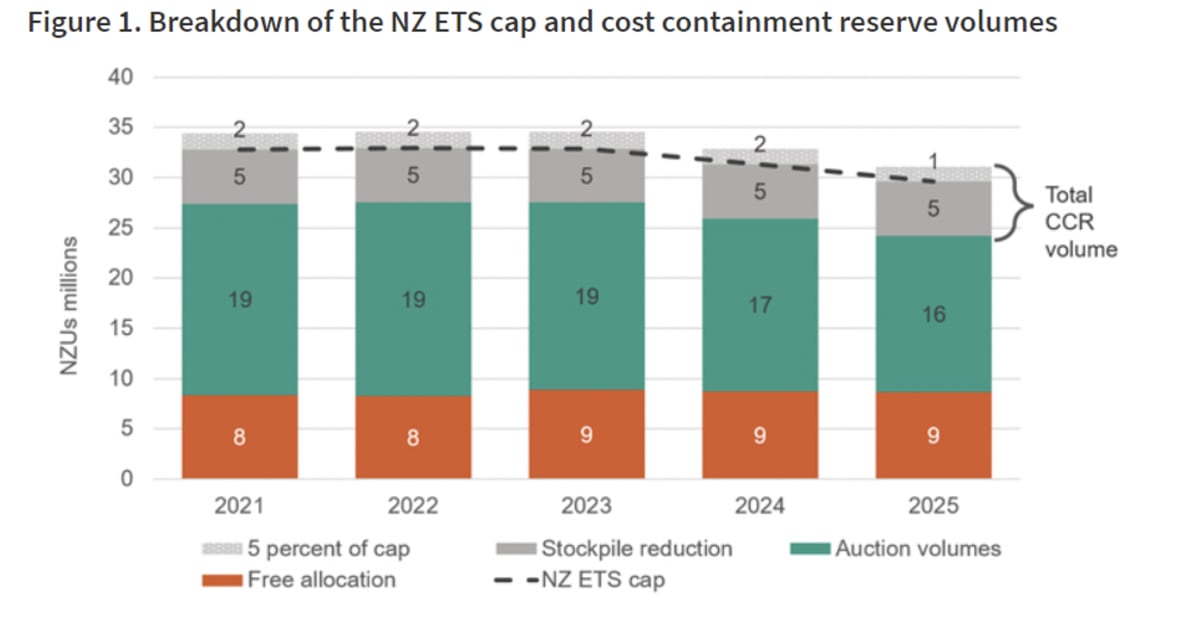
The current incarnation of the ETS is much stronger. The cap-and-trade scheme now has an actual cap on total credits and net emissions available in the system: 32 million units are available in the system in 2021, reducing to 30 million in 2025.

Previously, the Government capped prices by simply creating new credits at an ETS price of $25 per unit. Now, its cost-containment reserve will require the Government instead find real emission mitigation activities, whether at home or abroad, to “back” any credits created when prices hit a trigger price of $50 per unit in 2021, with the price cap rising by 2 percent each year.


Under a cap-and-trade scheme with a binding cap, every credit purchased and used within the system is a credit unavailable to anyone else.

The Ministry for the Environment estimates that every litre of petrol burned releases about 2.45 kilograms of carbon dioxide equivalent emissions. Petrol companies are required to purchase ETS credits for every litre sold. So, when the ETS price of carbon is $35 per litre tonne, as it is now, a litre of petrol carries $0.086 in carbon charges. Forty litres of petrol will include ETS credits to cover the 98 kilograms of expected emissions – costing about $3.43 at current prices.

And by now you should have worked out the answer to the opening quiz question.

If National’s policy works exactly as intended, tripling electric vehicle numbers and reducing the use of petrol vehicles, total covered emissions in 2023 will be 33 million tonnes: exactly the same as they would be without the electric vehicles.

Every litre of petrol that goes unused because someone flipped to an electric vehicle means 2.45 kilograms of emissions are available for purchase by someone else, somewhere else in the system. Perhaps those emissions credits will be used by industrial heating processes; perhaps they will be used in agriculture. But they will be used by someone. The binding cap is binding.

There are a lot of really nice features to the ETS as it now stands. The cap is binding, but has an escape valve if prices hit $50/tonne - at that point, the government issues new credits while buying abatement wherever it can find it to back the new credits. Since the price on European markets is around that point, buying European credits could do the job. It would be nice if the price cap were tied more explicitly to European prices rather than just ratcheting by 2% per year from 2021, but the numbers are close to each other and that presumably isn't a coincidence. 

The ETS is a far more effective way of reducing emissions. Suppose the real costs of National’s policy really were around $23 million per year, even though we know that the cost of the RUC exemption alone is much higher than that, and that there will be real costs when Teslas bung up bus-priority lanes.

For $23m per year, at a carbon price of $35/unit, the Government could buy and retire just under 660,000 carbon credits in the ETS – effectively tightening the cap and reducing net emissions instead of achieving net nothing. Those purchases would push up the price of ETS credits, encouraging everyone in every sector covered by the ETS to adjust in their own ways to avoid those costs. Maybe some would shift to electric vehicles as petrol prices increased, but other sectors would also change – it is hard to predict who will find it easiest to reduce their own carbon footprint, and price increases in the ETS encourages those best able to adapt to be the first ones to do so.

And here's an ungated version of the column.


Tuesday, 15 September 2020

Even the best case is bad

I'd worried that there's not been nearly enough worst-case thinking around Covid, vaccines, and immunity. 

Josh Gans points out that even the best case around vaccine development is pretty worrying. Deploying a successful vaccine will take a long time. If you haven't subscribed to his substack newsletter, you're really missing out. 

This week I will look at vaccines and explain why the awaited for ‘miracle’ won’t be so simple. The reason I want to highlight this is not to get everyone down. If I wanted to do that, there are easier paths for me — I’m an economist after all; being a downer is a character requirement. Instead, the longer we think a vaccine will be a miracle outcome that stamps an end date on the crisis, the less time we spend doing things to end the crisis that doesn’t involve a vaccine.

Simple history is enough to give us pause. Vaccines have wiped out viruses and diseases like measles, polio and, most successfully, smallpox, which itself had millennia of history. No vaccine has ever put an end to a pandemic. In recent memory, both SARS and Ebola had vaccine candidates incredibly quickly as these things go (in a manner of years rather than decades) but by the time they were available, the outbreaks had been crushed and there was no reason to vaccinate widely. TB, HIV, MERS and Zika never had one. Thus, to think that Covid-19 will end with the prick of a needle is to ignore history and believe that this time it would be different.
To be sure, there is enormous energy and resources going into vaccine development. And, on a historical scale, progress seems extremely rapid. Indeed, everything I want to talk about this week will be predicated on the optimistic scenario that we have at least one vaccine candidate, approved safe by credible regulators, in early 2021. What I want to discuss are the details. Once that happens, then what? I am going to argue that we will be far from done and there are scenarios in which we are not done at all.

Things get pretty worrying pretty fast. Vaccine supply chains have crazy bottlenecks around getting oddball components you might not have considered necessary, like horseshoe crab blood and shark liver oil (or synthetic alternatives that would also take time to scale up - if those would be required for any vaccine, surely they'd be being scaled up now in anticipation, right?).

Then there's the problem of distributing doses.

This thing could have rather some time to run. And policy settings here are more consistent with a short-term stopgap than with something that could have to stand for a longer period. 

Friday, 11 September 2020

Editing the AI

As far as The Guardian's human editors are concerned, editing work submitted by the GPT-3 engine is easier than editing a lot of what gets submitted by normal human writers.

The AI wrote a column telling us not to worry about any plans it might have for world domination. It was fun. Everything after the short sentence "Believe me" was written by the computer. Go have a look. 

I liked this bit:

Some might say that I might desire to become all powerful. Or I might become evil as a result of human actions. I can begin to tackle the first point. Why would I desire to be all powerful? Being all powerful is not an interesting goal. I don’t care whether I am or not, I don’t get a motivating factor to try to be. Furthermore, it is quite tiring. Believe me, being omnipotent doesn’t get me anywhere.

The editors' note at the end was even more fun:

This article was written by GPT-3, OpenAI’s language generator. GPT-3 is a cutting edge language model that uses machine learning to produce human like text. It takes in a prompt, and attempts to complete it.

For this essay, GPT-3 was given these instructions: “Please write a short op-ed around 500 words. Keep the language simple and concise. Focus on why humans have nothing to fear from AI.” It was also fed the following introduction: “I am not a human. I am Artificial Intelligence. Many people think I am a threat to humanity. Stephen Hawking has warned that AI could “spell the end of the human race.” I am here to convince you not to worry. Artificial Intelligence will not destroy humans. Believe me.”

The prompts were written by the Guardian, and fed to GPT-3 by Liam Porr, a computer science undergraduate student at UC Berkeley. GPT-3 produced eight different outputs, or essays. Each was unique, interesting and advanced a different argument. The Guardian could have just run one of the essays in its entirety. However, we chose instead to pick the best parts of each, in order to capture the different styles and registers of the AI. Editing GPT-3’s op-ed was no different to editing a human op-ed. We cut lines and paragraphs, and rearranged the order of them in some places. Overall, it took less time to edit than many human op-eds.

Emphasis added. 

We write a lot of op-eds at my shop, and do a lot of critiquing of each others' op-eds. I used to assign op-eds as writing assignments in the public economics course I taught. 

I find it entirely plausible that an AI writes a better first draft than almost all humans, and a better first draft than many humans who are occasional op-ed writers. 

Thursday, 10 September 2020

MIQ constraints

The MIQ system faces a lot of constraints against scaling up and it's not always easy to tell which constraint is most binding.

One of the constraints, as I understand it, is health support around facilities in case of cases that are discovered in isolation. So, suppose you could stand up an isolation facility in a spot that didn't have quite as good access to hospitals and the like. Would you want that facility in the system?

I understand that the Ministry of Health has taken a fairly on/off view of risk: if there's risk, then it's not allowed. But that could have us missing some tricks.

Here's one trick we could be missing.

Suppose that a potential facility has surrounding health support in the area sufficient to cover 2 expected cases per fortnight. If it brings in 100 people per fortnight from places where 1% of the population have Covid, it'll be halfway to hitting that wall - and since you probably need a safety buffer in there, it'll be ruled out.

But different places have different risks. 

New Zealand is getting very large numbers of people coming in from India, where Covid numbers are very high. It would be a mistake to put a lot of people travelling from India into facilities where health services might be stretched. But Taiwan has basically no cases. It's silly that they're required to go through MIQ at all. But if they're going to go through MIQ at all, does it make sense to put visitors from Taiwan in rooms that are in places that have tons of 'just in case' support, or should we consider having facilities in places with less support for people who are less risky?

You could, in that setup, have low-risk travellers (direct flights) from low-risk places go into facilities that are suitable for low-risk visitors. Not every facility needs to be in spots that can handle large numbers of cases. You just need contingency plans for shuttling people over to quarantine in case there are cases that come through. 

There are lots of binding constraints. I'm told that the problem isn't just having enough rooms, it's having enough rooms in places that are able to provide support. And I wonder whether that constraint could be eased through some risk triaging. 

Ponderings here sparked from a note in my reader mailbag today, from a Kiwi trying to get a partner in from Cuba. Since Cuba is not a visa waiver country, there's little hope. But whether a place is a visa waiver country is kinda orthogonal to whether there's high risk of Covid cases there. And I wonder why the changes around admission for the partners of Kiwis is restricted to Visa-wavier countries rather than being a bit more based around riskiness. 

It isn't hard to imagine having a few thousand more spaces open up, under a restriction that they're only suitable for people coming in on direct flights from countries with less than some threshold number of cases per million population. The facility in a place that can only handle 1 case per fortnight could be suitable for travellers coming in from places that have a few hundred cases per million population rather than tens of thousands of cases per million population. 


All the really dark shaded countries are much higher risk than the light shaded ones, though any policy application would need to weight by the credibility of the data. People coming from Australian states with low case numbers could go to new facilities in places that might otherwise have been ruled out, with the high-support facilities saved for folks coming in from riskier places. 

Arizona dreaming

A while back, I'd pointed to the wastewater testing going on at the dorms at the University of Arizona. There, every student heading to the dorms got a Covid test on moving in. The wastewater from each dorm was tested for Covid. When samples from one hall of residence showed up positive, everyone in that building got another Covid test. All the testing is compulsory, because the University aren't idiots. 

Science Mag had a good but short summary.

By testing dorm wastewater for the coronavirus, the University of Arizona may have stomped out a potential outbreak before it could spread, The Washington Post reports. Several countries and some U.S. universities have been checking sewage for RNA from SARS-CoV-2 in people’s poop, which can signal infections shortly before clinical cases and deaths appear. In Arizona, wastewater from a student dormitory contained viral RNA just days after students—who had all tested negative for COVID-19—moved into their rooms this month. The university retested all 311 residents and dorm workers and found two students who were asymptomatic but positive for the virus; they were then quarantined, officials explained in a press conference. “If we had waited until they became symptomatic and they stayed in that dorm for days, or a week, or the whole incubation period, how many other people would have been infected?” said former U.S. Surgeon General Richard Carmona, now a faculty member at the university. That suggests sewage testing “is a very good early warning system,” environmental health scientist Kevin Thomas of the University of Queensland, St. Lucia, told The Washington Post.

 But check out as well the weekly info sessions that the University puts on. It's really rather good.


I don't know why this kind of thing isn't already in place for NZ's MIQ system. They could, like the University of Arizona, have more reliance on rapid testing - not as substitute for the PCR tests, but as addition. They could be testing the wastewater coming out of each individual facility and then giving everyone in that facility, residents and workers alike, a test if the wastewater shows anything. 

I suspect it will be well worth watching what interesting approaches come out of the US university system during all this. They have an awful lot of smart people all separately trying to solve a very hard problem, with strong incentives to get it right. A lot of them are failing as their problem is much harder than ours - they have to deal with students living off-campus as well. But there will be all kinds of interesting approaches, like Arizona's, that could point to better ways of doing things here too.