Friday, 13 November 2020

Rationing scarce MIQ spaces

Imagine yourself in the place of the MBIE boffin tasked with deciding which application for a scarce MIQ space is most deserving or most needed.

The job isn't easy.

The government keeps a small number of spaces in MIQ for getting critical workers in. But somebody has to decide which workers are most critical. Applicants fill in forms to make their case, but that won't help a pile. Every applicant will have incentive to present the most sympathetic case possible, and whoever is assessing the cases has to figure out how much overstatement is present in any of them.

Think only about agriculture for a moment. 

I can easily sympathise with the horticulture folks who are looking at just horrible losses because they can't get workers in through MIQ to do the picking. 

There are lots of calls for them to just pay more, but it can easily be the case that differences in worker productivity at wages paid, combined with fairly elastic demand for the picked product, mean that the growers really don't have space to move. If paying what it would take to get Kiwis to move out to where the crops are and pick them would exceed the value of the picked crop, it makes more sense to let it rot in the field. 

Should the expert zucchini picker from Thailand get the next space?

Or should it go instead to experts in driving the specialised equipment used in silage harvesting? Seven Sharp covered it last month, suggesting that certification in driving the rigs is a five-year process. I've watched the video, and honestly it doesn't look that much different than the old Gleaner L2 we ran decades ago. Hydrostatic drive, rear wheel steering, pick-up header, more controls (and steering!) on the joystick than the L2 had but the basic concepts are the same. I'd imagine that, in a pinch, any retired farmer could do it if they had basic familiarity with other harvesters. Heck, I'd even like to imagine that I could do it if I watched an expert driving around for a few rounds then had the expert supervise me for a few rounds - even though Dad never let me drive the Gleaner and instead had me in the dusty dusty grain trucks as opposed to the lovely air-conditioned cab of the L2. I'd watch the tutorial, note the autopilot button (no tractor I've ever driven had autopilot!), and have at.

But I could really really easily be wrong, and those machines are worth a lot of money. Some of the fields here have crazy hillsides and hazards that might really really need an expert, especially if they're often running a straight-cut header rather than just a pick-up reel.  

How is it that some desk-jockey in Wellington has to decide whether it's more pressing to get a harvester-driver in, or a horticulture worker, or an engineer? Some applications sound more plausible, but Wellington desk jockeys like me aren't expert in any of it even if we drove tractors when we were kids. We don't have the knowledge necessary to make the call and we can't acquire the knowledge necessary to make the call. Who should get the next spot will depend on a big mix of how expensive it is to get a local trained up to do the job, how urgent it is, the value at risk if the job doesn't get done or gets done to a lower standard, and piles of other considerations that would be hard to credibly convey to somebody at a desk in Wellington.  

The shadow price of MIQ spaces has to be in at least the tens of thousands of dollars, and much higher than that in cases that would be inframarginal in any sane world but are still knocked by by MBIE bureaucrats. We hear of cases of projects running in the tens and hundreds of millions that are held up because the relevant MBIE officials figure that engineers are all perfect substitutes for each other and that a specialist from overseas could be perfectly replaced by a local who doesn't know the kit. To me those engineering cases sound more plausible than that a retired farmer couldn't train up to drive newer harvesting equipment, but that's just a reckon on my part. I can't know for sure. And neither can the MBIE decider.  

The only real way of knowing which uses are highest value for a fixed number of scarce spaces would be to auction the spaces held for overseas workers. The companies that would have the hardest time finding a local to do the job and with the most value at stake would outbid the others. 

I really doubt that someone who might pick zucchinis would get the next space, but fair enough if so. The point of an auction system is to discover the most valuable ways of allocating scarce spaces. 

And if you don't like that money then picks winners, consider that the alternative saves piles of spaces for stupid boat races because Ministers think that subsidised boat races are more important than any other business purpose or family need. The alternative to letting those benefitting from the spaces decide it amongst themselves through an auction is leaving it with people with less knowledge and worse incentives. Imagine if we tried dealing with housing scarcity in Auckland by abolishing house auctions and letting the Ministry of Housing evaluate applications to buy houses. They'd have given half the houses in Auckland to the boat race people by now, and another quarter to anyone involved in horse racing. 

Wednesday, 11 November 2020

Afternoon roundup

 The afternoon's worthies on the closing of the browser tabs for a system update:

  • This mess has been a long time coming. There are piles of small rural water schemes that largely supply stock water. The government has been trying to figure out how to apply water quality standards to that sector where the number of people on those water supplies is tiny, where treating huge volumes of water intended for stock is just stupid, but where government and councils worry that cost-effective solutions could leave them legally liable if anything goes wrong. You'd think there'd be some way of letting households on those schemes install their own UV filtration on a caveat emptor basis. Three cheers for the Local Democracy Reporting fund that helps this kind of journalism. 

  • Getting a tenant who terrorises the neighbours evicted apparently takes long enough that the neighbours have all gotten security cameras installed, there have been multiple police calls, and finally the tenant breaking into the neighbour's house at night. It's great that the Tenancy Tribunal granted the immediate eviction, but you've got to wonder about a process that takes all that to get there. I wonder what things would look like if landlords, including state housing providers, could evict a problem tenant on having letters requesting it from a supermajority of neighbours. 

  • The Ministry of Health does not like to comply with the Official Information Act. Just read through this mess. Some journalists wanted to be able to map out vaccination rates by neighbourhood. The data exists. It wouldn't have been hard for the Ministry to aggregate it up from meshblock to neighbourhood if it wanted to confidentialise, but nothing really enforces the Official Information Act. 

  • I am still angry about an old Circa Theatre play that cast developers as moustachioed villains, and NIMBYs as heroes. Continuing to try to get housing built in a housing crisis, despite the best efforts of the politically powerful, is heroic. So three cheers to Ian Cassels, and brickbats for everyone else trying to stop Shelly Bay.

  • The RBNZ is again talking about LVRs. House prices are terrible, and RBNZ policy is exacerbating things because of the existing supply constraints. But Michael Reddell's critiques the last time through remain pertinent. Is there really a plausible financial stability / prudential regulation basis for the rules? They never made much sense to me on that basis, or at least the case for them hadn't seemed to have been made. I could kinda see how they might make sense if the Bank were targeting not just CPI but also wanting to pull the peaks down on asset price inflation. 

  • Jack Vowles starts parsing the numbers on party switching in the NZ election. For every voter National lost to ACT, it lost about 2 to Labour. And Labour pulled in a pile of votes from people who hadn't voted in the prior election. One bit relevant to some speculation:
    There has been speculation that many of those switching from National to Labour did so to keep the Green Party out of a coalition and thus prevent any possibility of a wealth tax being introduced. When asked the reason for their vote, five people who switched from National to Labour did mention the wealth tax and the need to keep the Green Party out of government. For only three of these was this the major reason for their vote shift; and these people form a small minority of the 500 National to Labour switchers in the sample. In their responses to another question in the survey, two thirds of those 500 switchers indicated they were actually in favour of a wealth tax. 

Tuesday, 10 November 2020

In search of Arrow-Debreu worlds: housing futures

My Newsroom column this week wishes that New Zealand had Case-Shiller markets. 

The relevant bit (Update: now ungated here):

House prices have been ramping up with lower interest rates, perhaps in expectation that the new Government will not enable sufficiently more construction for some time.

If an investor expects house prices to drop, owners of rental properties can reduce their exposure, but otherwise it’s a hard market to short.

Similarly, those wishing to build up enough funds for a house rely on KiwiSaver portfolios that may bear little relationship to the cost of housing.

What’s missing are markets like the US “Case-Shiller” indices. These track house prices across major US metropolitan markets (Canada also has a version). Traders at the Chicago Mercantile Exchange then buy and sell contracts based on the performance of the index.

Saving to buy a house in San Francisco? Buy futures contracts on the index tracking San Francisco house prices. The value of an investment tracks the cost of housing in a desired location. Live in San Francisco and feel dangerously overexposed to an overvalued market? Short the transaction instead.

These kinds of markets let people buy little bits of exposure to the property market in ways a KiwiSaver portfolio generally does not. The value of an investment may fluctuate in dollar terms, but it will move in parallel with the cost of the cute little cottage next to the waterfront.

None of that helps solve New Zealand’s housing shortage – at least not directly.

But it might provide an indirect benefit. It could help in figuring out if policy changes are likely to enable more housing. Suppose the Government tweaks infrastructure financing – or urban planning, or council incentives or new building – and promises more housing within the next few years. If investors found the plan credible, the price of futures contracts on the housing indices would be an early signal.

Letting potential buyers put a toe into the market by buying futures contracts on house prices in a desired area could help them save for that cottage. And it would make their walks through neighbourhoods where house prices outpace some of the best stock-pickers’ portfolios just a bit less vertigo-inducing.

I would love to be able to short housing. 

It isn't so much that I'm expecting a price collapse, but rather that I'm among those who are terrifyingly exposed to housing. Buying a house in Wellington, unless you're on a lot higher income than we are, means a huge portion of your household wealth will be tied up in a house in an earthquake zone. Insurance might fix your house after The Big One, but there's reasonable odds that the city substantially shrinks, and that house prices in the city collapse.

What can you do? You can't insure against that kind of loss. Borrowing against your house to buy other assets doesn't help much because there's no jingle-mail in New Zealand: you can't just hand the bank the keys to a house that's underwater on a mortgage. You still have to pay off the full amount, even if the house is worthless. 

If there were a Wellington Case-Shiller market, you could construct a rolling short. Short the futures market, take the cash now, invest it in other stuff, cover the short later by shorting the next period's market. In effect you'd be able to extract equity from your house without taking on a mortgage, losing the upside of some capital gains, but hedging against falls in the local housing market. If the earthquake hit and collapsed house prices, covering the short would be way cheap. 

There are broader benefits to having signals about market expectations of future relative scarcity. If the government touts some big policy as being The Solution, and futures prices don't move, well, maybe the market's wrong or maybe the policy won't work. 

It could be that NZ just isn't big enough for there to be much liquidity in those markets. Maybe I reason too much from introspection. But if I were currently trying to save for a house, the gulf between house price appreciation and Kiwisaver returns would be driving me nuts. Saving in part by buying the house price index would mean that those savings wouldn't lose value relative to the housing market. 

And from where I am now, I'd like to own less house. Like, if somebody wanted to pay me to buy a third of the upside of any capital gains in my house and taking the same third of any potential capital losses (me paying no rent but them paying no maintenance/rates), giving me a wad of cash that I could invest in things that wouldn't go foom in a Wellington earthquake, well, contracting costs might be a substantial issue but I'd be open to it in principle. Past me would be very keen to pay current me for some exposure to housing, and current me would be happy to sell to past me. Surely there are others out there now who are where I was when we were saving for a house. It feels like the kind of market that should be able to exist, at least if there were enough folks around who think about these things in similar ways. 

Monday, 9 November 2020

Things that don't make sense when you have an ETS

RNZ reports on the potential effects of the ban on coal in industrial heating.

Fonterra supported the ban. Smaller industrial users didn't:

Horticulture New Zealand said in its submission that the consultation document did not appear to consider impacts of the proposals on greenhouse-grown crops.

It said phasing out existing coal boilers used for space heating of greenhouses would be "devastating" to indoor vegetable crop production.

Barnes said food production in New Zealand could be dramatically affected.

"If things move too fast we could end up seeing some of our members go out of business before they're able to implement new alternatives, which would mean you would be getting potentially more imports and less locally produced product, particularly in the South Island."

We have an Emissions Trading Scheme with a binding cap. Industrial process heat is covered. Every lump of coal that's burned in the covered sector has to buy an emission credit. If that credit doesn't get purchased to cover the emissions from an industrial heating plant, it'll get purchased instead by someone else for some other bit of emission. The binding cap binds. 

If it happens to be the case that the lowest cost way of stopping the next bit of carbon emissions is in industrial process heat, then those will be the uses that stop as the binding cap binds and emission prices go up. At best, the ban gets you the same outcome that the ETS would give you. But there's no particular reason to believe that those plants are the cheapest spots for reducing carbon emissions. The ban in that alternative case just means forcing higher-cost ways of abating emissions.

Saturday, 7 November 2020

Tax burdens and the proposed new tax rates

Susan Edmunds at Stuff asked me what effect Labour's proposed new tax rate on earnings above $180k might have on the usual "people in the top x% pay y% of all income tax" figures.

The actual answer is complicated. Some on those kinds of incomes can just reduce their wage income and keep income within a company structure, where it would hit a lower tax rate until earnings might be dispersed. 

But Labour had had estimates of that the new tax rate would earn $550m per year from the top 2% of earners. If we take the total income tax paid by those on >$150k per year, add the $550m from those above $180k, you can ballpark it. 

Using 2019 figures, the top 3% of earners on $150k+ paid 23.5% of all income tax. Adding the expected revenues from the new tax rate would increase that to 24.7%.

I don't think that's any material difference. 

So my notes back to Susan included this bit that she used:

“Income tax is only one part of the Government’s overall tax take, though. GST, company tax and excise all also matter. Focusing on income tax alone would then overstate the proportion of overall revenues paid by the highest-earners.

“On the other hand, the Government provides many income transfers, some of which are targeted by income, some of which are universal.”

He said data from 2010 showed the bottom 40 per cent of households each received about $20,000 more in services than they paid in taxes, while the top 10 per cent of households paid about $50,000 more in tax than they received in services and transfers.

Crampton said lower-income people had been more heavily affected by Covid-19 job losses, which could skew the tax bill even further to higher incomes.

But he said some higher earners would also restructure their affairs to make the most of lower company and trust tax rates, to reduce their overall tax bills when facing a new, higher rate. Most companies are taxed at a flat rate of 28 per cent.

It would be great to get an update of those 2010 Policy Quarterly figures; it would be a big job to do it though. 

For my sins in being helpful when a reporter called asking for an update on a commonly-used figure: 

I think it's pretty funny. Running a simple calc when a journalist calls asking for an update on a basic number, well, if that's raising an alarm, I'm not quite sure how I'd characterize my more normal ways of raising alarms. 

When I'm trying to raise some kind of alarm about something, it isn't that hard to tell. I'll be jumping up and down about it on Twitter, putting out press releases, and writing reports or short policy notes. 

I'd not bothered running the calculation before because I'd never seen it as being all that important. 

I had seen misperceptions of the effects of the Greens' proposed wealth tax as being important. 

My raising the alarm about stuff tends more to look like this:

Newstalk:
One economist claims the Greens' wealth tax will hit more Kiwis than the Party thinks.

The Greens say the tax, which has become a hot issue in the final week of the election, would only affect the top six per cent of the population.

However, New Zealand Initiative economist Eric Crampton told Heather du Plessis-Allan the real number's closer to 20 per cent.

He says right now, about 20 per cent of retirees would be subject to it.

And he expects future generations will also build wealth over their lifetime, reaching a peak after retirement.

"We need to be thinking not just about who is currently subject to the wealth tax, but who can we expect to be subject to the wealth tax."
Newsroom
But the Greens’ numbers have their own problems. To go through those, we need a brief detour through basic wealth dynamics. It is a problem plaguing every iteration of wealth inequality surveys using static comparisons to make claims about what proportion of wealth is held by which proportion of people.

Wealth builds over time, and that matters for every question about wealth measurement.

Most people start life with little wealth. Taking on student loans to earn a higher income later on means beginning adulthood with a heavy net debt position, as education does not contribute to measured wealth on Statistics New Zealand’s balance sheets. As graduates move into employment, they begin paying down their student loan debt while (hopefully) building up savings. If they buy a house, they take on debt that has an offsetting and appreciating asset. Otherwise, they build up retirement savings.

Individual net wealth peaks shortly after retirement. Retirees then draw on those savings.

A cross-sectional snapshot of the country will reveal a lot of people with net debt, a lot of people with few net assets, and a few people with a lot of net assets. That, and the failure to account for the effects of New Zealand Superannuation, can make wealth distributions look more unequal than they really are.

Even if every Kiwi followed exactly the same wealth trajectory, beginning with net debt and ending with the same retirement net worth, simple differences in ages would mean that a small proportion would be wealthy at any given time.

The Greens argue that only 6 percent of Kiwis would be subject to their wealth tax. But that seemed almost certainly to be based on a misleading cross-sectional snapshot. A reasonable proportion of today’s youth would be subject to the tax as they reach retirement. After prodding their representatives on Twitter more than a few times if they had checked what proportion of retirees might be subject to the tax, I decided to ask Statistics New Zealand instead.

I asked Stats to go back through the 2018 Net Worth Survey and sort net wealth holdings by age.

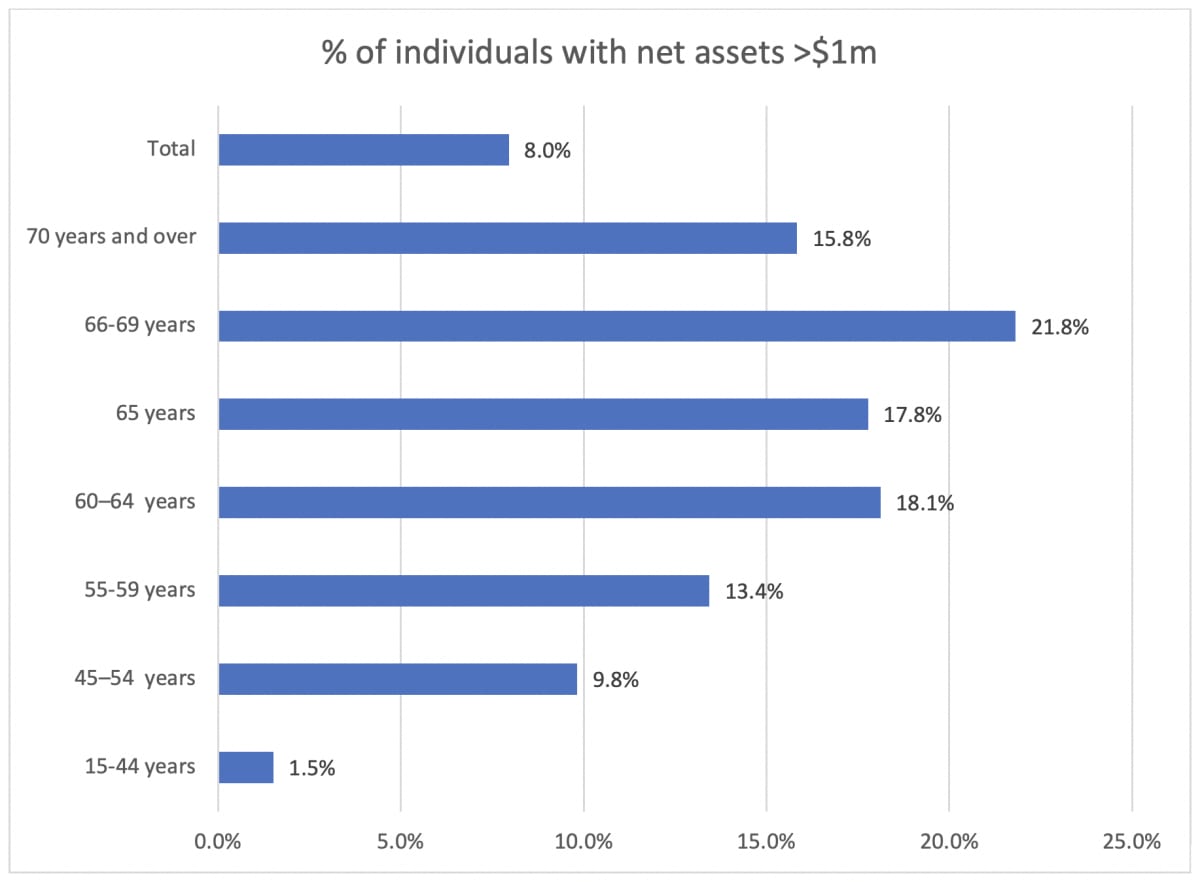
Without any sorting by age, the 2018 survey suggested 8 percent of individuals held net wealth in excess of $1m – so that was already rather higher than the 6 percent suggested by the Greens.

And, as expected, there was a severe age skew in the data. While only 1.5 percent of those aged 15-44 held a $1m in net assets, that proportion rose steadily for older age groups. Just over 18 percent of those aged 60-64 reported more than $1m in net assets, along with just under 18 percent of 65-year-olds. Wealth peaks among those aged 66-69 which means 21.8 percent of retirees would be liable for the wealth tax.

I'm not exactly subtle when I'm actually raising an alarm about something. I tend to get a bit excited and go on about it. 

Friday, 6 November 2020

Far from the frontier

Richard Harris spent a bit of time going through firm-level panel data on NZ firms, looking at the productivity frontier here and the distance to the global frontier.

Here's the upshot:

The most important conclusion from this study is that while there is some evidence of a failure of productivity-enhancing technologies to diffuse from firms operating at the national productivity frontier, the major problem is failure of productivity-enhancing technologies to diffuse from firms operating at the global productivity frontier. New Zealand’s major problem is that frontier firms are underperforming because of their characteristics (e.g. small and lacking international connections) while productivity is overall adversely affected by a lack of competition, which generally creates barriers to exiting and insufficient reallocation of market shares from lower- to higher-productivity firms. In terms of the policy response needed in New Zealand, Andrews et al. (2015, p. 93) note that ‘innovations at the global frontier do not immediately or inevitably diffuse to all firms ... frontier innovations often need to be adapted to national circumstances’. However, to increase the likelihood of diffusion from the global frontier, there is a need for a sufficient level of global connections via trade, FDI, participation in global value chains and the international mobility of skilled labour. New Zealand does not do well on any of these factors. In addition to improving the trajectory of firms at the national frontier (towards the global frontier), there is also the need to ensure greater resource reallocation towards more productive firms. As Andrews et al. (op. cit., p. 97) argue: 

If small firms are (on average) old, this might reflect barriers to post-entry growth and weak market selection mechanisms ... A key message is that creative destruction and up-or-out dynamics are central: entry matters but what happens next is crucial – all else equal, young firms should grow rapidly or exit (i.e. “up-or-out”) but not linger and become small-old firms. 

With respect to New Zealand, there does appear to be clear evidence that here are higher exit barriers (except for frontier firms where the wrong firms, with higher productivity, were exiting 2001–16) due in part to a lack of competition associated with an over emphasis on producing for small domestic markets.

One particularly depressing bit: the data from his study ended in 2016. Over the fifteen years covered, "only mining saw a substantive upward trend in the frontier." 

Which part of mining? 

"In mining, being located in the rest of the lower North Island provides a nearly 11% greater probability (cet. par.) of belonging to the frontier in this sector (reflecting the gas and oil sector that is predominantly located in the Taranaki region." 

Tarankai's oil and gas industry was speeding ahead of the rest of the sector, and ahead of every other sector. 

Of course, that kind of behaviour cannot long be tolerated around here. 

Thursday, 5 November 2020

Renting sucks

 Leigh-Marama McLachlan notes one of the bizarre things about renting in New Zealand.

Landlords here do 3-monthly inspections, and they can be rather a bit more invasive than anything you'd be used to if you've lived in North America.

It's worth thinking about why things are like this. The knee-jerk reaction is to want to ban it; I'm more interested in why this happens. Banning symptoms tends not to fix problems. 

Some potential explanations:
  1. New Zealand houses are of worse quality than those overseas. Without constant vigilance, they turn to mold and rot. Owners have incentive to monitor and make those investments; renters do not.
    1. This could be part of it, but does that really require visits every three months? And while checking that vacuuming and the like is done might be a way of getting a signal on tenant type and whether less noticeable things are being done, it does seem more than a little over the top. Couldn't a landlord do better by easing back the intrusiveness as they get a better sense of tenant type?
  2. Perhaps it's harder to evict a problem tenant in NZ, so running processes that are guaranteed to provide a pretext if needed can have value.
    1. Again, perhaps part of it, but still seems to be overkill.
  3. Insurers require regular inspection of rental properties
    1. Sure, but nothing requires that the inspections be crazy over-the-top, right?
    2. And this just pushes the problem back a level: why do insurers require this?
  4. More small-time landlords here, so each investment property is likely to be a much larger fraction of the landlord's wealth.
    1. If you're a shareholder in a firm that owns hundreds of rental properties, that firm will exercise due diligence over all of them but any tenancy-gone-wrong is hardly world-ending. If you own one rental property that is a substantial part of your wealth, a tenancy-gone-wrong can be a catastrophe.
    2. While I find this plausible, it doesn't explain why insurers would require it as part of landlord cover. The insurers would be diversified, and they still demand it, so there has to be something else going on as well.
  5. Property management companies expect to be sued by the owner if they're not hyper-vigilant and something goes wrong, so they go over-the-top.
    1. Much of this remains question-begging: why don't they then strike better contracts with the owners? Why would owners prefer contracts like this to ones that might let them charge tenants a bit more in money rent rather than in hassle-rent?
The fundamental underlying problem I think is still the massive shortage of housing. 

In a housing shortage, landlords can extract higher rents. And in a rental rationing equilibrium, that won't just be on money rents. 

Were we in a land of plenty, landlords would have to compete harder to get tenants. An insurer that didn't require 3-monthly inspections would outcompete others because landlords who wanted decent tenants would want to offer something that felt less like prison cell inspections. You could still have problems with (4), but worse landlords would be competed out, and those landlords would do better by selling their properties to those who could rent them out more efficiently.