Showing posts with label NZIER. Show all posts

Wednesday, 27 March 2024

The alcohol levy review - an ongoing OIA saga

I keep a bit of a watching brief on the old BERL social cost of alcohol figure. It turns up in weird places. 

As aide memoire, BERL produced the number as commissioned work in the late 2000s that was meant to follow the method set by Collins & Lapsley in Australia. 

The Collins and Lapsley method has a few problems. But BERL compounded those problems with choices that seemed designed to generate a larger number for the tallied social costs. 

For example, Collins & Lapsley had aetiological tables that tried to attribute the fraction of different disorders that might be attributed to alcohol use. Their tables had a few disorders where the aetiological fraction was negative because drinking reduces the incidence of that disorder. BERL decided that, because they were only looking at harmful drinking, it was ok to just set all those cells in the table to zero rather than maintain a number showing benefits (and consequent reductions in net harm). 

Matt Burgess and I went through the BERL report, seeing what the number would look like if more standard method were followed. For example, BERL counted as social cost to the country every dollar spent on alcohol, including every dollar spent on excise, by those drinking more than about 2 pints of beer a day. Drinkers' spending on beer is a social cost only in the sense that private costs are part of social costs. And since benefits enjoyed by drinkers would need to be netted for any sensible net cost figure, the whole thing was a bit suspect. 

BERL responded to the critique by updating the figure to no longer count as a social cost drinkers' spending on alcohol excise, but let the rest stand. 

Brad Taylor joined Matt and me for an update to the review in 2011, when we went through the underlying Collins & Lapsley work. We adjusted upward the revised BERL figure, but the majority of the BERL-tallied costs were either double-counting or costs far better considered private than external and social. 

BERL provided an updated figure in 2018, but it turned out just to be the old figure multiplied by GDP growth over the period. Which could be fine if the initial number were sound (it wasn't) or if alcohol social costs scaled with GDP (they don't necessarily, and especially where alcohol consumption was declining over the relevant period). 

And the whole thing is a bit silly where the measured social cost really doesn't matter. The policy question is always whether any intervention, whether excise or otherwise, provides net benefits. Interventions can fail to do so despite very high measured social cost; they can also provide benefits even if social costs are low. The only reason for generating large social cost numbers is to motivate "something must be done" responses. 

Anyway. 

The number turned up again in last year's "Independent Review of the Alcohol Levy Stage 1: Rapid Review". The work for the Public Health Agency was undertaken by NZIER and Allen + Clarke. 

The work included this section:

90. The cost of alcohol-related harm to New Zealand society is significant. This section provides a summary of existing estimates of the cost of alcohol-related harm in Aotearoa New Zealand. 

91. The most recent study to quantify the social cost of alcohol in Aotearoa New Zealand was conducted by BERL in 2009. Commissioned by ACC and the Ministry of Heath, the report aimed to quantify the social cost of alcohol and drug related harm looking at the personal, economic, and social impacts. While the estimate of the social cost of alcohol-related harm in Aotearoa New Zealand published by BERL in 2009 and updated in 2018, or rather the methods used to generate it, have been criticised by some commentators, it has been widely cited in the alcohol-harm research and policy space in New Zealand over the last 14 years (BERL, 2009; Nana, 2018). The Law Commission’s 2010 report on the review of the regulatory framework for the sale and supply of liquor also cited the BERL 2009 report. 

92. In 2018, the updated estimate of the social cost of alcohol, based on the BERL methodology, was calculated to be $7.85 billion per year (Nana, 2018). This estimate included costs resulting from justice, health, ACC, social services, unemployment, and lost productivity. Intangible costs such as years of life lost from premature death, lost quality of life, child abuse, sexual abuse, and impacts on victims of alcohol-caused crime are also relevant to assessing the overall impact of alcohol-related harm on society. The 2018 update did not include intangible costs. A recent Australian Study found that in Australia $48.6 billion AUD of intangible costs could be attributable to alcohol (National Drug Research Institute, Curtin University, 2021). 

This section seemed particularly poorly undertaken. Citing the 2018 figure seemed particularly odd where the thing was just the old number multiplied by cumulative GDP growth. 

It's also incorrect to say that the 2018 update didn't include intangible costs. Intangible costs of lost life and lost quality of life were included in the 2009 figure, and the 2018 figure just inflated the old number by GDP growth.  

Paragraph 91 alludes to that 'some commentators' have criticised it, but said nothing about the nature of those critiques or who made them. Were the concerns trivial or notable?

Meanwhile, the bibliography included these two relevant references that weren't included in Para 91:

Crampton, E. (2018). The alcohol cost ‘zombie’ has returned. 

Crampton, E., & Burgess, M. (2009). The Price of Everything, The Value of Nothing: A (Truly) External Review Of BERL’s Study Of Harmful Alcohol and Drug Use (Working Paper No. 10/2009).

The 2009 piece was my original critique of the BERL figure with Matt; I'd have preferred the updated critique from 2011. The 2018 column had my initial guess that the updated BERL figure was just an inflation and population growth adjustment; my 2019 column had Ganesh Nana's confirmation that the new figure was the old figure inflated by cumulative GDP growth. So I'd have pointed to the 2019 column instead. 

But the authors clearly knew about my critiques. That they were in the bibliography suggested that there might have been more fulsome discussion of those critiques in earlier drafts. 

On 6 September 2023, I sent an OIA request to the Ministry of Health asking for all early and working drafts produced by NZIER [Paragraph 14 of the report said that NZIER undertook the analysis of existing data and evidence]; for correspondence between and notes from conversations between MoH, HPA, Allen + Clarke and NZIER regarding NZIER's analysis; and, for any peer review of the report. 

On 15 September, MoH replied saying that the correspondence would be extensive and that I needed to refine the request if I wanted to get anywhere. 

I replied immediately asking them to prioritise delivery of early and working drafts, and any peer review. I also suggested prioritising correspondence and relevant notes from meetings between and among MoH, HPA, and Allen + Clarke regarding the NZIER report. 

On 6 October, I reminded MoH that the refinement of my request only asked that they prioritise two parts of the request, and should not have triggered a clock reset; the requested information was due.

On 17 October, I had a reply from the Public Health Agency's Ross Bell. He noted that they'd considered the refinement as having triggered a time extension. But more substantively, they refused early and working drafts, as well as peer reviews, under 9(2)(g)(i) to protect free and frank expression of opinions. 

I proceeded immediately with the Ombudsman. 

On 16 November, the Ombudsman's Office commenced investigation. 

On 13 December, the Ombudsman's Office advised that the Ministry was prepared to reconsider its decision with respect to final drafts and asked whether that would be sufficient. I wouldn't know until I'd seen any released documents - if the released drafts let me see what had happened in the relevant section, that would be fine. If they didn't, I'd need to see more. I'd have to wait. 

On 2 February, a Senior Investigator at the Office of the Ombudsman noted that the Ministry had advised it would be providing a partial release, and asked whether I wished that they review the withholding of the earlier drafts; I noted that I couldn't know until I'd seen what they would release.

On 4 March, the Office reported that they were still chasing the Ministry about the later drafts. 

On 11 March, the Ombudsman advised that he had sent a letter to the Ministry recommending that the documents be released immediately and apologise for the delay.

At close of business on 14 March, the Ministry of Health released the later drafts. Ross Bell, Group Manager, Public Health Strategy & Engagement at the Public Health Agency, apologised for the delay and any related inconvenience.  

While those drafts did include some annotations from "KT" and Te Whatu Ora, they did not provide much light on what had happened with the section on alcohol social cost. The earliest draft was substantially similar to the final. 


So I still cannot really tell what happened. 

The bibliography references to the critiques suggest that, at minimum, those references were included as a citation in an earlier draft of Para 92. It's possible that an earlier version included more substantive discussion of those critiques, but it's hard to say.

I've asked the Ombudsman to form a determination around those earlier drafts' discussions of the costs of alcohol-related harm.

I suspected that the first draft from NZIER included substantive discussion of the relevant arguments. NZIER aren't idiots; they know this stuff. It's in the bibliography, so it was there at some point. 

If there had been more substantive discussion, was it excised at request of Allen + Clarke, or at request of the Public Health Agency?

In either case, the effect is a document sent to the Minister, advising on the alcohol health levy, that provides a fairly one-sided view on alcohol social costs. 

I yesterday received an additional bit from the Ministry, which might speak to the Public Health Agency's views on things:

Kia ora Eric,

Further to the below email sent to you containing the reconsidered documents of your OIA (ref. H2023031477), the Ministry has identified a paragraph pertaining to yourself in one of the early draft documents. While the Ministry is maintaining its position on withholding the early draft documents under 9(2)(g)(i) of the Act, the following excerpt is being released to you under section 16(1)(e) of the Act: 
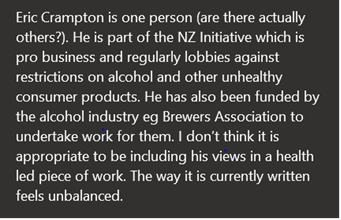

So it seems that early drafts did include substantive discussion of my critique of the BERL figure, and that someone caused it to be erased.

I'd also note that I was discussant at the NZAE meetings on the BERL paper in 2009. It was standing room only, because my critique of the BERL paper had already been released. The Ministry could consider asking any economist in the room whether my critique was just a me-thing, or whether the profession broadly shared my concerns.

I did that work as an academic in the Department of Economics at Canterbury, five years before I joined the Initiative, and two years before doing any industry-funded work. The funded 2011 work [funded by NABIC] discovered an error in the earlier unfunded work that had us revise upward the earlier estimate of alcohol social cost. 

I note that Ross Bell, now relevant Group Manager at the Public Health Agency, was Executive Director of the Drug Foundation when the BERL figure was originally being critiqued. 

Here is the issue of the Drug Foundation's "Matters of Substance" newsletter that included discussion of the controversy around BERL's number. It would be surprising if Bell were not aware of the difficulties with BERL's figure. He had the masthead editorial on the issue of their newsletter in which my critique of the BERL figure was discussed. 

I'll look forward to seeing whether I can get any further with this via the Ombudsman. 

In the meantime, it looks pretty obvious that the Public Health Agency was very happy to put a biased document up to the Minister as advice - whether they requested that outcome directly, or had Allen + Clarke do it.

A provisional health warning on advice from the Public Health Agency may be in order. At least until we can figure out what the heck is going on over there. 

And a reminder that government-commissioned reports face censorship regimes. If the Ministry doesn't like what it says, well, the offending bit gets disappeared. As an offending bit here seems to have been disappeared. 

Sunday, 25 April 2021

The case of Californian tomatoes

It's a weird way to cite Clemens et al 2018.

NZIER's latest report for ProdComm on immigration has a box inset titled "The case of Californian tomatoes." 

The inset, pasted below, notes the American 'bracero' agreements between the US and Mexico which allowed Mexican manual labourers to work in American fields. The inset goes through a 2010 piece by  Ed Taylor looking at the substitutes that emerged for imported workers, after the end of the restrictions. It notes mechanisation, and describes rising wages over the subsequent period alongside unionisation and other changes.


It's a bit hard to establish causality in any of that discussion. The Taylor 2010 piece is a bit of a narrative literature survey. But the impression left by the inset was that the substitution away from bracero workers, after the programme ended, led to higher wages for farm workers. I've copied it below; maybe your reading of it is different than mine.

But the first footnote in the inset is to Clemens et al 2018. Footnote 212, at the end of the first paragraph. Looking at the footnote's placement, it seems there just to establish the existence of the bracero agreements. But Clemens 2018 is the piece I talked about in my NZ Herald column last year, when I was annoyed that NZIER had ignored Clemens's work in its first report. 

That work, published in the AER in 2018, didn't just document that the bracero arrangements existed. It  was able to establish causality about the effects of ending the bracero agreements for the wages of local farm workers. It used a diff-in-diff structure comparing states that relied on bracero workers with those that didn't, before and after the end of the programme. And it showed no increase in wages for local farm workers consequent to the ban on bracero workers. 

Clemens et al conclude:

The exclusion of Mexican bracero workers was one of the largest-ever policy experiments to improve the labor market for domestic workers in a targeted sector by reducing the size of the workforce. Five years afterward, the agricultural economist William Martin called advocates of the policy “obviously… extremely naïve” since “capital was substituted for labor on the farm and increased effort was exerted by the agricultural engineers in providing the farmers these capital alternatives” (Wildermuth and Martin 1969, p. 203). We find that in broad terms this assessment, though perhaps uncharitable, was accurate: bracero exclusion failed to substantially raise wages or employment for domestic workers in the sector. Employers appear to have instead adjusted to foreign-worker exclusion by changing production techniques where that was possible, and changing production levels where it was not. This mechanism requires further elucidation. Further research should explore other natural experiments to test causal links between labor scarcity and endogenous technical change, as urged by Acemoglu (2010, p. 1071)

So, the restriction did lead to mechanisation (and changes in which crops were planted) but that didn't do anything for wages or employment of local farm workers. 

It's then, well, I bit weird to write a whole box inset on the changes in access to migrant labour in US agriculture that leaves a strong impression it led to improved wages, while entirely ignoring the finding of the first paper cited in the box inset, published very recently in the top journal we've got, that shows no causal link from banning migrant workers to higher wages. 

How does that happen? Did nobody read the Clemens piece or know what it was about? Or did it just not seem relevant to any of them that the paper's clear finding was rather at odds with what the box inset was suggesting?

If you like mechanisation for mechanisation's sake, or take a cargo-cult understanding of productivity, then maybe banning migrant workers and replacing them with machines, with no effect on wages or employment for local farm workers is great. Pull a pile of foreign workers out of the denominator on a productivity calculation and put machines in instead, and you'll get a different number on productivity. 

But there's a difference if that outcome obtains because the firm saw the machines as being more cost-effective as compared to it obtaining because the foreign workers were banned. 

Deporting all the RSE workers to force their replacement by machines seems a cargo-cult version of productivity. That Clemens found no improvement in wages for local ag workers suggests pretty strongly that the move there really wasn't improving the local workers' productivity in any meaningful sense. 

It seems that most of Wellington is convinced by the kinds of stories that were prevalent among the American progressives of the 1930s. It didn't lead to good policy back then either. If you've read Tim Leonard on that era, it's hard not to hear echoes of Edward Ross's worries about migrants' predisposition to "underlive" locals. 

Friday, 6 April 2018

Otago's sweet tears

Otago's public health people, perhaps unsurprisingly, didn't like NZIER's take on sugar taxes. They've blogged on it here, but they seem to have missed a few important points.
A Report commissioned by the Ministry of Health, written by NZIER, has recently been getting air-time as an argument against taxing sugary drinks.  However, the Report seems to us to be seriously flawed.
For example, the Report argues that soft drinks do not impose a negative externality.  A negative externality is when consumption of a “good” (product) imposes costs on others.  For example, it is universally accepted that tobacco smoking results in costs to society (eg increased health care spending), and therefore has negative externalities that justify tax.  The same is true of sugary drinks increasing obesity/diabetes/tooth decay rates that then results in health costs to society.  It is well recognised by economists that soft drinks impose such a negative externality, eg 2 ,5.  Just as with alcohol and tobacco in nearly all high-income jurisdictions, this negative externality issue is a strong rationale for the state imposing a tax to help internalise the cost to society and cover some of the future costs to the health system.
This is the minor point in their argument, but it is worth noting potential confusion on externalities because even some economists mess this one up. The ability to offload health costs onto others, either through insurance where the premiums don't distinguish between smallish changes in risk, or through a public health system, only generates technological inefficiency to the extent that it changes consumption.

Think of it this way. There is a total amount that somebody's health care is going to cost. Imagine a world without a public health system and where private insurance premiums were perfectly adjusted to risk factors. Think about how much a person's health care will cost in that world in total. Then add back in the public health system or a less granular private insurance system (or one where they're compelled to use community ratings or somesuch). By how much does the total spending on that person's healthcare increase because they're able to offload the costs of unhealthy diets and the like onto other people? The increase in the risky behaviour associated with the cost-offloading imposes a technological externality.

But not all of the cost associated with that is a net social cost either! The person engaging in more of the risky activity gets some benefit from it, and that benefit needs to be netted out. The net social cost is the excess of the extra bit of cost over the extra bit of benefit. If you want a measure of the "social cost" of sugar or whatever, you should be looking to that little triangle rather than the total quantum of cost.

So we should never be looking at the total health costs associated with some kind of consumption - just at the cost associated incremental change caused by the ability to offload cost. All of the rest of the health cost is a pecuniary effect: it changes the identity of who pays for something rather than the amount paid. And even when we're looking at the incremental increase in the cost, part of that too is a transfer rather than deadweight cost.

Ok, enough about that. We covered it in Jenesa's Health of the State report, and I'd covered it here before.

The more substantial critique from Otago is that NZIER's literature review was incomplete. At page 18, NZIER lays out its review method:
The literature reviewed for this report was identified by first searching for English-language peer-reviewed papers published in the last five years with evidence of an impact of a tax or levy on sugar-sweetened beverages, sugar or sugary foods through the following databases: Econlit, Pubmed/Medline, Google Scholar, National Bureau of Economic Research (NBER), Research Papers in Economics (RePEc), Te Puna. The search used a combination of keywords and phrases, including "sugar", "soda", "sugary", "sugar-sweetened", "beverage", "drink", "tax", "levy", "impact", "effect",
"evidence", "consumption" and "intake". As searching is an iterative process, other keywords were introduced later, including "elasticities", "price", etc. and additional targeted searches were added for authors with multiple relevant publications, for papers that were already known to the reviewers, or for papers identified in the references of other included papers where these appeared relevant. Opinion pieces, letters to editors, media articles, presentations, and authors’ replies to comments on
published papers were excluded.
Keep that in mind. They're only looking at English-language, peer-reviewed papers published from 2012-2017.

Now here's Otago's critique:
The literature reviewed by NZIER also seems rather incomplete. Eg, for the 9 studies that we are aware of which have examined the impact of real world sugary drink taxes on health – the NZIER Report refers to just one of them.6 The missed ones include studies suggesting health favouring associations for BMI/obesity7 8 9 10and for reduced cardiovascular disease11; along with studies showing no benefit for health.12 13 14 Yet even for two of the latter studies finding no association – the authors suggest the null finding is probably because of very low tax rates in the studied settings and they recommend higher tax rates.12 14 We are also surprised as to why the well-publicised report from the Australian Grattan Institute on sugary drink taxes published in 2016,2 was also missed by NZIER. Perhaps as a consequence of a suboptimal literature search strategy, NZIER have missed some key information and this may have limited the value of their conclusions.
Now let's check those references.

6 is Fletcher et al, 2015, published in Health Economics. This was included in NZIER's review.

7 is Fletcher et al 2010, published in Contemporary Economic Policy. Remember that NZIER's review included papers published in the last five years. Since NZIER's work was in 2017, the earliest inclusion date is 2012. So it was excluded.

But let's have a closer look, just for fun. Because this one is fun.

Fletcher et al 2010 one does indeed suggest that while there is no effect of sugar taxes on outcomes, it could be because observed taxes are too low.

Now what Otago either didn't know or didn't want you to know is that Fletcher et al 2015 is an answer to Fletcher et al 2010. The 2010 work posited that there could be bigger effects at higher tax rates - that there's a nonlinear response. The 2015 paper tests for that nonlinear response and rejects the hypothesis that the 2010 paper suggested for its null finding - there's no evidence of nonlinear effects within the range of observed taxes.

So, the question for the Otago people then: is there any good reason to highlight a mechanism that the authors disprove in later work? I can think of a few bad reasons. And the only good way to include it would be with a health warning that the mechanism was kinda torn apart by the authors' later work.

But it's all kinda moot since the study was restricted to work in the past five years.

8 is Kim et al 2006. That's six years before NZIER's window.

9 is a master's thesis from 2013. I think that's excluded by the restriction to peer-reviewed papers, but it's perhaps debatable for a thesis that's made it through committee.

10 is a 2010 paper, so two years before the window.

11 is a 2015 paper published in the Journal of the American Heart Association. So it meets the criteria. So it's arguably a fair call that it should have been caught in the search. It wouldn't have much changed the result since it's just a cross-sectional study across US states suggesting that states with higher taxes on soda also have lower odds of poor cardiovascular health, but it would be a pretty big stretch to draw anything causal from that. You need at least panel data work identifying on state-level changes in soda taxes. Otherwise how could you tell that other things aren't driving both policy and health outcomes?

12, 13, and 14 were all published in 2010 or 2009, and so are outside of the review window.

And 2 is a Grattan Institute report that would have been excluded as it wasn't a peer-reviewed journal article. Otago didn't chide NZIER for missing the Initiative's report on sugar taxes, but it would also have been properly excluded as it also wasn't a peer-reviewed journal article.

Ok. So the Otago People are mad that NZIER excluded a bunch studies that the Otago People know about. They didn't bother to check the exclusion criteria in the NZIER's paper, and instead jump to the next paragraph claiming that NZIER is beholden to Big Industry interests even though this report was MoH funded.

On checking, it looks like NZIER failed to include one study that they should have included, but including it wouldn't have made a darned bit of difference. I suppose the Otago People could have complained that the review window was too narrow - I don't know why it was set at five years but that seems a reasonable window where sugar taxes are pretty new. But the complaint as it stands seems more than a bit off.

My disclosure: the Initiative is funded by a broad range of corporate members including ones the Otago People wouldn't like. Their membership has zero influence on my views of the Otago People's work. 

Tuesday, 6 March 2018

NZIER on the foreign buyer ban

Richard Harman's Politik newsletter points to NZIER's rather scathing submission on Labour's proposed ban on overseas buyers. NZIER's submission is here. There are some very good bits. 
We understand why this Bill has been introduced. We understand why Treasury has written a Regulatory Impact Statement (RIS) that contains very little evidence. We too would like it to be easier for first home buyers to get into their own home.

But none of these things detracts from the fact that, from an economic perspective, this Bill is a poorly-designed solution to a poorly-defined problem. As a result, NZIER opposes the Bill.

We recommend the Select Committee considers the scope for exemptions from the sweeping provisions of the Bill in terms of investment in certain regions or in certain types of residential development that would add to New Zealand’s housing supply and are less likely to be thought of as sensitive.

Given the lack of empirical evidence and poor data quality around overseas investment in existing houses or residential land, we recommend a timely and well-publicised monitoring and evaluation process to ensure the Bill does not have unintended consequences.

...

We have a great deal of sympathy for Treasury – it was effectively railroaded into delivering a RIS to implement a proposed legislative change with which it likely disagrees, and it would have been very difficult from a relationship perspective for Treasury to develop a RIS that explicitly advised against the new government’s proposal.

What’s the economic problem, exactly?

In a RIS, the problem definition should clearly identify the market or policy failure that needs to be addressed, what is causing the problem, and – ideally – how material the problem is. The problem definition is the foundation on which any RIS should be built, because it clearly explains why change is required at all.

The problem definition in Treasury’s OIA Bill RIS falls well short of best practice. In fact, it is almost non-existent. It contains almost no information or empirical content. It merely states that the new government has a stated policy commitment to “ban overseas speculators from buying existing houses” and the RIS is all about how to implement the political proposal.

This is effectively Treasury waving the white flag from a policy analysis perspective. It seems clear that Treasury were not asked to analyse whether the proposal makes any economic sense based on first principles.

An evidential void 

Obvious questions that have not been considered are:
  • What empirical evidence is there that overseas speculators are pushing up house prices in New Zealand? Which countries’ speculators are having the greatest influence?
  • In the absence of empirical evidence, recognising the limitations of existing LINZ data sets, how reliable is the anecdotal evidence on the role of overseas speculators in artificially inflating house prices?
  • How significant is this inflationary effect, compared to other potential drivers of house price inflation, such as supply-side constraints and land availability?
  • Why is home ownership ‘better’ for Kiwis than renting? (i.e. what is the welfare loss to Kiwis attributed to the current legislative framework?)
  • What does the desired ‘future state’ look like, and how likely is the proposal to contribute to this state?
Without at least initial answers to these questions, it is very difficult to judge whether the proposal will make any material difference to home affordability for Kiwis at all. 
I like NZIER's heading questions too:

  • "Will the OIO have the capacity to deal with 3,000% more screening applications?"
  • "Is this really how we want to be regarded in trade negotiations?"
  • Coming to New Zealand - we welcome skilled migrants (but only if you don't buy an existing house)

Heck, you've even got telecom providers like 2 Degrees submitting on how the Bill will screw up getting telecom infrastructure in. Why? Because three of the big ones are classed as overseas persons and their infrastructure often winds up being situated on residential land. So it'll push back timelines on getting 5G through because they'd have to jump through OIO hoops. Stupid stupid stupid legislation. And it'll screw up power infrastructure in Wellington because the Wellington lines company is foreign-owned.

The legislation is terrible. Aren't there cheaper ways for Labour to pander to xenophobic nationalists? Free flags or something?

I wonder how bad legislation would have to be for Treasury to produce a more honest and thorough RIS. 

Friday, 2 February 2018

Sugar taxes - NZIER's advice

Sugar taxes just are not effective in improving health outcomes. When we surveyed the evidence for our report, The Health of the State, we found no compelling reason to think the things would work.

NZIER's report for the Ministry of Health reaches the same conclusion.

First, some backstory and grousing about document release under OIA. 

Back in October, I requested that the Ministry of Health provide me a copy of the report it had commissioned reviewing the effects of sugar taxes.

The Ministry of Health delayed my request under section 9(2)(f)(iv) “to maintain the constitutional conventions for the time being which protect the confidentiality of advice tendered by Ministers of the Crown and officials”, and under 18(d) as the report would soon be publicly available. But they never said how long 'soon' was.

I interpreted that combination as meaning they needed time to brief the Minister. I advised the Ministry that as I expected that it would take a fortnight to brief the Minister on the report, I'd be following up with the Ombudsman at that point.

The Ombudsman's Office provided a helpful hurry-along, reminding MoH of its preference that 'soon' have a definite date around it.

I received a copy of the report on Wednesday by courier, 50 working days after the initial request for a report that was just sitting on the desk at MoH. It's also now up on NZIER's website, which is fortunate as the only digital copy MoH was willing to provide would have been unusable: image files in a PDF rather than searchable text.

But enough complaining about the OIA.

It looks like NZIER found the same thing that we did. They reviewed forty-seven peer-reviewed studies and working papers published over the last five years.
In our review of the literature, we find that:
  • Taxes do generally appear to be passed through to prices and some reduced demand is likely

  • Estimates of reduced intake are often overstated due to methodological flaws and incomplete measurement

  • Price elasticities from early studies with fundamental methodological flaws have later been used in a number of other studies to assess the impact of sugar taxes, resulting in significantly overestimated reductions in demand

  • There is insufficient evidence to judge whether consumers are substituting other sources of sugar or calories in the face of taxes on sugar in drinks 

  • Studies using sound methods report reductions in intake that are likely too small to generate health benefits and could easily be cancelled out by substitution of other sources of sugar or calories

  • No study based on actual experience with sugar taxes has identified an impact on health outcomes

  • Studies that report health improvements are modelling studies that have assumed a meaningful change in sugar intake with no compensatory substitution, rather than being based on observations of real behaviour.
The evidence that sugar taxes improve health is weak.
The NZIER report notes that the Ministry was particularly interested in the evidence around taxes on sugar-sweetened beverages.

The report emphasises that sugar taxes only improve health outcomes through a chain that must hold at every link. Imposing the tax must increase prices; increasing prices must reduce consumption; reducing consumption must reduce energy intake; reduced energy intake must reduce physiological risk factors.

When NZIER evaluated the literature, they found substantial reason to worry about the chain that leads from taxes to potential health benefits. They find causality hard to determine; problems in estimates of consumption elasticities; difficulty in finding links between taxes and health outcomes; and little work on optimal tax design.

They conclude:
As we noted in the section on frameworks, there are multiple steps in the chain of intervention logic from the well-established principle that an increase in the price of a good leads to a reduction in consumption of that good and, all else equal, to an improvement in health outcomes.

There have been several recent examples of governments imposing taxes on sugar with the intention of improving health outcomes and, thus an extensive literature examining the effects of those taxes.

Our conclusion is that the evidence base gets weaker further along the chain of intervention logic.

If taxes did not have economic costs, through deadweight losses and implementation costs, then even a slight causal link between a tax and an improvement in health outcomes might be justified. That, however, is not the case.

We have yet to see any clear evidence that imposing a sugar tax would meet a comprehensive cost-benefit
Anti-sugar campaigners have framed opposition to sugar taxes as reflecting the pecuniary interests or ideology of those opposing those taxes. The evidence instead suggests that those taxes would have little discernible effect on health outcomes and would be unlikely to pass any cost-benefit assessment.

Monday, 19 June 2017

Higher education, big big numbers

I don't think we can blame the consultants for this one.

Normally, big big numbers in economic impact reports are a black mark on the consultancy producing them. They don't come with enough health warnings, and the misleading big big figures draw headlines too easily.

Dave Guerin's Ed Insider newsletter (essential reading for anybody following tertiary ed in New Zealand) covers the Universities NZ report, produced by NZIER. He writes:
Universities NZ released Regional activity of universities (30 pages) on 27 Apr 2017 (UNZ media release).
  • The report had straightforward analysis of the direct university spending and employment in their region, and the contribution to regional GDP.
  • NZIER also estimated the indirect and induced expenditure due to universities, but placed major caveats on those figures, stating that UNZ had specifically asked for them. They noted that the government did not see such numbers as a credible argument for increased government expenditure on universities. NZIER repeated their 2-paragraph warning 9 times in the report, and added an appendix with more detail on the issue.
  • Universities NZ cited the largest number possible ($19.95b) in their media release.
For an example of a nice health warning, here's a bit from NZIER's Exec Summary:
Estimating the size of these indirect and induced effects in a way that is economically meaningful is problematic. They can be estimated using multipliers that try to reflect the ripple effects of university expenditure on the economy, but this approach makes so many assumptions that the estimates should be seen as indicative only. The multiplier analysis approach (used in the mid-2000s but now discredited) massively overstates the indirect and induced economic activity attributable to any industry because it fails to consider alternative uses for the resources employed by the industry. At best, multiplier based estimates of indirect and induced effects are a measure of the current footprint of the university in the city/region. They cannot be added to calculate a national total across cities/regions and they are not accepted by central government as a credible argument for increased expenditure on university education or R&D.

Though indirect and induced effects are estimated in this report they should be seen as indicative only. See Appendix A for further caveats and comments on indirect and induced effects.
Pretty blunt. When clients use the big big numbers, even when the reports have health warnings as blunt as these are... yikes.

Thursday, 27 August 2015

No it didn't!

The Financial Services Council's Peter Neilson says Treasury's analysis of Kiwisaver's all wrong:
Neilson said the NZIER report found the evidence for Treasury's argument was too narrow because it used data only from the global financial crisis years.

He said it did not consider that KiwiSaver attracted young and low-income people who would not usually have been involved in formal savings schemes.

"The analysis simply compared the results for the people in KiwiSaver with those who were not, as opposed to those in the target audience who joined KiwiSaver compared with those in the target audience who did not."

"We need to compare apples with apples. People on a benefit can't afford to save and are likely to receive a higher income from New Zealand superannuation than they received during their adult lives on a benefit anyway.

"At the other end of the scale, people who were saving for retirement by investing in rental property or a farm would be unlikely to use KiwiSaver other than to just pick up the KiwiSaver incentives.

"For this group KiwiSaver would probably not increase their savings, it would only change the composition of their savings. Neither of these categories were in the target group for KiwiSaver and should not have been used for comparison," Neilson said.
I haven't read the NZIER piece yet. But I'm familiar with Treasury's work in the area.
  1. While the Treasury's 2011 work was based on a 2010 sample, their more recent 2014 work was based on SoFIE and IRD data covering 2002-2010. They have a panel of 10,000 individuals from 2002 through 2010. 
  2. The 2014 paper uses a difference-in-difference analysis looking at those who joined Kiwisaver as compared to those who didn't; they also ran diff-in-diff after sorting by age, gender and the like.  
  3. The point of difference-in-difference is to let you compare those who joined with those who didn't in a way that's meaningful. The differences in the savings rates for the two groups in the period before Kiwisaver forms your baseline; the differences in the savings rate afterwards forms your treatment effect. Sure, there can be plenty of differences between the two groups. But those underlying differences are caught in the first differencing in the difference-in-difference. It somewhat odd to critique a difference-in-difference analysis for just comparing two groups. 
  4. They found that KiwiSaver members accumulated less wealth than non-KiwiSaver members, correcting for other stuff. This is in the difference-in-difference: those joining KiwiSaver accumulated less wealth than those not joining, as compared to how both were doing before KiwiSaver.
  5. If you want to restrict analysis to the ones that are really targeted by Kiwisaver and evaluate it on that basis, that's way different from a standard "was this programme a good idea" analysis. Think of it this way. Suppose that there's some terrible disease. One person in a million gets it. The only cure is getting a vaccine at birth. The vaccine costs $100,000. A cost-benefit assessment looking at the programme as a whole will say it's a colossal waste of money: you don't spend a hundred billion dollars ($100,000 * 1 million people treated) to prevent one instance of a terrible disease. But if you looked at it only on a target audience perspective - the one guy who'd have gotten the disease, then it's worthwhile: $100,000 to save that life was worthwhile. It's still a pretty bad programme on the whole though.
I will have to look up the NZIER report; it has to be better than what's here reported.

Update: the NZIER report is here. On first cut, it seems very odd to hang a lot on the behavioural economics literature around people screwing up savings when recommending a programme the default products of which are often entirely wrong for the person directed into them. 

Thursday, 24 October 2013

NZIER on Fiscal Sustainability and Capital Gains Taxes

Bill at Groping Towards Bethlehem posted today on the NZIER report on New Zealand's fiscal sustainability. This is mostly about short-run and long-run projections for debt and whether we have room to raise additional revenue by increasing tax rates without hitting Laffer curve effects. Bill takes issue with a comment in the press release by one of the report's co-authors, Kirdan Lees, saying that we need to take action now to avoid reaching a U.S. like situation. I agree with Bill that major differences in political systems between the U.S. and New Zealand mean that the U.S. is not a good comparison. But that is because our system (probably) leaves us better positioned to respond to unpleasant projections before the situation becomes dire, and therefore doesn't negate the value of making those projections.

But what really caught my eye, via David Farrar's comment on the same report (here and here) is that it called for taxes on land or capital gains as a way to broaden the tax base. Now capital gains taxes (or at least gaps in the arguments in favour of them) are a bit of a hobby horse of mine (various posts archived here), so I went to the report to see what the justification was. After reading it through (and then searching for "capital gains" to see if I'd missed anything), the best I can see for the justification is as follows:

  1. if we continue with the current path, growth in government expenditure as a result of an ageing population will exceed growth in tax revenue pushing out the debt to GDP ratio;
  2. this will necessitate either tax increases or expenditure reductions;
  3. we have room to increase tax revenue by increasing tax rates (that is, we are on the right side of the Laffer curve);
  4. taxes, however, do have disincentive effects;
  5. ????;
  6. a tax on capital gains or land would be a good option to explore. 

Now Kirdan is a very good economist, so I am sure he has something in mind for step 5. I wish it had been included in the report, however. Based on the rest of the report, it seems that the argument is not about reducing tax distortions between capital gains and other sources of income, but rather about a general broadening of the tax base. This only makes sense if a capital gains tax is expected to raise positive revenue, in which case it would represent an increase in the effective tax rate on capital which is already triple taxed relative to labour income (by being taxed once when the original money saved was earned, again as it accrues interest, and a third time when the portion of the nominal return that just represents adjustment for inflation is also taxed). Maybe this effect is outweighed by other benefits of a capital-gains tax, but I would really like to see what these benefits are believed to be.

Postscript: While writing this post, I have come across a news story saying that Treasury are now recommending a capital gains tax and or land tax as an alternative to or supplement to (I'm not sure, I need to check the source documents) the Reserve Bank's loan-value-ratio policy. I will be interested to see what Treasury's justification for a CGT is.

Monday, 23 April 2012

Nanny ascendant

Kiwi healthists have been busy this past week.

Here's more from Doug Sellman on soft drink addiction (and other addictions):
People needed to find an activity pleasurable to want to repeat it. If they repeated it enough, it would become a habit, which could then become an addiction.
"As they're doing that there are genetic switches that change free will into a dehumanised state of drug craving and compulsion."
Christchurch-based researchers at the University of Otago developed a new list of 49 foods people should avoid and published their findings in the New Zealand Medical Journal earlier this year. The list is of the most addictive foods, Sellman said.
The foods were energy and calorie dense, high in fat and/or added sugars, prepared using a high fat cooking method such as frying or roasting, or low in essential nutrients.
They included muesli bars, ice cream, cakes, chocolate, doughnuts, jam, honey, pies and pastries. Energy drinks, cordial and fruit drinks also made the list. [EC: updated the link to one that works, emphasis added]
Sellman says those 49 foods are the most addictive. The list includes quiche, sausages, salami, and muesli. If I eat enough quiche, I could trigger genetic switches that will turn me into a dehumanised craver of quiche.* We really ought to remember how Sellman sets the bar on addiction whenever we read him about what has to be done about alcohol, tobacco, fatty foods, soft drinks, muesli, or pastries, or when he compares companies selling unhealthy food to drug dealers. Human agency disappears in his model pretty quickly.

Meanwhile, the anti-tobacco folks are pushing not just for plain packaging, discussed last week, but also for some seriously large excise tax increases. 3 News says the Ministry of Health is pushing for $100 per pack prices. And, helpfully, they've linked the OIA-released MoH advice to the Minister of Health.

The MoH document wasn't nearly as bad as I'd expected.** Instead, it looks like they've commissioned NZIER to do some work on what would actually be necessary to achieve the National-led coalition's goal of a tobacco-free New Zealand by 2025. Unsurprisingly, it'll take some pretty big policy changes: large tax increases, lots of anti-tobacco advertising, and potentially stronger alternative measures. I think at paragraph 6 they might be alluding to tobacco by prescription only when they say "At what point might it be preferable to consider alternative approaches, eg. a new regulatory regime that stringently controls tobacco as a highly toxic, hazardous substance and/or as an extremely addictive, harmful drug?"

At paragraph 54, MoH notes the potentially regressive nature of the excise increase but argues "although the tobacco tax is of itself regressive, increases in the tobacco tax are actually progressive." This might actually be true at the tax levels they're talking about. Marginal changes in tobacco excise are highly regressive; few people quit relative to the increase in tax paid by poor smokers who continue smoking. The O'Dea report said that even a 50% increase in tobacco prices would see 36,990 non-quitting Decile 1 households each spend an extra $928 per year while an estimated 4,110 quitting Decile 1 households would save $2,981; the poorest cohort then winds up spending a net extra $22 million in tobacco excise while decile 10 households spend a net extra $31 million. Excise hikes of the magnitudes being thrown around could conceivably wind up reducing total tobacco excise paid by low decile groups. But they would have other problems:
A leading academic says an extreme increase in the price of cigarettes could lead to black market dealing.
Speaking in response to a Ministry of Health discussion to raising the cost of a packet of cigarettes to $100 over the next eight years, Otago University health economics lecturer Des O'Dea said: "We all remember the days of prohibition in the United States and what that did to foster organised crime."
"While I don't think it would be anywhere near the scale of that, we could well see raids on retailers and a black market develop for cigarettes," he said.
I don't put a lot of weight on concerns that plain packaging legislation would lead to counterfeiting and smuggling; at least I'm not yet convinced of it. Is it really that hard currently to print fake labels for cigarette packets or to put anti-counterfeiting features into plain cigarette packs? But $100 packs of cigarettes have to yield a fair bit of home-grown tobacco outside of the excise regime and a fair bit of smuggling.***

Hopefully making it clear just what is needed to achieve the SmokeFree 2025 goal will have the government think again about the whole thing.


* I choose to avoid this risk, preferring the perilous whole milk and butter. I fear for Seamus though.

** I've read it twice, and I can't find a single reference to the "costs of smoking" number that MoH had been pushing a couple of years ago. Matthew Everett's the MoH contact person on the briefing document and is presumably the same Matthew Everett with whom I'd had fairly extensive discussion about the MoH's figure at the time. I'm glad to see that MoH doesn't seem to be pushing that figure any longer in its policy recommendations.

*** For both alcohol and tobacco, if anybody has ever seen estimates on the elasticity of informal supply through home production or smuggled goods with respect to excise changes, I'd love to see it. I worry that measured estimates of price elasticity of demand might overstate actual consumption decreases if there are reasonable shifts into illicit supply.

Tuesday, 6 March 2012

Grow for it!

New Zealand, population 15 million. That's the target for 2060 in a new NZIER working paper making the case for substantial New Zealand population growth.
A population target of 15 million by 2060 (2.5 times that now projected) is not only “feasible”, it is also likely to be sufficient to achieve the benefits from scale. It would allow four main cities with a population of three million or more each. This would foster competition within New Zealand to create conditions amenable to building local firms that can foot it internationally. It would bring New Zealand’s population into close proximity of the Netherlands (but still nowhere near the population density of that country).
There's an awfully good case to be made for growth. Ed Glaeser's recent book makes a compelling argument that ICT is far more a complement to than a substitute for density - it makes everything better, but it makes New York better faster than it improves New Zealand. Australia will continue to benefit from agglomeration effects; stagnation relative to Oz fuels out-migration and worsening outcomes. Bill Kaye-Blake says we're doing fine given our distance - and he's right.
This changes the tone of the policy recommendations. It isn’t about claiming that the institutions (the tax system, the science system, the education system) are messed up and need to be fixed. Instead, it is about recognising that we’re pushing this economy uphill and asking what tools might help.
I think increased immigration should be on the policy agenda as a tool that can help in that context.

New Zealand is shifting immigration priorities to de-emphasize the family route and pull in migrants from higher up the income ladder. TVHE reminds us of the harm we do to poor foreigners abroad by such moves; we also do harm to ourselves to the extent that lower skilled workers are complements to high skilled labour - I'd certainly appreciate lower-cost domestic help.

The best counterargument is that there are potential external costs from lower-skilled immigration if we expect that income correlates with intelligence, intelligence is heritable, and intelligence matters for the long-term quality of policy in a democratic system and for overall productivity. Here's Garett Jones on how IQ matters.

So it's not crazy on the face of it to try to encourage high skilled immigration to New Zealand if we care about outcomes here rather than overall global welfare (I care about the latter, but that's me). But I would note that income will be a poorer proxy for IQ or skill differences if we're looking at individuals in a pooled international cross-section than within countries. Moreover, there's no real "lump of migrants" beyond which we can't accept more people. Why not make it easier for high income, high skilled people to move here while keeping the current family immigration route?

Potential policy moves that encourage immigration, and especially higher-skilled immigration? First on my list would be immediate permanent residence for any foreign student completing a Bachelor's degree at one of the New Zealand universities. This will not only boost foreign student enrolments (helping to cross-subsidize domestic students) but also provide a nice selection mechanism for those who are most likely to really make a contribution. We could also draw in high skilled American migrants by not losing our comparative advantage in civil liberties and sane copyright legislation.

Complementary to increased immigration would be fixing local land use policy that forces up housing prices, but that's also well worth doing for its own sake.

Thursday, 3 February 2011

Easy to fire means easy to hire

In 2009, National implemented a policy making it easier for small employers to fire workers within a 90-day trial period. Most economists would reckon that barriers to firing are really barriers to hiring and so the policy ought to make it more likely that a company will try on a new worker. Bill Kaye-Blake at NZIER's preliminary analysis says that firms subject to the policy had a smaller decrease in hiring during the recession than did larger firms not subject to the policy.

That's consistent with what we'd expect. But we'd also want to know:
  • What was the pattern in hiring declines in prior recessions by firm size? Are larger or smaller firms more likely to freeze hiring plans? If it were previously the case that small firms were quicker to cut hiring, NZIER's estimates understate the real effects.
  • We need to know something about firings at those firms as well. I'd expect somebody at one of the leftie blogs to make the claim that those firms were hiring more because they were firing more and that it's all just churn. That seems very unlikely. But it would be nice to have the data.
Nice stuff NZIER. HT: Bernard Hickey.

Wednesday, 4 November 2009

NZIER report rocks

NZIER has released a report on sustainability and the environment in New Zealand. Excellent. Were I teaching Econ 224 again next year, it would be on the syllabus for my week on environment and sustainability. Long story short, the report reminds us that resources for use in improving the environment are scarce and we're wasting many of them on initiatives that will provide little benefit. Consequently, we ought to reallocate resources away from carbon abatement and waste minimization and towards addressing air and water pollution. Very sensible.

The last government put in place some surcharges for landfill uses predicated on an "all landfill is bad" philosophy. Says NZIER
Waste policy in New Zealand has achieved much over the past decade but further extensions for sustainability purposes are questionable. The new Act’s levy on wastes disposed to landfill bears no relation to measurable externalities coming from landfills, most of which are now relatively new and managed to high standards, and as a revenue raising device it is simply inefficient. It has no appreciable benefit in reducing the depletion of environmental stocks or their contributions to economic welfare. Pursuing targets for waste minimisation and maximising material recovery, reuse and recycling, without explicit consideration of the costs and benefits, will itself be wasteful of non-material resources such as labour, energy and capital, diverting them from other activities of value to the community.
Which is pretty much what I say in lecture as well.

View the report as being Lomborg's Copenhagen Consensus applied to New Zealand. It could be better, of course: tied for top priority is reducing pressure on biodiversity, but no mention is made of policies that currently hinder private efforts to breed endangered species (Roger Beattie's excellent work case in point). But it's a great start.

For students: 224 is off next year. I'm on sabbatical first half of 2010 and first half of 2011, with a half teaching load in the second semester of each year (with some parental leave added in for 2010). So I'm teaching the second half of intermediate micro theory next year, with Erskine Visitor Max Stearns covering my 336 class, and then likely 224 and 336 in 2011.

Tuesday, 11 August 2009

NZIER on internalities

The latest NZIER Insight tackles the issue of internalities. Economists traditionally count only external costs as policy relevant. Internality theory argues that self-control problems lead people to consume more than they would want to. So, if the problem drinker sincerely wishes he could drink less than he currently drinks, the costs to him of his excess drinking get to count as a policy-relevant cost because government could, in theory, make him better off by encouraging him to reduce his consumption.

If we take internality theory seriously, it's not a call for higher taxes on goods consumed by folks with self control problems. Rather, it's an argument for ensuring that sufficient self-control mechanisms are available. Fortunately, many such mechanisms are available. Other economics blogs have already discussed at length private self-binding mechanisms. If that's insufficient, in the case of alcohol, Pharmac already heavily subsidizes disulfiram. For much less than the cost of a bottle of beer per day, you can buy a pill that will make you violently ill if you consume alcohol.

Given that these mechanisms exist, aren't secret, and, in the case of disulfiram, are already heavily subsidized by the government, I just can't buy internalities as policy relevant for alcohol. It's schizophrenic. Internality theory requires that the person suffering the excess cost really wants to be able to cut back; if we then have evidence that plenty of available mechanisms for cutting back are ignored, I call phooey on counting internalities.

Some folks might well want to go the step further and argue "self-control all the way down" - that the same self-control problems that stop the drinker from going cold turkey also mean that the remorseful drinker always promises to take the disulfiram tomorrow. Well, that really seems observationally equivalent to that the consumer just enjoys his drink but knows that he can reduce social disapprobation by whining about self-control problems. One of the best things about economics, done as economics, is that we tend to ignore the lies people tell about why they do things and instead look to preference as being revealed by action.

Unfortunately, Zuccollo at NZIER muddies the waters a bit in using internalities to justify BERL's shonky analysis of the costs of alcohol use. Yes, if you buy the internalities argument, then there will be some internal costs that get to count as policy relevant. But it isn't all internal costs! Rather, it's just the excess costs that are incurred because of the internality problem: the area above the marginal benefit curve and below the marginal cost curve to the right of the intersection of the two curves. Instead, BERL counted all internal costs as social costs under an assumption of zero benefits to harmful consumers. By contrast, our analysis looking only at external costs makes more sense if "internalities" from excess consumption roughly balance internal benefits (consumer surplus) from prior consumption.

Zuccollo insists that consideration of internalities isn't just disguised paternalism. Yes, in theory, if you buy the theory, the problem drinker welcomes the imposed tax. But in practice it's impossible for the government to implement such a scheme non-paternalistically. As Glen Whitman puts it,
In short, the old paternalism said, “We know what’s best for you, and we’ll make you do it.” The new paternalism says, “You know what’s best for you, and we’ll make you do it.”
Zuccollo notes the problems of implementation given that governments haven't access to our utility functions, saying
Perhaps this is the main reason why internality taxes are not yet gaining widespread popularity in government circles.
Perhaps also botched and shonky applications of theories that remain out of the mainstream canon of economics oughtn't form the basis of a government commissioned economic cost analysis. And perhaps other economists ought to keep an eye out that internality taxes not gain more credence than they're due. Read Whitman, linked above.