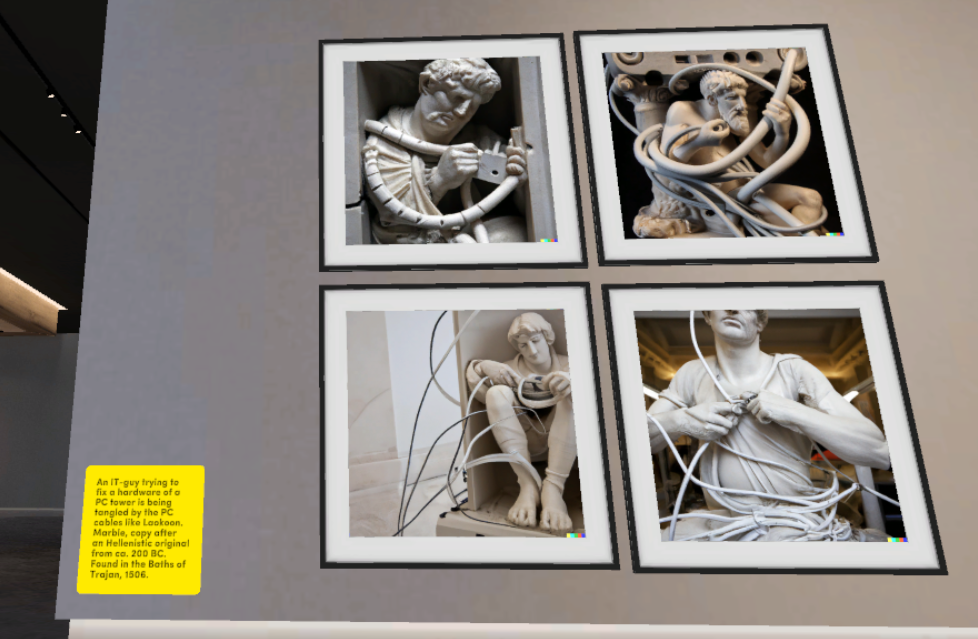
- A virtual art gallery of DALL-E created works. My favourite:The link gets you the annotated guide, as well as a link through into the gallery so you can walk around for a look.
- A stress test run for the ECB shows that climate change really isn't a prudential issue for central banks. Doubt it will encourage Adrian Orr to stop tilting at this windmill.
- More experts warning about MoH's advice on Covid testing. MoH currently only notes that a negative test isn't required for ending isolation. MoH should be advising people that there's substantial risk they're still infectious if they're testing positive. It was about two months ago that Anne Wyllie was describing the Ministry of Health's advice as 'dangerous misinformation'...
- Dodger Stadium is banning Roger Owen from throwing peanuts to punters.
- Aged care facilities are short on nurses and having to shut down beds. Labour seems generally of the view that it's bad for the sector to rely on migrant nurses. It'll be interesting to see how this one ends; it has a lot of potential to end badly. How many people will be pushed out of care?
- Marc Daalder has a modest proposal.
- Some fun and absurd trolley problems.
- The Gods of the Copybook Headings return to Germany.
- Lindsay Tedds works out the implications of Alberta ending its indexation of tax brackets. NZ really really should start indexing its tax brackets, or insist that the RBNZ do its one big actual job so it doesn't matter as much.
- Immigration restrictions don't just impinge on the liberty of those abroad. They are also a substantial hindrance on the liberties of those already here. Just ask Ilya Somin.
- Chloe Swarbrick is pushing for a lot more controls on alcohol. She's citing the BERL figure as part of the motivation. I wish people would remember that BERL's $7b+ figure isn't from a report. Their old $4.9b figure was from a report, which was severely flawed. They then multiplied that old figure by GDP growth over the period to get the new number. That's it. The initial number was nonsense but even if it had been right, the inflation requires that alcohol harm be a constant proportion of GDP. Wouldn't you even want to check whether consumption had dropped over the interval? The Greens like to claim to be evidence-based...
- Starting salary for lifeguards in Wellington, requiring a 40-credit certificate that can be done from age 16 on the job, is $51,663. It matches the starting salary for teachers with a Bachelor in Teaching. The lowest rung on the Lecturer scale at Canterbury is $82,882 and would generally require a PhD. So spending 8 years training for a PhD, after finishing NCEA at age 18, means forgoing half a million dollars in lifeguard salary as compared to starting lifeguarding at age 16.

Showing posts with label art. Show all posts
Showing posts with label art. Show all posts
Thursday, 7 July 2022
Afternoon roundup
The morning's worthies:



Wednesday, 10 April 2013
Still life
Cheryl Bernstein points out the ironies in the Environment Court's decision on the Cass landscape.
She writes:

She writes:
In making his decision not to allow irrigation at Cass, the Environment Commissioner, Robert Nixon, noted that the proposal would not serve to change the actual landscape painted by Rita Angus. But he agreed that the painting had "powerful symbolism", and that the proposed land-use associated with irrigation could have a significant adverse visual impact on views from State Highway 73, around the area of the painting. Nixon cited the high landscape values of the area -- variously shared, historic and recognised "significant natural science, aesthetic, and Tangata Whenua landscape values" -- and declined the application to industrialise the landscape.
Art history 1: industrial irrigators 0, you might think. A rare decision. But it might equally be recognised that there is something of an irony to this. One of Angus's purposes in painting the burned-off vistas at Cass was, like many of the more progressive artists of her generation, to depict the effects of modernity and economic progress on the landscape. Speed, transportation, telecommunications, industry: all are present in Angus's modernist depiction of Cass. Her inclusion of telegraph poles and railway tracks reveals a landscape in the process of being altered -- made modern -- by its inhabitants.
... In citing Angus's painting as a factor in the decision not to allow industrial-scale irrigation in the Cass landscape, there is clearly a gentle irony in a work of art concerned with the effects of modernity stalling contemporary economic "progress".It is too easy to veto others' uses of their own property; too many want to turn the country into a still life.
Maybe there was more merit to @LaraJeffery's tongue-in-cheek policy proposal than I thought when I first saw it.*
* Lara's tweet at the Australian Libertarian Society's conference this weekend came after discussion of Seasteading, a policy proposal that Australia encourage its elderly to retire at lower cost in the Philippines, discussion of drug legalisation, and frequent rambling interjections by grouchy older attendees. Her proposal consequently managed to touch all the bases.
Thursday, 4 October 2012
Package art
The supermarket aisle is a kind of an art gallery. Every product's packaging is designed to be eye-catching; some reach the level of artwork. I love how Warhol's interpretation of the Campbell's Soup Can is now featuring as a version of the Campbell's packaging; if the limited edition were up for sale in New Zealand, I'd be buying it. The packaging can add value directly: it can be beautiful. That adds very real value, no matter what the no-logo types claim.
I've worried about plain packaging pushes on tobacco likely being extended to alcohol. Recall that there's a reasonable case that Inuit print art began because indigenous artists were curious about how the guy who painted the Player's Light packages managed to get the little sailor to look the same on every pack. And alcohol packaging can be rather pretty: variations in bottle style, label images - those are worth keeping.
NBR reports that Beck's has announced a run of bottles here in New Zealand that will feature commissioned NZ art. I've shamelessly scraped their image below, but you should subscribe.
 NBR writes (paid, subscribe!) that NZ artist John Reynolds, who created the labels:
How long 'till we see taxpayer-supported propaganda like this directed at alcohol?
I've worried about plain packaging pushes on tobacco likely being extended to alcohol. Recall that there's a reasonable case that Inuit print art began because indigenous artists were curious about how the guy who painted the Player's Light packages managed to get the little sailor to look the same on every pack. And alcohol packaging can be rather pretty: variations in bottle style, label images - those are worth keeping.
NBR reports that Beck's has announced a run of bottles here in New Zealand that will feature commissioned NZ art. I've shamelessly scraped their image below, but you should subscribe.
...pulled lyrics from record label Arch Hill's extensive song catalogue - featuring artists such as Family Cactus, The Clean and Street Chant - as inspiration to create the 24 multi-layered pieces of artwork.The article notes Beck's has been doing this kind of thing since 1987.
How long 'till we see taxpayer-supported propaganda like this directed at alcohol?
Wednesday, 21 December 2011
Droit de Suite
A model of an artist's lifetime earnings is incomplete if it ignores complementary investments by early investors in the artist's works: the curators and collectors who buy early works and who work to make sure that it gets in front of the right people in the cultural elite. Unless you're born into an art family, you're just not likely to have the connections necessary for success.
And so I'm pretty sceptical about Droit de Suite - policies that seek to redistribute portions of realized capital appreciation in artworks back to the originating artist. At the margin, they reduce incentives for gallery owners, curators, and collectors to make complementary investments in new artists. What are the distributional effects?
Note further that none of this requires that investors are only in it for the money; they're just less able to afford to keep making those investments where the returns are taxed. It wouldn't be surprising if the insult given by the implicit devaluation of their role were as motivating as the reduction in forward-looking returns. But budget constraints do bind too.
@CherylBernstein points to a newly introduced American bill that would implement Droit de Suite in the U.S.
Update: Consider now the case in which curators and collectors really have no effect on an artist's success. In that case, the policy still results in reductions in the amount those folks are willing to pay for a new risky artwork and so still effects transfers from those artists who never become successful to those who do and from artists when they're young and poor to when they're old and successful. But there's less efficiency consequence as the ancillary investments by others are of less value.
And so I'm pretty sceptical about Droit de Suite - policies that seek to redistribute portions of realized capital appreciation in artworks back to the originating artist. At the margin, they reduce incentives for gallery owners, curators, and collectors to make complementary investments in new artists. What are the distributional effects?
- A windfall gain in the current period to established artists at the expense of those who made complementary investments in their success;
- A transfer to those artists who become successful from those who never do;
- For a successful artist, a transfer of income from when he's young and poor to when he's old and established.
Note further that none of this requires that investors are only in it for the money; they're just less able to afford to keep making those investments where the returns are taxed. It wouldn't be surprising if the insult given by the implicit devaluation of their role were as motivating as the reduction in forward-looking returns. But budget constraints do bind too.
@CherylBernstein points to a newly introduced American bill that would implement Droit de Suite in the U.S.
The Equity for Visual Artists Act of 2011, would set aside 7% of the price for works resold for more than $10,000 at major auction houses, such as Christie’s and Sotheby’s, with half the proceeds going to the artists and half to non-profit art museums.If the portion going to non-profit art museums goes into a common pool rather than to the museum that first exhibited the artist's work, or to the museum of the artist's choosing, recipient museums have free-rider problems in making investments in emerging artists. What do I mean? Consider two non-profit museums. The first makes large investments in figuring out which new artists in the community are worth promoting and works hard to help them become successful; the second spends the same amount of money hosting travelling exhibitions from other galleries. The first museum buys a lot of the emerging artists' work and hopes to use earnings from the small proportion that really pan out to help future emerging artists; the second just banks revenues from travelling exhibitions to fund later hosting of travelling exhibitions. The proposed policy takes money from the first museum and gives it to the second, reducing museums' incentives to invest in new artists.
The legislation, as it stands, would only apply to the resale of works at public auction houses “with more than $25 million in sales in the prior year”. Auction houses that operate only online would be excluded, as would private galleries.Prediction: more sales shift to online and private galleries from public auction houses. I have no sense of how costly that is in terms of sale revenue foregone, but if most auctions are coordination games, and everyone's making the flip, it's probably not that bad. The big auction houses will be lobbying hard against the legislation and might find it worthwhile to flip to online-only auctions.
Update: Consider now the case in which curators and collectors really have no effect on an artist's success. In that case, the policy still results in reductions in the amount those folks are willing to pay for a new risky artwork and so still effects transfers from those artists who never become successful to those who do and from artists when they're young and poor to when they're old and successful. But there's less efficiency consequence as the ancillary investments by others are of less value.
Saturday, 3 December 2011
Fun conferences I've not attended
I'd thought @adzebill was trolling us when he started livetweeting this conference. You can see how I was confused by tweets like:
Meanwhile, @BruceSchneier points to a U Minnesota conference on Cephalopods and Art:
Knives out already: speaker upbraided for not "addressing the sociology of the paua". #NZFoodHistand
The Symons Touchstone Score for Biscuit/Cake Iconism peaks in the 1920s. #NZFoodHistBut here are some of the conference papers:
Aaliyeh Naqvi-Sherazee – “Food, identity and place-making: Indian settlers in 1920s New Zealand”It all sounds ridiculous fun; I envy @adzebill's attendance.
Donna Brien – “‘An Affaire de Stomach’: Australian and New Zealand 1920s Food Writing”
Duncan Galletly – “Iconism in cakes and biscuits”
Helen Leach – “Home Science and the arrival of the ‘modern kitchen’ in 1920s New Zealand”
Janet Lymburn & Diane Langman – “Driving Change: Imaginative Thinkers”
Janet Mitchell – “Mélanie S. Primmer, B.A. and the Up-to-date-Housewife”
Jeanette Fry – “The influence of generic cookbooks and pamphlets over the past 90 years and the role of advertising in reducing the cost of daily living; Or, how mustard saves you money on every meal.”
John Webster – "Trying to find Miss Fidler"
Nancy Pollock – “Chinese contributions to New Zealand gastronomy”
Nicola Saker – “By their menus ye shall know them: Or, if you are what you eat, what you eat is who you are”
Tui Flower – “First-hand experience of kitchens”
Meanwhile, @BruceSchneier points to a U Minnesota conference on Cephalopods and Art:
Why do we make images, where do they come from and what is their primary function? Human image production and image distribution systems have made rapid growth to the level of unimaginable saturation in urban contemporary life through design, architecture, city planning, Internet, fine arts, and other media. The Origin of Image Making: Behavioral Ecology of Cephalopods and Art brings together scientific, humanistic and artistic attempts to investigate these ever critical existential questions by examining the cognitive and interpretive systems of the adoptive coloration of cuttlefish as a model to code and to re-map visual information such as paintings, photographs and video.I wonder if male cuttlefish better able to make artistic displays in their patterning enjoy more reproductive opportunities. Does the Art Instinct extend to cuttlefish?
This conference’s primary goal is to create a discussion platform among scholars, experts, and students from different academic and non-academic fields. During the two-day conference, we will focus on cuttlefish research including neuroscience, comparative psychology, animal behaviorology, and art as conceptual, practical and/or tangible foundations to understanding our own visual communication system.
Sunday, 14 August 2011
Recent Acquisitions
We have made the following acquisitions over the last few months.
This one in response to the ongoing economic turmoil:

This one consequent to the geological unpleasantness:

The latter sat at CoCA for a few weeks after the February earthquake before we were able to collect it; we'd bought it a couple weeks before the quake. It would have been helpful.
Tuesday, 25 May 2010
Art as investment
Room for Debate takes on art as investment.
First up, Denis Dutton.
I don't worry that the price of the stocks in which the university's superannuation fund invests is artificially inflated (and money returns diminished) by a few weirdos who like to frame stock certificates and hang them on their walls. But if I'm buying a Picasso as investment (and, middle-brow guy at best, drawing minimal consumption benefits from having the thing around), and the next bidder over earns not only capital gains but also a whole pile of smugness benefits from having a Picasso on his wall, well... that's not an auction I want to win.
Next up, Eileen Kinsella.
Third, Donald Kuspit.
A fairer test would be for an art expert to pick a bundle of works sold today, then check the appreciation of that bundle against a couple of international stock indexes over time. I'd also worry about liquidity problems. It's always easy to cash out a stock portfolio. But art markets are much thinner.
Finally, Kathryn Graddy.
And, it's the "dividends in the form of enjoyment and recognition" that I worry would reduce the expected value of the money returns, at least for the naive investor, to below what he'd be getting with more standard investments.
First up, Denis Dutton.
Paintings and sculptures remain the locus of yet another kind of value. A painting is in principle the singular physical product of an individual artist’s hand and mind. Its complex textures and color gradations will likely make it impossible to trust the accuracy of any reproduction. As we see it today, “Nude, Green Leaves and Bust” is, down to exquisite detail, exactly what it is because of Picasso’s skill and expressive power.I can agree with Denis that a Picasso is likely to be a better store of value than a random draw emerging artist, but solid investment? I can't buy it. If there are two assets you can purchase, one of which provides only a flow of returns over time while the other provides both a flow of returns and consumption benefits, with a pretty wide distribution of the utility derived from that consumption across individuals, you have to expect that the return on the latter must be lower than that on the former.
In this respect, the painting is a perfect, intricate and utterly irreplaceable record of a historic artistic achievement. Whether or not you regard it as a truly great Picasso (personally, I don’t), it is a solid investment: Picasso’s place in the foreseeable future of art seems assured, and with it the interest and value of this painting.
The high prices commanded by top-end works of art are often ridiculed as somehow crazy or even obscene. Why is paying $100 million for an ugly downtown office building acceptable, while the same sum paid for an object of enduring beauty is a scandal? I rather find reassurance in the idea that in at least some of its forms, beauty can be a traded — and sublimely expensive — commodity.
I don't worry that the price of the stocks in which the university's superannuation fund invests is artificially inflated (and money returns diminished) by a few weirdos who like to frame stock certificates and hang them on their walls. But if I'm buying a Picasso as investment (and, middle-brow guy at best, drawing minimal consumption benefits from having the thing around), and the next bidder over earns not only capital gains but also a whole pile of smugness benefits from having a Picasso on his wall, well... that's not an auction I want to win.
Next up, Eileen Kinsella.
The abundance of blue-chip artworks available this season sparked global demand. Experts tell me that when rare works like the Picasso, which was from a private collection and had been off the market for 50 years, or the $28.6 million Jasper Johns Flag (from the collection of the late Michael Crichton) come on the block, they will find buyers no matter what the economic backdrop since they are so rare.Doesn't that sound like "The housing market is bouncing back nicely with lots of buyers being drawn in by all the great mortgagee sales. It's rare that the mansions owned by investment bankers come on the mortgagee market, and so they're snapped up when available."
The reasoning is that the quality of the work will make the buyer confident in his acquisition, no matter what is going on elsewhere in the art market or in the broader economy. Buying right now seems to be concentrated at the high end of the market where, as one dealer told me, “a relatively small number of international buyers are willing to spend lots of money on a very small number of objects.”
This is why we are seeing a resurgence in the market. Confidence has returned at a rapid rate. Spring sales in the past two weeks were over $1.1 billion, up considerably from the total for last year. Top collectors are fully aware that the best examples of blue-chip art have been snapped up by major museums and important private collections.
Third, Donald Kuspit.
Long before the economy almost collapsed a year ago, art-savvy people argued that works of art are the new equities: one can make more money in the art market than in the stock market. The value of Picasso and Giacometti kept increasing while the value of General Motors and General Electric decreased. Stock prices go up and down, but the stock of certain artists keeps going up."...certain artists...". Yup. And the same holds true too of "certain stocks". The paintings I did in kindergarten - those have really tanked in value. But shares of Microsoft purchased around 1980: those did really well over the same period. Clearly stocks are great and art is terrible. Ahem.
Why? Is it because their works are unique, making them prized possessions, or because they were avant-garde innovators, not to say geniuses? The answer has less to do with the artists’ achievement and more to do with the fact that people are buying the brand name and getting the work along with it.
The name is the high-priced, desirable, one-of-a-kind commodity, not the work, which has a certain incidental relationship to it. This has to do with the celebrity culture: artists have been absorbed into its spectacle. Their creativity has been appropriated by it, making every celebrity seem like a great artist in the making, and every artist a celebrity in the making, aspiring to make spectacular art.
A fairer test would be for an art expert to pick a bundle of works sold today, then check the appreciation of that bundle against a couple of international stock indexes over time. I'd also worry about liquidity problems. It's always easy to cash out a stock portfolio. But art markets are much thinner.
Finally, Kathryn Graddy.
The art market is alive and well. Should we be surprised? Frankly, there are not a lot of other attractive assets out there. Yields on Treasury bonds are at all time lows, the current risk-reward profile of the stock market appears to be less than ideal, and gold prices are at dizzying heights.I'm no art guy, but I'd thought the Picasso was somewhat less than a well-recognized piece: the press called it "rarely seen", having last been exhibited in 1961. Clearly a Picasso, but "well recognized"?
The recent record-breaking prices fetched at auction for blue-chip artworks reflect this sentiment. Giacometti’s “Walking Man” and Picasso’s “Nude, Green Leaves and Bust” are both well-recognized and lasting creations. Even if many art critics complain that Picasso’s Nude is not one of his best, the painting is still a well-known piece by a famous and innovative artist.
The buyer of this work has invested in an asset that could act as a store of value both in the presence of inflation and general economic uncertainty. This buyer will also receive dividends in the form of enjoyment and recognition — among friends if not the public.
And, it's the "dividends in the form of enjoyment and recognition" that I worry would reduce the expected value of the money returns, at least for the naive investor, to below what he'd be getting with more standard investments.
Many people did not enjoy the financial turbulence of 2008 and early 2009. If liquidity and income are not important considerations, investing in cultural assets may well be the way to go. Fine musical instruments, another alternative asset, have been a solid investment through both booms and busts, and have largely avoided many of the ups and downs of the art market."If liquidity and income are not important considerations"... some investment! The last paragraph seems distinctly odd. I'd thought these kinds of markets - common value, incomplete information - more plagued by winner's curse than by fortunate buyers. And bundled moral obligations to show the work? I suspect a fair few art collectors get a lot of utility from loaning their works out, if only because of the little plaque that then goes under the piece while it's on exhibition: "On loan from the private collection of X". But unless the work were sold under a restrictive covenant demanding that the work be exhibited, I have a hard time seeing the case for a moral obligation.
Nonetheless, these fortunate buyers of cultural assets should recognize their moral obligation to make their purchases available at least at times for the public to enjoy.
Monday, 10 May 2010
Chutzpah [updated]
Update 12 May: Lichtenstein's estate has backed down. Excellent.
Roy Lichtenstein's work could not have existed if the standards of copyright enforcement his estate seeks to enforce on others had been enforced on him. Low costs of creation for me, but not for thee.
Transformative work as defence for Lichtenstein under fair use?
Wrote the Boston Globe a couple of years back:
Deconstructing Lichtenstein has been pairing Lichtenstein paintings with the comic book originals.
Now, I'd agree with Lichtenstein that moving the art from a comic book page to canvas IS transformative. But surely then too would be taking a Lichtenstein piece and transforming it for use a handbag, on a bumper sticker, or on an album cover.
- Roy Lichtenstein creates pop art heavily derivative of panels of graphic novels. As best I'm aware, he didn't pay royalties to anyone whose work he used.
- A band buys a piece of art from an artist who, as part of an art class, painted another piece of work derivative of the same comic book panel as the one used by Lichtenstein; they use this as an album cover
- Lichtenstein's estate, whose website includes a scary "don't steal our IP" intro, sends a threatening email to the band:
“Dear Elsinore Music,
You have adapted a Roy Lichtenstein image for the cover of your new album. This is a copyright violation. Please contact me.
Sincerely,
Shelley Lee
Manager of Intellectual Property
Estate of Roy Lichtenstein
745 Washington Street
New York, NY 10014
T (212) 255-4570 x105
F (212) 727-3138
shelleylee@estateofroylichtenstein.com
www.lichtensteinfoundation.org”
Roy Lichtenstein's work could not have existed if the standards of copyright enforcement his estate seeks to enforce on others had been enforced on him. Low costs of creation for me, but not for thee.
Transformative work as defence for Lichtenstein under fair use?
"The closer my work is to the original, the more threatening and critical the content. However, my work is entirely transformed in that my purpose and perception are entirely different. I think my paintings are critically transformed, but it would be difficult to prove it by any rational line of argument"
Wrote the Boston Globe a couple of years back:
After visiting a Lichtenstein exhibition in Chicago, attorney Mark Weissburg wrote an article titled ``Roy Lichtenstein, Copyright Thief?" ``I was struck by the fact that Lichtenstein was never sued for copyright infringement," Weissburg wrote. ``Under copyright law if you copy a protected work without permission you are breaking the law . . . . The Copyright Act also prohibits what are called `derivative works.' These are works that play off of or incorporate or embellish another work. Virtually every one of Lichtenstein's paintings was either an out and out copy or at least a derivative work."Can't pay the prior artists back royalties, but can send chilling copyright notices to the folks going forward. Copyright is broken and Roy Lichtenstein's estate is shameless.
Intellectual property attorney Stacy Friends agrees. ``It is just like sampling, and this is considered `stealing , ' " she says. ``The question to be asked is why people who clearly had a right to sue chose not to. In the time period that we are talking about, there might have been some historic leeway for fine art." It is possible that a copyright holder did threaten to sue, and instead reached a private settlement, she speculates. It is now a moot point. The statute of limitations for copyright infringement is three years.
Comic book companies owned the original copyrights. DC Comics declined to comment for this article. Russ Heath, a DC artist whose work Lichtenstein used, says the publisher was never interested in suing Lichtenstein, probably because there wasn't much money to be made. ``He never even had me over for a cocktail, and then he died. So I guess I'm out of luck."
Ninety-year-old artist George Tuska couldn't come to the phone, but his wife, Dorothy, says they had no idea that a 1961 Buck Rogers panel drawn by her husband became ``Emeralds," a valuable Lichtenstein canvas. ``Oh my God," she says. ``That is unbelievable." Sotheby's sold ``Emeralds" to an anonymous buyer for $1.6 million in 1999.
One artist whose work Lichtenstein appropriated, Joe Kubert , says he doesn't care. ``My focus is on what is happening today." As it happens, the Lichtenstein Foundation uses an exact copy of a Kubert picture of a fierce dog, titled ``Grrrrrrrrrrr!!" to illustrate a warning to copyright violators on its website. Grrrrr indeed.
``Nobody seemed to raise this issue way back when," says the Foundation's Cowart. ``This wasn't supposed to be about exploiting the exploited. We are all in favor of having the drawers and writers receive as much credit as humanly possible. We owe them esteem but can't pay them back for the royalties they might have received."
Deconstructing Lichtenstein has been pairing Lichtenstein paintings with the comic book originals.
Now, I'd agree with Lichtenstein that moving the art from a comic book page to canvas IS transformative. But surely then too would be taking a Lichtenstein piece and transforming it for use a handbag, on a bumper sticker, or on an album cover.
Friday, 26 March 2010
Small delights [updated2]
Wandering downtown Christchurch last weekend, we found a wooden shipping container on the pedestrian mall just outside of Alice in Videoland. Two men were prying the front open with crowbars. We of course stopped to see what was going on. When the front of the container opened, a three-man alt-country band inside started playing. After a couple of tunes, they slowly moved outside of the box, using the box-front as an impromptu stage (the acoustics were, unfortunately, better when they were playing from inside of the box). After a half-hour or so, they retreated inside the box, played one more song, and the same men again nailed shut the front of the box.
Ira danced enthusiastically through much of the performance.
They never announced themselves, explained anything, or even spoke a word to the audience. Just music.
I love Christchurch....
Update: Apparently it was an art project. Sue sends me the link. Ira sits appreciating the show on the right hand side of this picture.
Update2: The band is "The Unfaithful Ways". Their debut video is here. Their MySpace page is here. I rather like "I Can't Get Your Cruel Love Off My Mind".
Ira danced enthusiastically through much of the performance.
They never announced themselves, explained anything, or even spoke a word to the audience. Just music.
I love Christchurch....
Update: Apparently it was an art project. Sue sends me the link. Ira sits appreciating the show on the right hand side of this picture.
Update2: The band is "The Unfaithful Ways". Their debut video is here. Their MySpace page is here. I rather like "I Can't Get Your Cruel Love Off My Mind".
Monday, 16 November 2009
Virtuosity
Is it possible to wow the public without tossing your hair around? Yes and no. Fred Astaire never let you see him sweat, but he sweetened his deceptively casual virtuosity with just enough charm to make it irresistible. Tatum, by contrast, was more like Jascha Heifetz, a titan of the violin who brought off his stupendous feats of technical wizardry without ever cracking a smile or looking anything other than blasé—and though Heifetz was immensely famous, he was always more respected than loved.Terry Teachout on Arthur Tatum.
The great violin teacher Carl Flesch got to the bottom of this paradox when he observed that "people would forgive Heifetz his technical infallibility only if he made them forget it by putting his entire personality behind it." The operative word here is forgive. To the small-d democrat, virtuosity is an insult, a tactless reminder of human inequality that can only be forgiven when the artist makes clear through visible effort how high a price he has paid for his great gifts. Art Tatum, like Heifetz, was too proud to make that concession. He did all his sweating offstage. That's why his exquisitely refined pianism will never be truly popular: No matter how much beer he drank, you could never mistake him for one of the guys.
Dutton says that we admire displays of skill and virtuosity:
Teachout gives Diana Moon-Glompers or an Ayn Rand villain as his "small-d democrat". The small-d may be committed to no genetic basis for differences, but I'm not sure that that commits him to resenting all displays of skill; they'd just be more likely to put it up to training-only.
- Human interest in high-skill activities -- particularly those with a public face, such as athletic or artistic performances -- derives at least in part from their ancient status as Darwinian fitness signals.
- High-skill performances are normally subjects of freely given admiration; in fact, achieving the pleasure of admiration is a reason audiences will pay to see high-skill exhibitions.
- As signals, high-skill performances are subject to keen critical assessment and evaluation -- the fastest or highest in athletics, the clearest, most eloquent, deepest, or most moving in the case of the arts.
I did take the recommendation to buy some Tatum though ... awesome....
Saturday, 17 October 2009
50 Years of Cape Dorset prints
If it weren't for a pack of Player's Light cigarettes, we might not this year be celebrating fifty years of Cape Dorset Inuit printmaking.
The Fiftieth Anniversary collection of Cape Dorset prints can be viewed here (hit the link for "exhibits"). Susan's favourite is Ohotaq Mikkigak's Face to Face.

I'd pick Ningeokuluk Teevee's Seasonal Migration, below, though her Imposing Walrus and Kananginak Pootoogook's Owls' Silhouette also rate highly. I'd previously posted here on Teevee's work.
 And it wouldn't exist but for the blending of northern and southern influences, mediated through a tobacco package.
Here's Tyler Cowen slapping Benjamin Barber around on related topics.
According to Houston, the carver Osuitok Ipeelee had been studying the identical printed images of a sailor's head on two cigarette packages, marvelling at the skill and patience it must have required to produce the same likeness repeatedly. Houston's Inuktitut vocabulary was too limited to explain the printing process, so he rubbed ink on a tusk newly incised by Osuitok and pulled an impression of the image on a piece of toilet tissue. Osuitok declared: "We could do that"One of the now most culturally authentic forms of Inuit art came from the synthesis of traditional Inuit carving and observations of southern cigarette packages. When cultures meet, great art ensues.
James Houston, 1971, pp. 9-11, quoted in Hessel's "Inuit Art: An Introduction".
The Fiftieth Anniversary collection of Cape Dorset prints can be viewed here (hit the link for "exhibits"). Susan's favourite is Ohotaq Mikkigak's Face to Face.

I'd pick Ningeokuluk Teevee's Seasonal Migration, below, though her Imposing Walrus and Kananginak Pootoogook's Owls' Silhouette also rate highly. I'd previously posted here on Teevee's work.
 And it wouldn't exist but for the blending of northern and southern influences, mediated through a tobacco package.
Here's Tyler Cowen slapping Benjamin Barber around on related topics.
Friday, 16 October 2009
Dutton on Conceptual Art
Canterbury's Denis Dutton contributes an op-ed in today's New York Times asking whether conceptual art has jumped the shark tank.
Alternatively, we could of course set up markets that pay out in a hundred years' time based on the valuation of different works at that point; price differences across different types of art would be informative. I suspect those markets would be rather thin though. Lousy lack of Arrow-Debreu....
Since the endearingly witty Marcel Duchamp invented conceptual art 90 years ago by offering his “ready-mades” — a urinal or a snow shovel, for instance — for gallery shows, the genre has degenerated. Duchamp, an authentic artistic genius, was in 1917 making sport of the art establishment and its stuffy values. By the time we get to 2009, Mr. Hirst and Mr. Koons are the establishment.He suggests that works that embody obvious displays of skilled craftsmanship will better hold value over time as we've evolved a preference for appreciating displays of this kind of skill.
Does this mean that conceptual art is here to stay? That is not at all certain, and it is not just auction results that are relevant to the issue. To see why works of conceptual art have an inherent investment risk, we must look back at the whole history of art, including art’s most ancient prehistory.
The appreciation of contemporary conceptual art, on the other hand, depends not on immediately recognizable skill, but on how the work is situated in today’s intellectual zeitgeist. That’s why looking through the history of conceptual art after Duchamp reminds me of paging through old New Yorker cartoons. Jokes about Cadillac tailfins and early fax machines were once amusing, and the same can be said of conceptual works like Piero Manzoni’s 1962 declaration that Earth was his art work, Joseph Kosuth’s 1965 “One and Three Chairs” (a chair, a photo of the chair and a definition of “chair”) or Mr. Hirst’s medicine cabinets. Future generations, no longer engaged by our art “concepts” and unable to divine any special skill or emotional expression in the work, may lose interest in it as a medium for financial speculation and relegate it to the realm of historical curiosity.Is there data sufficient for testing of the hypothesis? Are there works created in 1700 that evidenced great skill in fine-tuning the zeitgeist but little in terms of craftsmanship, that were valued (at the time) comparably to works that showed little zeitgeist-skill but decent craftsmanship? We then could look at current auction prices for the two types of works from long ago as one way of testing the Dutton zeitgeist-bubble hypothesis. I am sufficiently culturally illiterate to have no clue where even to start looking.
In this respect, I can’t help regarding medicine cabinets, vacuum cleaners and dead sharks as reckless investments. Somewhere out there in collectorland is the unlucky guy who will be the last one holding the vacuum cleaner, and wondering why.
Alternatively, we could of course set up markets that pay out in a hundred years' time based on the valuation of different works at that point; price differences across different types of art would be informative. I suspect those markets would be rather thin though. Lousy lack of Arrow-Debreu....
Tuesday, 9 June 2009
Afternoon roundup
- Larry White joins the faculty at George Mason University: a great hire for GMU. Larry's monetary work is top-notch.
- Brian Doherty at Reason covers Seasteading. Liberty by exit or liberty by voice is probably the most important argument libertarians are going to be having over the next little while. Seasteading has much greater chances of advancing liberty than do other options; whether existing states would allow them to exist remains the biggest problem.
- Annie Pootoogook's work is on exhibition at the Museum of the American Indian. I'm a fan of Cape Dorset work: in particular, Ningeokuluk Teevee's owls. A print of "The Owl and the Boy" hangs at our house: it depicts what happens to young children who stray too close to the edge of the ice at dusk.


Subscribe to:
Posts (Atom)