If Uber drivers are employees, rather than contractors, as the Court sees things, how will depreciation on their cars be handled? Contractors can count all those expenses against their earnings. Employers will pay you mileage if you use your own car for work purposes, but that seems like a nightmare in this case. Uber would have to start caring about what kind of car you use, where it can otherwise leave it to the driver-partner.
I'd not thought about that one.
A snippet of what I had thought about:
If the court is right about the law, and it’s more likely to be right about it than I am, then the law is wrong. It makes it impossible to operate models that make both drivers and riders better off. Drivers who prefer an employment arrangement rather than contracting already have an obvious option: send a CV to a traditional taxicab company.
The Government will have to legislate around this mess.
The Government could set a new category into employment law for platform workers so companies could offer benefits without fear of workers being deemed employees, and so workers could maintain valuable flexibility. However, any new set of boundaries between categories will bring its own future challenges.
Alternatively, it could liberalise employment law more broadly. If Uber and its drivers agree that they are in a contracting relationship and nobody is forcing drivers to work with Uber, the courts could be required to recognise voluntary agreements among consenting adults. That approach would be flexible against changes in real-world circumstances, but more at risk of changes in government.
Perhaps the safest option would be a combination of the two. A broadly workable category for platform workers combined with the ability to contract voluntarily could preserve the former against future governments opposed to the latter.
An ungated version should show up on the Initiative's website in due course.
"Uber muscled into our country in 2014 without a second thought about employment law or the rights of the people working for them, and drivers are long overdue some agency in their lives."
Recall that Uber 'muscled in' on NZ's archaic taxicab regulations, not on our labour laws. Before Uber, drivers had had to sign up with one of the small number of companies providing 24-hour dispatch. Not exactly a scenario that's friendly to drivers.
Remember too that Uber has to compete for driver-partners with other ride-share companies, and with existing cab companies.
Bill Rama, an Uber driver and First Union delegate, said drivers were paid on average less than the minimum wage, and only for about 50% of the hours they work. He said the company also took no responsibility for the safety of its drivers or its passengers.
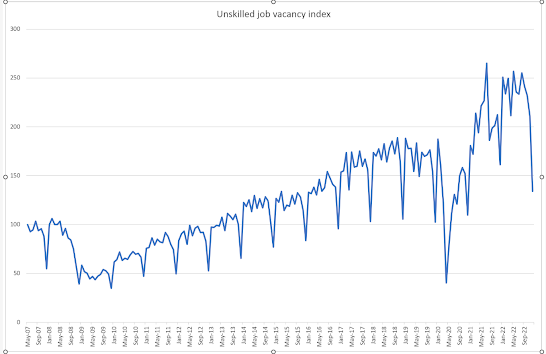
We've had an incredibly overheated labour market. Does it seem likely that Uber's forcing people into sub-minimum-wage work?
If Uber was able to keep driver-partners through the 2021-22 period when the thing was hotter than it had ever been, doesn't that kinda suggest that those drivers weren't being exploited?
NZ has a lot of options for drivers who want to take jobs on apps. Uber, obviously. But also Lyft, Ola and anyone else can enter the market if they want. The Employment Court is trying to decide whether Uber drivers are employees. It's an odd kind of employment if someone can have three or four different apps open at the same time, taking jobs as they come. Macfie takes a very union-sympathetic position; haven't seen other reporting on the court case.
The New Zealand Principals Federation suggests merging the teacher colleges into the universities might have something to do with declining teacher competence. I was on faculty at Canterbury when the College of Education merged in in 2006. It never made much sense to me on academic grounds. Teacher training was vocational training. Experts in vocational training, of the kind provided at a College of Education, are not necessarily great fits at a university where research expectations matter more than teaching ability. It seemed likely to result in great teacher trainers being exited in favour of those able to get papers into low-grade education journals.
New Zealand now has a trade union whose purpose is to defend the free-speech rights of those whose outside-of-work statements get them in trouble with their employers.
It looks like the government will be using procurement rules to try to favour Māori-owned businesses. There's some evidence that these kinds of rules, in the US, increase black business ownership rates while also increasing government contracting costs by something on the order of 3.8% or 5.6% on those contracts.
Not too long ago, Canada’s Northwest Passage was effectively unnavigable. The ice was simply too thick for sailing ships to make it through during the too-short summers.
And while Netflix’ excellent miniseries The Terror brings an additional supernatural element to the horrors of being icebound on the Royal Navy’s Arctic expeditions of the mid-1800s, the reality was awful enough.
It took more modern icebreakers, and global warming, to make the route more viable.
And for one part of the global regulatory pack-ice, it took Uber.
Imagine, if you will, a heavily armoured icebreaking cargo ship designed to plough through the Northwest Passage. Once the path through the ice is cut, other ships can follow more easily. The icebreaker will get its cargo through first but at a much higher cost per container than the ships that follow in its wake. The armour and the fuel to push through the ice do not come for free.
Over the past decade, Uber has been breaking a lot of regulatory ice.
Most here will remember Uber’s 2016 Parliamentary hearings. Uber’s Richard Menzies had to explain to a Parliamentary committee, some members of whom may have gotten just a little too accustomed to chauffeured services, that there was no risk of someone trying to flag down an Uber as though it were a taxicab. The cars could only be hired using an app on a phone.
Perhaps because our MPs so badly embarrassed themselves in those hearings, New Zealand wound up with workable regulations. It would have been hard for Parliament to recover from a second demonstration of technological incompetence.
But New Zealand is only one country in a big world. And most other countries start with far worse policy than New Zealand. Their pack-ice is thicker than ours.
I go through some of the regulatory ice-breaking that Uber has undertaken, and note the work yet necessary in sorting out reclassification risk.
I conclude:
Principles-based regulation establishing safe harbours against reclassification risk for those providing greater benefits to contractors seems a useful path forward but the path to get there is not free and clear. It takes an icebreaker.
In other areas we talk of first-mover advantages. That is not the case when we think about icebreakers. Breaking the ice is something of a public good. It is a difficult job, and I expect the terrors of trying to make Uber’s model work in France were only slightly less terrifying than being icebound in the Northwest Passage.
But once the ice is broken, anyone can follow. In those cases, there is some merit in being a fast-follower – unless someone is willing to pay an awful lot to have their container be first through the passage. Those of us along for the ride might raise a glass from time to time to the icebreakers.
An ungated version will be up on the Initiative's site in due course and will be linked at that point [Update: it's here].
Dr Crampton said Uber was ultimately an example of how new technology and business models could very quickly show gaps between the intent of a law and its seemingly outdated execution.
“They want a level playing field, the taxi industry is saying everyone should have the same rules but we need to step back and look at what the purpose of those rules are.
“The existing sets of taxicab regulations, the point of them is to make sure people are comfortable and safe getting from A to B.
“A lot of the things that the regulations are trying to achieve are already being achieved by the Uber app.
“So you have to think, should a level playing field be in terms of regulation or be a standard that the regulation should bring everyone up to?”
I’m a fan of classic episodes of The Simpsons. In Cape Feare, Sideshow Bob sneaks a ride under the Simpsons’ car, with murderous intent. After an unpleasant ride, he steps out from under the car, and onto a rake. And onto another. Every time a rake hit him in the face, it got just a little bit funnier.
Watching the Transport Select Committee’s handling of Uber is funny too, but not ha-ha funny.
Back in November, Uber faced the Transport Select Committee. They should have had a lot to talk about. A lot of the rules around taxis are there to solve problems that really do not come up with app-based systems – and impose a lot of costs at the same time. Working through those details would have been a pretty worthwhile use of the Committee’s time.
Instead, the Committee seemed baffled by even the simplest details of how Uber works. They wanted assurances that Uber would not be picking up passengers trying to hail cabs at taxi stands. Uber’s Richard Menzies had to explain, over and over again, that their cars can only be booked through their app.
The government took some well-deserved rakes to the face from the press after that debacle, with the Transport Minister having to defend his “clueless” committee.
Maybe you’re an optimist and thought they’d have learned from that. And maybe you’d have thought Sideshow Bob would have stopped at just one rake.
Last week, the Committee released its report on the Land Transport Amendment Bill. The Report promised to update the rules to respond to emerging technology. But they kept the rule requiring drivers to keep paper logbooks. That’s Sideshow Bob’s second rake to the face. And keeping the rule that would require multinational Uber to be based here in New Zealand if it wants to operate here – that’s the third rake.
Sideshow Bob stepped on nine rakes before he was done. I wonder what the Transport Select Committee might think of next. Requiring Uber hire people to walk in front of their cars with a red flag? Mandatory “I am not a taxi” signs on the roof? Making Uber legal, but only if you book using a Blackberry? Maybe Ubers could be forced to carry printers to provide hardcopy of the emailed receipts.
There are a lot of rakes yet out there. Get your popcorn.
They could at least change the rule requiring Uber's CEO to move to New Zealand.
I think the main lesson here is that if you do something nice for somebody, never tell a journalist.
Yesterday, Frances Cook reported on an Uber driver who saved the day for an American couple who were stranded in Auckland due to the cyclone. They needed to get to Wellington for a business trip, and the flights were cancelled. So he drove all night and they made their meeting. Uber Hero!
Soon after, a bevy of control freaks started tweeting about how the ride was likely illegal due to maximum shift duration rules. NZTA has been looking for ways to knife Uber, so they got in on it too.
And so, a few hours later, Frances Cook had another story: the driver might leave New Zealand rather than face the courts for having helped the American couple while breaking NZTA rules. Uber zero!
It's worth keeping in mind that if the jetlagged couple had rented a car and driven all night, on the wrong side of the road, knowing nothing about NZ driving conditions, it would have been far riskier - but totally legal.
A couple bottom lines:
Be wary about talking to reporters, even if you think you've done good. The law might not be on your side - especially if you're an Uber driver.
Rules on logbooks and maximum driving shifts are a bit silly relative to a first best: penalties for impaired driving that include driving while fatigued. The latter would cover people who drive themselves or friends for free as well as commercial drivers.
Update: Another useful way of checking whether the maximum hours rules do any good would be just to check whether any Uber drivers have been involved in any fatigue-related accidents while working. Shift requirements for Uber drivers don't make any sense anyway, as somebody who's 8 hours into a driving day that started driving that morning will be less fatigued than somebody who's 2 hours into a driving shift that started after a normal work day. Are there disproportionate fatigue-related accidents for Uber drivers?
Do read the second Cook story. Uber's competitors sure are appalled.
The only way I'd ever seen of getting out of transitional gains traps efficiently was by compensating the losers by taxing the winners.
Is that what's going on in Australia with Uber?
Let's recap.
Recall that Tullock's transitional gains trap obtains whenever the excess profit from a regulatory rent gets capitalised into the price of the asset in regulatory fixed supply. In the taxicab case, that's the medallion that gives you the right to drive a cab in supply-regulated markets. Once that capitalisation happens, the owners of the asset will have enjoyed a capital gain, but future buyers only should earn normal rates of return on investment. And there's the trap: the rule no longer conveys excess profits to anybody, but any changes will be fought because they'd impose capital losses.
Tullock thought that Pareto solutions were impossible in that kind of case, but I proposed something close to one anyway. Buy out existing licence holders at the value of their permits and abolish the permit regime (obviously use a price from before wind of the announcement got out). Issue bonds to cover the buy-out cost. Implement a tax on taxicab usage that pays off the bonds, and retire the tax when the bonds are paid off.
Advantage: the winners compensate the losers, and we get to move to the more efficient state of the world. It is not a Pareto move, because plenty of owners would prefer not to have had their permits taken at yesterday's price, but it's not far.
Uber makes maintaining the taxicab cartel more expensive. Cartel enforcement requires political will, and Uber makes the costs of the cartel more obvious to voters. And Uber also enables cartel driver defection: they can drive Uber on the side. Equilibrium stringency then should fall.
And we've seen that in New York. Medallion prices are way down. I used to lecture on this stuff, and noted the successes of Medallion Financial, a specialised lender that provided capital for folks to buy taxicab medallions. Their website once bragged* about how medallions provided above market returns for decades and were highly secure. Here's their stock ticker:
Meanwhile, the price of medallions has dropped from about a million dollars in 2014 down to $250,000 again.
So what does this have to do with paying off the losers? The main point of paying off the losers to get out of a transitional gains trap is to enable the switch to the more efficient outcome. If you're going to get to the more efficient outcome regardless, then paying the medallion owners is just a transfer that might have potential equity justification.
And so we come to Australia, where they're looking to tax Uber riders to compensate owners of cab licences.
If the change were going to happen anyway, should the existing cab owners be paid? I hadn't before caught this excellent piece by Richard Holden.
He works out which licence holders already earned back the price of their licences on a normal rate of return and argues there's no need to compensate those who've already earned back the value of their licenses. Most require no bailout on those grounds alone. Excess returns on these things are due to their inherent political risk anyway. Licence-holders in New South Wales who bought prior to 2012 had already earned back their investment, as had those in Victoria who bought before 2006.
For those who haven't yet earned a fair return on their investment, because they bought their licenses too recently, there could be hardship grounds for providing assistance, but he argues that it's little different than other cases where risky investments have not paid out. Do we bail out everyone who invested in IPOs of companies that fizzle? People who bought late bought knowing that the tech was changing. And if the case for payment is on hardship grounds, it should be means-tested and funded out of general government revenues rather than by cab riders.
Holdin also points out pernicious incentive effects if innovators have to pay off affected industries all the time. I've seen compensation as a last resort way out of horrible political equilbria, like Canadian dairy - not as something that should be the default.
* This was on their website circa 2000. I saved it and used it in my lecture notes on rent-seeking and transitional gains traps.
My grandfather got to this country from Europe, via Argentina, in 1923. He had $150 in his pocket, and soon after he got here, New York City issued 11,787 taxi medallions - the same number as there were until just a few years ago. Back then, they cost $10 apiece. My grandfather bought one, and he started driving a cab. In his mind, it was one of the few jobs in which success depended only on how hard you worked.
Soon, he had saved up enough to buy his second medallion, and by the 1960's, he had 150. They were terrific investments - better than stocks. We recently figured out that since the 1930's, the Dow Jones industrial average has gone up 11 percent a year on average, and taxi medallions 17 percent. Today, they sell for $250,000 each. In the 1970's, my father started selling off some of the medallions to diversify. But no bank would lend money to the buyers - immigrants from the Soviet Union, Haiti and India - because they didn't have any bank statements. So he started a loan business. We've lent over $1 billion and never had to possess a single loan even though the interest rates are higher than on bank loans.
A lot of people who should have failed intermediate microeconomics like to make the following argument.
The theory of perfect competition has perfect information as an underlying assumption
Nobody has perfect information
Therefore, government must regulate to protect people from bad choices because market failure.
It's wrong on a pile of grounds. First, and most importantly, the first welfare theorem gives us sufficient conditions for optimality, not necessary ones. But even leaving that aside, we need a Demsetz move into comparative institutional analysis. How do people act to overcome their information problem? Are there profitable opportunities for some entrepreneur to bridge the knowledge problem so that consumers and producers can meet up successfully? Are there heuristics that consumers use in response to information problems and how close to optimality do they get us? And, most importantly, do the legislators and bureaucrats have any better clue themselves?
On that latter point, here is how New Zealand's Parliament covered itself in glory this afternoon in the select committee hearings on Uber. Parliament's deciding how to modernise the transport regs so that innovation can happen. There are some problems in the proposed legislation, but the Transport Committee has the MPs who are most expert in the committee's area. The best of the best. Here's what they thought about how Uber works:
Appearing before Parliament's Transport Committee, Uber New Zealand general manager Richard Menzies tried to argue that the company should not have to adopt outdated taxi requirements like logbooks, signage and stringent driver and vehicle checks.
But first he was forced to explain to the committee, over and over again, that Uber was not a "rank and hail" taxi company.
National MP Alastair Scott was the first to bite.
"We're concerned that you could get some gypsy operators who are not licensed by anyone appearing on a taxi rank."
Labour MP Sue Moroney interjected, offering a more politically-correct term: "Cowboys".
"Cowboys, gypsies, whatever," Scott said.
Menzies politely explained that an Uber vehicle could only be ordered through its app.
"People can't simply spot at Uber and jump into random car," he said.
Labour MP Sue Moroney wasn't convinced.
"How do you know that? How do you know that people who are your drivers are not sitting at taxi stands or being hailed?"
Menzies, looking slightly bemused, said: "We don't use taxi ranks."
None of these people seems to have ever used the service, or ever to have talked with anyone who has.
Green MP Jan Logie noted that the law change would allow Uber to use taxi ranks - how did Uber feel about that?
Menzies, again: "The way our system is currently set up, we don't need taxi ranks."
The whole point of Uber is to not have drivers sitting around at freaking taxi ranks, idling. They go to where demand is expected.
As it was becoming apparent that no MP on the committee had ever used the Uber service, National MP and technophile Maurice Williamson piped up that he was a "massive fan".
But he did not favour the ordinary Uber, he said. He wanted to know when Uber New Zealand would roll out Uber Black - the company's VIP service.
By now, Uber's committee appearance had gone well overtime. But Moroney wanted one last shot, asking Uber whether it would actually follow any rules set by Parliament.
"All I want to hear is that you won't be breaking the law," she said.
Menzies raised his hands in front of his face, wordlessly, as the committee chairman brought the session to a close.
I have a different argument we might wish to consider, in place of the one with which I opened. I think it works better.
Good laws don't require that MPs have perfect information about the industries that they're attempting to regulate, but they should be at least half-way to having a clue.
They don't. Not even close. And the feedback loops that help normal people get a clue when they make mistakes - those don't operate for MPs. They can be wrong, forever, with no personal consequence. They may even be more likely to be re-elected rather than less if they're wrong in particular ways.
Therefore, Parliament should get out of the way. Stop pretending you're protecting me from bad cab drivers or whatever with rules that protect incumbents when you have absolutely no clue how Uber even works. Get Out Of The Way. Everything else has far more risk of doing harm than of doing good.
Roger Partridge lays out some of the problems with the government's proposed changes to the taxi regs. While the government talks a good game about flexibility, the rules do the opposite. For example, paper logs for drivers makes little sense when drivers' records are all already in the Uber app, and where someone with 2 hours on-shift might be far more fatigued than the driver who's been on 6 hours, if the former just came off the day job.
The upshot of the rules is to increase the fixed cost for prospective drivers. And that wrecks what seems one of the main benefits of Uber for drivers: flexibility. When fixed costs are high, that pushes things towards a smaller group of drivers putting in lots of hours rather than a greater number of drivers putting in a bit of time here and there when it suits their schedule.
Uber, the ride-sharing company launched in 2010, has grown at an exponential rate. This paper provides the first comprehensive analysis of the labor market for Uber’s driver-partners, based on both survey and administrative data. Drivers who partner with Uber appear to be attracted to the platform largely because of the flexibility it offers, the level of compensation, and the fact that earnings per hour do not vary much with the number of hours worked. Uber’s driver-partners are more similar in terms of their age and education to the general workforce than to taxi drivers and chauffeurs. Most of Uber’s driver-partners had full- or part-time employment prior to joining Uber, and many continued in those positions after starting to drive with the Uber platform, which makes the flexibility to set their own hours all the more valuable. Uber’s driver-partners also often cited the desire to smooth fluctuations in their income as a reason for partnering with Uber.
The paper uses, among other things, administrative data from Uber on drivers' driving patterns: when they're active picking up fares, and when they're not on the clock.
Another interesting tidbit: the survey of drivers shows only a fifth of drivers see it as a full-time job, and only a fifth had worked in transport in their previous job. The New Zealand government still wants drivers to have a P-endorsement. If you weren't working as a cab or commercial driver in your previous job, that's a pretty big barrier. Given the proportion of drivers in the US who came to Uber from outside of the commercial transport sector, it's a barrier that matters.
The paper makes really rather clear that the flexibility Uber offers matters for drivers.
First, the Uber platform provides a great deal of flexibility for driver-partners, and this
characteristic of work in the on-demand economy may attract workers who supply labor
to the sector more generally. Responses to the BSG survey indicated that many driver-partners
valued the flexibility to choose their hours and days of work. Furthermore, the
administrative data indicate that a large share of driver-partners avail themselves of this
flexibility and vary their hours from week to week. Compared with traditional taxi
drivers, Uber driver-partners tend to work substantially fewer hours per week. For
example, taxi drivers and chauffeurs were five times more likely to work 50 or more
hours per week. The high fixed costs of obtaining a medallion to drive a taxi in many
areas could explain the longer hours of taxi drivers. The finding that hourly earnings for
Uber’s driver-partners are essentially invariant to hours worked during the week also
makes Uber an attractive option to those who want to work part-time or intermittently, as
other part-time or intermittent jobs in the labor market may entail a wage penalty.
Second, Uber’s driver-partners are more similar in terms of age and education to the
general workforce than to taxi drivers and chauffeurs. There are many possible
explanations that could have contributed to this result. First, the U.S. economy was
operating at less than full employment during the period studied, and more highly
educated and younger workers may have had fewer alternatives available than is
normally the case in this time period. Uber may have represented a particularly attractive
bridge option for these workers. Second, entry barriers in traditional taxi and limo
services may prevent a broader segment of the workforce from gaining such jobs. And
third, a segment of the general public may be drawn to Uber over traditional taxi and
chauffeur jobs because Uber permits greater flexibility in terms of scheduling. The fact
that new drivers continued to partner with Uber at an accelerating rate in late 2014 and
2015, when the economy strengthened and the unemployment rate fell below six percent,
suggests that weakness in the economy was not the major reason why driver-partners
partnered with Uber. In addition, most driver-partners were employed prior to joining
Uber. These considerations suggest that Uber has attracted driver-partners with a wide
range of backgrounds because they value the type of opportunity for flexible work that
Uber provides.
Let's hope the NZ government doesn't wreck that flexibility. More on that momentarily.
The government's been rather insistent that Uber drivers have P-endorsements - a process adding substantial costs for Uber drivers and making it pretty unlikely that folks would sign up for the occasional shift. The government says it's needed to keep customers safe - that Uber's end-to-end GPS tracking of driver and passenger, and Uber's own checks on drivers, aren't enough.
He said changes had been made to the system to ensure it would not happen again.
All trips were now matched with GPS data before drivers were paid, and both scheme providers and users would be made aware of the correct procedures to follow, Bayfield said.
If only there were some company out there that did end-to-end GPS monitoring and billed automatically on trip completion. Couldn't trust them though. Their drivers might not have a P-endorsement.
And it's these P-endorsed incumbents that the government's trying to protect by cracking down on Uber.
The NBR's Jason Walls asked me for comment on Minister Bridges's warnings of a potential ban on Uber. His article is here ($).
I have a hard time seeing what consumers get out of Uber drivers getting a P endorsement over and above what Uber is already doing - and especially where Uber drivers and passengers are GPS tracked at every point along the journey. People who want a P-endorsed driver can hire a taxi that provides P-endorsed drivers. If the P-endorsement is so gosh-darned important, why aren't the incumbent cab operators advertising heavily about how their drivers have it? If customers really wanted that, then existing operators would have no need to worry about the competition.
While I think it would be best to ease back the taxicab regs across the board, it isn't nuts to see the app tracking as being a pretty decent substitute for existing safety regs that apply to standard taxis. And especially where customers can choose.
It is not ignorance that leads to customer annoyance with surge pricing. Customers understand exactly what surge pricing does. And that is why they do not like it.
From the customers’ perspective, surge pricing does two things. First, it encourages more drivers and so makes it more likely that the customer can get home (or where ever else they are going) in less time (albeit at a higher - and possibly much higher - monetary price).
This is the economic ‘plus’ from surge pricing. Economists call this an allocative gain. It means that more mutually beneficial trade occurs because there are drivers who are only willing to drive for the higher price but there are also customers willing to pay that price. Setting a lower ‘normal’ price would just mean that the drivers stay at home and the customers don’t get home.
Second, however, surge pricing creates a transfer.
When I jump into the Uber car I don’t know if my driver only decided to work because of the surge pricing. He or she might have been out there anyway. And in that case, I just pay more even though the driver would have been there anyway. Of course, the driver also gets more. The money doesn’t disappear. It is a transfer. My loss through paying the higher surge price is the driver’s gain. So from an economic perspective, this transfer is neutral. But that doesn’t make the customer feel any happier.
So economists love surge pricing because it improves ‘allocative efficiency’. Customers tend to dislike it because it means all customers pay more, even if their driver would have been working regardless.
He notes that American bans on price gouging are fundamentally counterproductive: where customers really hate price hikes and would punish firms for it, firms already have incentive to avoid it - even if it's to the strong detriment of consumers. I've argued that this kind of reputational concern can induce a market failure in a post-disaster context. Christchurch really could have used some petrol price hikes post-quake, but nobody was doing it.
King rightly notes that, if surge pricing puts off customers enough, either Uber or a new competitor will come up with a better way of handling things:
For example, instead of surge pricing everyone, the price rise could depend on the customers history. Regulars get a lower price than those who have just downloaded the App due to the crisis. Of course, to encourage drivers, they would need to receive a uniform higher price. So Uber would have to sit in the middle and manage payments. This will most likely lead to lower profits for Uber in the short run. However, it will be a long run investment in goodwill.
And if Uber does not come up with a better alternative to its hated surge pricing, one of its competitors will.
Firms in other sectors behave as though they expect to be punished more for pricing to meet demand than for running out of product: stores run out of snow shovels in blizzards. And if some store always charged a premium so they could keep an emergency stock of snow shovels out back, well, that store would likely have no customers except during the blizzard.
King's mechanism would effectively save those emergency snow shovels for the regulars. But would taxi regulars really be willing to pay a premium on day-to-day traffic to ensure supply availability during peaks? Uber would have to be betting so. I'm not sure it's a bet I'd make - but it would depend on the premium they'd have to charge at off-peak times where they'd risk being undercut.
Well, the Ministry of Transport proposals around Uber could have been worse.
This week's white paper produced two preferred options. The first would place requirements on drivers; the second, on transport operators. The National Business Review asked me for comment on the proposals; here's what I told them.
“The government’s approach to
taxicab regulation intends to avoid risks where new services, like ridesharing
or carpooling apps, work outside of existing regulations, and to modernize the
existing regulations so services like Uber are a better fit. But are those
risks really large enough to compel regulation?”“The Transport discussion
document advances two options it views as preferable to the status quo. The
first of these would place the burden of compliance on approved drivers; the second,
on approved operators. But both options would require that drivers have a P
endorsement, that drivers work within limited time periods, that vehicles have
a certificate of fitness, that drivers pass health tests, and that vehicles
have mandatory security cameras – albeit subject to potential exemption by
application.”“While the proposed regimes
would be more open than the status quo, they could be substantially more
liberal. If Uber were ever to decide, for example, that some other test were
more effective in determining driver suitability than the P endorsement, as a
passenger, I’d trust Uber’s judgement. It’s their reputation on the line if
drivers prove unfit, and they have an international reputation to maintain.
Regulations requiring that drivers undertake extra training, or that cars used
in new services carry more than the standard Warrant of Fitness, make it just
that much harder for new drivers to come into the market and pick up a few
shifts. It makes things like Uber work less well. There are potentially many
people who would be willing to take the family car out during a period of surge
demand, but who would never find it worth the bother of getting a P endorsement
(which requires taking a course and waiting 6-8 weeks for processing), and
keeping the car under a Certificate of Fitness rather than just the WoF, and
getting a doctor’s certificate, and putting in a camera. These regulatory
rigidities make it harder for surge pricing to bring more drivers into the
market at times when people really need rides. And, really, what’s the point?”“I would have liked to have seen
a sixth, less regulated option. In a world in which I can immediately complain
about the vehicle’s quality through an app-based feedback mechanism, and where
we already have warrants of fitness for cars, it is hard to see the case for
certificates of fitness. Where drivers can be chosen based on their reputation
and where customers can leave immediate feedback, it is hard to see the case
for P endorsements over regular driver’s licences. If I can pick up a
hitchhiker without a P-endorsement and without a certificate of fitness, or a
doctor’s exam, why should that be illegal just because the hitchhiker finds me
with an app and pays me?”
The story's here. Campbell Gibson does a great job of excerpting from my excess verbiage.
Way too many policy arguments take the following form.
Markets in an ideal world are efficient.
Here is a potential deviation of the real world from blackboard conditions, so we're in a second-best.
Policy can ameliorate outcomes when there is a market failure. So, here's what we must do.
What's missing? Any evaluation of whether the policy cure is actually an improvement on the status quo. Some policies are like using tweezers to pull out an irritating splinter - great idea. Others would have you hack off the arm to avoid the splinter.
Harold Demsetz very nicely made this point way back in 1969. He was there critiquing Arrow on information market failures, but the lesson is more general. It isn't enough to simply point out a potential market failure. Markets fail but policies don't automatically induce nirvanas. We need comparative institutional analysis to tell us which world sucks less: the world with a market failure that isn't addressed by policy, and the world in which a real-world policy involving actual tradeoffs comes in to try to solve it.
In a first-best world, we would have proper congestion charging and the like;
We don't have proper congestion charging;
Taxicabs can increase congestion;
Uber likely increases the number of cabs;
Therefore we need a complicated regulatory structure for Uber imposing fees by time of day and location of service.
Baker also reckons that while Uber's drivers are contractors, not employees, and despite that those drivers like the flexibility, the drivers should be treated like employees for minimum wage and overtime purposes.
Some folks just hate the idea of voluntary transactions among consenting adults that don't route through the State somehow along the way.
A couple things to note:
It's eminently unclear that Uber increases congestion. In the longer term, it will reduce the amount of street space that need be devoted to parking, freeing up more road for driving. It will also reduce peoples' need to take a car for the day because of that one trip they need to make mid-day and instead let them commute in using the bus, then take an Uber for the part when they do need a car.
Using charges on Uber to solve congestion instead of broad-based congestion charging is nuts. Unless Uber is a very large proportion of cars on the road, having any effect on congestion using charges on Uber would have to involve just massive variability in ultimate Uber charges on consumers, which would deter any use of the service. I favour congestion charging, but implementing it on Uber only makes as much sense as imposing congestion charging only on blue cars.
Update: a reader points out that Uber surge pricing is already a form of congestion charging. It's a good point.