Showing posts with label politics. Show all posts

Thursday, 13 August 2026

Spills

A new and more rational basis for ongoing choice of party leaders in a Parliamentary system.

Step one. Set a prediction market contract. "Pays $1 if the leader of the X Party is a Minister after the election." 

Step two. Set prediction market contracts: "Pays $1 if the leader of the X Party as at the date of election is {Name}."

Step three. Set conditional contracts. "Pays $1 if the leader of the X Party is a Minister after the election conditional on {Name} being Party Leader as at the date of election."

Step four. Set a decision rule. "The leader of the X Party changes to {Name} if {Name} shows a demonstrable sustained improvement in the Party Leader being a Minister after the election over the status quo, and superior to other {Name} options."

Works for both major and minor parties; their leader only becomes Minister (or Prime Minister) conditional on being in a winning coalition.

Punters from all parties could weigh in and put their money-votes on who they think would be most likely to improve each party's chances. 

A crazy ideological campaign to try to tank the other side's chances by picking a bad leader would draw in liquidity from outcomes-based traders - that's Hanson & Oprea (2009). The 'demonstrable sustained improvement' part is to give time for liquidity to come in in response to attacks - as well as guard against blips. 

No more dramas. No more press conferences. No need to try to attempt to count to whatever the required number of MPs might be to effect a spill and trust that nobody changes their mind along the way. Just watch the prices and let the leader be whoever maximises the Party's chances of being in a winning coalition. 

Probably only feasible in a country that's sensible enough to legalise prediction markets. 

Wednesday, 22 May 2019

Parliament and Twitter Hate

I stay the hell away from twitter fights about which MP draws the most attacks on Twitter and where lines are on what's allowable or not for very public figures who themselves often give pretty hard. Threats of violence seem absolutely wrong; otherwise, I'm not going to be drawn into the argument.

But it seems it would be trivially easy, for somebody who knows what they're doing in Twitter's API, to scrape out all the tweets referring to each MP, and build a timeline of affect. Like, overall volume of tweets referring to an MP, relative mood of those tweets, and how that changes over time.

You'd expect that senior politicians and more vocal politicians draw more attention, both good and bad, and that politicians that are more active on Twitter also draw more attention. All of that should be able to be controlled for. And then you'd be able to check for the effect of things like changing portfolios, movement into and out of cabinet, movement into and out of opposition and all that.

Anyway - a fun project for someone with time and who knows how to play with Twitter's API. I bet the Herald's data journalists could do it in no time at all and put up some ranking that could be interesting.

Update: Thomas Lumley's had a first cut at things:
He later notes that the negative words in reply to me seem to be people sharing my outrage at the outrage-of-the-day, while negative replies to Ms Ghahraman are rather worse. It's an interesting first cut. I also really wonder how much negative engagement is driven by bots as compared to real people. David Hood points out that prior to the last campaign period things just looked less polarising. Did NZ change, or is someone messing with us?

Thursday, 18 April 2019

He's a failure on top of everything else.

"His greatest shortcoming is that he's unable to do the thing I don't want him to do! What a blistering fraud!"

I love the alt-text on today's Wondermark.

It sounds too much like Question Period here.


Thursday, 20 December 2018

Sunk costs in politics

Sunk costs matter more in politics than in markets. They matter everywhere, but firms have better incentives to stop throwing good money after bad.

In politics, you have to keep throwing that money at things like the America's Cup because reversing would signal that you screwed up in the first place, and politicians expect voters to punish them more for admitting that than for just riding the damn thing out.

This was part of a longer thread from Auckland Councillor Richard Hills, some of which is now deleted.

Auckland Council voted to throw money at a yacht race - the America's Cup. And when it inevitably came back begging for more money, as everyone had to have known it would, "you can't stop half way... you're not going to stop it when you've spent so much."


I wish Councillors believed it politically possible to say 
"Know what? We should have foreseen this pitch for extra cash, but we believed them when they said that this time is different. Our bad. But we're not going to give them any more money. If they want to cancel their boat thing or take it elsewhere, that's their call. But we'll want all our money back if they do - and we will never ever again put a dime of public money into a boat race otherwise."
I'm not blaming Hills here - he notes that he'd tried taking more expensive options off the table. But it is a nice illustration of political thinking around sunk costs.

Wednesday, 19 December 2018

Coalitions mean plausible deniability

Who knows what the true model here is. Whatever the true model, we simply don't know whether statements by New Zealand's Foreign Affairs Minister represent New Zealand foreign policy.

Here's Richard Harman. You should subscribe to his newsletter if you want to keep track of what's going on in NZ politics:
The Prime Minister, Jacinda Ardern, confirmed yesterday that she did not see Winston Peters’ major speech on NZ-US relations before he delivered it in Washington, DC, on Saturday.

The speech has raised questions about whether New Zealand is moving its foreign policy closer to the Trump administration and away from the independent stance it has pursued since the ANZUS breakdown in 1985.

It has surprised observers in Wellington that such a major speech could be delivered without at least the Prime Minister’s prior approval and probably that of the Cabinet as a whole as well.

And it has left unanswered, questions as to where New Zealand sits between the United States and China.
Harman has lots more at the link.

So it's impossible to tell whether Winston's speech represents the current view of the government, whether it's Winston off on a branch, or whether it's a deliberate coalition strategy to have someone who can be dismissed as the crazy uncle cozying up to the US to let other parts of the coalition stay friendlier with China: "Oh, that's just Winston. You have to forgive him. They're retail politicians. Retail politicians can get away with anything here. They just have to remind people that they're retail politicians when they're doing it."

The thing I hate most about MMP is the diffusion of responsibility. Given the limits of voter attention, the best we can hope for is that they dish out reward or punishment appropriately come the election, and that fear of that constrains government. But when everyone and no one is responsible for policy, that is a bit harder.

Thursday, 22 March 2018

Things that should be obvious

A short list:
  • If a small oil-producing country ceases producing oil, it has no particular effect on the price of oil or oil consumption because the rate of extraction increases (very slightly) in other places that have more oil. It has no short-run effect on climate change. Maybe in the very long term, where want of New Zealand's supply affects prices, it could have an effect. But the main effect is to punish companies doing that work in New Zealand and their workers. If you want to reduce oil consumption or greenhouse gases, you need to reduce demand for it by increasing the price of it. 

  • If you're the Regional Economic Development Minister and you want more flights to towns where the main carrier doesn't find service to be commercially viable, and if no other carriers pick up service to those towns, then you could put out an RFP for provision of service to those towns and let the carriers bid for it. It's still a bad idea, because it may then induce carriers to drop service in some towns in hope of subsidy. But it's a less bad idea than yelling at the company's CEO and demand that he run an unprofitable service to the detriment of the shareholders who aren't the NZ Government.
    • Jones was pandering in this. He isn't an idiot. It would have been surprising if he hadn't known that he was demanding something he had no authority to demand and that it would be unwise for the CEO to actually do*. He was pandering to voters who are idiots (and induced one Labour MP to reveal type in the process). But there is a point where this kind of thing has a metastupidity bordering on evil. Pandering to idiots in ways that erode economic institutions is rather not good. Creating the impression that a decent chunk of the governing coalition has little respect for the rule of law is bad. This kind of talk is the stuff of tinpot dictatorships and Trump. 

  • Legal markets for marijuana and ecstasy and the safer party pills, where products were subject to the Consumer Guarantees Act and where producers adulterating products would be punished, would stop Fentanyl-laced drugs at concerts and would be far more effective than ramping up punishments for producers of synthetic drugs. National pushing for increased penalties on this one is a travesty. They tried, with Peter Dunne, to set up a legal highs regime that could have reduced harm, then buckled under pressure. Now, for what seems like the sake of getting a trivial win by carving NZ First away from Labour on a vote Labour won't care about, they're further wrecking the prior regime rather than trying to fix anything. 
Blaise Drinkwater provides an excellent summary of the stupidity of National's bill upping penalties on synthetic cannabis. At least some National MPs will have figured this out. That they are supporting it anyway is not good.


Just about every political party has disgusted me this week, and we still have two days left.


* Note that Damien Grant contests Geddis's [linked] contention that Directors doing this would be behaving illegally: where the company isn't insolvent, Directors pushing small unprofitable activities aren't likely in breach. I am not a lawyer. But egads the Minister shouldn't be talking like this. 

Tuesday, 11 July 2017

Coalitions

Peter Ellis's NZ election simulations show a 58% chance that any coalition would require New Zealand First in it. 


So 58% chance that Winston is in either coalition, and an additional 6% chance that Winston makes the tie that puts a Winston-Labour coalition neck-and-neck with National's coalition.

So there looks to be zero chance of Labour's being able to put together a coalition that does not involve New Zealand First. But there's reasonable chance that National could.

There are some New Zealand First policies I like. I think the version they've been pitching for shunting some GST revenues back to Councils is completely unworkable, but there are workable ways of achieving that objective - and finding better ways of funding Councils and improving their incentives is rather important. NZ First is more sympathetic than most parties to devolution as well.

But if New Zealand First's strong anti-immigration position is your biggest concern, I think that has to argue for a strategic vote for one of National's current coalition partners that has been pro-immigration: ACT, United Future, or potentially The Maori Party with Carrie Stoddart-Smith now there as candidate.

Voters of the left who are pro-immigration will have a difficult time this go-round.

Tuesday, 31 January 2017

Difficult scenarios

Suppose that you were a Republican Congressman who were faithful to the Constitution and believed that President Trump should be impeached for violation of the emoluments clause, for ordering executive agencies to ignore judicial orders, for the travel ban full stop, for musings about the problems caused by the Geneva Convention, and for what he's yet likely to do.

You know that if you signal your willingness to vote for impeachment, and if there are not the numbers to vote for impeachment, you are finished. Your career with the GOP is over. And if you are particularly pessimistic, you might think that any firm hiring you afterwards would face reprisals from the President. You have a mortgage to pay. Effectively, your life will be ruined. Even if the impeachment were successful, the GOP would likely take a hit in the mid-terms and you might not survive it.

You know that the Democrats have 194 seats in the House and 46 in the Senate. Even assuming all Democrats voted to impeach, which itself is less than certain, you need 218 votes in the House and 67 in the Senate. So you need 24 like-minded Republicans in the House and 21 in the Senate.

You also need to know that their support is secure. Each alone would face ruin by opposing the President.

Unsurprisingly, Gordon Tullock wrote about this kind of scenario. In the Paradox of Revolution, Tullock reminded us that if a revolution has public good characteristics, it will be undersupplied, and that revolutions are consequently undertaken by someone who has something to gain.

It is difficult to see who among the potential revolutionaries - those backing impeachment - would stand to gain. Pence would take Trump's place after any impeachment and seems unlikely to reverse course after having committed to supporting Trump in the indefensible; he even deleted the tweet in which he expressed opposition to banning Muslims from entering the United States. [UPDATE: looks like the tweet wasn't deleted, it was a glitch somewhere. In my defence, one source.] And after Pence comes Paul Ryan as Speaker of the House.

In Tullock's calculus, nobody wants to participate in revolution unless they have low personal cost of being involved, get a lot of entertainment value out of being a revolutionary, or have something to gain: the private benefits are washed out because of the low likelihood that any one revolutionary turns the tide. That calculus changes in considering impeachment: each of the impeaching representatives would have a reasonable likelihood of decisiveness, but they all need to have reasonable expectation that the others will move.

What you need then is a Schelling Point. You need a coordination apparatus such that everyone knows there's sufficient support when the time is ripe, and that everyone knows that it's time when it's time without anyone having had to talk about it. If you talk about it, your plans could be revealed and you could be made an example to discourage others.

And it isn't looking good. McCain and Graham came out against the Executive Order. People like McCain and Graham coming out provides a coordination point for other dissenters. It looks like there are 15 in total who oppose the Executive Order, although that list is a bit out of date now. Opposing a dumb Executive Order may be a lower hurdle than supporting impeachment.

On the other side, the Kochs have come out strongly in opposition to the Executive Order. They're principled libertarians. And they are taking a bit of risk because a lot of what they do is subject to regulatory whims out of the White House. Their signalling potential opposition to Trump is risky for them, but potentially emboldening for congressional opposition.

I fear that if would-be impeachers expect to fail and expect to be destroyed if they fail, they never get going. One potential solution would be if there were reasonable expectation that Republicans who destroyed their careers in a failed impeachment attempt would find quiet sinecures elsewhere - the equivalent of funded chaired positions in American policy think tanks or activist groups, for example. In that case, the reduction in the downside cost could mean the downside cost never eventuates. But only if there were enough Republicans who cared enough about the constitution that 45 of them would vote to impeach if they didn't have to worry about it destroying their careers.

And if it turned out that there were only 40 who cared, and tried, and failed, that could be even worse. The median voter in Congress would change.

Difficult scenarios. And I'm nowhere near close enough to American politics to know whether the numbers are there.
Thursday, 10 November 2016

Buckle up

I wrote a short piece last night for The Spinoff on last night's election. I'll change my views if we get refined exit poll data that tells me otherwise. But it also seems to be the conclusion others are now drawing too. I also talked about this with Mark Sainsbury this morning.

It isn't an income inequality class war thing. It's more complicated than that, with a lot of it being the mess I'd hinted at in my summary comments on our inequality debate: the egalitarianism of respect that is sorely needed.

A snippet from The Spinoff piece:
I expect a lot of kiwis will be tempted to see the Trump phenomenon through an income inequality lens. While rising income inequality is a myth in New Zealand, it isn't in America. But that easy narrative doesn't sit well with the data, or not in the obvious ways. Gallop polling back from August even showed Trump supporters weren't those, on average, left behind by globalisation or automation. Supporters did not have lower income and were not more likely to be unemployed. And the same Gallup study showed supporters were more likely to work in industries that did not really have to worry much about competition from China - like construction. But they were more likely to live in places far from the media and political elites.

...

What exit polls are out so far show Clinton won among those earning less than $50,000 per year, but lost among those on higher earnings - despite Clinton having much stronger support among the college-educated. It isn't easy to simultaneously lose badly among those on higher incomes and win strongly among those with college degrees. And race has certainly played a role. None of this cleanly fits an income inequality narrative. But it does fit a cultural narrative.

...

Look back again at Vance's description of life in hillbilly country. There was a great interview with Vance in The American Conservative a few months ago. He talks about the resentment felt in those communities about being looked down on by urban elites. About being told that their way of living and religious beliefs and pride in military service are wrong. About their accents being a great source of amusement. Trump earned the same condescension from urban elites that a lot of people who aren't in that elite feel pretty regularly. And warnings about Trump's racism, misogyny, and potential fascism ring hollow when those words have lost the meaning they should have through overuse: when everything is a microaggression and when President Bush was regularly compared to Hitler, well, people start discounting when they shouldn't. And there's always a fraction of the population that just wants to watch it all burn.

...
As for what now?

It won't be the end of the world.

But it will be rather bad.

Back in March I'd pointed to the institutional constraints that would stop a Trump Presidency from being apocalyptic. I was too optimistic about two of them.
Read the whole thing...

Wednesday, 9 November 2016

Trump reconsidered

In March I said that Trump wouldn't be the end of the world.

He likely won't be the end of the world, and is still likely to be less bad than most people think. But he will be terrible.

Two things I'd revise from my March piece at The Spinoff:

First, I had not sufficiently accounted for the harm that a vindictive President can do through the levers of the administrative agencies.

Second, I had thought that the GOP elite's hatred of Trump would prove a constraint against him: that he would face internal party opposition that would constrain some of what he might want to do. I was too optimistic on that one. The GOP elite fell into line when Trump won the candidacy. I doubt it was because they accurately forecast a Trump win. Rather, they had, I think, careerist concerns about being seen to oppose the President. That part is the scariest if we look ahead through a Trump Presidency, forecast at 81.6% as I head out from the office.

Thursday, 3 March 2016

America needs Bob Jones

Things were bad for National in the late 70s and in the lead-up to the 80s. Robert Muldoon, then Prime Minister, supported policies that, if continued, would be utterly ruinous for the country. But die-hard National voters would continue to vote National out of tribal loyalty. And no internal coup seemed in the offing.

Bob Jones, a property investor and National Party supporter, saw the mess. He established the New Zealand Party. It ran on an economically liberal platform, in the British sense of liberal. Free markets, an end to the license raj, and a place for National supporters to place their votes if they couldn't hold their noses and vote for Labour.

Bob intended to win. He lost the election, but his policy ideas won. The Muldoonist version of National died. Labour enacted many of the necessary reforms, and National was recast in more economically liberal lines.

Trump looks as bad for the Republicans as Muldoon was for National. But lots of died-in-the-wool Republicans could never vote Democrat.

Will there be a Republican who can stand up and say that a Trumpist version of the Republican Party does not deserve to win, that the Republicans would be better losing than having Trump as its elected President, and that the Republican Party is better than appeals to tribal racism?

Americans, and Republicans who care more about free markets and free people than about having their team win any particular election, really should watch the excellent documentary on New Zealand's 1984 election, and on Bob Jones.

Bob Jones

Trump's likely to be the nominee. More worrying is that he's trading around a 20-25% chance of winning the Presidency. Sure, it's not likely to be as bad as many might think, but that doesn't make it not-bad. Just because an electoral system is more robust to madmen than you might think is no reason to go around letting madmen become President.

Tuesday, 1 March 2016

How I learned to stop worrying and love the Trump

Yes, Trump would be a terrible, terrible President. But he'll be as institutionally constrained as the others. So things won't be as bad as you might think.

Here's me at The Spinoff, with a round-up of eight reasons that you're likely overestimating how bad things would be - and especially if you're used to a Parliamentary system with party-line votes.

A snippet:
4. I doubt Trump will feel much constrained by any of the things he’s mooted as policy during the campaign.
Trump isn’t running on policy, he’s running on mood. He clearly has some pretty crazy policy views, but he’s also pretty clearly making policy up as he goes, sometimes just to get an applause line. So long as whatever policy he winds up promoting is consistent with the mood he’s setting, whether it meets the letter of what he’s said in the campaign probably won’t matter much. Why?
5. Trump should be better than most at providing the symbols his supporters want, while gutting the substance, when he needs to.
Again, Trump isn’t really running on policy. He’s running on the long frustration felt by rather a few Americans. Working class, high-school-educated Americans living away from the coasts in ‘fly-over country’ have been the objects of elite derision for ages. Does Trump seem better or worse than most at providing the kinds of symbols his supporters crave, while not doing much of substance?
To be really clear: I am in no way saying it won't be bad. It just likely won't be as bad as you're expecting.

The really scary thing is that there seems to be a big constituency for what he's selling. Worry less about Trump, more about that.

Update: On that last point, see also Steven Mazie's piece over at Big Think.
What’s going on? Will Wilkinson, a former Big Thinker, tweeted this week that while he’s “not convinced Trump would be a disaster as president” — presumably because of the formidable constitutional, institutional, and political constraints that limit how much damage (or good) any president can do — he is “convinced a Trump win would be proof of a preexisting cultural disaster.” I think that’s just about right. ANew York Times analysis of exit polls from South Carolina and other survey data reports that Trump supporters are thoroughly intolerant of people unlike themselves. People who want to ban Muslims from coming into the United States, not so surprisingly, flock to Trump. But so do voters with bones to pick with other large, undifferentiated groups of people: gays, blacks, and foreigners, to name a few.
One-third of Trump supporters look fondly on the internment of Japanese-Americans during World War II, while only around one-tenth of Marco Rubio and John Kasich voters hold this discredited view. Seventy-eight percent of GOP voters in South Carolina say they oppose the idea that whites are a superior race, but only 69 percent of Trump supporters do. Seventy percent of Trumpites oppose the decision to lower the Confederate battle flag at the South Carolina statehouse in the wake of last year’s deadly shooting in a Charleston church, and 38 percent lament that the South did not win the Civil War. Maybe most alarmingly, nearly one in five Trump voters admits to opposing the Emancipation Proclamation, Abraham Lincoln’s 1863 move to free southern slaves. And a third of Trump supporters would like to ban gays and lesbians from entering the United States.

Thursday, 25 February 2016

Poverty, homeownership, political economy, and a modest proposal

The New Zealand Initiative today launched a report on the state of poverty in New Zealand. Two key findings for us today:
  1. Poverty in New Zealand, relative to other countries, is highly concentrated among children. The elderly have very very low poverty and hardship rates. Children, not so much.
  2. Poverty is substantially affected by housing costs. Before housing cost measures of income poverty are much better than those after housing costs. 
This is in part due to NZ Super. Every old person gets a transfer from the government equal to two-thirds of the median wage. Since poverty lines are generally defined around that fraction of the median wage, you don't get old people in poverty. You also have disproportionately high homeownership rates among the elderly, so the rise in housing costs doesn't really affect them.

Yesterday's Auckland Council meeting on the Unitary Plan demonstrated much of what's wrong with urban planning in New Zealand. Elderly home-owning people, resistant to any potential change anywhere near them, are very likely to vote, do not care about the costs of home ownership (and, indeed, mock younger people showing up at those hearings), and are able to bully councillors into blocking any increases in density. Renters' interests then are not particularly well represented.

And so, my modest proposal:

Henceforth, eligibility for NZ Super will be means-tested, but in a particular way. Eligibility will be restricted to those who do not own a house, either themselves or through a trust, and who do not rent their home from a family member. Those approaching retirement would be entirely free to sell their home, bank the proceeds, and rent a home; or, they could maintain their home while foregoing NZ Super.

I'm still not sure whether I'm serious on this one.* But it is fun to think about.

Update: The money saved from the NZ Super bill could, in this proposal, be redirected towards targeted programmes in lower decile schools.

* Update 2: It is likely impracticable. Just think of all the workarounds. Prohibited from owning? Sell to a younger friend with a long-term lease agreement and an option for your own kid to buy back at a fixed price at a later date. But it's still fun to think about.

Update 3: I was far too quick in the paragraph about NZ Super. NZ Super is set at two-thirds of the average after-tax wage for a couple, and single elderly get 65% of that rate. That won't get either a couple, or an individual, up to the relative poverty line on its own. The elderly don't show up in the relative poverty stats when a 50% of median household income line is used, and don't show up in material hardship measures, and don't show up in AHC measures of poverty, but do show up in the "relative to 60% of BHC median income" measure. I thank Bryan Perry for the reminder.

Tuesday, 23 June 2015

The languages of Omecron Perseii 7 and Omecron Persii 9

Since none of us can really affect political outcomes, it's generally irrational to pay too much attention to politics. On that measure, men are far less rational than women - or at least by the studies of political knowledge I've come across (two examples), and my own work on New Zealand.

This general finding is supported by a very different kind of method. Schwatz et al trawled through 700,000,000 words, phrases and topics provided by 75,000 Facebook volunteers. The authors were interested in personality differences and language. But the gender difference in propensity to talk about politics was stark. Here are the word clouds, sorted by gender. I apologise for the curse words.


At least in this Facebook sample, women talk disproportionately about relationships and feelings; men disproportionately curse, talk about sports and video games, and talk politics.

If we look at the topic clusters, women's focused on family and feelings (emotions, cute things, happiness, friendship, family/friendship); men's were politics, sport, war, video games, economics-politics, and cursing. Or at least that's my summary of each of the topic clouds. Within the central core, government shows up on the men's side; nothing policy-related shows up on the women's side. Or, at least, these are the words that are most *distinctively* associated with each gender. If somebody on Facebook is talking about the economy, tax, budget, the government, freedom, democracy, rights, or liberty, it's likely to be a guy - at least in this sample.

HT: Max Roser

Thursday, 3 May 2012

Labor and Labour

Andrew Leigh, Australian Labor MP and top-notch economist, says the case against inequality cannot rest on Wilkinson & Pickett's "The Spirit Level": the evidence there presented is just too fragile.
One set of arguments suggests that we should care about inequality for what are called ‘instrumental reasons’. Inequality, some contend, is associated with worse outcomes in areas that society cares about, such as health, crime, savings and growth. This argument is put most strongly in The Spirit Level, by Richard Wilkinson and Kate Pickett. It is an argument that I used to believe. Indeed, I deeply want to be true, but my own research persuades me otherwise.[25]The closer you get to these asserted effects, the more fragile are the findings. If there are negative effects of inequality on those social outcomes, they must be extremely small. (There are also small positive effects. For example, my own work shows that inequality boosts growth, though the trickle-down process is slow.)
New Zealand's Labour Party seems to care more about mood affiliation than about sound evidence, at least given the number of posts over at Red Alert lauding Wilkinson and Pickett, most recently here.

There are better and worse arguments against inequality. Why does New Zealand Labour have to go for the dumb ones? The comments thread on the last link over at Red Alert, the New Zealand Labour Party Blog, has Labourites dismissing any criticism of Wilkinson and Pickett as being only ideologically driven. The Standard, the unofficial Labour Party blog, is at least as bad.

Guys, please go and read Andrew Leigh. And NZIER's Bill Kaye-Blake. Neither of these guys are ardent ideological righties, and I'd expect neither of them to shy away from endorsing Wilkinson-Pickett if they thought the argument was supported by evidence.

Thursday, 15 December 2011

It's the bet, not the stakes

Robin Hanson wonders why folks have taken offence at Mitt Romney's holding fellow GOP nomination contender Rick Perry*, ** to account by offering a bet: $10k if Perry could prove what he claimed existed in Romney's book. Here's Robin trying to make sense of things:
The idea that a presidential candidate couldn’t afford a $10,000 bet is crazy, as is the idea that ordinary folks don’t know this fact. Candidates pay for TV commercials, which cost lots more than $10,000, and they fly all around the nation in planes, which gets expensive.

So clearly we have moved high up into belief meta-levels here. “Yes, most people know Romney can afford $10,000, but some aren’t sure that most others know this, and so this shows that Romney doesn’t know about such folks.” Or “It is rude to point out that you are rich, even when everyone knows you are rich. Yes wearing nice suits shows he’s rich, but not wearing suits is socially unacceptable. Offering smaller bets is acceptable, however, so offering a big bet could be interpreted as bragging about wealth. Not that I’d interpret it that way, but someone might, and this shows Romney doesn’t realize that.”
I'm not generally one to disagree with Robin, but I think explanations based on voters' having sophisticated conjectural variations models in their heads is a bit of a stretch.

My hypothesis: there'd have been just as much offence taken if he'd offered $100 or $1000 stakes. A non-trivial proportion of statements made in political debates are demonstrably false. They're thrown out in the heat of debate with little chance that the opponent will have ready access to counterevidence; worse, there's risk that bringing up counterevidence moves the debate to where the opponent wants to go anyway. Sure, plenty of online armchair quarterbacking lists all the falsehoods. The candidates never have to front up and answer FactCheck or the news articles. But paying up on a bet is far more humiliating, both for the candidate and his supporters. No partisan wants to witness his idol's humiliation in having to pay up. And so they come up with other reasons for being offended.

If partisanship is more faith-based than fact-based, offering a bet in political debate is akin to going into a Catholic Church with a gas chromatograph in the middle of Mass and offering to bet the priest $10,000 that the wafers are chemically identical before and after purported transubstantiation. The followers might say they're offended about the stakes, even though the Church could back it. But the real problem is nobody wanting to see that their prophets are false.

* Rick Perry's campaign ad, nicely lampooned here, reminded me a lot of the old Dead Milkmen*** song Stuart. Rick Perry's supporters aren't like the other people here in the trailer park - the ones who don't know what the queers are doing to the soil....

** Why hasn't anyone done anything useful RickRolling Rick Perry?

*** First, footnotes in footnotes is cool. Second, the Dead Milkmen are awesome. And "Big Lizard" is the 3-year old's current favourite bedtime song. But I have to Bowdlerize it. And I don't know whether it's better to keep him away from Dead Milkmen 'till he's ready for the proper version, or ease him into it with Bowdlerized versions. Tough problems.

Thursday, 1 December 2011

ACT Redux

David Farrar is right: the ACT Party, as it has been, is dead.
ACT have always had two strong components to their brand. On economic issues they were strongly liberal, supporting massive tax cuts, no minimum wage, privatization of all SOEs etc. Those who served with Banks in the National Cabinet say Banks was not a huge supporter of the Richardson camp. He certainly is a fiscal conservative, and centre-right economically. But not someone who would privatize the hospitals.

The other component to the ACT brand has been a degree of social liberalism. This has been patchy rather than consistent, but overall most ACT MPs have been social liberals. John Banks would not describe himself as a social liberal.

Therefore my conclusion is that ACT, as we know it, is dead. There is talk of a name change for ACT, and that would be a sensible move, both because of the different brand John Banks has, but also because the ACT brand itself is pretty tarnished also.

Banks should move to position ACT as a conservative party, which reflects John Banks. Banks would be a good leader of a conservative party. The challenge of course is you also have a Conservative Party led by Colin Craig. And as I understand it, relations between Craig and Banks are not friendly – Craig took many votes off Banks for the Auckland Mayoralty.

A merger between whatever ACT gets re-named and the Conservatives would be a win-win, if they can work together. Craig has the money and the membership base. Banks has the seat in Parliament which means you do not need to make 5%. However just because it is logical does not mean it will happen. Colin Craig doesn’t strike me as someone who would settle for co-leader.

As for ACT itself, my suggestion is that those who identify as economic and social liberals need to have a get together next year and look at who is willing to commit to a new party, perhaps calling it the Liberal Party, and targeting the 2014 election. Many many especially urban younger New Zealanders are classical liberals (even if they have not heard the phrase) and support lower taxes, a smaller state etc but also don’t think Parliament should be greatly restricting what consenting adults can do.

I’m not about to quit the party I support, but I would be prepared to spend quite a bit of time assisting the formation of a new Liberal Party, and making sure lessons are learnt from the mistakes of the past.
Lindsay Mitchell agrees.

I wonder whether Banks' overtures to the Conservatives were designed to push out the remaining liberals. By various online discussion threads, that seems to have been the effect.

I think there's space for a cosmopolitan liberal party grounded more in evidence-based policy than in ideology - pushing liberal policies for which there's sound support - and focused on incremental gains. As a rough cut from the 2008 NZES, there are around 7-8% that would fall into the top quartile of economic liberalism and the top quartile of social liberalism. That's more than are found in the top quartile of economic liberalism and bottom quartile of social liberalism, but still suggests that a Party playing to a hard-core libertarian base would fail.

A party focused as strongly on social freedoms as economic freedoms would have a harder time getting the soft-touch treatment that National has given ACT as it could plausibly go into coalition with Labour. But if it could get over the 5% hurdle, which would involve a massive amount of work with a good chance of failing, it could have reasonable long-term influence relative to a limited set of goals. Advancing economic freedom in coalition with National while preventing some erosions of social liberty, and advancing social liberalism in coalition with Labour/Green while perhaps mitigating the worst of their economic policies, would be an admirable achievement. I'd hoped that this was where Brash would take ACT, back before I figured out what Banks was.

The core enthusiasm and grunt-work for any new Liberal party would have to come from the ranks of the ACT on Campus group and the better parts of their List. But they'll need a few more experienced hands; it's good to hear Farrar's willing to help them out.

Bit of fun: on one of the discussion threads, Peter Cresswell paints me as part of a Gramscean liberal march through the institutions; I suppose I tend to be a bit of a counterhegemonist at the margin. Can there be marginal counterhegemony? Heck, just promoting mainstream economics is sometimes counterhegemonistic [though heads may explode both right and left at the suggestion].

Monday, 28 November 2011

Party positions - I don't believe it edition

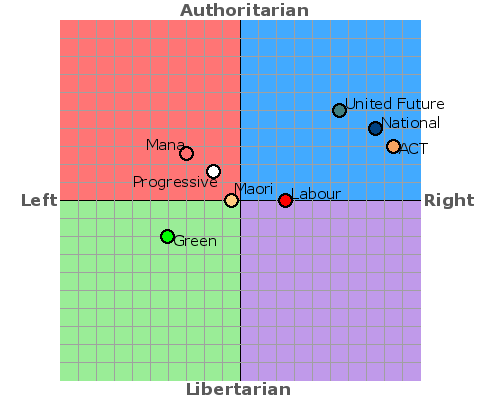
Political Compass placed NZ political parties on a two-dimensional left/right, authoritarian/libertarian chart. (HT: Bryce Edwards)

  1. The left-right economic axis seems about right. It's odd that Labour this year, running on a $15 minimum wage, capital gains tax, and a fairly dirigiste programme, ranked right of centre, but the relative positions seem roughly correct.

  2. The authoritarian-libertarian axis does not seem right. ACT, which mused about marijuana legalization, is ranked more authoritarian than Labour, which would have imposed pretty severe alcohol regulations. ACT is also ranked as more authoritarian than Maori, who seek to ban the sale of tobacco. Many of ACT's candidates were explicitly libertarian. Putting them as more authoritarian than Labour requires putting a fair bit of weight on their crime & punishment stance and mapping views on indigenous rights / individual rights onto a libertarian / authoritarian axis. The party positioning for ACT might be right for the post-election result, with John Banks as the only ACT MP. But not pre-election. Brash was the most libertarian candidate we've had in ages; it's a shame he didn't win in '05 (conditional on his having had an equivalent to Heather Simpson keeping the details in order).

  3. They're right that the Greens aren't tons more socially liberal than Labour. Yes, they take a relatively libertarian position on gay marriage / adoption, copyright, freedom of speech, and marijuana policy. But they also take a relatively authoritarian position on "nanny state" issues. I don't think the Greens, Maori, and ACT aren't as far apart on social liberalism as here made out; those three parties were regularly the ones who voted liberal on social issues in the last couple of Parliaments. 

  4. They correctly place no major party in the right/libertarian quadrant. Even ACT ought only have made it onto the zero line for 2011. This remains a bit puzzling as NZES data shows there are at least as many voters would count as social liberal / fiscal conservative as there are true conservatives. The classical liberals who have supported ACT will have to think hard about whether ACT remains the best vehicle; they know John Banks better than I do.

  5. I wonder where the dot for NZ First would have landed. North-centre?

  6. I wish they would release density maps of survey respondents by country. Sure, it's a self-selected sample. But I'd still be curious how many respondents from NZ wound up in the purple quadrant.

Tuesday, 4 October 2011

Public Choice as User Guide

Machiavelli's analysis was both positive and prescriptive: how ought the prince maintain and extend his power? Public Choice has sometimes been accused of being a handbook for would-be despots.

Now, Bueno de Mesquita (HT: @Isegoria) has produced a book that leans more closely to this kind of users-guide: The Dictator's Handbook: Why Bad Behaviour is Almost Always Good Politics. This one's going to the top of my Amazon queue. In the meantime, here's Moynihan's review.

There would probably be a market for an intelligent-layman treatment of all the public choice results on voting and elections written as a guide for candidates and junior politicians.

Friday, 29 July 2011

Things I learned this afternoon

Fairfax has an awesome infographic on its latest poll results. David Farrar reports Keith Ng's the guy behind it; it's hellacool.

It is impossible to come away from the detailed breakdowns with anything other than thorough admiration for the juggernaut that John Key has built. iPredict's saying 90% likely that he forms the next government; I can't think of anything that's a more sure bet on iPredict; I'm very long and have been for rather a while (1400 shares long National bought at average of $0.76; 1200 short Labour at average of $0.22 but hedged by a few hundred on the Labour Justice Minister contracts that span the Labour space but were much cheaper than buying Labour).

Things that surprised me:
  • National Party support is stronger in Auckland (60%) than on the Mainland (55%). The rural/urban split still kinda holds, but National still has 55% of the urban vote to 62% of the rural.
  • There is NO gender split on support for National. 56% of men and 56% of women support National on the Party Vote. ACT is a sausage-fest (3.6% to 0.7%), but that's not a big surprise. A bigger surprise is that the gender split on the Greens is so small: 6.2% of men and 6.5% of women support the Greens. There is a big skew towards Labour among women, which mostly comes at the expense of ACT, Maori, and NZ First.
  • Green voters are the ones saying they're most likely to move overseas: 3.6% say they'll definitely move overseas for the long term. Sure, NZ isn't as green as the Greens would like. But where is better?!
  • Among those who voted National in '08, 82% say they'd pick John Key as most preferred PM; "don't know" is next on 14. Among those who voted Labour in '08, only 19% say Phil Goff is their preferred PM and 21% say Key. Read that again. More people who voted Labour in '08 prefer John Key as PM than prefer the current Labour Party Leader. 43% of Labour's '08 vote say they don't know who they want as PM. Of those intending to vote Labour this time around, 20% say Goff is the best PM, 46% don't know, and 16% say Key is best.  If this isn't enough to get Labour to knife Goff, I don't know what is. iPredict says only a 10% chance of that happening; I'm going long.

Things that didn't surprise me:
  • National polls best among the 35-59 set: 60% support among that group. But they still have 49% of those under 35 and 55% of those over 60.
  • ACT polls best among those over 60, with 2.9% support there to the 2% in the younger cohorts. Not particularly surprising as ACT has been pushing policies that resonate with social conservatives, alack alas. 6.6% of the oldies like NZ First but nobody under 35 does.
  • Few that voted National in '08 plan to flip to Labour - 4.5%. But 11% of those who voted Labour last time around plan to vote National. Labour is keeping only 79% of those it had in '08; National's keeping 92%. Even the Greens are only keeping 62% - 11% of former Greens are flipping National.
The only interesting question is whether National will govern alone or need a coalition. If it goes coalition, 32% of those saying they'd vote National this time prefer ACT as partner; don't know is next on 25%, then the Greens on  19%. More National supporters prefer a Blue-Green government than prefer a National-United Future government (1.8%) or a National-Maori government (13%).

If there were a button for a National-Green coalition government where Greens got responsibility for copyright and for marijuana law reform, I'd be pushing it. As only 13% of Green supporters prefer coalition with National, they'd then spend three years rending themselves asunder over their supporting National. And, we'd get decent copyright policy as well as a voice for civil liberties.