Showing posts with label populism. Show all posts

Wednesday, 25 March 2026

The case for considering fuel surcharges

Last week over in Newsroom, I laid out the case against subsidising fuel use during a supply shortage

That case is sufficiently obvious that you wouldn't think it would need to be made. But the New Zealand Taxpayers Union really disgraced itself by urging those kinds of subsidies via reductions in petrol excise. Petrol excise already is inadequate to cover the cost of the roading network. Taxpayers already subsidise road use. The NZTU wanted even larger subsidies from taxpayers to road users when it is manifestly unclear that we will be getting more fuel shipments

The piece also made the case for just letting fuel prices rise rather than contemplating various kinds of rationing. Letting prices rise automatically culls the lowest-valued uses of fuel. Governments concerned about equity implications can transfer money to poorer people. This point ought to be obvious to any economist who's done intermediate micro and the welfare theorems. Always surprised to note which bank economists might have missed the lecture on the welfare theorems. 

And it then made a point that I don't think I'd seen others make. I think it's also obvious. Real option value matters. 

But I also worry about the Commerce Commission’s insistence that prices should only reflect current supply costs.

Consider an analogous problem faced by hydroelectric generators.

The ‘cost’ of running water through a hydroelectric dam in February is that the generator cannot run that bit of water through the dam again in July. Rain is always uncertain. Holding storage back, in case inflows are lower than expected, has value.

If fuel storage tanks might not be replenished because import routes are disrupted or exports are restricted, the ‘cost’ of fuel is not whatever notional price fuel companies contract with overseas suppliers. A litre used now might mean a litre that cannot be used in June. It is possible that everything resolves itself before then. But it is also possible that things turn considerably worse. The Strait of Hormuz is less predictable than hydro lake inflows.

The commission’s messaging risks confusing today’s sourcing cost with the value of fuel in storage. If replenishment is uncertain, the relevant cost of selling a litre today is not just what it cost to source, but the value of keeping it in reserve. That is like telling hydro generators to run the sluices in February despite the risk of a dry winter.

And that gets us to the case for fuel surcharges. 

I do not think it's any kind of knock-down case. I certainly don't have the background figures to be able to tell. And if the government is confident that its agreement with Singapore and alternative sources of supply are secure enough, then none of it's needed. But it can be worth thinking through in advance, just in case.

Suppose the storage tanks are at their normal levels. Prices have increased, mainly reflecting increased price of fuel being loaded onto transport ships. But each ship now carries some risk of being diverted before it reaches New Zealand. That risk means each litre in storage carries some real option value: there is some chance that using a litre from storage today means that there will not be a litre to use in May or June. 

All going well, fuel companies price this in. If the transports stop arriving, fuel in storage is far more valuable than the current price. Every fuel company ought to be weighing the price it can get for a litre of fuel today against the potential price that litre could get in future if kept in storage, weighted by the likelihood that future prices are higher. 

It'll be complicated, and there aren't great numbers to throw in as probabilities. But it's in-principle doable. Fuel companies should have strong incentive to get that right. If a litre of diesel is worth $20+ in June if transports stop arriving, then selling today for $3 would be a mistake if the risk of the bad scenario is high enough.

And in the first best, government is in constant communication with the fuel companies about the negotiations it's having with foreign suppliers, and fuel companies are always weighing that up alongside their own market intelligence (and odds at Polymarket etc). 

There is no case for surcharges in that first-best world. Everyone's already weighing up real option values and they're priced in.

Here are a few ways that can go wrong. 

  1. Suppose companies think that they will be punished by the government for increasing prices today to reflect real option value, ahead of the risk materialising. They are not crazy to think that, given the kind of messaging that our populist Commerce Commission provided. In that case, they will choose some price lower than would otherwise be optimal. Their optimisation would be 'what is the highest price we can charge, below the actual optimal price, without drawing ire from the government?' 
  2. Suppose companies think that they will be punished by the government for increasing prices to very high levels in future if transport stops. In that case, a company holding fuel back against that future risk (and potential future returns) isn't able to realise those future returns. The social value of holding fuel back for future use would be high, but the private return would be expropriated through government seizure of stored supplies or other forms of de facto expropriation. 
  3. Even if the government were sensible, consumers may not be. Suppose one fuel company runs real-option-value pricing and another does not. The one charging higher prices today will be damned today for charging higher prices. The one that does not, will not. The one that charges higher prices today will be further damned if the bad state of the world obtains and they charge very high prices in June. The one that runs out will not be blamed for running out. How could they be blamed for running out? The Straits are closed. It isn't their fault. The one that really deserves blame is the one that 'profiteers' in June. Running real option pricing when others aren't means taking a hit to revenues today in expectation of higher returns in future if the bad outcome obtains. But the brand damage could be far higher than can be recouped, because approximately nobody is willing to think in real option value terms. This underlying mechanism is what drives populist government responses too.
I do not know what fuel prices reflecting real option value should be. But $3/litre diesel feels low when thinking about those risks. 

And that gets to the case for surcharges. If companies fear backlash for using real option pricing, government could set a surcharge reflecting the difference between actual prices and prices that incorporate that real option value. 

I'm not convinced by that case. And I have little confidence that government could get to the right number on it, even with smart people making their best efforts. But it seems worth thinking about. 

At a minimum, the government really shouldn't be saying anything that could be read as discouraging fuel companies from increasing prices. 

And the Commerce Commission's public messaging ought to be more around real option pricing. Saying the words 'real option pricing' would be a mistake. But I think enough people understand the hydro lakes to get the point? The generators hold water back when the lakes are high, resulting in higher electricity prices at that time of year, if they worry that the lakes will otherwise be too low mid-winter. If they didn't do that, we'd risk winter blackouts. And that's worse than higher prices when the lakes are high. 

Addendum/Postscript 31 March: Storage is a constraint. Real option value of fuel held back now is consequently lower, unless it were cost-effective to pay an arriving tanker to just stay here. And I doubt that currently stacks up.

I am very glad that the government here has not discounted petrol excise or jumped to other populist stupidities that tempt the Australians. 
Tuesday, 28 February 2023

Tilting at bank profits

RBNZ Chief Economist Paul Conway wants a ComCom market study into banking. He's worried about 'profiteering'.

But this is the first time the Reserve Bank, which is statutorily tasked with regulating banks, has stepped in so explicitly. It's been warning of "profiteering" in some sectors during the cost of living crisis and in the aftermath of Cyclone Gabrielle, and singled out the widening gap between mortgage and term deposit rates.

"It's a very legitimate thing for the central bank to be concerned about and to be keeping an eye on," Conway says. "It's a general warning across the New Zealand economy that now is not the time for profiteering. Now is actually the time to start paying the price, for climate change and, in this instance, for the cyclone."

Commerce Minister Dr Duncan Webb says no decisions have yet been made about the focus of the next market study. "However, I am focused on using the tool to ensure markets operate fairly for consumers," he tells Newsroom. "I am particularly interested in improving markets where the greatest long term gains can be made for ordinary New Zealanders."

I've also thought a market study into banking, and insurance, could be well warranted - but with a very different focus.

I've worried that barriers to entry look awfully high and that we may be missing out on innovations happening overseas as consequence. 

Last year I'd urged that ComCom change how it does market studies. Rather than a giant draft study that tries, and inevitably fails, to estimate weighted cost of capital and potential excess returns, start with a desk-based analysis of barriers to entry. 

Because whatever you wind up doing will depend on barriers to entry anyway.

Suppose that you really strongly believe that there are high excess profits in whatever sector. If you're right, what's stopping anyone from coming in and eating away at those profits? Remember that profits are a signal that tells other to enter. If they aren't entering, is it because you're wrong about your guess on excess profits? Or is it because there are regulatory, legislative, or other barriers preventing entry? 

When ComCom thought there were excess profits in supermarkets, and I was yelling about barriers to entry, some folks argued for KiwiGrocer as cartel-busting parallel to KiwiBank. But now we're talking about banks, and KiwiBank's already there as KiwiBank. And for whatever reason, it seems far less profitable than other banks. Surely that should give some pause.

Now banks wouldn't be the first place I'd be aiming a market study: medical services really should be first in line. But barriers to entry in banking and insurance are obvious things to look at. 

But man it's a worry if the RBNZ is wanting the thing aimed at 'profiteering'. If that's the kind of advice the Minister's getting, then expect a request for a very different market study. Instead of looking at barriers to entry, it'll be more like the Supermarkets draft study - where they raked the CEs over the coals for weeks and tied up supermarket exec teams for months in inquiries. 

If that's the request that ComCom winds up getting, then it's a test of ComCom. 

Do they indulge the Minister's preference for a highly politicised and populist bash on the banks in an election year? Or do they do the work that actually needs doing: checking whether barriers to entry, including the nonsense that RBNZ layers on top of the industry, and CCCFA regs, make for less competition than would be desirable?

Heck, RBNZ is undertaking an investigation into whether it should make it even harder for foreign banks to operate here. And Paul Conway's pointing fingers at banks for profiteering.

Jonathan has a few bits from me in his piece. It'll ungate tomorrow if you pull the /pro from the URL. But the bit including my quotes is here:

Dr Eric Crampton, chief economist at the NZ Initiative think tank, says the appropriate use of a market study would be to ascertain what barriers there are to new entrants to this country's banking market. 

New Zealand has been a slow follower on structural changes like open banking, and such easy wins as account number portability. When phone number portability was introduced in this country's cellphone market, it played a critical role in breaking apart the Telecom-Clear duopoly.

It's expected bank account portability would make it easier for bank customers to move their money (or their debt) to more a competitive bank.

What all this means is it can be difficult for a new player to get a toehold in banking here, Crampton says. "In groceries, the Commerce Commission found zoning and consenting proved substantial barriers preventing entry. In building materials, the commission’s draft study pointed to substantial barriers to using foreign-sourced building materials. In both cases, easing barriers to entry would improve competition," Crampton says.

"If the Commerce Minister told the commission to look at barriers to entry in banking, or in insurance, that could be worthwhile. The combination of barriers to entry and regulatory measures like the Credit Contracts and Consumer Finance Act may have had substantial detrimental effects on competition.

"If so, it would be great to document the barriers, their effects, and how those barriers could be eased. Is New Zealand seeing the same innovations in FinTech and InsuranceTech as are being seen overseas? Could a foreign online financial service provider easily enter the New Zealand market, or would it be impossibly hard given our scale? What are the effects on consumers?

"But I would greatly worry that, in an election year, a minister could be tempted to send the commission off on more populist tilts against the banks," he says. "Sending the commission off to interrogate the banks about interest rates and mortgage rates would be politically tempting and help divert attention from the prior government failures that led to rising rates. I would also hope that the commission would push back against proposed studies that would shed a lot more political heat than provide actual light."

It would be exceptionally disappointing if ComCom got put to populist electoral purpose this year.  

Monday, 27 June 2022

They didn't know. That's why they couldn't answer.

Newsroom's Jo Moir had been frustrated that Minsters at press briefings wouldn't give a straight answer on how the fuel tax holiday would apply to diesels.

The simplest explanation seemed almost certain to be the correct one: they didn't have any clue, because they'd given officials no time at all to think about it. It was a politically driven policy, not one that made any darned sense. It was a knee jerk response to the combination of rising fuel costs with the war in Ukraine, and declining polling numbers. 

Why would you ask officials' advice if the ones who'd have to implement it were likely to tell you the policy was just stupid and shouldn't be undertaken?

So I figured that nobody had bothered asking NZTA for advice about it. They'd be the ones stuck figuring out how to apply the fuel tax holiday to diesels, which pay Road User Charges rather than excise - for the obvious reason that the per-litre cost they impose on roads is far more variable than is the case for petrol vehicles. Petrol vehicles don't vary all that much by weight. Diesels span the range from tiny mini trucks to enormous transport units. And NZTA would likely point out all the difficulties in applying it to RUC.

Their response was fulsome. A hefty amount of correspondence about costing and then applying the road use discount - which began just before 3 pm on the Sunday afternoon before the government announced the policy. NZTA wasn't asked for advice. They were just asked to cost it. 

It was my column in Newsroom last week. I should have blogged it earlier - sorry. I also threaded the timeline from the hundred-odd pages of released correspondence. You can read the full OIA results if you like: their letter of response which includes a restatement of my request; their first set of documents covering the Sunday and Monday; and, the second set of documents where they start working things through after the announcement

This really is how the way the OIA should work - rather than getting tons of blank pages withheld as free and frank advice. We here get to see exactly how policy is made under the Labour government, and what officials have to do in the background.

From the conclusion to my column - but please do read the twitter thread laying out the entire timeline so you can judge it for yourself. 
A diesel subsidy equivalent to the petrol excise discount could have been simpler. But the press release from the Beehive had already announced a cut to road user charges, before anyone had had time to think about it.

So we wound up with a high-trust system and many potential stockpiling issues.

NZTA did an admirable job, under circumstances that should not be faced except under real emergency.

There was no emergency that required inventing policy on less than 24 hours’ notice to officials, forcing them to work past 11pm on a Sunday night.

There was only a political emergency caused by Labour’s drop in the polls, resulting in a ruined weekend for officials, extensive and imperfect backfilling of details afterwards, and theft from the Covid fund to cover road costs.  

It is a terrible way to run a country.

Jo Moir followed up with the Minister, who claimed officials had been given more than 24-hours notice. It's likely he'd chatted with the Ministry of Transport - which is supposed to be the policy shop. But NZTA would have to run implementation on it, and would be far more able to see the obvious problems in applying it to RUC. And they started work on the thing about 20 hours before the cabinet meeting, and 25 hours before the policy was announced.  

We're heading into some worse economic times. I do not expect it will lead to better policy. Rather the opposite. 

Monday, 20 June 2022

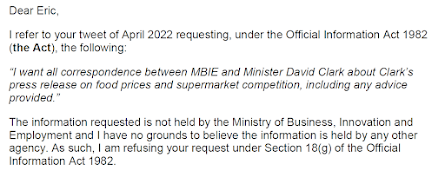
Supermarkets and inflation - denouement

In April, Minister David Clark put out a statement, as Minister, blaming supermarkets for inflation. 

He claimed that rising food prices "confirm the need to rein in the super profits of the supermarket duopoly" and "highlights the role the grocery sector is playing in driving up prices."

It was populist rubbish. Standard-drill models expect less pass-through of input price costs in less competitive sectors (though you can get different results if you make the models more complicated). 

I went through the standard econ drill on it in a column for the Dom Post.

But I also put through a couple of OIA requests just checking that he hadn't sought any advice from MBIE on this stuff. I really doubted that MBIE would have given him such shonky advice, but I was curious whether he'd bothered asking them about it.

So I asked, on Twitter. And MBIE, unlike MoH, is very good at catching OIA requests made on Twitter. 

I'd first asked for any correspondence on it and any advice provided. There was none. 


So I followed up, asking whether MBIE had provided any advice at all around supermarket pricing and inflation. They haven't. 


I can understand politicians mouthing off in their capacity as partisan MPs. 

I wish that that kind of rubbish wouldn't come out in their capacity as Ministers, and that they'd have at least sought some advice about whether they're talking utter nonsense. 

Friday, 22 March 2019

Right Here, Right Now

My column in this week's Insights newsletter - now a bit dated. The newsletter comes out at noon; our national moment of silence was an hour and a half after that.
Last week feels like it was a year ago. And the past week has made the world feel a little smaller.

Last night, the Rt. Hon. Stephen Harper, Prime Minister of Canada from 2006 through 2015, addressed members and guests of the Initiative at our annual retreat.

We found that Laureen, Prime Minister Harper’s wife, had lived in Christchurch as a young woman. Streets and buildings that stood as backdrop in news scenes playing in international media, for the second time in a decade and again for terrible reasons, were ones she remembered.

The world is smaller than we think.

Harper’s address reminded us that New Zealand and Canada remain rather special places in a world growing worryingly dark.

While living standards globally are better than ever, Europe, the UK and America have polarised – not along traditional left/right lines but on a newly emerging populist/elitist axis.

Trump and Brexit are obvious examples, but so too are right-wing populism in Germany and France, and the strange marriage of the populist left and right in the Italian government – which Harper likened to a coalition between Trump and Bernie Sanders.

Drawing on his recent book, Right Here, Right Now, Harper said this polarisation is inevitable when mainstream policy stops addressing the concerns of lower and middle-class voters.

In America, for what seems the first time, voters are telling pollsters they expect their kids to have a worse standard of living than they do. That builds an appetite for populism, and while populists have a keen nose for policy failures, they offer no positive policy agenda to solve the problems.

Harper rightly noted that Canada and New Zealand stand apart from those trends. In both countries, household income growth has been broadly shared across the distribution. We have not seen the income stagnation present in America. That makes for a better polity. It also makes for a country better able to accommodate migration; Harper noted Canada’s welcoming attitude to migrants and strong growth in immigration.

Populist resentment fuels anti-migrant sentiment. See Europe, the UK and America. In New Zealand, a broken housing market gave us a too-xenophobic 2017 election campaign. But last Friday’s tragedy brought us together rather than drive us apart.

During our moment of silence this afternoon, let us remember the victims – and renew our commitment to building a better New Zealand for all New Zealanders.
Subscribe to our newsletter here.