Of course it’s a serious problem.
At BEFU 2019, Treasury forecast that the government’s policy programme would have Core Crown tax revenue and Core Crown expenses at 28.8% of GDP in 2023.
At BEFU 2023, Treasury forecast that the actual 2023 figures would be Core Crown tax revenue at 29.3% of GDP and Core Crown expenses at 32.5% of GDP.
PREFU will very likely show a worse track for tax revenue (weakening corporate tax take; weakening GDP forecasts in part on milk prices; finally correcting the error that Treasury made at BEFU in tobacco excise forecasting) but, in the absence of signaled policy changes, a worsening track for expenditures. GDP will be lower than forecast so the denominator gets lower. A worsening economy means more spending on the automatic bits that kick in: benefit payments, hardship grants and the like. So the numerator’s going to be higher.
I haven’t checked Westpac’s numbers but haven’t reason to second-guess them.
If we compare what Labour’s policy package had lined up, as of 2019, for 2023, it’s obvious that the problem isn’t on the revenue side. Revenue is up on the 2019 forecast. It’s spending that’s blown out. Debt and spending had to be part of the Covid response. But Michael Reddell’s shown that NZ’s fiscal response has been huge compared to other countries.
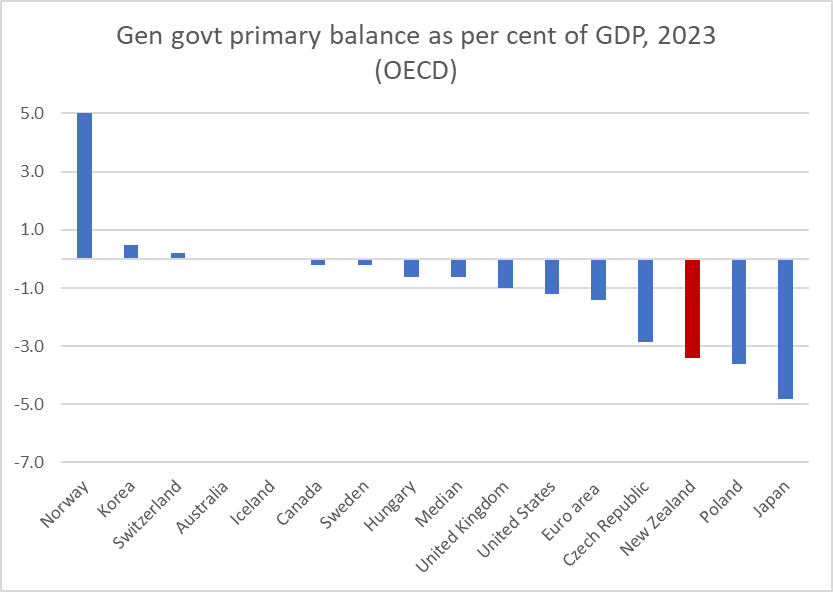
I’ve copied two of Michael’s charts below.
NZ started with a low net debt to GDP ratio. And still has a relatively low net debt to GDP ratio. But our increase in net debt was very large as compared to other countries, and the current general government primary balance is awful. Deficits that large might make sense in a recession, when tax revenues are down and spending on benefits is high. But doing this while the Reserve Bank is meant to be trying to get inflation back down is simply irresponsible.
The OBEGAL path presented at BEFU was not credible.
Treasury forgot that the government passed legislation banning the sale of cigarettes with nicotine in them from 1 April 2025; it projected a tobacco excise path that did not change with what amounts to tobacco prohibition. Recall that tobacco excise revenues are on the order of $1.7-$1.8 billion per year, and that the government’s projected surplus for 2026 was on the order of $0.6 billion. The VLNC rules bring forward the sharp drop in tobacco excise revenues that would otherwise have been expected further down the track. Annual tobacco excise revenues after 2026 are likely to be about a billion dollars lower than had been forecast at BEFU, on this single item, unless an incoming government eases the VLNC rules.
At the same time, large spending items like the food in schools programme were forecast to end at the end of 2024. It may be politically challenging for any incoming government to end that spending line in 2024. Treasury has to forecast based on what the government has legislated (barring its amnesia about the effect of tobacco prohibition on tobacco excise revenue). But expenditure paths that depend on decisions that are unlikely to be made may not be all that credible.
On the revenue side, inflation’s pressure on household after-tax disposable income is becoming intolerable. Had the income tax brackets been inflation-adjusted to 2017 levels, the median wage and salary earner’s after-tax income would be almost $1600 higher this year. Inflation-indexing only the bottom tax bracket would give $210 to everyone earning at least $17,000, and even the Job-Seeker benefit is now above that level. Coincidentally, that’s about as much as the government thinks its GST move on fruit and vegetables might save the average household.
At some point, the tax brackets will have to adjust to account for inflation. Failure to do so means more and more people on lower incomes wind up in higher tax brackets. But when it happens, tax revenue will drop.
Showing posts with label size of government. Show all posts
Showing posts with label size of government. Show all posts
Monday, 28 August 2023
Deficits and PREFU
Dan Brunskill got in touch last week asking whether the deficit is a serious problem and what's likely to come at PREFU. He only had room for a short bit of what I'd sent through, so I'll copy the rest here.



Wednesday, 9 November 2011
Crypto-optimism
Eli Dourado's excellent discussion of technologies of control and technologies of evasion reminds me of the anarcho-optimism of Cryptonomicon. Eli builds a business cycle story:
I love the story, but I'm not sure how well parts of it match the stylized time path. Here's Eli:
I'm a long term optimist on technologies of evasion. Eventually, something like BitCoin will be successful. Meanwhile, Patri is sparking more real-world hacks around control. The latest one: floating platforms 12 miles off San Francisco where foreign tech entrepreneurs could route around idiotic American immigration laws.
Here’s my model. First we need to differentiate between two kinds of innovation and think about their effects. The first kind of innovation is geared toward brute maximization of production. It is typically centralized and makes use of economies of scale. Examples might include an assembly line factory or a big, coal-fired power plant. Because these innovations tend to be centralized, they introduce points of control. The capital is typically fixed and therefore easy to tax and regulate. It’s well known in the development literature that it’s really hard for governments to control rural peasants who live off the grid. Once they move to the cities and plug into centralized services, it is easier to require them to send their children to school, for instance. Because these innovations introduce points of control, I will call them technologies of control.
On the other hand, not all innovations are about brute maximization of production. Some are about producing things that we already know how to produce in ways that have ancillary benefits. An important ancillary benefit is evading control. Examples of these innovations include 3D printers and solar power. The evasion of control that is possible with 3D printers is the subject of Cory Doctorow’s short story Printcrime. And portable solar power cells can make people harder to control by supplying electricity without the need to register an address, have a bank account, stay put, and so on. These are obvious examples, but control can be evaded through more subtle innovations as well. I will call innovations that circumvent points of control that can be used by governments or monopolies to exploit, tax, or regulate technologies of resistance.
Now, postulate some background rate of innovation. How many resources will be devoted to technologies of control and how many to technologies or resistance? The answer is that it depends on how invasive the state (or other monopolies) are. When the state is invasive, at the margin the incentive is to find ways to circumvent the points of control; a greater proportion of resources will go into technologies of resistance. When the state is non-invasive, at the margin the incentive is a purer maximization of production; a greater proportion of resources will go into technologies of control, which results higher growth.Add in time-to-build or other frictions in shifting capital from technologies of control to technologies of resistance, and we get cycles.
I love the story, but I'm not sure how well parts of it match the stylized time path. Here's Eli:
So far, I’ve been pretty general about technologies of resistance, but I want to tie it back into McJolfsson’s story about rapid skill-biased technical change. The key point is that labor is extremely regulated; firms that use labor are subject to intense government control. In part this is because policies that give labor a “bigger piece of the pie” are popular with voters, and in part it is because labor can complain and enforce its rights in a way that machines cannot. If you own a business and you are subject to intense government control, you are going to invest resources in circumventing the points of control. In our economy, that means getting rid of lots of labor as cheaply as possible, which means skill-biased technical change. As Arnold Kling has said, “if a job can be defined, it can be automated or outsourced.” But it’s because there is so much control exercised in the labor market that the incentive to automate and outsource is so high.Agreed. But surely American labour market regulation has been in decline since the late 1970s. I have a hard time seeing a big labour regulation shock anywhere in the 2000s that would have precipitated a dumping of labour. I suppose the shock has to come from technology reducing the costs of substitution more quickly than labour market deregulation reducing the need for such substitution. Do read Eli's full argument, which brings together Brynjolfsson's techno-optimist story with Cowen's Great Stagnation.
I'm a long term optimist on technologies of evasion. Eventually, something like BitCoin will be successful. Meanwhile, Patri is sparking more real-world hacks around control. The latest one: floating platforms 12 miles off San Francisco where foreign tech entrepreneurs could route around idiotic American immigration laws.
This immigration issue deeply affected the Blueseed team, of which two are immigrants (from Serbia and Romania), and the other is the son of Cuban immigrants. Rather than accepting the current reality, Dan tells us, "If U.S. policy hasn’t kept pace with the changing economic realities of the era, someone needs to find a solution that will help entrepreneurs come to Silicon Valley if they so desire. And that someone might as well be us. In other words, it’s time to stop complaining and start solving the problem."
On their website they state they plan to start accommodation prices off at around $1500 a month, and transportation will be provided to the mainland by a daily ferry. Internet connectivity will be provided via a point-to-point 40Gbps laser link with satellite link backup. They are also looking at additional backup solutions using submarine cable and potentially a series of WiMAX relay buoys. A visa is not required to earn a paycheck on Blueseed, and most residents will be able to travel back and forth to the mainland with a business/pleasure B1 Visa.I worry that it will be really easy for the government to change a line of regulatory code to make it tough for Blueseed residents to commute back and forth; but, I'm also not sure that they'll face big pressure to do so and regulatory inertia would then work in Blueseed's favour. Until some California Congressman reckons the extra votes he gets from making a stink about platform-dwellers stealing jobs swamps the costs he'd impose on the tech industry.
Friday, 1 May 2009
This graph has warped my fragile little mind

The graph above is from Bill Watson's excellent roundup of fiscal trends in Canada and the US. For my entire life, Canada's ratio of government spending to GDP has been higher than that in the US. For all those Democrats who threatened to move to Canada during the Bush years, Obama's saving them the trouble: the US is becoming Canada, at least in terms of size of government.
What will happen to those expenditure lines over the next few years? President Obama is pushing for big increases in health care and education and he’s piling on a lot more government debt — which means higher future interest payments—than we are.Perhaps the US should just give up and become Canada's 11th province. If Canada would take them.
It’s not inconceivable that in five years’ time, we’ll be spending less through our public sector than the Americans are through theirs. And if both countries get back to balanced budgets, that means the tax drag will be less here than it is there.
Getting your mind around the possibility that we will be the lower-tax jurisdiction in North America takes some doing, but in fact that was the case during the 1950s, some of the best economic years in our history.
Update: Veronique de Rugy urges America not to become France in the video below. Salut Vero!
Subscribe to:
Posts (Atom)