The outcome is absurd. Someone should not be prevented from buying a bottle of wine just because they have their teenager with them. But the problem isn't the store or the check-out clerk, it looks instead to be the rules.
The Herald's rounded up several cases of folks being turned away from the supermarket checkout because they have alcohol in the cart and the kids in tow.
Here's the Sale & Supply of Alcohol Act 2012.
Section 239(1) makes it an offence to allow alcohol to be sold or supplied to any person under the purchase age. 239(8) says you're in trouble if you know or have reasonable grounds to believe that the alcohol is intended for a person under the purchase age. While section 240 provides an exemption for on-licences, so if you have your parent along, it's all fine, but I can't see any parallel rule for off-licences.
So if I'm reading all of that right (I am not a lawyer), it is legal for a parent to buy alcohol, bring it home, and supply it to their minor child. It is legal for a parent to go to the pub with their minor child and to buy a beer for their child. But if the check-out clerk at the off-licence has reasonable reason to expect that a parent at the supermarket is buying the alcohol for a minor who is with them, then the store can be up for fines of up to $10k and potential loss of licence for up to seven days. Since the police like running stings and the penalties are high, you should expect risk aversion.
One potential solution would be to extend the exemption in Section 240 to off-licences. I have no clue how the supermarket clerk could tell that the two people at the check-out are parent and child, but neither do I have any clue how the bartender can verify the same thing at the pub if the parent passes the beer to the seventeen year old.
Wednesday, 11 July 2018


Monday, 9 July 2018
Sugar messes with your brain
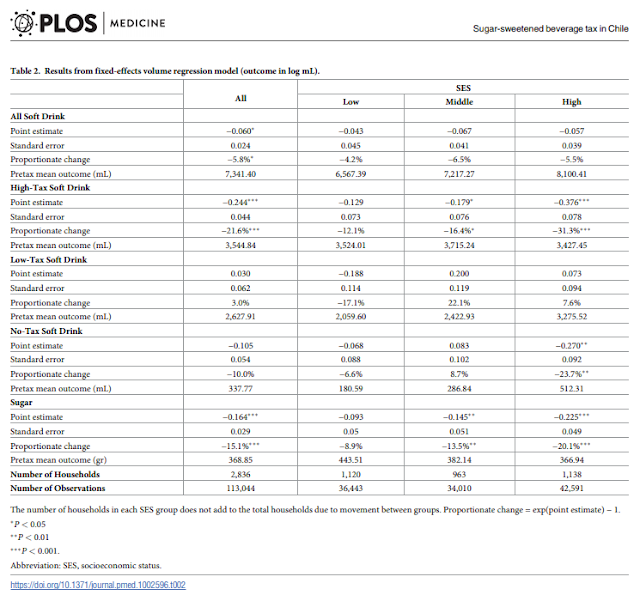
Boyd Swinburn endorses a new Chilean study on sugar taxes.
Here's the key table.
As Elron McKenzie might put it, "If everyone taxed all that they hated, where would we be? There would be nothing left. Because sooner or later, no matter how nice the things are that you like, somebody will hate those things too, and will want to tax them. And then, next thing you know, your favourite stuff is gone. So, like, what good is it, eh? So just keep the neutral GST."
Chile increased its sales tax on soft drinks above a threshold by 5%, from 13% to 18% (the high-tax soft drinks), and reduced its tax on lower sugar soft drinks by 3%; there's a separate no-tax soft drink category presumably covering diet drinks.The empirical evidence on SSB taxes keeps coming- more than for any other obesity prevention strategy @HelenClarkNZ @EricCrampton https://t.co/DBbdFpd3xK— Boyd Swinburn (@BoydSwinburn) July 4, 2018
Here's the key table.
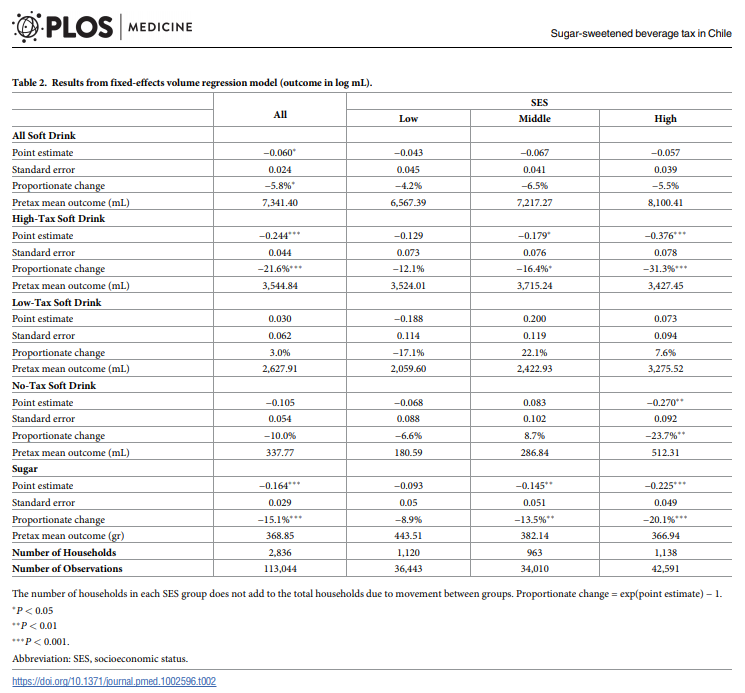
If we believe the result, increasing the tax on high-tax soft drinks by 5%, reducing it on low-tax soft drinks by 3%, and not changing the tax on no-tax soft drinks did nothing to consumption among low-SES groups but massively cut consumption of high-tax and no-tax soft drinks by high SES groups.
And the later tables say that tax pass-through was imperfect: there was a 1.6% increase in the price of all soft drinks: a 1.9% increase in high-tax item prices and a 1.7% drop in the price of low-tax items. So the wedge between high- and low-tax products, as seen by consumers, increased by 3.6%. The proportionate change in high SES consumption of high-tax drinks was a 31.3% reduction. Where we struggle to find evidence of effects in other studies, this one says there's an incredibly high price elasticity of demand among rich people but no effect among poor people.
Chris Snowdon finds the results unbelievable; I'm not sure he's wrong. The big drop in consumption of no-tax soft drinks suggests something else is going on.
Just as a guess - was the tax accompanied by a vilification campaign against soda generally? High-SES groups might then have responded but low-SES groups ignored the messaging. Low tax soda became cheaper, so there was some substitution to that category from both no-tax and high-tax soda that coincided with an across-the-board drop in soda consumption among high-SES groups. That is just a guess though. The results don't make a lot of sense.
In related news, commenter Nick R suggests the following:
Here's the thing about this debate. As far as I can see there is virtually no downside to the tax. Products that include a lot of sugar would cost more. So what? There is literally no hardship to that because nobody needs them. We can choose to buy them, or not. No biggie, and if we do buy them, the state gets the benefit of the revenue. So even if it has no effect on obesity at all it seems benign because the tax is largely optional, unlike (say) petrol duty. And if it does have an effect on obesity, even better.I always struggle when trying to see the world as people like Nick R see it. As I look at the world, if someone enjoys something, and you take it away from them, that has to be a harm to them as they see it. Like if Nick R enjoyed, I dunno, fancy cars, and I proposed a big luxury tax on the kinds of cars that lawyers like, surely it would sound ridiculous to claim "there is literally no hardship to that because nobody needs an Audi. Lawyers can choose to buy them, or not. No biggie, and if they do buy them, the state gets the benefit of the revenue." But it's nonsense, right? Those who buy something else instead are harmed by the tax. That excess of cost to consumers over the tax revenue to the state matters. And who am I to say that Audi-lovers should be taxed more than people like me who drive a ten-year-old Honda?
As Elron McKenzie might put it, "If everyone taxed all that they hated, where would we be? There would be nothing left. Because sooner or later, no matter how nice the things are that you like, somebody will hate those things too, and will want to tax them. And then, next thing you know, your favourite stuff is gone. So, like, what good is it, eh? So just keep the neutral GST."
Friday, 6 July 2018
Paying for more hostages
Ok, here's a fun one.
Set up an industry through heavy subsidies. An ancillary education sector sets up around it, training workers for that industry. Then when it comes time for an economic impact study, count as a benefit of maintaining the subsidies that workers trained for the subsidy-industry would have a drop in wages if they had to shift to another industry. Meanwhile, keep ramping up training schemes to build up more hostages for the subsidy-industry.
Or, in other words, Gordon Campbell didn't like my take on New Zealand's film subsidies. Here's Campbell, taking issue with the bit Matt Nippert quoted from me in the Herald:
The Sapere report looks at multiplier effects through the rest of the economy with film subsidies. That's the part where I'm really dubious at current employment rates. In the absence of film subsidies, folks in the flow-on-effect industries wouldn't be jobless. There'd be some reduction in wages, but it wouldn't be substantial - and at least not in the medium term.
People directly employed in the industry currently would see job losses, shift overseas, or take employment at lower wages - yes. But where government is also helping to fund industry training for the next generation of hostages [zero percent student loans; normal tertiary subsidies], we might need to look at dynamic effects.
In the absence of subsidies, people would train for other industries instead, with smaller effects. Heck, it's plausible that while those who otherwise would have trained for and worked in the film industry would be made worse off training for other work, their salaries could be higher if film work carries a wage discount because of the prestige.
Anyway, it just seems odd to justify continued subsidies for an industry on the basis of wage and employment costs to workers who have specific skills in that industry when we're also training up new workers for that industry.
Set up an industry through heavy subsidies. An ancillary education sector sets up around it, training workers for that industry. Then when it comes time for an economic impact study, count as a benefit of maintaining the subsidies that workers trained for the subsidy-industry would have a drop in wages if they had to shift to another industry. Meanwhile, keep ramping up training schemes to build up more hostages for the subsidy-industry.
Or, in other words, Gordon Campbell didn't like my take on New Zealand's film subsidies. Here's Campbell, taking issue with the bit Matt Nippert quoted from me in the Herald:
Crampton said the Sapere report - in concluding the subsidies generated more than $2 of economic benefit for every taxpayer dollar spent - was flawed in concluding most of the workforce would be left stranded out of work or in lower-paying jobs. "While that may be true during recessions, it is not true either on average or currently. And it is especially dubious where most of the film activity occurs in Wellington and Auckland," Crampton said.There are two things going on here.
Sure. Everyone knows there are 2,000 high paying, high skills jobs ready and waiting out there in Wellington. Or maybe they all could go north, and pick kiwifruit. Despite his vested interest in this issue, Peter Jackson was probably closer to the mark in the same NZ Herald article, to which he offered this observation:
"You seem to be asking whether New Zealand needs incentives. In my mind it's very simple: Does New Zealand want to have a film industry?"
The Sapere report looks at multiplier effects through the rest of the economy with film subsidies. That's the part where I'm really dubious at current employment rates. In the absence of film subsidies, folks in the flow-on-effect industries wouldn't be jobless. There'd be some reduction in wages, but it wouldn't be substantial - and at least not in the medium term.
People directly employed in the industry currently would see job losses, shift overseas, or take employment at lower wages - yes. But where government is also helping to fund industry training for the next generation of hostages [zero percent student loans; normal tertiary subsidies], we might need to look at dynamic effects.
In the absence of subsidies, people would train for other industries instead, with smaller effects. Heck, it's plausible that while those who otherwise would have trained for and worked in the film industry would be made worse off training for other work, their salaries could be higher if film work carries a wage discount because of the prestige.
Anyway, it just seems odd to justify continued subsidies for an industry on the basis of wage and employment costs to workers who have specific skills in that industry when we're also training up new workers for that industry.
Thursday, 5 July 2018
Winning hearts and minds
Sunday morning's pleasant brunch at home wound up having me shushing the kids a bit more than usual.
After universities, think tanks and sector groups are the next most prolific contributors of opinion pieces.While I do like that Radio NZ online has linked to the opeds, that's of little benefit to listeners who might be surprised to find out that the bulk of the Dom Post piece was about the Ministry of Health's advice on sugar taxes and the literature review that MoH commissioned from NZIER.
And well out in front among those is The New Zealand Initiative – a think tank funded in the main by the country’s leading corporates. The think tank has a weekly column in the National Business Review, a fortnightly one on Interest.co.nz and in 2017 published about 40 op-eds in the country’s newspapers. The Council of Trade Unions by comparison had 10 or so op-eds published last year.
The NZ Initiative op-eds tend to be well researched and strident. Here’s how its chief economist Eric Crampton began an op-ed on Stuff back in March:
"To begin with, sugar taxes are offensive. They presume that some government official knows better than you about what food choices are best for you. And when we think about how they're generally aimed at things like soda rather than expensive coffee drinks, they're also deeply classist. They presume poor people are too dumb to make the 'right' choices and must be guided by their betters."
And he concluded that piece with a dig at some Otago University public health academic who had written in support of sugar taxes.
"It is time that public health activists simply admitted that they got this one wrong and left us alone."
Despite describing public health professors as activists there was no disclosure on his own op-ed acknowledging that the New Zealand Initiative membership includes Coca Cola – a vocal opponent of sugar taxes internationally – plus the major supermarket chains.
On a subsequent op-ed on the NZME-owned Healthcentral.nz Eric Crampton included this disclosure:
"The Initiative is funded by a broad range of corporate members including ones the Otago People wouldn’t like. Their membership has zero influence on my views of the Otago People’s work."
So things can get a little testy in the op-ed world. ...
Both of those reached the same conclusions I have about sugar taxes.
Here's the bit Radio NZ didn't excerpt:
But don't just take my word for it.Radio listeners could be forgiven for being led to believe that I hadn't put up any evidence in support of my views and that my views were based only on our membership. They might be surprised to see that the whole thing was based on publicly funded work.
The Ministry of Health commissioned the NZIER (New Zealand Institute of Economic Research) to review the literature on sugar taxes around the world.
NZIER found little effect of sugar taxes on consumption, and no evidence of health benefits.
And documents released to the New Zealand Initiative by the Ministry of Health showed that the ministry had reached a very similar conclusion about sugar taxes, advising the minister that there is "insufficient evidence that a sugar tax would be effective in reducing obesity".
The ministry also warned that the quality of evidence presented in favour of sugar taxes "is a major concern".
All of that means that, even if sugar taxes were easy to implement (and they are far from easy to implement), there would still be no good reason to do it.
It is time that public health activists simply admitted that they got this one wrong and left us alone.
Apparently my pointing to the Ministry's work on this stuff needs some kind of health warning, but all the anti-sugar advocates who either ignore that work or make such a hash of reporting on it that you wonder why NZIER hasn't sued them for libel - that doesn't need a health warning.
Anyway, all of it led to former-Prime Minster Helen Clark being mad on Twitter.
I don't know that I won any hearts or minds in the exchange, but I had my fun.
.@radionz 📻 #Mediawatch analyses media coverage. This report on who gets op eds printed is fascinating. It points to the prolific presence of a think tank funded by corporates including by #BigSugar. No surprise then that it rails against #sugartax. @WHO https://t.co/sYfcz6N6Yu— Helen Clark (@HelenClarkNZ) July 1, 2018
I rail against sugar taxes because the evidence is against them. The Dom Post piece cited is here.https://t.co/bRXbq4gvZn— Eric Crampton (@EricCrampton) July 1, 2018
It points to OIAed work at MoH and funded by MoH showing they don't work. That evidence is here:https://t.co/g20plB7YnZ
There is plenty of evidence that a #sugartax will reduce consumption. It defies belief for the industry & its acolytes to assert that that has no health benefit; indeed the sector sounds more & more like the tobacco industry. @BoydSwinburn @robbeaglehole @SandroDemaio @kentbuse— Helen Clark (@HelenClarkNZ) July 1, 2018
I am well aware of those reports & do not consider them sound. Perhaps you should also acknowledge that members of your employer, the NZ Initiative, include Coca Cola & tobacco companies. @SandroDemaio @robbeaglehole @iPHC2 @WHO @sudhvir @kentbuse @UCLGenderHealth @DavidClarkNZ— Helen Clark (@HelenClarkNZ) July 1, 2018
Yes - the members of the NZ Initiative which employs you are on the website and include Coca Cola and tobacco companies.— Helen Clark (@HelenClarkNZ) July 1, 2018
Clark punted to public health advocate Sudhvir Singh when I asked what specific problems she could point to in either MoH's work or NZIER's; he pointed to a table of jurisdictions that have implemented taxes and some estimates of effects, but wouldn't provide any detail on whether NZIER botched anything in their review. She also endorsed Swinburn in pointing to the Otago blog post that criticised NZIER for not including publications that were outside of the commissioned review window.I really rather doubt that. It is the first thing people bring up when criticising our arguments. Actually taking on our arguments is pretty rare. Casting aspersions based on our membership - incredibly common.— Eric Crampton (@EricCrampton) July 1, 2018
NZIER report author Sarah Hogan waits still for a reply on this one.
This also amused me.We at NZIER would like to know in what way our report is not sound so that we can at least respond. Can you please explain? We would be happy to discuss and or clarify.— Sarah Hogan (@SarahHo48755599) July 2, 2018
For my sins, my Twitter notifications window are filled with public health zealots retweeting and liking Helen Clark's ponderings about the price of soda and bottled water; none of them seem to have noticed the links to prices at Countdown.*And here's prices online at Countdown.— Eric Crampton (@EricCrampton) July 2, 2018
Check for yourself.https://t.co/k4cWfM9Ccbhttps://t.co/ZvQ5OZyIQK
Cheapest water: $0.06/100mL
Cheapest no-sugar cola: $0.07/100mL
Cheapest sugared cola: $0.09/100mL pic.twitter.com/RrMcEOyrk8
Just look at this hot mess.
#BIGSODA be like #BIGTOBACCO, the #KillerCan like the #CancerStick ... #CokeIsHappiness #NewportPleasure must #DEFEATSODATRON to beat #NCDS join us for #InternationalQuitSodaDay Oct 20th #IQSD #BeatNCDS #WaterOnlySchools 🏆 pic.twitter.com/iFZJzfaVsk— Dr. Johnny Fever (@DrJuanFiebre) July 3, 2018
Defeat Sodatron? Barking. Absolutely barking. One for Chris Snowdon's slippery slopes file.
* And yes I know water can be more expensive than Coke in some dairies or petrol stations - that's just the local retailer having some local pricing power, knowing their market, and knowing that the kind of people who want to buy water are pretty price inelastic at that point. They could always choose to stock the cheaper varieties at lower price points if they wanted.
Wednesday, 4 July 2018
Around the traps...
I've not had a lot of time for blogging over the past week, but you can catch a few bits from me around the traps:
- Of course there was always going to be a surge of purchases by 'foreigners' in advance of the stupid foreign buyer ban. Anybody living here on a work visa would be rushing like hell to get their house sorted before the ban hits.
- But Labour seems to be successful in scaring away foreign investors. Most places want to attract foreign investment and have to work hard to do it. Scaring it away, that's pretty easy. If you have an Overseas Investment Office application in for buying a farm property and then have to worry about whether you're able to live in a house on the property or rebuild it when the time comes, perhaps easier just to find some other place to live where the government doesn't hate foreigners as much.
- The zero-percent student loans scheme was bad enough. Switching to fees-free study is worse. Folks on twitter got mad about this one and thought I was making numbers up, but it's right there on the darned Education Counts website. The government last year wrote off $0.4452 on every dollar it lent out. That's $662 million that could do a lot more in improving access to tertiary study if shifted over to means-tested student assistance and help for secondary schools in improving preparation for tertiary study.
- I don't like film subsidies. Will have a post on this later.
Interesting take on evidence-based policy
The anti-alcohol folks are pushing for stronger and mandatory warnings on drinks about the dangers of alcohol consumption during pregnancy.
This bit was particularly interesting:
RESISTANCE FROM INDUSTRY TO BE EXPECTEDTraditionally, the status quo has some weight. Those proposing changes to the status quo have to provide some evidence that the change will be beneficial - that the gains will exceed the costs. In areas where evidence on gains and harms is hard to come by, we can look to international evidence - or run trials.
Baddock argues attempts by the alcohol industry to promote measures to reduce FASD have been ineffective and rather seek to debate the evidence.
The NZMA submission urges decision-makers to be aware of, and pre-empt, industry counter-arguments to public health measures such as mandatory labelling.
Baddock says a standard alcohol industry tactic has been to cite lack of evidence as a reason not to do something, which has been used by others such as the tobacco industry to "thwart and delay" public health measures like plain packaging.
"It's not just alcohol. I think any industry tends to be resistant to anything mandatory that might affect their sales."
However, she is hopeful the alcohol industry will "come on board" with mandatory pregnancy warnings.
"I would love to see the alcohol industry put up their hand and say FASD is a real problem and we need to be helping reduce the harms done [by alcohol]."
It is a bit odd to pre-emptively say (my paraphrase): "Hey, we don't have any evidence that our policy proposal will do any good. We ran some focus groups suggesting that people don't pay much notice to current labels, but we have no particularly good reason to expect that mandatory labeling will change real-world behaviour in the cohort we should be worried about. But anybody pointing out the absence of evidence - we're going to pre-emptively say that they're industry shills."
Another fun bit - the anti-alcohol people worry that messages like 'it's safest not to drink while pregnant' might strengthen beliefs that light drinking in pregnancy is harmless.
Here's Emily Oster on that. She included a nice section on alcohol in her review of all of the evidence on the dos and don'ts during pregnancy.
There exists no large (or even small) randomized trial about drinking during pregnancy; such a thing is never likely to exist. This is not unique to drinking, of course – there are no large randomized trials of Tylenol usage in pregnancy, either, just a lot of large observational studies. And some women will read the existing evidence and still choose to abstain. But there is a growing body of data suggesting that, if women choose to have a glass of wine, there is no evidence they are harming their baby.So they're worried that people might draw the correct conclusion from the labeling - that heavy drinking during pregnancy is a very very bad idea, but a glass of wine every other day is going to be fine.
Telling women that an occasional glass of wine is more harmful to their baby than heroin or cocaine is misleading and may also be potentially dangerous. It surely would not be supported by the vast majority of the medical establishment. Focusing on punishing and shaming women who choose to have an occasional glass of wine during their pregnancy also takes away important focus from helping women who are struggling with truly problematic drinking and the social problems that often come with it.
Again - the anti-alcohol people will not be happy until they have incrementally gotten us to alcohol plain packaging. It's salami-slice tactics, exactly the same as used in the push against tobacco, incrementally piling on restrictions until the only thing allowed on the packaging is warning labels and small-print indication of the manufacturer.
Tuesday, 3 July 2018
Tax Working Group Tea Leaves
The group, chaired by Sir Michael Cullen, has been advised by officials not to recommend cutting company tax or offering a specially discounted tax rate to small businesses.I like inflation-adjusting interest earnings. The current setup means that during times of higher inflation, the real tax on interest earnings is very high. This builds a wedge between returns from investing in real assets and investing in interest-bearing assets.
However, it has been encouraged to consider dangling a couple of other lollies in front of investors and businesses.
In particular, Inland Revenue and Treasury officials advising the working group said there was a case for inflation-adjusting the tax system – even though they acknowledged that would be a "significant change".
That would be a boon for people with money in bank savings accounts and term deposits.
They would then only pay income tax on interest on their savings after interest payments were adjusted for inflation, rather than on the whole sum.
Age Concern, Consumer NZ, the Financial Services Council and the Taxpayers' Union lobby group argued for the change in their "Fair Tax for Savers" campaign in 2014.
It had already been raised as a possibility by Cullen in March.
Inflation-adjusting the tax base would remove "one of the biggest distortions" in the tax system and would also have implications for business tax, the officials said.
But in less positive news for some taxpayers, the officials advised against cutting New Zealand's 28 per cent company tax rate.
They said the rate was "relatively high by international standards" and looked at the implications of cutting it to 23 per cent.
But they concluded a cut would not be in the country's best interests, mainly because a lot of the benefits would go to foreign investors.
It would also mean there would be little case for a capital gains tax where getting rid of the interest distortion would get you most of the way towards what capital gains tax fans want anyway.
On company tax, you're always balancing a few margins. Too high a company tax rate relative to other countries and you scare away foreign investment. But too big a wedge between the top personal tax rate and the company rate and you encourage sheltering income in companies. So, all else equal, if international company tax rates are dropping, then New Zealand's should also drop somewhat, but if top personal tax rates are increasing, then the company tax could go up a bit.
Recommending a hold-steady on company taxes despite declining international rates then could be a signal of income tax increases at the top end. Or a recognition that the current government has shifted scaring away foreign investors to the benefit side of the ledger.
Subscribe to:
Posts (Atom)