Showing posts with label fat taxes. Show all posts

Wednesday, 30 January 2019

Red meat tax?

Boyd Swinburn's group wants rather a lot more controls on what we all get to eat. 

Radio NZ covers his report here; Chris Snowdon's summary of it is best.
The lead author of the report is Boyd Swinburn, a New Zealand doctor and food campaigner who declared last week on Twitter that the EAT-Lancet report shows where diets need to get to while his report shows how to get there. They are two sides of the same coin and whilst there is no shortage of policy suggestions in the EAT-Lancet document, including rationing and the outright prohibition of certain food products, the Lancet Commission takes it a stage further by calling for a global treaty.

Swinburn is obsessed with the web of corporate interests he sees all around him, thwarting his efforts to get the public to eat their greens. In 2017, New Zealand’s Ministry of Health commissioned the New Zealand Institute of Economic Research to look at the pros and cons of taxing sugary drinks. When the economists concluded, accurately, that ‘the evidence that sugar taxes improve health is weak’, Swinburn wrote a furious article denouncing ‘economists steeped in last century’s economic theories’, ‘merchants of doubt’ and the ‘vested interests of the food industry’. It is a theme he returns to with tedious regularity in the Lancet report.

...

Swinburn et al. seem to believe that the only barrier to governments leaping headlong into an extensive systems of taxes, warnings, bans and restrictions is ‘Big Food’. Whilst it would be naive to think that the various food lobbies have no influence on government policy, the authors never consider the possibility that this is because the industry’s arguments about trade, jobs, choice and prices appeal to politicians and, ultimately, to the public. ‘Big Food’ may not want tobacco-style regulation, but it is a logical fallacy to infer from this that politicians who reject such an approach have only done so because of ‘powerful lobbying’.

Whether or not the authors actually believe this narrative, it serves two useful purposes. Firstly, it allows wealthy activist-academics in the multi-billion dollar ‘public health’ industry to view themselves as plucky underdogs fighting Goliath. Secondly, it absolves them from answering difficult questions about whether their demands are reasonable, fair, or even realistic
Do read Snowdon's whole piece. Stuff has some of the government's response:
Associate Minister of Health Julie Anne Genter​ said the Government did not plan to tax red meat "at this stage", but an increase in awareness about climate change was affecting people's behaviour.

"Obesity and climate change are often framed as problems for individuals to change. This report shows it has been a failure of public policy and we need government action to protect our health and our climate."

The commission called for a global treaty, like those established for climate change and tobacco, to help governments restrict the influence of the food industry on policy and the establishment of a global philanthropic fund of US$1 billion (NZ$1.46b) "to support social movements demanding policy action".

The Lancet editor-in-chief Dr Richard Horton said the business model of large international food and beverage companies led to over-consumption of junk food in both high-income countries and, increasingly, low and middle-income countries.

Genter said she was "interested to learn more about how a global treaty would work, as politicians need to play their part too".

Swinburn said the food industry should be excluded from the "policy-making table" as the profit motive would always win out over improving health and reducing climate change.
There's a very good case for agricultural emissions globally coming under emission trading schemes or carbon taxes. In the absence of international coordination, the case gets tougher because you have to worry about whether production gets displaced to places where meat production is more carbon-intensive. Animal product prices would go up after agricultural emissions were included in the ETS, or in carbon taxes, but it would be a mistake to call that a red meat tax. It's more like, if you had a GST that excluded food products, getting rid of the exemption isn't a "food tax".

Going beyond that though, to tax and regulate and nudge and force everyone into eating and drinking only Boyd-Approved products - no thanks.

Previously:

Friday, 18 January 2019

Ration books

The IEA's Chris Snowdon tries to live by the ration book that The Lancet's public health people would impose on the UK.

First up, the recommended diet, from page five of their report.


I like that they have a 31 gram ration of sweets.* 

Anyway, Chris does his best. But it doesn't look all that appealing. 
Here's breakfast:
And lunch
And, finally, dinner for a hungry Chris.

As Chris points out, it's nice that this crowd has outlined an end-goal for once rather than the series of nibbles that always otherwise come with denials that there's a next step just around the corner. The report recommends measures like zoning bans on unhealthy food outlets, taxes and subsidies, reduced choice, reduced portions - and some non-daft things like finally getting water and effluent pricing right. But they have the whole thing back-to-front. 

Food choices shouldn't be targets. They should be the outcomes that emerge when distortionary subsidies are removed and when environmental effects are properly worked into prices. I'd be surprised if models that appropriately incorporated full environmental costs didn't result in changes in those choices. But you don't force it by nudges and shoves to get particular menus; you just make sure that prices incorporate costs properly and let people make whatever choices they want within that. 


* We can thank them for increasing the chocolate ration from 20 grammes to 30. 

Monday, 9 July 2018

Sugar messes with your brain

Boyd Swinburn endorses a new Chilean study on sugar taxes.
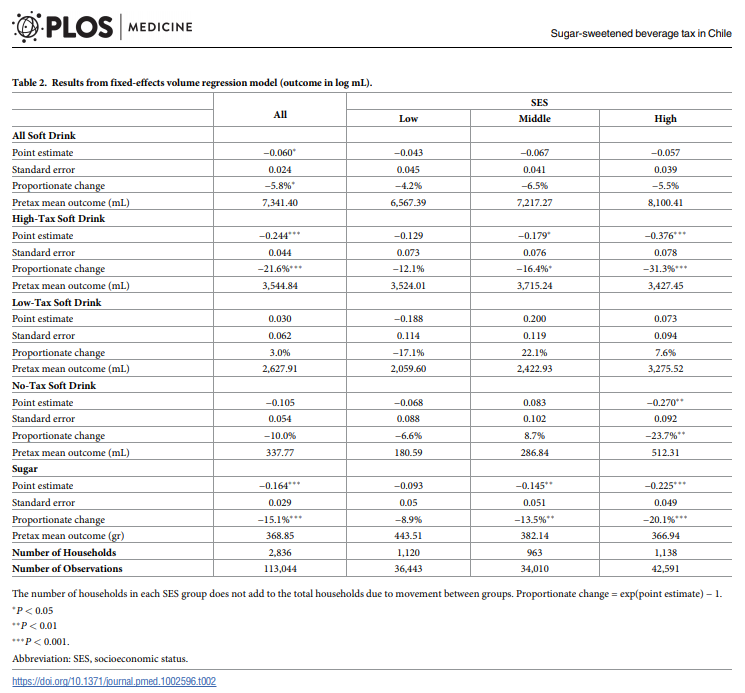
Chile increased its sales tax on soft drinks above a threshold by 5%, from 13% to 18% (the high-tax soft drinks), and reduced its tax on lower sugar soft drinks by 3%; there's a separate no-tax soft drink category presumably covering diet drinks.

Here's the key table.


If we believe the result, increasing the tax on high-tax soft drinks by 5%, reducing it on low-tax soft drinks by 3%, and not changing the tax on no-tax soft drinks did nothing to consumption among low-SES groups but massively cut consumption of high-tax and no-tax soft drinks by high SES groups. 

And the later tables say that tax pass-through was imperfect: there was a 1.6% increase in the price of all soft drinks: a 1.9% increase in high-tax item prices and a 1.7% drop in the price of low-tax items. So the wedge between high- and low-tax products, as seen by consumers, increased by 3.6%. The proportionate change in high SES consumption of high-tax drinks was a 31.3% reduction. Where we struggle to find evidence of effects in other studies, this one says there's an incredibly high price elasticity of demand among rich people but no effect among poor people. 

Chris Snowdon finds the results unbelievable; I'm not sure he's wrong. The big drop in consumption of no-tax soft drinks suggests something else is going on. 

Just as a guess - was the tax accompanied by a vilification campaign against soda generally? High-SES groups might then have responded but low-SES groups ignored the messaging. Low tax soda became cheaper, so there was some substitution to that category from both no-tax and high-tax soda that coincided with an across-the-board drop in soda consumption among high-SES groups. That is just a guess though. The results don't make a lot of sense. 

Here's the thing about this debate. As far as I can see there is virtually no downside to the tax. Products that include a lot of sugar would cost more. So what? There is literally no hardship to that because nobody needs them. We can choose to buy them, or not. No biggie, and if we do buy them, the state gets the benefit of the revenue. So even if it has no effect on obesity at all it seems benign because the tax is largely optional, unlike (say) petrol duty. And if it does have an effect on obesity, even better.
I always struggle when trying to see the world as people like Nick R see it. As I look at the world, if someone enjoys something, and you take it away from them, that has to be a harm to them as they see it. Like if Nick R enjoyed, I dunno, fancy cars, and I proposed a big luxury tax on the kinds of cars that lawyers like, surely it would sound ridiculous to claim "there is literally no hardship to that because nobody needs an Audi. Lawyers can choose to buy them, or not. No biggie, and if they do buy them, the state gets the benefit of the revenue." But it's nonsense, right? Those who buy something else instead are harmed by the tax. That excess of cost to consumers over the tax revenue to the state matters. And who am I to say that Audi-lovers should be taxed more than people like me who drive a ten-year-old Honda?

As Elron McKenzie might put it, "If everyone taxed all that they hated, where would we be? There would be nothing left. Because sooner or later, no matter how nice the things are that you like, somebody will hate those things too, and will want to tax them. And then, next thing you know, your favourite stuff is gone. So, like, what good is it, eh? So just keep the neutral GST."

Thursday, 5 July 2018

Winning hearts and minds

Sunday morning's pleasant brunch at home wound up having me shushing the kids a bit more than usual. 

After universities, think tanks and sector groups are the next most prolific contributors of opinion pieces.

And well out in front among those is The New Zealand Initiative – a think tank funded in the main by the country’s leading corporates. The think tank has a weekly column in the National Business Review, a fortnightly one on Interest.co.nz and in 2017 published about 40 op-eds in the country’s newspapers. The Council of Trade Unions by comparison had 10 or so op-eds published last year.

The NZ Initiative op-eds tend to be well researched and strident. Here’s how its chief economist Eric Crampton began an op-ed on Stuff back in March:

"To begin with, sugar taxes are offensive. They presume that some government official knows better than you about what food choices are best for you. And when we think about how they're generally aimed at things like soda rather than expensive coffee drinks, they're also deeply classist. They presume poor people are too dumb to make the 'right' choices and must be guided by their betters."

And he concluded that piece with a dig at some Otago University public health academic who had written in support of sugar taxes.

"It is time that public health activists simply admitted that they got this one wrong and left us alone."

Despite describing public health professors as activists there was no disclosure on his own op-ed acknowledging that the New Zealand Initiative membership includes Coca Cola – a vocal opponent of sugar taxes internationally – plus the major supermarket chains.

On a subsequent op-ed on the NZME-owned Healthcentral.nz Eric Crampton included this disclosure:

"The Initiative is funded by a broad range of corporate members including ones the Otago People wouldn’t like. Their membership has zero influence on my views of the Otago People’s work."

So things can get a little testy in the op-ed world. ...
While I do like that Radio NZ online has linked to the opeds, that's of little benefit to listeners who might be surprised to find out that the bulk of the Dom Post piece was about the Ministry of Health's advice on sugar taxes and the literature review that MoH commissioned from NZIER.

Both of those reached the same conclusions I have about sugar taxes.

Here's the bit Radio NZ didn't excerpt:
But don't just take my word for it.

The Ministry of Health commissioned the NZIER (New Zealand Institute of Economic Research) to review the literature on sugar taxes around the world.

NZIER found little effect of sugar taxes on consumption, and no evidence of health benefits.

And documents released to the New Zealand Initiative by the Ministry of Health showed that the ministry had reached a very similar conclusion about sugar taxes, advising the minister that there is "insufficient evidence that a sugar tax would be effective in reducing obesity".

The ministry also warned that the quality of evidence presented in favour of sugar taxes "is a major concern".

All of that means that, even if sugar taxes were easy to implement (and they are far from easy to implement), there would still be no good reason to do it.

It is time that public health activists simply admitted that they got this one wrong and left us alone.
Radio listeners could be forgiven for being led to believe that I hadn't put up any evidence in support of my views and that my views were based only on our membership. They might be surprised to see that the whole thing was based on publicly funded work.

Apparently my pointing to the Ministry's work on this stuff needs some kind of health warning, but all the anti-sugar advocates who either ignore that work or make such a hash of reporting on it that you wonder why NZIER hasn't sued them for libel - that doesn't need a health warning.

Anyway, all of it led to former-Prime Minster Helen Clark being mad on Twitter.

I don't know that I won any hearts or minds in the exchange, but I had my fun.


Clark punted to public health advocate Sudhvir Singh when I asked what specific problems she could point to in either MoH's work or NZIER's; he pointed to a table of jurisdictions that have implemented taxes and some estimates of effects, but wouldn't provide any detail on whether NZIER botched anything in their review. She also endorsed Swinburn in pointing to the Otago blog post that criticised NZIER for not including publications that were outside of the commissioned review window.

NZIER report author Sarah Hogan waits still for a reply on this one.
This also amused me.
For my sins, my Twitter notifications window are filled with public health zealots retweeting and liking Helen Clark's ponderings about the price of soda and bottled water; none of them seem to have noticed the links to prices at Countdown.*

Just look at this hot mess.

Defeat Sodatron? Barking. Absolutely barking. One for Chris Snowdon's slippery slopes file.


* And yes I know water can be more expensive than Coke in some dairies or petrol stations - that's just the local retailer having some local pricing power, knowing their market, and knowing that the kind of people who want to buy water are pretty price inelastic at that point. They could always choose to stock the cheaper varieties at lower price points if they wanted.

Tuesday, 6 March 2018

Hosking on sugar taxes

I'd chatted last week with Mike Hosking about sugar taxes. Hosking's followed it up this week in the Herald:
The New Zealand Initiative, who we have on the programme on an increasingly regular basis, might have done some of its best work yet.

Ironically, they do perhaps what the media should be doing more of. If you missed our interview on Friday, under the Official Information Act, they have got hold of papers that show the Ministry of Health has been (a) doing work on the sugar tax and its effectiveness and (b) looking at other work that's already been done.

This is the advice that goes to the Minister. And why this is important is the sugar tax debate, as most of us have suspected, has been hijacked by the zealots.

The research done is shonky and loaded. The research carried out by the ministry, who we can still presumably trust to be unbiased, is highly sceptical as to whether any tax would ever work.

This, hopefully, can once and for all put the subject to bed. It won't, of course, but at least next time the academics and the cloistered fanatics spring forth with another burst of tax PR, we have papers that show they are making it up.
Credit for the work in the OIA should go to MoH folks who did the work - both the original analysis and the tedious dredging through the files to find all of it.

All we did was request that it be made public.

I'm not sure why nobody else made that kind of OIA request. Perhaps when one-sided skepticism is in play and you've already cast the public health side as heroes, nobody's much interested in whether their story checks out.

Previously:

Friday, 2 March 2018

Sweet release

For the past several years, public health lobbyists have pretended that all opposition to sugar taxes is ideologically motivated or dishonest. They have argued that the only thing stopping the government from implementing their beneficent proposals has been the actions of nefarious interest groups.

And so it is interesting to read what the Ministry of Health's officials actually thought about sugar taxes.

I requested the Ministry's advice under OIA. They provided it. And it shows that the Ministry's officials raised the same concerns that we did, and that NZIER did, about sugar taxes. The Ministry's advice to Minister Coleman was consistent also with Treasury's warnings about sugar taxes - warnings that the public health people tried to discourage Health officials from considering (see document #34).

Overall, the Ministry worried that measured effects of sugar taxes on consumption were unreliable (but likely small) and that there was no evidence of health benefits from sugar taxes. I summarise the 37 released documents at the link above, and link through to each one. Draw your own conclusions.

Boyd Swinburn's oped in the Herald last week had a lot of problems. But the most insulting of them was his insistence that those opposing sugar taxes are "merchants of doubt". He didn't name any names, possibly because he knows about defamation law. But I was the one who OIAed the NZIER document that he's mad about, and I was the one who made sure that it received the attention it deserved.

And it turns out that my read of the evidence matched how folks in the Ministry of Health were reading things.

There were folks in the Ministry whose views were closer to Swinburn's, and it's awfully fun reading through the OIA to see the ones who are literate in economics trying to get ever more simplified versions of John Gibson's work in hopes that those without an economics background might understand what's going on.

I have no doubt that Swinburn, and his friends, are sincere in their beliefs. I do not believe that they are only pitching their theories because they are troughers wanting ever-greater public health grants. They are just honestly and sincerely wrong.

It could be fair for them to argue that NZIER, the Ministry of Health, Treasury and the Initiative are all wrong on sugar taxes. But when a diverse group reaches the same kind of conclusion on something, it is kinda stupid to argue that it's because of nefarious interests. It's sadly effective, but still pretty disappointing behaviour.

Please keep this episode in mind the next time that the public health crowd runs the ad hominem play when they disagree with me.

Monday, 13 June 2016

Soda taxes when discount brands exist

Which of the following sounds more like the real world?

In world A, you walk down the grocery aisle. You want to buy some soda. You see that the price of your favourite brand of soda has gone up. You decide not to buy any soda and you consequently drink less soda.

In world B, you walk down the same aisle with the same intention. On seeing that the price of your favourite brand of soda has gone up, you look around to see if it's available at a lower price point in cases of cans, or if a different comparable brand is available, or you give the discount brand a second look. Or, you decide to hold off that week because you still have some stored in the cupboard from last time it was on special and you can buy a few cases next time it's on special. Either you spend a bit less to drink the same amount of a discount brand, or you don't spend anything this week but still drink about as much as you otherwise would have because you're drawing down your stocks.

Turns out that most of the studies that try to estimate the effects of soda taxes assume we live in world A. I live in world B, and suspect you might too.

Waikato Professor of Economics John Gibson provided a superb presentation on the problem at the Ministry of Health at lunchtime today.

How effective a fat or soda tax is at curbing consumption depends on how responsive people are to changes in prices. If people are not very responsive to changes in prices, taxes will not do very much to change consumption.

Most measures of price responsiveness depends on very poor data. For example, in New Zealand, studies will use the Household Economic Survey's measure. The HES provides an income share measure: what proportion of your weekly family expenditure went to fizzy drinks, or to meat, or to any of a wide variety of other categories. That, combined with a price series on the average price of sodas, is used to get an assumed measure of quantities consumed. So when average prices go up, total family expenditures on the fizzy drink category get divided by a higher average price. The change in quantity consumed then comes out of that.

But while that can work well if the product is very specifically defined, like "6 pack of 330mL cans of Coke Zero", it stops working if the category is "fizzy drinks". Why? People respond in two ways to price hikes. They can reduce the total quantity consumed, but they can also change what they buy: shifting from more expensive products to packaging that costs less per unit (say, an 18-pack of cans instead of a single can for a lower unit price), or shifting from a more expensive brand to a store brand. All of the HES-derived figures assume zero change in the quality of what is purchased and consequently assume all of the movement is on the quantity side.

John points out that this is hardly a problem unique to New Zealand. Hundreds of studies do this and consequently overestimate the actual responsiveness of quantity to prices. Economists at least are typically well aware of the problem: it's been pointed out at least as early as 1955.

Deaton proposed a potential solution - which was about as good as you could get without direct observations on all of unit values, prices and quantities. Under a few restrictive assumptions, you can estimate quality changes by looking at the unit prices paid by households of different incomes.

Gibson uses data from Vietnam where they have unit values, budget shares, and prices for 45 food and beverage groups to look at how biased price elasticities are when they don't control for changes in quality. Using the standard method, Gibson found price leasticities around -0.8. Correcting properly for quality changes, which his data lets him do, measured elasticities dropped to about -0.20. In other words, the true price elasticity of demand is a quarter of what typically gets reported. And while the Deaton solution helps somewhat, remains pretty far off.

Here's the key slide. The "Unrestricted elasticity of quantity with respect to own-price" shows Gibson's elasticity estimates that recognise quality shifts - again, this is only possible where you have all the data, and we typically don't. The second line shows the price elasticity you'd get if you used the standard method which assumes that nobody makes changes along a quality dimension when prices change. The third line gives the elasticity measure you'd get using Deaton's method.


Here are John's slides from his presentation.

Your bottom line: sugar taxes will probably do about a quarter as much as you might have previously thought in changing consumption. Sure, this is data out of Vietnam, but note that opportunities for quality shifting are larger in richer and more developed economies, because there will be more brands at more price points. And where opportunities for downshifting stop if you're already on the lowest possible price point because you're very poor, that constraint will bind less in richer places.

And worry too that all of this still overestimates the price responsiveness of consumption as compared to purchases where people can store durable goods like soda.

Jenesa pointed to these problems in her report, citing Gibson's then-in-progress work. There's a lot of wishful thinking in the public health sector. One prominent public health researcher/activist (Chatham House) argued at the MoH presentation that even if taxes didn't change behaviour that much, they still could be worth trying as they can't really do harm. Where do you start....

Crossposted from The Sandpit

Wednesday, 23 March 2016

Inputs and Outputs: Soda Tax edition

My flight back from Auckland over the weekend, cramped into a window seat with a large individual in the middle seat and nobody at all in the aisle seat, had me thinking again about soda and fat taxes.

I simply don't buy most of the fiscal externality arguments (costs to the public health system) for soda taxes. Yes, those who are obese have higher current medical costs than thinner folks. But thinner folks on average live longer and, on a lifetime assessment, cost more in some foreign studies. I've not seen domestic work on it.

But more importantly, for the fiscal externality argument to be anything other than just a transfer, we'd need to show that people actually change their consumption because we have a public health system. Remember that economists care about externalities to the extent that they change behaviour. If they don't, it's just a change in the identity of who pays the bill for something. If the number on the bottom of the bill doesn't change, it's not the kind of externality that causes problems.

And, again, if "the activity costs the health system money" is sufficient basis for tax and regulation to change behaviour, it is easier to list all of the things that shouldn't be taxed or subsidised than it is to list all the things that should be. Books probably shouldn't have a fat tax or be subsidised. Wait, no. Subsidise exercise books, tax cook books for desserts, subsidise healthy cook books. I'm having a hard time thinking of things that don't have effects on health and that consequently wouldn't draw some health tax or subsidy.

Catherine Rempell over at the Washington Post makes the most sensible case around this stuff I've yet seen; she takes the economics seriously. If you want to reduce obesity for some reason, and people have different ways of becoming obese or of getting thinner, then taxing inputs like sugar is a bad way of changing outcomes. The general rule in economics is to target outcomes rather than inputs if it's the outcome you care about. Is the outcome that the health people really targeting just sugar consumption? Or is it being healthier and thinner? If it's the latter, then a soda tax is silly.

After going through all the reasons soda taxes are unlikely to work (elasticities are overestimated; people substitute to other sugars), she hits the nut of it:
Instead of arbitrarily singling out one category of bad foodstuff for taxation — and the categories of bad foodstuffs will always be somewhat arbitrary — a more effective route to reducing consumption of excessive sugar or calories might be a universal, graduated sugar or calorie tax.

But even that still doesn’t quite seem fair or, for that matter, efficient. After all, a calorie tax would also hit people who consume more calories because they are very active, like marathoners. Besides being regressive, a tax on calories or sugar would also effectively, if unintentionally, make it more expensive for trim people to exercise.

In other words, a lot of inputs go into determining whether a person is obese. Taxing some of those inputs distorts the relative prices of those inputs, but it doesn’t necessarily change the desired output: obesity rates.

Which raises the question: Why not just target the output, rather than some random subset of inputs? We could tax obesity if we wanted to. Or if we want to seem less punitive, we could award tax credits to obese people who lose weight. A tax directly pegged to reduced obesity would certainly be a much more efficient way to achieve the stated policy goal of reducing obesity.

Of course, “fat taxes,” even when framed as weight-loss tax credits, seem pretty loathsome. Why is . . . unclear.

Maybe it’s because they’re regressive (but so are soda taxes). Maybe it’s because it sounds like we’re shaming fat people (but arguably so does any policy aimed at reducing obesity). Maybe it just feels unfair to tax people based in any way on their genes, which, like diet and exercise, can also be an determinant of weight.

But if we assume it’s impossible for obese people to lose weight by any combination of inputs they do have control over, it’s hard to simultaneously argue that making one of those inputs more expensive could lead to some nationwide weight-loss miracle. Pop goes the pop-tax rationale.
Emphasis added.

Waiting on someone to claim that she's an industry shill, as that seems to be the favourite NZ argument against anybody who's not drunk the sugar-tax kool-aid.

There are two possible counterarguments against Rempell.

First, if all of the following are true, then a sugar tax can be second-best:
  1. Reducing sugar consumption is the most effective way of improving healthiness for a very large proportion of the people who are targeted;
  2. The target population is responsive to prices on inputs;
  3. The target population is immune to information campaigns in a particular way. So if you tax people based on some measure of BMI or body fat, and tell them "The best way to cut your annual fat tax bill is to reduce your sugar consumption, they have to reply "I really want to reduce my annual fat tax bill and be less fat, but I do not believe you about sugar and there's nothing you can do to convince me." 
There's another way they can be immune to the evidence: "I am happy the way I am, and I enjoy eating the things I eat even though I know they make me fat. Stop preaching at me. Here's my $100 contribution to your stupid stupid campaign to make me be other than I am." In that world, both fat taxes and sugar taxes are evil, not helpful.

If all three of those are true, then taxing the input can be a second best way of achieving the outcome. Taxing outputs works where people have different ways of producing the output and can come up with their best ways of doing so. If we assume that people are too dumb to do that, and that reducing sugar consumption really is a magic bullet, then tax the input.

The other way Rempell can be wrong is if sugar really is simply worse than other things.

If you believe the "Sugar is toxic" people, then obesity isn't really the outcome target. Obesity is one way that having eaten too much sugar manifests, but there are all the skinny people who drink sugar walking around like sleeper agents, oblivious to bad stuff until sugar sneaks up and kills them. Then sugar consumption is the outcome variable that should be targeted independently of obesity. I think it's ludicrous, but some people believe it, and have wrapped that kind of story into generalised anti-corporate conspiracy theories where anything is bad that can have a Big put in front of it.

Tuesday, 16 February 2016

And more about that Mexican study

In January, I'd noted a couple problems with the latest BMJ study on soda taxes.

To recap, they found that poor cohorts in Mexico substantially reduced their soda consumption on the implementation of a peso-per-litre SSB tax. That tax in the public health press has been characterised as a 10% tax, and that's made it easy for those who want to see big effects to characterise it as showing strong price elasticities in poorer communities.

I'd noted that if Mexico has discount brands similar to New Zealand, the peso-per-litre on a cheap off-brand product would be far more than a 10% tax and that they're then overestimating the elasticities. I've also noted that a peso is just under 2% of the daily minimum salary reported in the paper's sample, and that if we wanted a tax here that had comparable effects on affordability, it would need to be more like $2 per litre. Normally we'd just go with elasticities at means, but here the main effects were really concentrated in the poorest households. I do not know what the price of off-brand soda is in Mexico though.

But that's as far as I went with the critique. I also worried about the difference-in-difference empirical technique, but I left that to one side. Let's get to that now.

Difference-in-difference actually started in public health. Angrist and Pischke's text notes its first use in figuring out whether cholera was spread by water or by air. When one part of town flipped to an upriver water source and saw a big reduction in cholera as compared to the district that maintained the downstream water source, the difference in differences (the change in the difference between the two places over time) pointed to water. Nothing in the control district should have been affected by the treatment district's change in water supply and so it gives a nice counterfactual trend. Since the treatment district dropped sharply and control didn't, we had an answer.

A normal diff-in-diff needs a control group. Everyone in Mexico was subject to the soda tax, so it won't be a "this group of people were affected and this group weren't affected" diff-in-diff. It would instead have to get a counterfactual consumption trend from consumption of some other good that isn't itself affected by the soda tax.

Suppose that soda consumption is affected by the weather and by general wealth. When it's hot and you have money, you buy soda to cool off. In that case, you could take, say, consumption of suncreen as your control group - if the trend in sunblock sales were predictably related to the trend in soda sales in the pre-tax period. I don't know whether it is or isn't: I'm just saying the kind of control group we should be looking for. Maybe t-shirts. Or fans. Anything that had a regular correlation with consumption of taxed beverages before the tax took effect would work - so long as that group weren't also affected by the tax. If bottled water sales co-moved with soda sales before the tax, you couldn't use bottled water to predict things after the tax: if the tax did induce a shift away from taxed beverages, some of that would flow over to bottled water. If you then forecast what soda consumption would have been but for the tax based on the observed increase in water sales, you'll overestimate the tax's effect.

The only comparison group talked about in the BMJ paper is untaxed beverages, and that cannot have been the basis for a difference-in-difference: consumption of untaxed beverages will have gone up because they weren't taxed, so using that would strongly bias upwards the estimated effect of the tax.

I think, but do not know for sure, that what they've done is look at the pre-tax trend in sales, the post-tax trend in sales, and called the difference between the two a difference-in-difference because a trend is the difference between two points. It's the only thing that makes sense, but I've not really seen this kind of thing described as a difference-in-difference before.

In the abstract, and in the text, the paper's authors talk about how they've used a difference-in-difference approach to estimate the effects of the SSB tax. Here are some examples.
To test whether the post-tax trend in purchases was significantly different from the pretax trend, the authors used a difference in difference fixed effects model, which adjusts for both macroeconomic variables that can affect the purchase of beverages over time, and pre-existing trends.
Difference in difference fixed effects analyses
As the tax was implemented nationally, it was not possible to construct a true experimental design to study the association between the tax on sugar sweetened beverages and purchases. Therefore we applied a pre-post quasiexperimental approach using difference in difference analyses along with fixed effects models,36 37 with fixed effects at the household level. Fixed effect models have several advantages, mainly that they account for non-time varying unobserved characteristics of households (for example, preference for certain types of beverages). As such, non-time varying measures (for example, region of household’s residence) are omitted in the model.
Model predicted differences in beverage purchases in stores: overall findings

Supplemental table 2 presents the coefficient estimates for each of the beverage categories from the difference in difference fixed effects models at the household level controlling for socioeconomic status, age, and sex, and for contextual measures of households. Based on these estimates, we back transformed the predicted log volumes for each of the 12 post-tax months using Duan smearing.38 We compared estimated counterfactual volumes purchased in the post-tax period based on pretax trends (expected volumes if the tax had not been implemented) to adjusted volumes purchased in the post-tax period (based on predicted values from the model) and derived the absolute and relative differences from January to December 2014.

Table 2 and figure 1 show that for taxed beverages the absolute and relative differences between the post-tax volume and its counterfactual widened over the 12 post-tax months from −11 mL/capita/day (−5.6% relative to the counterfactual) in June to −22 mL/capita/day (−12% relative to the counterfactual) by December 2014, giving an average change of −6.1% over 2014. In total, during 2014 the average urban Mexican purchased 4241 mL (seven 600 mL or 20 oz bottles) fewer taxed beverages than expected (based on pretax trends). This was related to a decrease in purchases of non-carbonated sugar sweetened beverages (−17% relative to the counterfactual) and taxed sodas (−1.2% relative to the counterfactual). See supplemental Figure 2.
And here is Supplemental Table 2:
And here's Figure 1, where they illustrate things.

SSB blog 2

A standard diff-in-diff would let you have rather more confidence in what's going on. For example, suppose that beverage consumption is a lot higher when it's hotter out, and that your control group tracked that well. If 2014 were cooler than 2013, you'd expect less consumption. If your diff-in-diff tracked that already, you wouldn't need to worry about it. If what you have instead is just a panel fixed effects study, you need to account for more of the seasonality. Just putting in month-by-month dummies might not do it if June 2014 is more than a degree colder than June 2013.*

In short, I'm way less confident that anything going on in here is causal. When I usually see diff-in-diff, I expect something that at least leers a lot more suggestively at causality than we'd get out of a plain panel fixed effect study. And this isn't that.

Meanwhile, Geoff Simmons and David Farrar have conflicting views about the nature of the underlying data.

Here's Geoff:
The researchers looked at actual sales data from a sample of over 6,000 households in Mexico. They found that the 10% tax reduced soft drink consumption over the year by 6%, but this had risen to 12% by the end of the year. For poor people the effect was even greater – reducing consumption by 9% on average but 17% by the end of the year. Consumption of untaxed beverages – especially bottled water – rose by 4%.
And here's David:
You see Katherine Rich points out in this article that the Popkin paper relies on reported data from respondents, not actual sales data. So this entire paper is based on people saying they think they are now drinking less. It is far from robust, despite peer review.
It can't both be sales data and not sales data, can it? Well, it's a bit of both, kinda. Here's the paper:
Enumerators visited the households every two weeks to collect diaries, product packaging from special bins provided for this study (scanned by the enumerators), and receipts, and to carry out pantry surveys. Bar code information provided all other data.
It isn't sales data, but it isn't just survey data either - if the paper's description of the Nielson household survey is right. It's rather a mix combining diary data with checks on that by enumerators looking at receipts and checking folks' shelves and discarded packaging.

It's probably the best that can be done in terms of data on what that sample of households is up to, and I wouldn't dismiss it as being subject to the same recall problems as straight diary data.

But it also squares poorly with aggregate sales data.


And this puzzles me. If household consumption is dropping, why would aggregate sales be going up? The time period is too short for changes in demographics to have generated a Simpson's Paradox.

Anyway, if we take the study entirely at face value, and consider it to be entirely causal despite not really having a difference-in-difference method, and don't ask too many questions about why they used Duan smearing rather than just GLM or Poisson with a log-link despite likely heteroskedasticity, then the paper says the peso-per-litre tax reduced consumption of sugar-sweetened beverages for poor households by 35mL per person per day. About two tablespoons per day, or one 600mL bottle every 17 days. For a per-litre tax equivalent to 1.7% of the daily minimum salary reported in their survey.

Meanwhile, an experimental study in the US subsidising folks' purchases of healthy foods wound up increasing purchases of unhealthy foods through income effects. Smaller numbers in that sample, but a proper experiment rather than observational correlations with poor adjustment for potentially time-varying trends.


*August 2014 turned out warmer than August 2013. I'm not going to go through and pull each month.
Monday, 15 February 2016

Creating externalities

If the obese are less productive, they'll be paid less by their employers or, ultimately, fired. Consequently, externalities from obesity running through employment and productivity should not be particularly large, or at least no more worrisome than any other employee-level behaviour that affects on-the-job productivity: laziness, conscientiousness, pleasantness and so on.

Well, except if the law goes and makes it a problem. Here's Cullen Law's discussion of obesity and employment.
New Zealand law imposes similar [to the previously discussed Australian case - hit the link] obligations on employers under the good faith requirements of the Employment Relations Act which requires employers to be “active and constructive” and “responsive and communicative”. Additionally, employers must consult employees before a decision likely to have an adverse effect on the continuation of their employment is made.

In 2014 the New Zealand Employment Court case of Dunn v Waitemata District Health Board discussed the extent of employers’ obligations when dealing with an employee who is medically unfit for work. The Court stated that an employer is not required to keep a job open indefinitely where an employee is suffering from a prolonged illness. Much depends on the circumstances, including the employer's needs and what can and cannot reasonably be accommodated, and the anticipated timeframe for any return. A fair process must be followed. In the Dunn case, the dismissal was also held to be justifiable.

Alternatively it is possible that in a case similar to Parahi’s, that the law of frustration would apply. Frustration occurs when there is an unforeseen change of circumstances, through no fault of the parties, which means that the performance of an agreement will be either impossible or something radically different from that which was contracted for. Such cases are not considered dismissals but rather a termination by operation of law. The usual circumstances of frustration of employment relationships include sickness or injury.

Although the chances of being fired for obesity are very minimal and limited only to where it would impinge directly on your ability to fulfil your job, it is an interesting problem that has only recently been brought to the fore. Obesity has historically been a non-issue but as the 2015 New Zealand Health Survey found that 31% of adults in our country are obese, it is bound to be a developing area of employment law. I am sure we all, as New Zealanders, will watch with interest whilst trying to avoid being in the 31% of people at risk.
Doesn't seem a big issue thus far. But if it becomes difficult to dismiss people for not being able to do their job where obesity is to blame, then the combination of a bad law and obesity would make for externalisation of cost. And it'll be tallied as a cost of obesity rather than as a cost of stupid laws.

Wednesday, 3 February 2016

Healthy subsidies

What happens when you give shoppers a discount on healthy foods? Not very much, according to a new field study by Cawley, Hanks, Just and Wansink.

Their mechanism was neat. Shoppers' purchases at a supermarket were tracked via loyalty card; participating households also received a debit card. Depending on the treatment group, they either got a 10% rebate on all food purchases or a 10% wedge between healthy and unhealthy foods that was either framed as a tax on unhealthy foods, a subsidy for healthy foods, or as both: in all of those treatments, the real effect was a 15% discount on healthy foods and a 5% discount on unhealthy foods. Groups were evaluated relative to their baseline readings before treatment began, during which they all received a 10% rebate on all purchases; they then can run difference-in-difference to get treatment effects.

What did they find? No significant effect on actual purchases, but a lot of perceived effects.
In the survey conducted after the treatment concluded, subjects were also asked whether or not participating in the study influenced their shopping. The unconditional means by group are reported in Table 12. Those in the treatment groups (all pooled) expressed greater agreement with the statements that they were buying more starred (nutritious) foods, more healthier foods, and a higher percentage of healthier foods, but the difference between the treatment and control groups is not statistically significant in any of those cases.
There are significant differences in the mean response to these questions by frame. Specifically, those in the tax/subsidy frame tend to express greater agreement that the study led them to buy more nutritious foods, buy healthier foods, and buy a higher percentage of healthier foods, relative to those in the subsidy frame. Notably, we did not see such a difference in our data in the actual expenditures and quantities purchased.  
Some of the lack of effect is due to low power in a sample of about 200.

But they did run a neat permutation analysis afterwards checking to see whether the effects they did find across the groups made sense: they re-ran everything over a thousand iterations in which each participant was randomly assigned to having been in a different treatment than the participant actually was in. And they there found that 70% or more of the random-draw assortment showed larger effects than the ones found in the main estimates that looked at the effects of the group the person was actually in.

What do the point estimates say in a low(ish) power study? Treatment groups spent $1.11 more on nutritious foods and $1.55 less on less nutritious foods per week. If you look solely at lower income households, they spent much more on both nutritious ($7.03 per week) and less nutritious ($7.11) foods: the income effect of the subsidy mattered. Households in the treatment group increased the share of expenditures on nutritious foods by about a percent. That effect was smaller among poorer households because they spent a lot more on both categories.

The biggest effect they find is when they split things out by treatment frame and by income category: low-income households told that the debit card provided them a subsidy for nutritious food substantially increased purchases of less nutritious food ($21.23 per week), with no statistically significant (but still a large point estimate) increase in purchases of nutritious food of $11.58 per week. We should be careful on this one though as low powered tests will only find large effects to be significant.

They conclude:
Taxes on energy-dense foods are arguably the most commonly-advocated anti-obesity policy. The results of this paper have several implications for such policies to promote more nutritious diets. First, taxes may need to be large to change behavior. In the U.S., taxes on soda pop and snacks average one to four percent (Chriqui et al., 2014), but we find no significant impact on expenditures or purchases from a 10 percent relative price change. Second, price changes may have different impacts by income; we find that subsidies for nutritious food may lead low-income households to buy more of all food, including more of the less nutritious food that the policy is attempting to discourage. 
...while giving the usual caveats about drawing inferences from studies that might not have sufficient power.

Monday, 11 January 2016

I'm addicted to Mexican soda

Ok, maybe not.* But I've been having to read through some of the studies on the effects of Mexico's soda tax.

Chris Snowdon points to a new one in the BMJ. They run a panel fixed effect analysis using Nielson household consumption data looking to see whether consumption of taxed and untaxed beverages changed after the imposition of a peso-per-litre tax on non-dairy and non-alcoholic beverages with added sugar. They cite other work showing the tax was largely passed on to consumers.

What's interesting is that the behavioural response was largely due to reduced consumption among the poorest quarter of Mexican households. The poorest quartile reduced consumption by 35 mL per day, or 17.4%, by the end of the period - relative to the counterfactual established in the pre-tax period. Middle SES households reduced consumption by about 5%. Both groups increased purchases of untaxed beverages; we do not know whether or how much of any of this was substitution to sugar-added dairy drinks (if the tax were restricted to non-dairy sweetened drinks as described in the BMJ), fruit juice with lots of natural untaxed sugar, or home-made sweetened lemonade and the like.

Let's assume that they've got everything right in their panel metrics. I'm not familiar with a couple of their techniques, including Duan smearing factors, so will just take it at face value.

Why would it matter that the biggest response was among the poorest? A peso per litre doesn't sound like much (and isn't much in New Zealand money), but the minimum salary reported in the sample is 59.30.** So a peso is about 1.7% of the daily minimum wage. The New Zealand minimum wage of $14.75 gives a minimum daily salary of $118 for an 8-hour day. A comparable soda tax in New Zealand would then be set at $2 per litre - if the object were to make it roughly as expensive for lower income cohorts.

Yes, the excise tax, on average, was about 10% of the purchase price of a litre of soda. But it's an excise tax, not an ad valorem tax. A peso added to a 10 peso bottle would be different from a peso added to a 5 peso bottle. I would love to know what the ex ante price of the discount brand sodas in Mexico was.

Here in New Zealand, Coke on special is about $1.70 per litre. The discount off-brand product is about $0.80 per litre - less than half the price. Any per-unit excise has a much larger effect on the price of the cheapest good than on the average price.

If you put a 10% tax on soda in New Zealand, I wouldn't expect it to do much. You'd have reasonable substitution to off-brands among lower income or value conscious cohorts, but total effects wouldn't be huge. If you put in a $0.20 per-litre excise, I'd expect larger effects as it disproportionately hits the price of the cheapest product. If you put a $2 per litre excise, so that the effect on affordability for the poorest cohorts were properly copied over to New Zealand from Mexico, I would expect very large effects on soda consumption, and especially among the poorest cohorts. Demand curves do slope down.

I don't think any of the soda tax advocates here have mooted a $2 per litre excise tax. But I'd be surprised if we didn't start hearing calls to increase any soda tax, if one were implemented. It took a while for tobacco excise to hit $0.60 per cigarette in New Zealand. In 1994, it was $0.15, or $0.23 in today's money.

Other fun questions I've not elsewhere seen asked:

  • The Mexican tax seems to be per litre of sweetened beverage, regardless of sugar content. If I lived in that environment, in places where customers have access to clean water, I'd sell a concentrated syrup for dilution at home rather than a ready-to-drink product. I wonder whether anybody there is doing that. Alternatively, I'd sell a bottled sugar-free product with a sugar sachet attached to it with a rubber band. Mix your own!
  • Even if things aren't turning into syrups, you should expect an increase in the sugar concentration in sugary beverages: taxed for a teaspoon, taxed for a cup.
  • I don't know whether the tax applies to just a bag of sugar at the supermarket. There is an 8% ad valorem tax on "a defined list of non-essential highly energy dense foods". A bag of sugar is pretty cheap. Even if the 8% tax applies to it, an 8% tax on a kilo bag of sugar has got to be cheaper than a peso-per-litre of sugar-sweetened beverage. 
    • Enterprising children should surely be setting up lemonade stands and dodging the tax man. Here's a recipe for Mexican lemonade: about a quarter cup of sugar per litre. A kilo of sugar is 5 cups, so 20 litres per kilo. That would draw 20 pesos in excise tax alone, were it taxed as a beverage. I suspect that the kilo of sugar itself would retail for less than that, with or without an 8% ad valorem tax.*** Sweet sweet tax-dodging lemonade stands.
    • One also wonders about whether any of the purchased bottled water to which folks are substituting is being used in untaxed home production of lemonade. The folks who have the Nielson household sales data should be able to tell whether purchases of sugar have changed. Why wouldn't you check that and report on it?


* Just their radio.
 

** Mexico has a minimum daily salary, not a minimum hourly wage. They're here using an inflation-adjusted minimum salary.

*** One dated source has the reference price for sugar at 6579 pesos per metric tonne. If that's a wholesale price, it's 6.6 pesos per kilo. Retail might then be 15-20? An 8% tax would be less than 2 pesos on the kilo where the beverage equivalent tax would be 20 pesos. Sugar in NZ retails at around NZD$3/kilo, which would be about 35 pesos, but I'd be surprised if Mexican retail prices were close to NZ retail prices.

Wednesday, 14 October 2015

Creeping bans

Not satisfied with banning sodas for sale at hospital cafes and shoppes, they're now looking to also restrict diet soft drinks and smoothies.
The Nelson Marlborough District Health Board may move to extend its ban on sugary drinks, the board's principal dental officer says.
A ban on the sale of drinks with added sugar from cafes and stores at Wairau Hospital, in Blenheim, and Nelson Hospital was introduced at the beginning of last year. 
The policy prevents the sale of soft drinks, energy drinks and flavoured milk on hospital premises.
Diet drinks, smoothies and fruit juices were not included in the policy. 
However, the board's principal dental officer Dr Rob Beaglehole said the health board might move to follow the lead of three Wellington district health boards, which not only banned drinks with added sugars but also prohibited the sale of drinks with artificial sweeteners and limited the volume of juices and smoothies. 
This would mean diet soft drinks, such as Diet Coke and Coke Zero, could not be sold on hospital grounds. 
"Emerging evidence suggests that not only are the diet soft drinks detrimental to teeth but that they are also a contributing factor to obesity and type two diabetes," Beaglehole said. 
This isn't the first time I've heard the argument that diet drinks are no better than the sugary kind for overall health. They have fewer calories but the calories in sugary things aren't the only problem.

But consider what this sort of thing means for those pushing soda taxes. Would it mean broader taxes on soda (diet or not) plus juice and smoothies and whatever Starbucks now makes? Would soda just be a foot in the door for expansion to other drinks?

Note that the article above is a couple weeks' old now - I'd missed it first time round.

Saturday, 15 November 2014

Eagle vs Whale

Whaleoil took aim at my former colleague John Gibson.

John received a Marsden grant for some work looking at the elasticity of soda consumption to soft drink taxes. When I saw that John had received the grant, I knew he had to be up to something really interesting, so I dropped him a note asking about it. He told me that a lot of current estimates of the effects of taxes on consumption are confounded by that we use data on total spending as a proxy for consumption, and where consumers can substitute down a price/quality ladder with an excise hike, total consumption may be rather more inelastic than we might have estimated from data based on a consumer's change in spending after a tax: what can look like a drop in spending after a tax hike could be a maintenance of ex ante consumption at a lower price point. Interesting stuff indeed. I hadn't blogged on it yet due to the busy. I wish I had hit it earlier now that I see Whale went after John.

I supposed Whale guessed from the project title that this would be another publicly funded attack on consumer freedom. John's project isn't that, as John later explained in a "right of reply" post. Good on Whale for posting it.

Thursday, 9 October 2014

Morning roundup

Short notes on the worthies from the open tabs, each of which would merit a full post in an unconstrained world.
  • If this high court ruling holds, expect no new policies to cover full replacement. Justice Whata ruled that Vero must cover the full costs associated with reinstating a Christchurch building, even where some of those costs are due to things like requiring deeper piles than were necessary when the policy was set. I think the insurer is right that it should not be liable for costs that are consequent to changes in Council rules; alternatively, Councils could give free money to each and every person in town by requiring that, post-quake, every house be made of gold and have platinum spouting. I also do not think that Councils should be changing the building requirements for a reasonable interval between an insured event and the completion of earthquake repairs. If the building code isn't good enough, fix it ahead of the event so that insurance pricing can incorporate a better measure of expected repair costs or so owners can insure to a higher value to allow for the higher costs.
  • Remember "Shoot, shovel and shut up"? Property owners have incentive to take defensive action before a costly regulation is put in place, even if that means destroying valuable habitat. I wonder if that's what's happening in this story. A church is bulldozing two houses to put up a parking lot; the street is about to be designated as a "special character area" in the Unitary Plan. Could be that they'd have held onto the houses if they'd reckoned they'd face much much higher costs if they wanted to demolish sometime down the line. I wonder whether other areas about to come under such protections are seeing similar precautionary demolitions.
  • There'd be a billion screaming anti-tobacco activists if tobacco sponsorship of an arts festival resulted in the cancellation of some anti-smoking play. Government anti-tobacco health funding of the West Australian Opera has resulted in the cancellation of Carmen because there would have been on-stage smoking; I've seen outcry from Catallaxy and Crikey. Nothing much otherwise. 
  • Addiction is something most addicts grow out of. I love this quote: 
    So why do so many people still see addiction as hopeless? One reason is a phenomenon known as “the clinician’s error,” which could also be known as the “journalist’s error” because it is so frequently replicated in reporting on drugs. That is, journalists and rehabs tend to see the extremes: Given the expensive and often harsh nature of treatment, if you can quit on your own you probably will. And it will be hard for journalists or treatment providers to find you.
    Similarly, if your only knowledge of alcohol came from working in an ER on Saturday nights, you might start thinking that prohibition is a good idea. All you would see are overdoses, DTs, or car crash, rape or assault victims. You wouldn’t be aware of the patients whose alcohol use wasn’t causing problems. And so, although the overwhelming majority of alcohol users drink responsibly, your “clinical” picture of what the drug does would be distorted by the source of your sample of drinkers.

    Bryan Caplan has similar thoughts


  • Political ignorance remains a major source of political failure. How can we get things right where voters fundamentally fail to understand the basics on the composition of federal spending?

Monday, 6 October 2014

Sugar tax

I was on the CBC's The 180 on Sunday, discussing sugar taxes, fat taxes and paternalism. The audio's at the CBC site.

While lots of people can point to expanding waistlines as something they find undesirable, just not liking how other people look isn't a sound basis for public policy.

To the extent that costs are borne by the public health system, it's not even obvious whether sugar-linked obesity increases or decreases overall health care costs: there's higher cost at every age, but earlier death. Which effect dominates really isn't clear.

Further, much of the effect is what economists call a transfer. Sure, there will be some effect on total consumption when the cost of the medical bill is externalised, but that's different from the costs of being unhealthy. Most of the costs of being unhealthy are borne by the person who's sick. Maybe you'll consume a bit less exercise and a bit more unhealthy stuff, at the margin, when your health insurance bill doesn't vary with your decisions, but you still have to live with the consequences. People would take less care when driving if their insurance premiums weren't affected by the number of speeding tickets they get, but they'd hardly start rolling their cars on purpose.

For the part of the effect that is due to changes in behaviour under a public health system, implementing a full tax-and-subsidy mechanism to make people behave as they would if they were under an insurance system winds up undoing much of the benefit of a public health system: it replicates insurance premiums, but at a higher administrative cost.

Finally, there's just something wrong with telling people not only that they have to be signed up for a compulsory insurance system that they might not want, but also that because they're signed up for it, they're going to be subject to a pile of taxes and subsidies and regulations to make sure that the overall system isn't too expensive.

And even if all of that could be swept aside, there isn't particularly good evidence that soda taxes even work. Instead, there's just substitution over to calories from non-soda drinks. A comprehensive, and very high, sugar tax would change behaviour. Tobacco taxes have reduced smoking considerably. But recall that, at least in New Zealand, you're paying $0.55 in tax per cigarette. If the average price of a pack of 20 cigarettes is about $17.20, then tax is 63% of the cost of a pack. A comprehensive tax on all sugars that resulted in a $0.50 increase in the cost of a can of Coke might also reduce sugar consumption. There's no particularly good reason for doing such a thing, or at least not one motivated in things other than your aesthetic preferences over how other people should behave, but that high a tax could have effects.

Paternalistic regulations on consumption are insulting. They're classist in application. When they're based on "costs through the public health system", they are unlimited in potential range. And when they're packaged up as "let's tax soda and subsidise healthy foods", you empower an army of rent-seekers to argue over the edge cases.

Friday, 25 July 2014

Touch your toes...

If lack of physical activity is really to blame for increased obesity, rather than increased caloric intake, do we switch from soda taxes to mandatory morning callisthenics?

From the American Journal of Medicine's press release on two new studies (here and here):
Sedentary lifestyle and not caloric intake may be to blame for increased obesity in the US, according to a new analysis of data from the National Health and Nutrition Examination Survey (NHANES). A study published in The American Journal of Medicine reveals that in the past 20 years there has been a sharp decrease in physical exercise and an increase in average body mass index (BMI), while caloric intake has remained steady. Investigators theorized that a nationwide drop in leisuretime physical activity, especially among young women, may be responsible for the upward trend in obesity rates.
By analyzing NHANES data from the last 20 years, researchers from Stanford University discovered that the number of US adult women who reported no physical activity jumped from 19.1% in 1994 to 51.7% in 2010. For men, the number increased from 11.4% in 1994 to 43.5% in 2010. During the period, average BMI has increased across the board, with the most dramatic rise found among young women ages 18-39.
I expect to do substantially more walking on moving to Wellington. Optimal policy, if obesity reduction were your goal, would need to consider the relative cost elasticities of caloric consumption and exercise. The jump from about 20% to about 50% of adult women reporting no physical activity does seem pretty large.

Hanley writes as commentary on the Ladabaum et al research:
What is missing from the Ladabaum et al paper is societal context. The finger-wagging Puritan in me wants sedentary folks to get up off the couch and exercise, but my public health background cautions me to go beyond the data tables and look at the lives of Americans today. 
Life, work, and leisure have changed dramatically in the US since 1988. With the blossoming of the Internet; the widespread use of computers and mobile devices at home and at work; and the increasing popularity of video games, our lives have been transformed. On an economic level, the prosperity of the 1990s dissipated after the September 11, 2001 terrorist attacks; years of war; the off-shoring of manufacturing jobs; and the Wall Street crash of 2008. Ubiquitous home foreclosures, lay-offs, and
continued unemployment/underemployment have fueled historic income inequality.
I note that none of the factors listed in her second paragraph really comes into the Ladabaum study, though poverty does correlate with obesity.

She points to poverty among single mothers as potential reason for little exercise (though the study does not give any breakdowns by single/couple household status); I'd wonder if it isn't just practicality. Who's going to get a babysitter to head out to the gym? We're hardly poor, and I couldn't imagine our shelling out for that. And while playing outside with the kids can be rather physically exerting (and is indeed my main form of physical activity), that's most easily done while somebody else is in the kitchen making dinner. In the summer, one of us would fairly regularly take the kids out to the beach or park after work and school while the other got dinner ready. You can't do that as easily in a single-parent household.

Further, while video games have indeed gotten more awesome, television is the main reported leisure-time activity of the poor and low educated. Walking around the block is not expensive; income alone should not be the main constraint except inasmuch as it means longer work hours. I'm reasonably sure, though, that recent data has higher income workers also putting in more total hours than lower income workers. Further, the time-rich unemployed have not been immune. Motivation could perhaps be a bigger issue.

The Australian Monthly [HT: @clairlemon] recently hit on some of the realities of morbid obesity - a very different problem than the smaller expansion in average waistlines.
I ask a young 200-kilo patient what he snacks on. “Nothing,” he says. I look him in the eye. Nothing? He nods. I ask him about his chronic skin infections, his diabetes. He tears up: “I eat hot chips and fried dim sims and drink three bottles of Coke every afternoon. The truth is I’m addicted to eating. I’m addicted.” He punches his thigh.
Addicted. The word is useless in my clinic, a mere barrier to any hope of self-determined change. My patient is not addicted; he’s a very lonely, unemployed young man who has gradually become socially isolated to the extent that the only thing available to him for comfort and entertainment is food. He has no friends, no money to buy other consumables, little education, no partner, no job. Some days he doesn’t leave his bed. The choice for him is to eat this food or experience no pleasure. The surgeon and I discuss his situation, concerned that he may overeat after the band has been fitted. We tell him that surgery may not be appropriate for him, given his situation. The patient is perturbed. “Well, what are you going to do for me if you won’t do the operation? Don’t you have some kind of ethical responsibility to help me lose weight?”
This is where the obesity-as-disease concept leads us – to a situation in which people demand that medicine shoulder the responsibility. What about the responsibility of the individual? And of society? My patient cries because the highlight of his day is returning from the supermarket with a plastic bag full of junk that he will eat and drink in his empty lounge room. What can I do for him? I can threaten him with his early demise, intensify his shame. I can offer him some evidence-based motivational lifestyle interventions – swap Coke for Diet Coke! Prescribe exercise? Walk for an hour at an average pace and you’ll only burn off the equivalent of one slice of bread. I could take the old-fashioned approach and wire his jaw shut. I have no hope of resolving his loneliness, his hopelessness, his lack of a job. I could, and do, refer him to a psychologist – if he’s lucky he may land one who is talented and sensitive and will try to get to the root of why this young man hates his own guts. More likely he’ll be offered a few sessions of behavioural therapy that will make everyone except him feel better.
It does not seem likely, at least to me, that folks like this would change their behaviour all that much in response to a soda tax. Better to try to address problems of long-term unemployment that give rise to this kind of despair.

I'm not offering any policy solutions to obesity. If the health and productivity costs of obesity were terrifically large, employers would start running morning callisthenics programmes to reduce their insurance premiums.* It would be great if cities fixed their regs to allow higher density so more folks could choose to be in more walkable neighbourhoods, but I'd hardly want to force everybody to live in those either.

Further, it may well be that optimal body mass has increased with the increasing opportunity cost of exercise-related leisure activity. It takes some value judgements to say that individuals' observed obesity outcomes are suboptimal where information about the benefits of exercise and about nutrition is readily available. Sure, most folks surveyed will claim that they wish they could be thinner. But whether that's notional or effective demand where half of those surveyed are undertaking no physical activity, well...

In related news, Brand-Miller and Barclay have been cleared of allegations that they'd falsified data in their study showing declining sugar consumption in Australia. Overall sugar consumption is down, though it may be up in some population subgroups. The review notes that increased obesity among those consuming less sugar may come down to reduced exercise.

* Of course, offsetting behaviour can kick in with these things. Follow the link....