Showing posts with label Danyl Mclauchlan. Show all posts

Monday, 25 May 2026

Supermarkets and the price of beef

Danyl McLaughlan's piece in The Listener ($) on NZ grocery retail is fun

There's a fair bit potentially packed into 'non-monopolistic prices' here.

Northelia was Edwards’ proposal to the Commerce Commission during its 2020-21 market study. It represented an unnamed group of investors with capital in excess of $1 billion who would establish a third entrant into the New Zealand grocery market on condition the commission break up the existing chains, making up to 175 supermarkets available for purchase at non-monopolistic prices. Crucially, it would also compel access to an existing chain’s distribution system.

There's a different bit I wanted to pick up on though. 

Here's Danyl:

Instead, Willis strengthened the grocery supply code and the wholesale access regime. None of the major international chains engaged with the government’s request for a proposal. Consumer price index data for 2025 showed fruit increasing in price by 10%, vegetables by 4.9% and meat by 8.6%.

Remember that meat trades internationally. We export a fair bit to the US. NZ producers will sell to the highest bidder - the ship ready to go to the US, the local butcher, or the supermarket. 

Here's what's happened to the price of ground beef in the US over the past year


US ground beef prices are up by more than 20% for 2025. It'd be surprising if NZ prices didn't go up as well. It's been part of a longer-term increase in US beef prices. 

The graph below sets 1 Jan 2020 at 100 for both CPI and ground beef prices. They're up about 76% over that period; CPI's up about 24%. 


I suppose folks could blame Woolworths and Foodstuffs for the run-up in US ground beef prices, and the National-led coalition too, but it seems more likely that high export prices pull up NZ domestic prices across the board. 

Or maybe Trump will order a break up of NZ supermarkets to help US grocery prices. Who knows. 

Tuesday, 5 March 2024

Even Lowerer Hutt

One annoying thing about writing a Saturday column for the Stuff papers is never knowing whether a piece will show up in print.

I'd thought this one was a banger. 

Anyway - the column.

Even Lower Hutt 

Transport historian Dr André Brett has suggested that Wellington be renamed Lowerer Hutt, perhaps to help avoid confusion within the region.   

Economists Matthew Maltman and Ryan Greenaway-McGrevy have been looking at Lower Hutt’s housing boom. Their paper, released this week by the Economic Policy Centre at Auckland University, suggests Brett was onto something.  


Wellington City could use a bit more Huttite thinking. And especially while Wellington’s response to the Independent Hearings Panel’s report on the district plan is still in play. 


While Wellington City mulled over whether it should be legal to turn rotting wooden tents into townhouses and apartments, Lower Hutt started building. 


From late 2016, Lower Hutt started a sequence of plan changes. They reduced parking requirements and introduced new zones allowing taller mixed-use developments and medium density housing. They allowed greater density within general residential zoning. And they quickly implemented policy changes set as part of Labour’s urban growth agenda – like medium density rules and upzoning requirements near public transport.


The paper tests whether those changes to zoning had any effect on building. 


It might sound like testing whether water flows downhill. 


The New Zealand Association of Economists surveyed its members this month. 96% of economists agreed or strongly agreed that district plan land use restrictions reduce housing supply. 94% agreed or strongly agreed those restrictions reduce affordability. And 98% agreed or strongly agreed that easing district plan restrictions will tend to increase housing supply and affordability.


But Wellington’s Independent Hearings Panel instead seemed convinced by one expert’s odd argument that zoning to allow more building, even in an obvious housing shortage, may not lead to more building. 


And perhaps the Commissioners saw no reason to believe that evidence from faraway places like Auckland could also apply in Wellington. 


So the Lower Hutt evidence is important. At least for those who need very specific local proof that water also flows downhill in the Wellington region. 


On notification of the plan changes, and especially after the changes started taking effect, Lower Hutt started issuing a lot more consents for townhouses and rowhouses. In the new zones enabling medium density and mixed use, there was the same jump in consents for townhouses and rowhouses – and also apartments. 


But perhaps that was just coincidence and Lower Hutt was only following the same trend as other councils. 


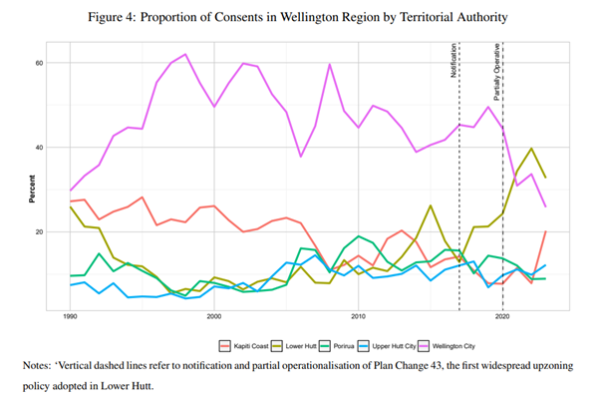
The authors used a variety of ways of checking that the zoning changes made the difference. For example, after the plan change, Lower Hutt shifted from being a moderate fraction of overall consents in the Wellington region to overtaking Wellington City. 


The economists also built a synthetic Lower Hutt and compared what happened there with the actual city. This method basically sets a complicated average of patterns in other cities that tracks how Lower Hutt’s consenting rates behaved before the change. Following that ‘synthetic’ Lower Hutt after the zoning change gives a comparison. 


Lower Hutt consented approximately 3260 more units than expected – a tripling the number of housing starts over the six-year period. More houses. More apartments. A few more retirement village units. And an awful lot more townhouses and rowhouses. 


It also affected building in Wellington City. Because it became relatively easier to build in Lower Hutt, some development shifted to the Hutt. Overall, about a quarter of the new consents in Lower Hutt were consents that might have happened in other places otherwise. 


This also matters for theories that a region may only have so much ‘absorptive capacity’ – another dubious argument relied on by Wellington’s hearings panel. 


The vast majority of new consenting in Lower Hutt, about three quarters of it, was new building. It did not just displace building that would otherwise have happened elsewhere. Lower Hutt’s reforms, all on their own, provided a 12 to 17% increase in housing starts for the whole metropolitan area. 


Lower Hutt then helps to keep rents in Wellington lower than they might otherwise be, by providing some of the housing that Wellington City would otherwise block. Every renter in Wellington owes a bit of thanks to Lower Hutt council. 


If Wellington Council cannot see fit to propose a district plan more enabling than the economically illiterate plan proposed by the Independent Hearings Panel, the combined Upper and Lower Hutt populations could well wind up exceeding Wellington’s.


If that happens, I think we should look back at the good Dr Brett’s suggestion. The Hutts’ ascendancy ought to be properly recognised. 


Wellington would become Lowerer Hutt, as Dr Brett suggested – or perhaps my preferred ‘Even Lower Hutt’. All of it would be part of the Greater Hutt Regional Council. Somes Island would of course become Hutt Island. 


And the ‘special character’ that drove Wellington’s residents, and tax base, out to the Hutts could stand as warning to other cities to at least try to be less stupid than the country’s capital.
 

Meanwhile, The Spinoff's suggesting abandoning Wellington for the Hutts and young professionals are abandoning Wellington for points farther afield like Christchurch

Buchanan said Christchurch felt more vibrant and there were plenty of young families who’d moved from the likes of Wellington and Auckland.

“Talking to my peers, former colleagues, family, and being out and about around the city, Wellington has a brain drain.

“Whether it be young teachers, firefighters or psychologists, people are unhappy or moving.”

Christchurch offered about 1000 housing options to choose from, Buchanan said, thanks to an increased supply of medium density homes in suburbs close to the city.

In Wellington, he was left with just 190. Most were in places like Wainuiomata, a Lower Hutt suburb with notoriously poor links to the city centre for commuters. A friend had recently paid $1.1 million for a small section and an old three-bedroom house in Upper Hutt.

...

According to a December 2023 Infometrics report, the average house price in Wellington City is $1,023,966 – roughly $100,000 more than the national average.

By contrast, CoreLogic measured the average house price in Christchurch as $757,881.

Wellington has long fought new-build developments, especially in the older inner city suburbs.

These “character areas” where Victorian villas still cling to the hills were described in a recent opinion piece in The Post by Eric Crampton as “wooden tents”, while by contrast he praised Lower Hutt’s initiative at constructing new-builds.

Buchanan attested to this, arguing the new builds in Christchurch only added to the character of the area.

I also had a podcast chat with Danyl McLauchlan on related issues - though we ranged a bit more broadly.

Thursday, 26 October 2023

Morning roundup

The morning's worthies.

Thursday, 1 September 2022

Mclaughlan on the administrative state

There's a lot going wrong. Danyl Mclauchlan documents a few of the problems in an essay for The Spinoff, building a case that they're all symptoms of government administration being run for the benefit of government administrators. 

  • Giant shortage of nurses; nobody bothers to put nursing on the priority list for automatic residence.
  • Health system falling apart for want of doctors and nurses; $11 billion project to reform the health bureaucracy;
  • $200 million so far on reforming the polytechs, the Chief Exec of the merged entity disappeared before resigning, and the whole thing is set to fall apart;
  • $120 million for business cases for Let's Get Wellington Moving, while Wellington's infrastructure is collapsing;
  • The fire service got centralised at considerable expense and is now falling apart;
  • ...but wait, there's more! Danyl writes:

In the past few months the government has created a new anti-terror research centre, committed $300 million to replace the school decile rating system with an equity number, created a a new ministry for disabled people, a new national health provider, a new health authority for Māori, a new ambassadorship for Pacific gender equality, a new supermarket watchdog. It’s hard at work creating a new mega-sized public media entity – estimated cost $350 million – and establishing four new regional wastewater entities at an estimated cost of $296 million (the total three waters reform is priced at about $2 billion). It has purchased Kiwibank for $2.1 billion. 

Some or all of these might turn out to be worthy enterprises but there’s a huge assumption in this government and on the left more broadly that they can only be Good Things – that questioning the rapid expansion of the administrative state can only be right-wing hate speech, part of a covert neoliberal plot to gut health, education, welfare. 

Aren’t we seeing an erosion in state capacity alongside all this centralisation and expansion? Aren’t outcomes in health, education and welfare trending down rather than up? What’s going on? You can’t have effective public services without bureaucracies, but it’s not clear that the torrents of money flowing into them are delivering more value to the public or to the marginalised communities some of them are named after. It’s almost as if the primary role of the administrative state is shifting from serving the people to the redistribution of wealth to the staffers, lawyers, PR companies, managers and consultancy firms that work in them, or for them. A billion dollars a year in public sector consultancy is an awful lot of money when you’re running out of teachers and nurses because you don’t pay them enough, and the fire trucks are breaking down.

The whole essay deserves reading. 

I'm not sure whether the underlying thesis is right. A permanent managerial class may have taken over, but there's no reason it has to be as stupid as New Zealand's has been. 

The people in the civil service aren't that different from the ones who were there under the last government. Many were appointed under the last government. Peter Hughes has spanned multiple governments. 

Danyl again:

Lasch mourns the decline of the mid-20th century socially democratic left; the working class movement that built the modern welfare state. And he notes that the PMC often imitates their rhetoric but primarily employs the state as a means to appropriate the public’s wealth for themselves while defecting from its core institutions. He notes: “They send their children to private schools, insure themselves against medical emergencies… In effect, they have removed themselves from the common life. Their only relation to productive labour is that of consumers. They have no experience of making anything substantial or enduring. They live in a world of abstractions and images, a simulated world that consists of computerised models of reality.”

And this disconnection from the physical world and their fellow citizens means their politics is increasingly therapeutic rather than material; it’s the politics of personal self-esteem, emotional wellbeing, self-expression, self validation, relentless positivity. Jacinda Ardern gave a nice demonstration of this in a recent interview on TVNZ’s Q+A with Jack Tame. When asked about her government’s failure to deliver across multiple policy areas and what she’d learned from these mistakes, she replied: “You know what, I would not ever change the fact that we have always throughout been highly aspirational. We have always focused on how we can make New Zealand better…  In setting out a vision for what that should look like, you will still hear me talk about New Zealand as a place that should be free of child poverty. Absolutely, because anything less in my mind… anything less demonstrates that we don’t believe that things can and need to improve.”

Danyl's dead right that vision and aspiration have been front and centre, with delivery left as afterthought at best. But I don't think that's entirely down to the bureaucrats. One of the first things that Labour did, on taking office, was abolish the targets that the previous government had set on the public service. They abolished accountability while setting aspiration as end in itself. 

Maybe it's the public sector's fault for being too ready to let Ministers get high on their own supply, but even in cases where the Ministries have been courageous in providing advice Ministers didn't want to hear, it didn't make any damned difference. MBIE warned about the problems in Fair Pay Agreements; government wanted to push ahead anyway. 

I tend to think this stuff starts at the top.

If the Minister of Finance demands evidence on value-for-money in adjudicating between different budget bids, because there will always be more bids than there's space to accommodate, that drives demand for rigour in analysis. If the Government wants everything put through a soft-focus wellbeing lens instead, then that razor gets dulled. And if you combine it with a ludicrously soft budget constraint where government borrows $50 billion, nominally for Covid, and then spends it on any darned thing that passes a comms test, you'll get what we've had. 

And it worked for the government for a while. But the Gods of the Copybook Headings eventually return. 

It all looks pretty bleak. Europe's heading for disaster if the energy futures market is anything to go by. Covid shocks were bad but what happens when European factories supplying critical parts into NZ supply chains can't afford to run? There's terrible mess ahead, we can't afford for policy to continue to be this persistently stupid, and there's no reason to hope that policy will stop being this persistently stupid.

What's perhaps even more depressing is everywhere else looks even worse.

How much ruin is there in a country?

Wednesday, 18 December 2019

Danyl on social media and the attention economy

The journalist Auberon Waugh often wrote dismissively of “the chattering class”: the upper middle-class cliques of journalists, academics, artists, intellectuals and activists (Thomas Piketty refers to it as “The Brahmin Left”, reflecting its 21st century transformation into a priestly caste primarily concerned with moral transgressions). They form the leadership and core constituency of leftwing political parties, and they still attempt to play a gatekeeper role around political debate. But instead of policing the window of debate – pretending to impartial objectivity while excluding what it feels should or cannot be said – it amplifies messages it believes lie outside the bounds of acceptability. The ruthless logic of the Attention Economy rules progressive online and media spaces; everyone competes for attention by demonstrating their moral and intellectual superiority, so any and every public statement that breaches progressive taboos or activates this class’s (very acute) sense of threat can easily earn massive media coverage.

The incentive structure here is terrible. The worst ideas and most deceitful statements are often the most amplified and therefore the most successful. The sustained moral panic about “fake news” (but only on the right), incentivises the manufacture of fake news. We can see this mechanism at work in almost everything the National Party has done this year: their policy work on criminal justice was a rather dry discussion document on how the party’s “social investment” model can apply to this sector, but it was launched with the announcement that “Strike Force Raptor”, would crack down on gangs, which are currently expanding due to Australia’s criminal deportation policy. This prompted the expected response from progressive commentators: that gangs aren’t a criminal problem, but rather a deeply fascinating and complicated epiphenomenon of colonialism and capitalism, a suite of arguments that sound deranged to most of the population who aren’t fortunate enough to reside in the leafy university-proximate suburbs that enjoy the lowest crime rates in the country.

This week’s National Party transport policy announcement is also pretty dry stuff: integrated ticketing; fuel efficiency; urban transport authorities. But the headline announcement was a plan to fine cyclists – cycling being a sacred activity among progressive elites – and this provoked the absolutely predictable response and led the web pages of all the media outlets. National has also taken to producing highly dubious graphs with deliberate errors like disproportionate bar widths, that it releases on Twitter – the heartland of progressive moral panic and intellectual contempt – that its opponents then compete against each other to amplify. Naturally these graphs don’t feature in its policy documents or press releases.
I was expecting a lot of bicycle-twitter outrage about the piece, but there's no evidence of it as yet. Wonder if they've not noticed it, or have properly appreciated it.

Saturday, 17 August 2019

Mind Fixers

The Spinoff has a superb piece by Danyl McLauchlan reviewing Anne Harrington's Mind Fixers. Thomas Szasz makes an appearance. A snippet:
In January of 1973 the psychologist David Rosenhan published an article in Science, one of the world’s most influential academic journals, titled ‘On Being Sane in Insane Places’. He’d conducted an experiment in which eight people (including himself) presented to twelve different psychiatric hospitals across the US, complaining of audible hallucinations: the words they claimed to hear were specifically chosen because they didn’t correspond to anything in the published literature linking them to psychotic symptoms. They were all diagnosed with either schizophrenia or ‘manic depressive psychosis’ and committed. Upon admission they started behaving normally and taking notes about the environment, in such an overt manner that their fellow patients accused them of being professors or journalists checking up on the hospital. At no point did any medical staff suspect they were not mentally ill. Eventually they were all discharged with a diagnosis of ‘schizophrenia in remission.’

Rosenham’s article ended with a story about a well regarded teaching and research hospital that had heard of his study and challenged him to send pseudo-patients to them, confident that they could detect such imposters. Over a period of several weeks they identified 41 individuals whom they diagnosed as sane but pretending to be mad. Rosenham had not actually recruited anyone for this study: these were genuine patients, 41 false negatives. Another critic of psychiatry, Thomas Szasz, made the point that none of this looked remotely like medicine. What psychiatrists seemed to do was identify people who behaved in unusual, socially unorthodox ways and declare that they were ‘sick’, and therefore in need of confinement and treatment, which they applied whether the patient wanted to be treated or not. Psychiatrists seemed to be violating the basic civil rights of their patients on an astonishingly vast scale.
I hadn't known about that study. Danyl concludes:
Two of the final quotes in the book come from high ranking members of the psychiatric priesthood, summing up the current state of the science. This first is Thomas Insel, a former director of the US National Institute of Mental Health for 13 years, who wrote:

“I spent 13 years at NIMH really pushing on the neuroscience and genetics of mental disorders, and when I look back on that I realize that while I succeeded at getting lots of really cool papers published by cool scientists at fairly large costs – I think $20 billion – I don’t think we moved the needle in reducing suicide, reducing hospitalizations or improving recovery for the tens of millions of people who have mental illness.”

And in 2016 the psychiatrist Shekhar Saxena, director of the World Health Organisation’s mental health unit, remarked that if he was diagnosed with schizophrenia he’d prefer to live in Addis Ababa in Ethiopia, or Colombo in Sri Lanka, where he could live as a productive if eccentric member of the community, as opposed to New York or London, where he’d be stigmatised and relegated to the margins of society.
And there are some well-deserved slaps along the way for journos who are a bit too credulous when they head out on attack against Pharmac. Read the whole thing.