Showing posts with label Wellington. Show all posts

Friday, 5 September 2025

Infrastructure roulette

In some respects it's reasonable to think about city council as being a kind of club.

Everyone who owns property in Wellington is a member of the Wellington Council club. The club levies itself to provide things that the club members want, and to cover off the cost of stuff that central government wants the club to provide that club members may or may not want. For some reason, renters were added as voting members of the club. But the debt that the club issues is ultimately backed by each of the club properties. We'll leave that messiness to one side for now.

The club finds that part of its infrastructure is in terrible shape - partially because of decisions of past club executives; partially because of a recent earthquake. 

The club can choose to rapidly replace all of that infrastructure. That would be very expensive. But it would sharply reduce the chances of very bad outcomes where infrastructure blows out.

Or it could choose to pace itself in that infrastructure replacement. That will be much less costly. So much less costly that you could, at least in principle, compensate anyone who suffers from those infrastructure blowouts if it's really the infrastructure that's to blame. 

The latter could be a very reasonable deal. Behind the veil, none of us know which of our properties is sitting on top of a water network pipe that will collapse catastrophically and destroy our home. But we'd all be bankrupted if we tried replacing all the pipes in a giant hurry - it's just impossible. So we're each better off if we all agree to take a more cost-effective path on the infrastructure refresh while compensating any club member who draws the short straw.

The alternative, with no compensation, is more like the club members agreeing to play a giant game of Russian Roulette. We don't know which of us will draw the short straw, but we hope to heck it won't be us because whoever it is will be ruined. 

It could be that the numbers don't actually work out this way. But it seems a reasonable stylised example. 

And in any particular case of blowout, you'd want to be sure that the club member hadn't contributed to the failure through their own negligence. 

But if it were clear-cut, it shouldn't be a legal battle. It should just be compensation. 

I mean, if a private company accidentally drove a bulldozer through your house and wrecked it, nobody would think it reasonable to force you to go to court to get them to compensate you. Everyone would pillory the company. There would be boycotts. Some Vic Uni quasi-academic might call for the company's chief executive to be hanged. 

Here's The Post.

Wellington City Council is refusing to pay for repairs after one of its own burst water pipes triggered two landslides that has left two families facing bills of up to $600,000.

A council-commissioned geotechnical report found the Wadestown slips were “most probably” destabilised by a failed drinking water main, owned by the Wellington City Council and maintained by council-controlled organisation Wellington Water.

The 50mm pipe ruptured on August 4, saturating the embankment, and the slips forced both households to evacuate. Residents are still living in temporary accommodation.

I Am Not A Lawyer. 

But it seems likely that the homeowners could sue council for nuisance, and win, and have costs awarded against council, but the costs won't likely be anything like what would be needed to make them whole as compared to council just providing compensation. 

Council is not a good club. 

Monday, 21 July 2025

Compensation for regulatory takings - reader mailbag

I've had a couple of recent columns explaining the in-principle case for compensation for regulatory takings. 

Such compensation is recommended in the Regulatory Standards Bill, and is likely to be part of proposed Resource Management reform. 

The shorter version of the argument was in our Insights newsletter; the longer one in The Post, ungated here. A snip:

The Regulatory Standards Bill sets a principle that legislation should not take or impair property without fair compensation. And, where practicable, that compensation should be provided by those benefitting. Parliament remains free to ignore that principle.

In some cases, the beneficiaries are the broader public and compensation should be provided by the government. In other cases, a smaller group would benefit. Where practicable, that benefitting group should be the one to provide compensation.

Done sensibly, none of this would prevent beneficial regulation. Instead, it would help solve an imbalance and inequity in how things are currently done.

Governments can be tempted to use regulation in cases where a spending measure would be more effective for achieving some desired purpose, simply because government can ignore the cost that regulation imposes on others. Compensation would bring a more level assessment.

And requiring that the beneficiaries compensate those harmed from loss of legal rights accords with many reasonable views of equity. Where the gains to the winners exceed the losses to the losers, those gaining can compensate those losing and everyone is better off.

The excellent Brent Layton emails with a fun Wellington Council regulatory takings case. He writes (I've bolded one bit):

Dear Eric

I “enjoyed” reading your recent article on the logic behind the Regulatory Standards Bill containing provisions pointing decision makers towards consideration of compensation to those subject to a regulatory taking. I also “enjoyed” watching on a streaming service you and Bryce interact with two Labour MPs and a TPM MP at a Select Committee hearing on the Bill. If any group in the country should be supporting compensation for regulatory takings it should be the TPM, but she clearly did not get this. The Labour MP’s seem to not realise that principled regulation will be in the interests of everyone, but particularly those without wealth to exploit regulatory loopholes and inefficiencies.

Earlier this month my partner and I were among a smallish group of landowners in Wellington subjected to a significant regulatory taking over collectively a large area of land. The Wellington City Council adopted its new District Plan. Under it approximately 20 hectares of our backyard in Karori is designated an SNA. The Wellington CC SNA restricts the rights of landowners to use and develop the land subject to it very materially. 

For us, the impact is not as great as for most other owners for three reasons. Most of our land subjected to the SNA is already subject to a QEII Trust covenant that constrains its use and development anyway. In addition, I made submissions on the Council’s initial proposal and got most of our non-QEII Trust land out of the SNA designated area. Most of my neighbours did not make submissions, some, at least, because they mistakenly thought the change of government had put an end to councils imposing SNAs. The proportion of their land now covered by an SNA  designation is in many cases very high. We had also done quite a bit of development in the area affected by way of putting in tracks, drainage of tracks, building reinforcement to stop the stream eroding areas, etc. knowing that Wellington CC was determined to effectively “take” the land. Maintenance rights are better than development rights under the SNA.

Our experience illustrates a point you made very clearly; that the absence from a need to consider compensation to those adversely affected impacts adversely the area taken. The initial Wellington CC proposal relating to our place contained a lot of land that was covered in gorse, blackberry, Darwin’s barberry, and buddleia. The extent to which there was natural vegetation it was limited to immature mahoe pushing their way up through the pest plants. There was also an area containing a cluster of very mature macrocarpa. The land had been farmed with goats until the 1990’s. 

The council had arrived at its proposed SNA’s through looking at articles, some very old, on where a botanist thought there was significant natural coverage or something else worth protecting and from looking at aerial photographs. Anything that looked like bush from a few thousand feet, was included. I think that no compensation would be paid meant the “planners” were able to take a wide view of what should be an SNA and wait for the landowners to complain and provide evidence that the area did not contain significant natural features.

In my submission I argued that, if there was a net benefit to the community, those adversely affected should be compensated. This would ensure the land designated is properly scrutinised. I also included photos showing that a lot of the areas on our land the planners wanted to include were not areas of natural vegetation. The Chair of the Hearings Panel organised for an independent botanist to come out and view the land in detail. The panel itself also paid us a visit but did not do a detailed inspection of the site. They looked along the valley from a good vantage point where you could see that the vegetation in the areas I had identified in the photos was not natural.

The upshot was that after receiving the botanist's report 3 of the 4 areas I had pointed out did not contain significant natural vegetation were excluded from the area designated as an SNA. The fourth area was still included in the SNA, this included an old but still used farm track flanked by gorse and the cluster of macrocarpas. I wrote to the Chair of the Hearings Panel and pointed out the inclusion of this area in an SNA was clearly a mistake. He replied there was no appeal until after the Wellington CC had adopted the plan. However, when I checked the plan released with the adoption I found the land containing the macrocarpas and the gorse flanked track are outside the legally imposed SNA. Possibly I misread the earlier map. I wish I had of taken a screenshot.

We have decided we will not appeal because the costs would be high and we think we may be net beneficiaries of Wellington’s regulatory taking, or, alternatively, we think it possible the SNA will become redundant by legislation as the impact on land and house prices gets wider recognition. We own in total a block of  approximately 65 hectares in Karori. The area - approximately 30 hectares - that could in future be developed for residential subdivision is outside the SNA. The effect of Wellington’s SNA designations is to severely restrict the supply of alternative land that could be developed. If the SNA designations remain, our developable land will be a scarcer asset and probably significantly more valuable. If the SNA designations get over-ridden by legislation, then it would have been pointless to have spent the money to appeal. 

From society's perspective, I think the SNAs should be over-ridden by legislation and a regime be introduced by which Councils that want to protect areas have to negotiate and reach agreement with landowners, including over payment of lump sum or annual compensation. From a personal point of view, we suspect we have been winners from the actions of the Wellington Council. To hell with those wanting and needing affordable housing; we are boomers and deserve to fly business class. 

Keep up the good work.

That last line of the penultimate paragraph is very clearly tongue-in-cheek - Council has restricted the supply of land that might compete with Brent's when developers want to build more greenfield housing in Karori. Which likely makes him better off all-up, but he'd clearly prefer that the SNAs hadn't happened. 

If council wants more land in parks in the green belt, it should buy land and add it to the green belt. Stealing it via SNA isn't right.

The map of the SNAs, at least as of the draft district plan, is here.

Tuesday, 8 October 2024

Where are the food carts?

I still don't get why there aren't more food carts on Wellington's waterfront. On a good sunny day, you might find, along a stretch of gorgeous waterfront more than two kilometres long, all of it close to downtown, 2-3 food carts. 

Meanwhile, downtown Christchurch restaurants are worried about the Arts Centre's plan to host around 30 carts not just on weekends: every day. They point to the rates bills they pay and consenting hassles they deal with that food carts avoid; they want Council to cut its subsidy to the Arts Centre if it doesn't abandon its food trucks plan. 

My column for this week's Post, Christchurch Press, Waikato Times etc:

Assessing council rates on land value alone, while abolishing the punitive ratings differential assessed on businesses, would be a better way of levelling that part of the playing field. The piece of land would pay the same amount in rates regardless of whether a restaurant, a shop, or some carts sat on it.

Similarly, radically easing consenting burdens would level the playing field while improving outcomes more generally. This week, results from the UK Growth Survey were released. Forty-four top UK economists were asked what their government should do to pursue growth. They overwhelmingly pointed to planning reform. We have the same problem.

Building a restaurant should be a simple by-right activity.

And letting food carts serve beer would remove a distortion that currently works in restaurants’ favour.

Christchurch council should only reduce the subsidy it provides to the Arts Centre to the extent that having food carts reduces the value of the public amenity that the centre provides. And really, food carts seem more likely to improve that amenity than impede it.

Christchurch’s problem then brings us back to Wellington’s puzzle. Food carts do not have to deal with resource and building consents, though they do need a food registration certificate. They enjoy a ratings advantage, and Wellington’s business ratings differential is even worse than Christchurch’s. And everywhere in Wellington’s downtown is a short walk from the waterfront. Christchurch is more dispersed.

So, on a good day, to steal a line from an old Australian tourism commercial, where the hell are the waterfront food carts?

Better to level playing fields by removing shackles rather than by adding them. But if food carts do have such an advantage, why are there so few on Wellington's waterfront? 

An ungated version of the column will eventually turn up here.

Friday, 8 March 2024

Afternoon roundup

The afternoon's worthies:

Tuesday, 5 March 2024

Even Lowerer Hutt

One annoying thing about writing a Saturday column for the Stuff papers is never knowing whether a piece will show up in print.

I'd thought this one was a banger. 

Anyway - the column.

Even Lower Hutt 

Transport historian Dr André Brett has suggested that Wellington be renamed Lowerer Hutt, perhaps to help avoid confusion within the region.   

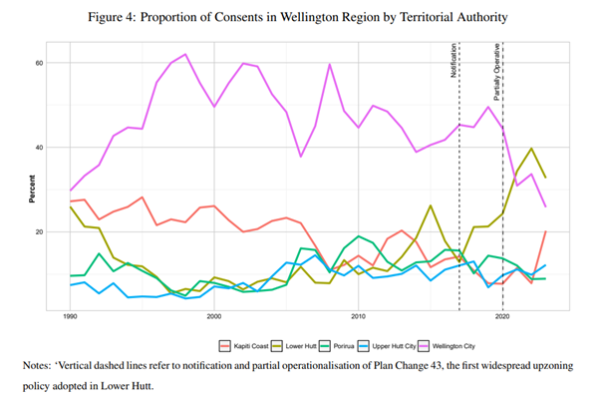
Economists Matthew Maltman and Ryan Greenaway-McGrevy have been looking at Lower Hutt’s housing boom. Their paper, released this week by the Economic Policy Centre at Auckland University, suggests Brett was onto something.  


Wellington City could use a bit more Huttite thinking. And especially while Wellington’s response to the Independent Hearings Panel’s report on the district plan is still in play. 


While Wellington City mulled over whether it should be legal to turn rotting wooden tents into townhouses and apartments, Lower Hutt started building. 


From late 2016, Lower Hutt started a sequence of plan changes. They reduced parking requirements and introduced new zones allowing taller mixed-use developments and medium density housing. They allowed greater density within general residential zoning. And they quickly implemented policy changes set as part of Labour’s urban growth agenda – like medium density rules and upzoning requirements near public transport.


The paper tests whether those changes to zoning had any effect on building. 


It might sound like testing whether water flows downhill. 


The New Zealand Association of Economists surveyed its members this month. 96% of economists agreed or strongly agreed that district plan land use restrictions reduce housing supply. 94% agreed or strongly agreed those restrictions reduce affordability. And 98% agreed or strongly agreed that easing district plan restrictions will tend to increase housing supply and affordability.


But Wellington’s Independent Hearings Panel instead seemed convinced by one expert’s odd argument that zoning to allow more building, even in an obvious housing shortage, may not lead to more building. 


And perhaps the Commissioners saw no reason to believe that evidence from faraway places like Auckland could also apply in Wellington. 


So the Lower Hutt evidence is important. At least for those who need very specific local proof that water also flows downhill in the Wellington region. 


On notification of the plan changes, and especially after the changes started taking effect, Lower Hutt started issuing a lot more consents for townhouses and rowhouses. In the new zones enabling medium density and mixed use, there was the same jump in consents for townhouses and rowhouses – and also apartments. 


But perhaps that was just coincidence and Lower Hutt was only following the same trend as other councils. 


The authors used a variety of ways of checking that the zoning changes made the difference. For example, after the plan change, Lower Hutt shifted from being a moderate fraction of overall consents in the Wellington region to overtaking Wellington City. 


The economists also built a synthetic Lower Hutt and compared what happened there with the actual city. This method basically sets a complicated average of patterns in other cities that tracks how Lower Hutt’s consenting rates behaved before the change. Following that ‘synthetic’ Lower Hutt after the zoning change gives a comparison. 


Lower Hutt consented approximately 3260 more units than expected – a tripling the number of housing starts over the six-year period. More houses. More apartments. A few more retirement village units. And an awful lot more townhouses and rowhouses. 


It also affected building in Wellington City. Because it became relatively easier to build in Lower Hutt, some development shifted to the Hutt. Overall, about a quarter of the new consents in Lower Hutt were consents that might have happened in other places otherwise. 


This also matters for theories that a region may only have so much ‘absorptive capacity’ – another dubious argument relied on by Wellington’s hearings panel. 


The vast majority of new consenting in Lower Hutt, about three quarters of it, was new building. It did not just displace building that would otherwise have happened elsewhere. Lower Hutt’s reforms, all on their own, provided a 12 to 17% increase in housing starts for the whole metropolitan area. 


Lower Hutt then helps to keep rents in Wellington lower than they might otherwise be, by providing some of the housing that Wellington City would otherwise block. Every renter in Wellington owes a bit of thanks to Lower Hutt council. 


If Wellington Council cannot see fit to propose a district plan more enabling than the economically illiterate plan proposed by the Independent Hearings Panel, the combined Upper and Lower Hutt populations could well wind up exceeding Wellington’s.


If that happens, I think we should look back at the good Dr Brett’s suggestion. The Hutts’ ascendancy ought to be properly recognised. 


Wellington would become Lowerer Hutt, as Dr Brett suggested – or perhaps my preferred ‘Even Lower Hutt’. All of it would be part of the Greater Hutt Regional Council. Somes Island would of course become Hutt Island. 


And the ‘special character’ that drove Wellington’s residents, and tax base, out to the Hutts could stand as warning to other cities to at least try to be less stupid than the country’s capital.
 

Meanwhile, The Spinoff's suggesting abandoning Wellington for the Hutts and young professionals are abandoning Wellington for points farther afield like Christchurch. 

Buchanan said Christchurch felt more vibrant and there were plenty of young families who’d moved from the likes of Wellington and Auckland.

“Talking to my peers, former colleagues, family, and being out and about around the city, Wellington has a brain drain.

“Whether it be young teachers, firefighters or psychologists, people are unhappy or moving.”

Christchurch offered about 1000 housing options to choose from, Buchanan said, thanks to an increased supply of medium density homes in suburbs close to the city.

In Wellington, he was left with just 190. Most were in places like Wainuiomata, a Lower Hutt suburb with notoriously poor links to the city centre for commuters. A friend had recently paid $1.1 million for a small section and an old three-bedroom house in Upper Hutt.

...

According to a December 2023 Infometrics report, the average house price in Wellington City is $1,023,966 – roughly $100,000 more than the national average.

By contrast, CoreLogic measured the average house price in Christchurch as $757,881.

Wellington has long fought new-build developments, especially in the older inner city suburbs.

These “character areas” where Victorian villas still cling to the hills were described in a recent opinion piece in The Post by Eric Crampton as “wooden tents”, while by contrast he praised Lower Hutt’s initiative at constructing new-builds.

Buchanan attested to this, arguing the new builds in Christchurch only added to the character of the area.

I also had a podcast chat with Danyl McLauchlan on related issues - though we ranged a bit more broadly.

Monday, 12 February 2024

Around the traps on housing

Wellington's Independent Hearings Panel put up its recommendations on the Wellington District Plan. 

They note that Council's plan provides far more than the minimum required zoned housing to keep up with projected demand and so scaled it back.

A few bits from me on all this.

Oli Lewis and Dileepa Fonseca at BusinessDesk

Wellington already suffers from infrastructure challenges, and restricting housing development in existing areas may worsen it. 

That’s the view of Geoff Cooper, general manager for strategy at the Infrastructure Commission, Te Waihanga, who commented to BusinessDesk expressing surprise at recommendations made by an independent hearings panel (IHP) convened to hear submissions on a proposed district plan put forward by the Wellington city council.

...

Cooper said that the NZ infrastructure strategy, produced by the commission, also highlighted a need for national direction to help guide planning decisions. 

“The aim of this national direction is often about balancing economic matters, like enabling housing supply for future New Zealanders, with other factors.” 

Economic considerations needed to be given appropriate weight, he said. 

“We note that as of today, the list of 999 accredited RMA independent commissioners includes just 12 that report having expertise in economics – amounting to 1.2%.” 

Crampton was far more scathing, saying the Wellington IHP clearly needed economic assistance. 

“Their engagement with the economic evidence presented was incredibly poor; they were unable to distinguish academically credible arguments from academically risible arguments, and they provided a series of recommendations that will worsen housing affordability,” he said. 

“All in all, the report discredits the IHP process and the methods used to select panellists. Wellington council would be right in dismissing the IHP report’s conclusions.”

Tom Hunt asked what I'd thought about it:

The New Zealand Initiative chief economist Eric Crampton said the council’s proposed district plan had a larger buffer between planned-for supply and projected housing demand in Wellington in coming decades. The new recommendations significantly reduced that buffer, which particularly mattered when Wellington was starting from a housing shortage.

But he believed the whole system may need to change to rely less on forecasts of whether housing demand would be met by zoned supply. If housing was unaffordable, people could be expected to leave town, reducing forecast demand, he said.

Instead, councils and the Government could watch land values. If those prices showed that zoned land was scarce, as work by the Infrastructure Commission had shown, then the Government could get councils to zone for more development.

There had been 2016 work by Covec and MRCagney for MfE looking at how prices could be used as signals of zoned scarcity. This was part of the prep for the older National Policy Statement on Urban Development Capacity. NPS-UDC was replaced by NPS-UD, and none of it took price signals as seriously as it should have. They're mentioned as one of many possible things to look at when they should be a trigger compelling release of more zoned land. 

I talked about this a bit more over at The Herald. The full column is gated but I've snipped a couple bits. 

In short, it’s a backward kind of way of setting urban plans. Forecasts of demand are not only highly uncertain, they also depend on housing affordability.

If you start with overcrowded, poor-quality housing, you will have a hard time fixing it. And if the resulting unaffordability discourages people from moving here while encouraging young families to flee, projected demand is the wrong measure entirely.

None of it faces a simple sanity check. Land prices can quickly show whether councils have zoned sufficient land for development. Last year, the Infrastructure Commission compared the 2021 price of land just outside of city limits to the price of land just inside the boundary. They accounted for the cost of turning rural land into urban land, like earthworks, surveying, planning, and development contributions. And they found urban zoning quadruples the price of land inside Auckland and Tauranga’s boundaries, while more than tripling land value in Wellington, Hamilton and Queenstown.

Those ratios had increased substantially since 2010.

Since the commission’s work accounted for land development costs, the price multiples at the boundary largely reflect scarcity caused by zoning.

If it were legal to turn rural land around Wellington, like in Ōhāriu, into housing, land zoned for housing in Wellington would not cost $490 per square metre more than land just outside the boundary. As the typical Wellington section is about 600sq m, the commission’s figures mean zoning at the boundary added almost $300,000 to a Wellington section’s price in 2021.

This simply would not happen if the council had really zoned enough land for development.

But the problem is not just at rural-urban boundaries. It will also be at every other zoning boundary where zoning creates scarcity.

On the plus side, the IHP work really didn't mess around. Some reports are just kinda bad. And then inertia sees them adopted. But this one's bad enough that it's unified everyone other than the more hopeless NIMBYs against it. So it's more likely to be tossed.

It also seems to have inspired the latest NZ Association of Economists member's survey. If you're an NZAE member, do check your inbox for that survey. It asks member whether zoning provides a binding constraint against housing supply and consequently affects prices. 

And on the fun side, Twitter urbanist Boxcar Joey mapped the conspiracy of Twitter urbanists against the IHP proposal.

Thursday, 25 January 2024

Afternoon roundup

Sure doesn't take long for the tabs to pile up after summer break.

Some worthies:

Wednesday, 24 January 2024

Water metering - a small piece of silver buckshot

Chris Parker at Treasury sometimes quips that there are no silver bullets for solving housing in NZ, only pieces of silver buckshot. Basically you've got to do a lot of things to solve the problem; any one of them on their own won't do it. 

I was on RNZ's The Panel yesterday afternoon (here, from around the 11 minute mark) talking volumetric charging for water and water metering. It's come up as a solution for Wellington's increasingly obvious water problems. 

It's good. But it's only a small piece of silver buckshot. The other bits of shot are more important. 

Currently, Wellington Water manages pipes it doesn't own on what bits of funding it can beg from the councils that own the pipes and set the levies for water. It also currently seems to be terribly managed, with atrocious-sounding costs for repairs. Councils have to give them more money to fix the pipes, but need to be able to trust that it won't just be eaten up by having (purely hypothetically) engineers spend days of paperwork on minor repairs. 

If you added water levies into the mix, it'd be good, but it wouldn't solve the main problem. I love volumetric charging. But if the water agency has limited capacity, and the same kinds of folks fix pipes as put meters onto pipes, I'm not convinced it's the first thing that should be done. 

One great feature of water metering is identifying leaks. Wellington Water cannot keep up with very obvious known leaks. The leak on Tinakore Road that I'd walk by every morning I walked to work for months before Christmas was still there when I got back from Christmas break. Eyeballing it, the volume would be comparable to what might come out of a couple of garden hoses put together, fully open, 24/7. That leak hasn't been big enough to hit their priority list. 

Do you want the next Wellington Water employee fixing leaks like that, or installing meters? How many meters would you have to install before households would reduce water use by an amount comparable to what's flowing out of that one leak? 

The first-order problem is still that the water company doesn't own the pipes or decide on its own charges, subject to ComCom oversight on charging, with ability to back independent debt with water system revenues. 

Friday, 10 November 2023

Afternoon roundup

The end-of-week closing of the browser tabs

Monday, 6 November 2023

Maybe spend less on stuff that isn't pipes?

If this is correct, it seems even more irresponsible for Wellington Council to be spending any substantial amount of money on anything other than the pipes for a while. 

A billion dollars a year is what it would take to fix Wellington’s water woes, but the boss of Wellington Water, Tonia Haskell, says that is a figure beyond councils to fund.

“Councils can’t afford it and a new water entity probably could not afford that either, unless the Government chips in,” Haskell said in an interview with The Post.

...She describes $1b as an “unconditional budget” and notes that it could take many years to do the work required. “I do not know at what point that tails off.”

The annual figure of $1b includes the cost of such things as a new wastewater outfall pipe for Hutt Valley, installing meters, new reservoirs, upgrading wastewater storage and treatment plants across the region and completely renewing the piping network.

I do not know whether there's gold-plating in the treatment plant upgrades that could be trimmed back. If the costs here include completely renewing the piping network, the costs of that renewing ought to be spread over decades rather than borne up-front. And note that these costs are for the whole region rather than just Wellington. 

But however you structure it all, the costs won't be small. The same set of households and businesses will be paying the combination of rates and water charges to cover the bills over the decades to come.

Spending a hundred million more than necessary on a central library, and another hundred million on town hall, and the convention centre, and who knows what bill yet to come on the Michael Fowler Centre and the Opera House and the insane-looking subsidy to a multinational movie theatre company and whatever's going on in transport... c'mon folks. Give it a rest until we know what kind of burden we're all looking at for fixing the pipes. 

Or at least quit whining to central government that you need bailouts when you're simultaneously deciding to spend a heck of a lot on projects that look pretty iffy while the pipes are falling apart. 

Friday, 27 October 2023

Afternoon Wellington roundup

It's gorgeous days like today (well, the walk in this morning was grand) that help explain how Wellington can be so abysmally governed. If it weren't for days like this, who'd stay?

A closing of some tabs.

Councillor McNulty at least tried his best on some of this. I've been imagining him in lieu of the other McNulty, recreating that scene from The Wire, walking around the Town Hall site, pointing at things, and just repeating one word. 

Oh: rain's now shown up. 

Thursday, 26 October 2023

Morning roundup

The morning's worthies.

Friday, 20 October 2023

There Is No Alternative - Wellington Council edition

It looks like Wellington Council officials are providing councilors with an offer they're not supposed to refuse.

Earlier this week, Council heard a presentation from officials on options around the Town Hall. 

As presented, there seemed no reasonable alternative to spending another $70 million to $147 million to finish strengthening works. 


Stopping works and closing the building off would only save $60 million relative to finishing. Demolishing it would cost $20m less than finishing it. And delaying would just escalate costs. 

If you look at it that way, why wouldn't you finish the thing? Sunk costs are sunk, and the choice before Council is whether to spend a small bit more to finish the project rather than aim for demolition. 

And especially when officials put a lot of time pressure on the thing, wanting a decision by next Wednesday.

But there are a few oddities in there. 

Closing up the building would have a year's worth of work finishing the basement to prevent flooding, completing critical structural works, reinstating heritage fabric and the like. Safety and other works like that are $33.42 million. 

Demolition would add $39.35m on top of close-up costs: Environment Court applications, demolition planning and works, professional fees and contingencies. 

But why would you complete critical structural works or finish the basement if you were going to bowl the thing? If they netted those costs out somewhere, it sure isn't mentioned. The only reason to finish the basement rather than fill it is if you were planning to sell the site for someone else to build on, and you'd only do that if the value added by finishing were more than the cost right?

Delisting the building from the District Plan (heritage buildings are protected because they're there listed) would open up a lot of options. 

But officials caution that if a delisting process started now, it could be in the courts until December 2027. And Council could easily lose. There is insanity in the rules around this stuff, but the rules are the rules. 

Officials noted that a Local Bill might allow faster delisting - but wind up warning against that too. 

It's pretty easy to imagine what an enabling Local Bill would look like. 

It would enable council to delist buildings by simple majority vote, without right of appeal. A delisted building would be deemed to have no special value, heritage, cultural or otherwise, when considering building or demolition consents.

With an enabling local bill in place, council could weigh up different options. 

A local bill enabling delisting could do a lot of derisking. If it turns out that preserving one bit that nobody would ever notice would add $20 million to the cost, they could just save the $20 million. They could weigh things up on a case by case basis without worrying about being sued. 

The council document notes that council carries the majority of the geotech and heritage risks. The geotech side is largely now understood, but paragraph 24 still has "heritage restoration costs and requirements" as one of the remaining risks council faces. At para 26 they note that heritage risk replaces ground risk when restoration work starts. 

But officials also suggest the local bill path is impracticable:
Pathway 3: Local Bill

95. Aside from a successful plan change, the only other path to demolition is to seek to
pass a Local Bill specifically for this purpose. This would then override the District Plan
and general RMA provisions.

96. A Council decision to demolish the building under an enabling Act could still be subject to judicial review challenging the lawfulness of demolition. Any Bill would need to be drafted in such a way as to leave no room for ambiguity in interpretation on this point.
As with the other pathways discussed, the Council would need to consider the significant precedent effects in pursuing this option, including that, in practice, a Local Bill is an option available to the Council but, unlike a resource consent, not necessarily one that could be pursued by other building owners.

97. Pursuing a Local Bill would be subject to similarly high levels of uncertainty as a resource consent and/or plan change process. The local MP would be required to manage the Bill through Parliament and Council would be required to draft the Bill and meet all associated legal costs. The Bill would need support from a majority of MPs to be passed and it may take several years from introduction of the Bill before it is passed into law. It would also be subject to public debate through that process. As an example, the Girl Guides Association (New Zealand Branch) Incorporation Bill is a private bill that was introduced in February 2021, and has still not had its second reading two-and-a-half years later.

This still feels like There Is No Alternative framing. 

Local Bills are fast. Rotorua's local bill was at Select Committee within two weeks of being introduced; it was there shot down. The Girl Guides bill is a private bill.

If an incoming government has had a gutsful of Wellington spending piles of money on things that aren't the water pipes, it may well be inclined to ensure speedy treatment of the Bill, so it gets through the Committee stages reasonably quickly. 

Worst for an incoming government would be Wellington Council being able to credibly say, 

"Look, we tried our best not to have to spend another hundred million dollars on this damned building, and likely another half billion yet to come on Opera House and Fowler Centre. And who knows what down the track. 

But we are entirely tied up by central government legislation. 

Priority buildings in Wellington have to have works or demolition completed within 7.5 years of being notified. 

Our officials tell us that if we started today to try to delist the Town Hall, we might have a decision out of Environment Court by December 2026 and up to another year for High Court appeal. That's four years of legal process. 

And the clock is already ticking on Fowler and Town Hall. If we started normal legal processes this year to delist the buildings and untie our hands, we'd have less than four years* to actually do the works on them afterwards.

We asked a red-tape-hating government to let us make the choices that were right for our community, and they forced us to waste hundreds of millions of dollars instead."

* If those are priority buildings as well; it's 15 years all-up if they are not. I have no clue which buildings get a priority label. If it's based on risk to others, Opera House seems riskier than Fowler. 

It would seem more surprising if central government knocked this back rather than supporting it, really. 

A few bottom lines then:
  • Wellington Council likes to pretend that it has no choice but to spend an extra hundred million or so on this building, and who knows how much more on buildings yet to come. But there is a potential choice. Wellington Council could support a Local Bill that would enable council to delist buildings and proceed on more rational basis. 
  • Regardless of whether they think an incoming government would support a local bill, Wellington Council should put one up. If central government says no, Wellington Council could more plausibly ask for help in dealing with the cost consequences of loopy central government regulations. 
  • Central government is in a caretaker mode now, but when it starts up again, it should say yes to a local bill while starting to think about entirely redoing how heritage amenities are supported. The current regulatory framework is utterly unfit for purpose. It imposes massive cost on owners of buildings but little financial support. It just doesn't work. Flipping the system to ditch the regulatory restrictions while providing payments to the owners of buildings for continued provision of heritage amenities would allow greater real support for a smaller number of valuable buildings worth supporting.

Friday, 13 October 2023

Afternoon roundup

Eight browser windows each full of tabs. Something's gotta give.