Showing posts with label taxation. Show all posts

Thursday, 18 July 2024

Shakedown finances

There are a lot of problems with the Paul Goldsmith / Willie Jackson media bargaining bill. 

I hit on some of those over in the Stuff papers this week.

A snippet:

If the bill goes ahead with only that change, some things are predictable.

Meta will exit news in New Zealand, as it is set to do in Australia. Australia’s government has been mulling over whether it ought to compel Meta to continue providing news in Australia – which is a bit odd. This all started from a notion that Meta was stealing news. One normally doesn’t encourage thieves to keep at it because of the benefits of the fines assessed against them.

When Meta leaves, outlets where Meta provides a lot of free distribution and links will take a substantial hit. They will appear at the minister’s door asking why he has done this to them. They will be right to do so. He will have to come up with an answer despite the fiscal situation and explain to his Cabinet colleagues why he needs to boost media subsidies.

Moreover, New Zealand’s reputation among tech investors will decline. What should they think about places that shake down the tech sector to subsidise other industries?

There is a completely defensible case for public support for journalism. This bill fails to help and causes substantial additional problems.

I wish Minister Goldsmith luck.

The more I think about it though, the more the tax policy aspect of it really bothers me.

NZ has had a decent tax policy process overall. Some bits are incoherent - depreciation settings on commercial buildings and interest deductibility for rental property businesses seem to flip on political whims rather than on any sound basis. But overall, the generic tax policy process is good.

What Minister Goldsmith and National are setting up here is an end-run both around the generic tax policy process and the vote allocation process. 

The legislation that Minister Goldsmith wishes to progress would set the Minister as decider on whether to designate a platform for compulsory bargaining. A Minister could tell Meta/Google/Twitter/Microsoft that if they give some specified amounts to whichever media companies, that would be enough to avoid designation. 

Whatever the resulting de facto tax is, it will not have gone through any kind of IRD tax policy process. Nobody will have checked whether it makes sense, how it interacts with other taxes, what it does to BBLR norms. It won't have to be voted on by Parliament, except in the legislation enabling the Minister to act as extortionist. 

Normal drill in spending measures is that different Ministries put budget bids up to cabinet. Those bids fight against each other for scarce public funding. There's an implicit evaluation of all of them against each other - ideally via cost-benefit assessment, but often also against political considerations. 

None of the money handed over to media companies through Goldsmith's extortion bill will go through that process. Nothing will adjudicate whether the money is appropriately allocated across media outlets/objectives, or whether spending in that area is more important than in other areas that normal vote bids have to compete with.

It is an end-run against both IRD and against the normal vote allocation process. We wind up with tin pot funds for different things, contributed to 'voluntarily' by sectors heavied to make the contributions. 

It is terrible precedent. 

If Government learns that it can avoid all manner of fiscal and procedural constraints by heavying a disfavoured industry to fund a favoured sector through regulatory impost or through promise of regulatory forbearance if the heavied sector does 'enough' to pay off the favoured sector, do not expect it to stop with tech platforms and news media.

Other applications are obvious.

The Grocery Regulator could be instructed to go hard against supermarkets in areas that are of little public benefit but massive cost to the sector, unless the grocers 'voluntarily' agree to do enough to supply food banks free of charge. Who could object? Anyone who does would be painted as either being in the pockets of Big Supermarkets, or as hating the poor, or both - good policy be damned. 

It isn't hard to come up with more of these. 

It's a terrible path. 

I hope Paul Goldsmith comes to his senses. 

Tuesday, 7 May 2024

Inflation and GST thresholds

I hadn't thought about this one until a helpful email showed up in my inbox.

It's pretty obvious that income tax thresholds should automatically index with inflation - whether to anchor the thresholds in percentiles of the income distribution, or to anchor against a real consumption bundle. 

But what about the threshold for filing GST?

My correspondent notes that when GST was first set in 1986, the threshold was $24,000. $24,000, CPI-adjusted to today's dollars, is $65,000. But the GST filing threshold is $60,000. So should it go up? There's a petition before Parliament on it

That's a far more fun question than inflation-adjusting income tax thresholds. 

The threshold for filing GST, as I've understood things, tries to balance the cost imposed on small businesses against revenue lost from failing to impose GST. If, as a small trader, you do not file for GST, you cannot claim back the GST on your inputs. The government loses only the 15% of the value that your firm adds in transforming inputs into goods or services for others - not 15% of your turnover. 

If you're at the threshold and purchase inputs equal to half your turnover, then not filing means that the government misses out on 15% of $30,000: $4500. If it costs that business more than $4500 to deal with the GST system, then making them file destroys value. 

When the threshold was set in 1986, accountancy software like Xero didn't exist that lets you submit GST by clicking a button, so long as you're keeping the rest of your accounts up to date in there - which many companies would want to be doing to simplify their year-end company accounts. 

So the question isn't whether inflation has reduced the real value of the filing threshold as compared to 1986. The question rather is whether inflation has reduced the real value of the filing threshold by more than tech has reduced the real pain of filing GST for small traders. Filing GST can still be painful. But I have no sense of how much less painful it is now than it would have been for a small trader in 1986. 

If tech has simplified things enough, you could even imagine a case for reducing the filing threshold rather than increasing it. 

I wonder whether anyone's able to compare the pain of small-trader-filing for GST in 1986 as compared to now. Is it 10% easier? 50% easier? Or has something else dumb happened that made it actually harder despite tech?

I don't have any answer here. Just the way of framing the question. The relevant question isn't inflation per se. It's the real value of the filing threshold relative to the cost of filing. 

Friday, 3 May 2024

GST back to councils?

If a localist agenda involves punting more responsibility down to councils, then central government assistance in funding some of those responsibilities could make sense. 

If councils were only responsible for core infrastructure, that can and should be covered by rates revenue and user charges on use of the infrastructure. If the resulting rates charges are unaffordable because of low income in the district, that's generally a problem for central government redistribution policy. Central government takes a lot of money from higher earning households and redistributes it to lower earning households, particularly lower income households with children. 

And if central government wants the council to provide infrastructure services to a higher standard than the council's residents would choose for themselves, because of central government priorities, it's appropriate for central government to assist with the cost difference. 

But if a more localist approach would have councils taking on more responsibilities over social services, that should not be funded through rates. Social services are inherently part of the state's vast redistribution mechanism. If local councils funded education, or health, or other such services out of local revenues, then central government would need to look to mechanisms like those used in Canada for topping up the accounts of poorer councils so that comparable bundles of those services could be provided in different places. The education system is already fairly redistributive, with a lot more central government funding for schools serving poorer communities' needs than those serving richer communities - whether it's done through decile measures or the more recent index measure. 

Anyway, that's just background and what I've thought is fairly settled standard local public finance in NZ. 

A couple years before I joined the Initiative, Jason Krupp at the Initiative had been arguing for giving the GST on new housing builds back to councils. I argued against it because it's impossible to track GST that way. But they were simply using GST as shorthand. What they were, and have continued, to suggest is taking the value of new housing construction in a district, multiplying it by the current GST rate, and sending it to council as a grant to help encourage them to build more housing. They could put it toward defraying the cost of necessary infrastructure; they could build a golden statue of the mayor with it. So long as it made councils more likely to say yes to housing. And I think that all makes sense - there are substantial spillover costs on the rest of the country and on central government when councils don't enable enough housing in places where people want to live - up and out.

Yesterday, Politik newsletter reported on some work by Infometrics on returning the GST charged on local council rates back to councils.

This seems a tremendously bad idea. 

Brad Olson was quoted:

"Rates should still be charged GST, as councils are providing goods and services for local residents, ratepayers, and others. But given the constant discussion about the need to fund local Government differently, perhaps GST on rates should be collected and then returned to local councils," says Mr Olsen.

I completely agree with the first line. There's a populist line about GST on rates being a tax on a tax, but if it weren't there, it would cause no end of distortions. There are all kinds of margins on which ratepayers might prefer to shift service delivery from the private sector or from households over to council provision if council-provided services had a preferential tax treatment, and from user-charges set by council to general rates funding for things already provided by council. 

As simple example, Wellington currently charges a per-bag collection fee for trash and people can choose to contract with private waste collection services if they prefer that instead. It's all fine. User charging like this recovers the cost of landfill services while providing incentive to avoid generating more trash than would otherwise be optimal. I don't know whether council is charging the right amount relative to a full cost recovery model, but the bones of the thing are right.

And suppose that an average household spent $100 per year plus GST on trashbags from council for collection services. 

If council shifted that service to just being rates funded - put out as much trash as you like, and it's covered in your standard rates bill! - and if households did not change the amount of trash they put out, then council could charge the $100 extra on rates and get $15 back from central government. Or charge a bit less and get a bit less back such that they were back to cost-recovery. 

If households put out more trash because they faced no marginal cost, council would still be better off - so long as they didn't increase trash generation by more than 15%. But more likely, households would generate more trash than that, and then either rates would have to increase by a greater amount, or councils would start rationing trash bags by non-price mechanisms, or some combination of the two. It would be a mess. 

Don't do this.

Basic drill on local public finance, or as best I've understood it, is:

  1. Set appropriate user charges on everything that can reasonably be user charged.
  2. Use rates to cover the cost of services that cannot reasonably be user-charged. 
Rebating GST on rates to council pushes councils away from user charging on stuff that can reasonably be user-charged. It also distorts toward council over private service delivery - at the margin, some things best provided privately get shifted into council's wheelhouse because council provision is tax-preferred. 

And if you set it instead such that councils get a GST rebate on both rates and user charges, you still have the distortion toward council over private provision. 


Wednesday, 24 April 2024

Afternoon roundup

A closing of some of the tabs

First, a set from closing a pile of the week's accumulated stories from the Stuff papers. I wonder whether the people who complain about the absence of real journalism bother reading what The Post and Sunday Star Times have been putting out lately. 

And the rest of the tabs. Or some of the rest. I'm drowning here but the computer needs to be rebooted.... 

Monday, 15 April 2024

Net tax

Stuff's Federico Magrin does a whip-round on the updated Treasury estimates of net fiscal impact by income decile

An early version of that paper had been presented at a workshop last year January or February, but for whatever reason wasn't able to be released until after the election. Bit of a shame where there were a lot of claims floating around about who was paying how much. 

The work uses 2018/19 tax and income data. Key charts:

Households below the sixth equivalised disposable income decile receive more in transfers than they pay in tax. The sixth decile is a wash. The top four deciles pay net tax, with the bulk of the burden on decile 10 households who each contribute about $75,000 per household more in tax than they receive in transfers and government-provided services. 

The tax and transfer system sharply reduces the Gini inequality measure. If you're hearing someone citing market Ginis in arguments for higher transfers, know that they either do not know what they are talking about, or are hoping that you won't understand what they're doing. Inequality in final income is much lower than inequality in market income.


There wasn't space in Federico's column for everything that I'd sent through in response to his questions, so I'll include the full answers here (nothing wrong or misleading in how he presented anything; just like keeping track of what I've said about things). 

Treasury’s work really helps us understand that tax and transfer have to be viewed together. It would be easy to damn GST or income tax for not being progressive enough, in isolation, for those who support a lot of redistribution. But where other countries rely heavily on a lot of tax exemptions or preferred tax status for particular groups to achieve redistributive outcomes, New Zealand largely does it through transfers and government-funded programmes. Tax and transfer, put together, sharply reduce income inequality as compared to inequality before taxes and transfers. And the work clearly shows that households in the top ten percent of earners bear a very heavy proportion of the cost of our tax and transfer system.

Treasury’s work relies on data from 2018/19. Since then, a new top marginal tax rate of 39% was introduced for earnings above $180,000, which will have increased the amount of net tax paid by top-earning households. However, inflation will have pushed a lot of lower-earning households into higher tax brackets, reducing progressivity at that end of the distribution. Finally, overall government spending on transfers increased substantially. In 2018/19, government was not in massive structural deficit. In 2024, we are. Far fewer households will now be net taxpayers, because far more government spending is being covered by debt that will fall on future taxpayers.

The tax and transfer system is redistributive by design. Households that are outside of the workforce or that are on lower earnings receive direct transfers to increase their income, and government provides a lot of services in-kind that those households would not be able to afford on their own if they had to pay for them. We all have different views on fairness, and mine is no better than anyone else’s. But what I don’t think is fair is commentary around tax that points to differences in before-tax income as reason to increase taxes and redistribution, while forgetting just how much work the tax and transfer system already does to reduce inequality and poverty.

[And, in response to request for clarification:] You will often hear commentators point to the amount of income earned by the top 10%, and use that as justification for higher tax rates. But that ignores the effects of taxes and transfers that are already in place. Treasury’s work provides that better context. People can come to different views on how much redistribution is enough, but they should at least start by understanding the extent of existing redistribution from the current tax and transfer system.


Friday, 20 October 2023

NZ Alcohol excise, in context

The Tax Foundation provides some helpful context for NZ alcohol excise.

Well not directly; NZ isn't on this map. But we can add it pretty easily.


So let's add New Zealand.

Excise on beer is $35.451 per litre of pure alcohol.

A 330mL bottle of 5% beer then has $0.58 NZD = €0.32 in excise at current exchange rates.

If NZ were a European country, our excise on beer would be three times the median - at least of the set of countries here listed. There are 28 countries listed. The fourteenth and fifteenth highest have excise of  €0.10 and €0.09. 

We'd be tied for fourth-highest with Sweden. 

Perhaps helpful context. NZ's prohibitionists sometimes like to complain that excise here is less than Finland. Finland is the highest in Europe, at six times the European median. 

FWIW I still like the idea of replacing NZ's messy excise tables. 

Beverages with less than 2.5% alcohol get taxed at 53.170 cents per litre of beverage. Beer and other stuff that's between 2.5 and 6% alcohol gets taxed at $35.45 per litre of alcohol contained in the beverage. Then there are goofy rates for wine, assessed per litre beverage at $2.84 for wine that's 6-9% and $3.55 per litre of beverage for wine between 9% and 14%. And stuff over 14% gets charged $64.57 per litre of alcohol.

It's a convoluted way of assessing a higher excise rate on spirits and higher concentration alcohol, but with a distortion favouring wine over beer - and charging a lower per-unit-alcohol charge on 14% wine than on 9% wine. 

If you put the whole thing on same basis per litre of alcohol in the beverage, evaluating at the top of the range of alcohol concentration, very low-alcohol stuff gets taxed at $21.27 per litre of alcohol; beer is $35.45, wine just at 9% is $31.51, wine at 14% is $25.32, and spirits are $64.57. 

There's a simpler and less distorted way of getting an increasing average excise rate while having a single marginal rate per litre alcohol, regardless of what it's in.

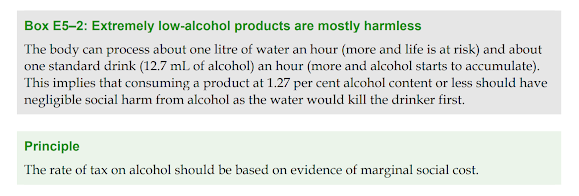
Just exempt the first 1.27% of alcohol from any taxation. 

Why 1.27%? If you drink bathtubs of water that had no more than 1.27% alcohol in it, you'd die of water poisoning before you died of alcohol poisoning. So it makes for a nice cutoff. Ken Henry pointed it out ages ago in a tax review. 

A $45 per litre alcohol excise, across the board, with the first 1.27% exempted, would have the same excise on low alcohol and on 6% beer. It would have a higher excise on wine than is currently the case - the excise in a litre of 14% wine would increase from $3.55 to $5.73. And excise on spirits would come down. $45 would have the thing pivot around current excise on 6% beer. 

Or you could calibrate the thing to pivot at current excise rates on wine. That'd be fine with me too. 

At $37/litre of pure alcohol, the excise on a bottle of 8.9% wine would be about where it is now, excise on a bottle of 14% wine would increase from $3.55 to $4.71, but excise on everything else would drop. 

The current setup is basically war on people who prefer cocktails to wine. I don't know why policy should pick a side in that. I like both.

In other Tax Foundation news, the 2023 International Tax Competitiveness Index is out. NZ dodged a bullet. Labour would have wrecked GST. But we will maintain our Number 1 status. 

Thursday, 5 October 2023

The problems of a tax-free threshold

Jim Rose details the problems with a tax-free threshold for the NZ Taxpayers Union. 

Running one that's revenue-neutral means you have to increase marginal rates further up. Increasing marginal rates to fund inframarginal transfers mightn't make the most sense. And there are better ways of targeting support, if that's what you want to do. 

He writes:

  • The introduction of a tax-free threshold is poorly targeted with many of the intended beneficiaries of the policy already receiving other Government support such as benefits, superannuation and tax credits, which could be increased without spillovers to other higher income groups.
  • The more important tax threshold that needs to be adjusted is the $48,000 income tax threshold that when crossed sees individuals paying a 30% marginal tax rate. Given that a full-time minimum wage worker earns $47,216 annually, they only need to work one additional hour a week or get a 40 cent per hour pay rise in order to be pushed into the higher tax rate. This, combined with the 27% abatement of Working for Families tax credits, can create punishing effective tax rates well above 50%, which has significant impacts on incentives to work.
  • Most of those in incomes low enough to substantially benefit from a tax-free threshold are either in groups where more targeted support can be provided (such as those listed above), are students working part time, or are second earners, again working part-time.
  • The tax-free thresholds proposed by the Greens and Te Pāti Māori, along with the one considered earlier in the year by Labour, would cost more than what is currently spent on Working for Families but spills over to many taxpayers who do not need it, rather than just those the policy intends to help.
 

Thursday, 14 September 2023

Foreign buyer taxes

The problem with taking GST off of food has little to do with the revenue cost of the policy, it's that it's just dumb to begin with. Any gains to households are smaller than those that could be achieved through other instruments, and there's long-term cost to the integrity of the tax system. 

So I won't put time into figuring out the numbers on the revenue cost. The policy's dumb regardless of the number.

I feel the same way about National's proposed tax on foreign house buyers. There's no good reason for imposing the tax; NZ has never had a foreign-buyer problem, it has and continues to have a regulatory-barriers-to-building problem. Make sure it's easy to build and let people build and buy houses if they want to build or buy houses. 

Michael Reddell, Sam Warburton, and Nick Goodall have put the work into reverse engineering National's numbers. Case looks strong enough that I'd expect Castalia to want to be allowed to release its figures in defense. 

But I don't want to burn cycles on figuring out whether the revenue raised by the tax would be closer to $700m/year or $200m/year. The policy's just dumb. 

It looked like National wanted to get its tax threshold adjustments up before PREFU, which meant hanging them on spending cuts would make them hostage to PREFU. 

So they made it standalone, funded by a bundle of other things that seem like generally bad ideas. 

Messing around with depreciation settings for revenue-raising purposes. What, are we supposed to pretend that commercial buildings don't depreciate whenever there's a revenue need? 

Setting a tax on foreign buyers of more expensive NZ houses (maintaining the ban otherwise) that has no good basis and could cause problems around tax treaties - or at least for perceptions of our adherence to their spirit. 

Trying to make foreign-based casino websites pay company tax in NZ on NZ revenues, on threat that they might set some nationwide internet filter blocking access to IP addresses known to be associated with noncompliant foreign betting sites. ISPs should be pipes, not filters. This is obnoxious and dumb. 

It breaks decent internet policy while also being entirely avoidable by a VPN. And when they find the policy unworkable, what are they going to do? Give NZ banks and credit card companies a list of forbidden transaction counterparties? Make them run some giant new AML compliance regime around whether they process transactions to sites that could be foreign gambling? It's all just bad and dumb. 

And remember how National accidentally banned iPredict? Well, now I watch Betfair's markets on the NZ elections. Are they going to break that too? What are they doing to do, assess GST on the house's rake on winnings where those winnings accrue to NZ-based clients? Would Betfair be arsed to keep track of that, or would they sooner block dealings with clients who are unfortunate enough to be stuck with governments stupid enough to try this kind of thing? 

Anyway. Thomas Coughlan asked me for comment on the foreign buyer thing before the new workings were up from Reddell et al. Here's what I told him (he used some, mainly that I'm punting on putting a number on this stuff). 
“Taxing foreign buyers is better than banning them from purchasing houses. New Zealand has an ‘it’s too hard to build’ problem, not a foreign-buyer problem. 

I’d be nervous about making a hard call on National’s revenue numbers on the foreign buyer tax without having access to the underlying workings. If there are a lot of properties that transact in the $10m+ range, it wouldn’t take many such sales to hit the annual revenue figures National has suggested. 500 $10m properties would do it, or 250 $10m properties and 500 $5m properties per year. A single $30m house would bring in as much tax as fifteen $2m houses. But I haven’t the background figures that would tell me whether those are huge numbers, or small numbers, relative to the number of houses in those price ranges – or relative to the number of wealthy people who’d never become NZ tax resident who might be keen to purchase a second expensive home in NZ. Perhaps the current very low dollar would help. $10m NZD is only $5.9m USD! 

I’m less concerned about National’s foreign buyer tax revenue figures than I am about the revenues from the proposed tax on overseas betting agencies. It seems optimistic to assume that a lot of them would choose to comply with NZ registration requirements rather than remind NZ-based customers about how to use a VPN to get around proposed web filters. And I’d far prefer that National fund inflation-adjustments to the income tax thresholds by getting government expenditures even down to the levels that Ardern had promised, pre-Covid, than with taxes that make little sense even if the numbers on them happened to work out.”
Dan Brunskill asked me for comment after he had a copy of the Reddell et al workings. Here's what I told him (he used some of it, mainly me avoiding weighing in in absence of the other side's workings - but man I do not want to adjudicate between those. The policy is too stupid to be worth the cycles.)
"In the 2019 Budget, Labour projected that 2023 Core Crown spending would be 28.8% of GDP. Instead, it is now 32.5%, and expected to drop to 31.4% of GDP by the end of the forecast window – if Labour sticks to its promised fiscal envelope. 

Paring government spending back to what Labour had promised, pre-Covid, would have given National plenty of room for inflation-adjusting the income tax thresholds. Getting long-term Core Crown expenditure, as a fraction of GDP, back down to what Labour had promised in 2019 would free up over twelve billion dollars, or about seven thousand dollars per household. 

Instead, they're embroiled in disputes about the amount of money that would be raised by a tax that never made much sense in the first place. Foreign buyers were never the problem. Regulatory barriers to building were and still are the problem. There was no good case for either banning, or taxing, foreign buyers. A tax is less restrictive than a ban, but hardly makes us seem friendly to foreign investors. And it seems inconsistent with the spirit of our international tax agreements. 

Without having the Castalia workings to see where the difference in figures comes from, it is hard to adjudicate between the two. There seems to be a case worth answering.

But between this problem, the implausibility of raising much revenue from foreign gambling sites, and the undesirability of plugging revenue holes with adjustments to depreciation, National should have been looking harder at the spending side."
The only real tax cut is a spending cut. Will look forward to what National winds up having to say on the spending side. 

National supporters really ought to be able to hope that National could get Core Crown spend down to levels no higher than Ardern promised (as fraction of GDP) in the first Wellbeing Budget. 

Remember the first Wellbeing Budget, 2019? The one that was meant to solve all the world's problems with sunshine and rainbows and unicorns and lots of government wellbeing spending? 


Is it crazy to expect a National-led government to not want to outspend Ardern 2019? Lots of room for inflation-adjusting tax thresholds if they can get back even to what Ardern promised in 2019....

Friday, 8 September 2023

Afternoon roundup

The closing of the tabs...

Wednesday, 6 September 2023

Debating tax

I was a last-minute stand-in for Ruth Richardson at Monday evening's debate at Vic Uni, hosted by the Free Speech Union

The moot: "The tax system is unfair and the wealthy must pay more."

Moots are fun. You don't have to argue what you believe, but it's easier and more convincing if you find angles sufficiently adjacent to true-beliefs. 

Had I been assigned the affirmative, I'd have focused on the regressive effects of fiscal drag, which have put a proportionately higher tax burden on those on lower real income. It's unfair, and rebalancing it would mean a greater proportion of the overall tax burden would fall on those on higher incomes. I'd have worked to frame the moot as being about relative shares. 

I also would have followed the line taken by Danyl McLauchlan on the affirmative that wealth accrued through rent-seeking is illegitimate, that zoning restrictions have created a rich landed gentry, and that those rich pricks work like hell to maintain the restrictions forever. If that's their game, tax every dime of it until they don't want to play anymore. 

But I led for the negative, with Jordan Williams for the Taxpayers Union as second. Max Rashbrooke led for the affirmative. So we were basically typecast. That's fun too. 

I expected Rashbrooke to focus on the good things done by the state, so I had that in mind. And that I have no clue about the actual rules of formal debate - but that Sean Plunkett, as moderator, wouldn't be hewing to such rules anyway. 

My opener:

There’s a lot packed into today’s moot. But it’s important to stay on point.

A tax system is fair to the extent that it treats individuals in equivalent circumstances equally. 

That it is predictable rather than arbitrary in application. 

That one’s proportionate share of the burden of providing public goods reflects one’s proportionate share of the benefits enjoyed thereof. 

And for government spending that is not on public goods, that the beneficiaries of spending are, wherever possible, called on to fund that expenditure. 

Those principles are reasonably agreed. They apply equally well for drawing the revenue necessary to fund a minimalist government, or an expansive one. You can find the roots of them going back at least to Adam Smith, and now in modern public finance textbooks.

Today’s moot doesn’t ask us to judge how large the state should be.

It does not ask us to judge which parts of life’s unfairness, and there are many, should draw government programmes or income support. 

Unfortunately, neither does it ask us about the unfairness created by the state when government makes it impossible to build more homes, to enter markets that are protected for the benefit of incumbents, or when Ministers’ families seem surprisingly adept at drawing lucrative government contracts at our expense.

If the moot asks whether there is any unfairness in the tax system, no tax system could pass that test. 

Smokers and moderate drinkers pay far more in taxes than they ever cost the health system. Everyone else pays slightly less in tax because of it. 

Failure to inflation-index income tax thresholds means that increasing numbers of lower income earners pay higher rates of tax. That is unfair.

Nevertheless, work presented by Treasury in February showed that, as of 2019, the net fiscal impact of the tax and transfer system was no worse for the bottom two deciles than it was in 2010, when the tax thresholds were last set. 

On that analysis, only the top three income deciles pay net tax. 70% of households receive more in transfers and services than they pay in tax. The 39% rate imposed since then will mean even more of the burden falls on those on higher earnings.


And tax issues facing migrants arriving in NZ with an overseas pension are byzantine at best. 

But the moot cannot have asked only whether the tax system is unfair to any trivial degree as that would make for uninteresting debate. We could all agree and go home. 

The moot would have to propose more than some de minimus unfairness, and that that unfairness could usefully be rectified by calling on the wealthy to pay more. Effectively, Revenue Minister David Parker’s tax proposition. 

This side is happy to stand in the negative against that moot. 

My partner, Jordan, will argue that Minister Parker’s proposition – the real underlying moot – violates norms of fairness. That the Prime Minister was correct to pull the plug, last-minute, on comprehensive plans that had been developed to impose a wealth tax. And that had that plug not been pulled, another plug would have been pulled instead – with the economy flowing down the drain as capital fled. 

I will stand against it by arguing a better moot: the tax system is unfair and everyone should pay less.

I do this by advancing one further proposition. If the government cannot demonstrate real value from the taxes it collects from us, it cannot justify even current levels of taxation let alone propose higher taxes on anyone. 

Our moot is not about the size of government. If taxes were raised fairly and government delivered value for that money, and could demonstrate that it could deliver even more value if it had even more money, that would be one thing. It would have to further demonstrate that putting a greater proportion of that burden on the wealthier would be most effective to that end, and perhaps it could if it focused on a land value tax. In that case, maybe today’s moot could be defended. 

But that is not the state we are in. 

Core Crown expenditures, for 2023, were estimated at 32.5% of GDP. In 2019, Treasury forecast that the government’s programme would yield Core Crown expenditure of only 28.8% of GDP. The difference of almost 4 percentage points of GDP amounts to $14.5 billion dollars this year – a substantial increase in the long term tax burden. Almost $7,800 more spending per household. 

And what do we have for it? 

A Jobs for Nature programme designed as a make-work scheme when economic calamity was predicted but that government stuck with – at cost of over a billion dollars. 

Administrative restructuring of the health system and the Polytechs that cost billions of dollars and have worsened outcomes – and may yet sink the Polytechs. 

Hundreds of millions on industrial subsidies to companies for investments that they can perfectly well make on their own. 

Oh – and a new subsidy for companies that make videogames. And how much have we spent on studying a misguided Lake Onslow scheme and various implausible new Auckland harbour crossings? 

And while it’s utterly small potatoes as compared to the overall budget, the complete contempt that Wellington officials have for taxpayers, demonstrated in lavish welcoming ceremonies for incoming CEs and second-tier officials, including flying in the appointee’s family or live-streaming the event, does not bode well for any increase in government revenue. 

If we adhered to the benefit principle of taxation, we wouldn’t be looking at surtaxes on the wealthiest. We’d be looking at surtaxes on the consultants that produce feasibility studies on projects that will never eventuate and reports on restructurings. 

PJ O’Rourke used to say that giving money and power to government is like giving whiskey and car keys to teenage boys. Supporters of this debate’s moot might figure it’s fair to tax the wealthy to fund more of that kind of drunken spree. I think it’s reckless. 

Until the driver’s sobered up, we ought instead to be talking about taking away the keys. The tax system is unfair. Everyone, wealthy or not, should be paying less.  

All fun.

Danyl made probably the most interesting argument of the night. He noted that any government implementing a capital gains tax would bear all of the political costs of doing so, but revenue wouldn't really start accumulating for some time because gains are assessed against a current-year start point. And that makes confiscatory wealth taxes more tempting, because the current government gets to benefit from the predation. 

I never trust the voting in these kinds of debates. It was based on how many people reported having changed their minds, but nothing stops them from voting strategically for the other side at the start of the debate to misreport a flip. In any case, Jordan and I eeked out a narrow win.

Monday, 28 August 2023

Deficits and PREFU

Dan Brunskill got in touch last week asking whether the deficit is a serious problem and what's likely to come at PREFU. He only had room for a short bit of what I'd sent through, so I'll copy the rest here.

Of course it’s a serious problem. 

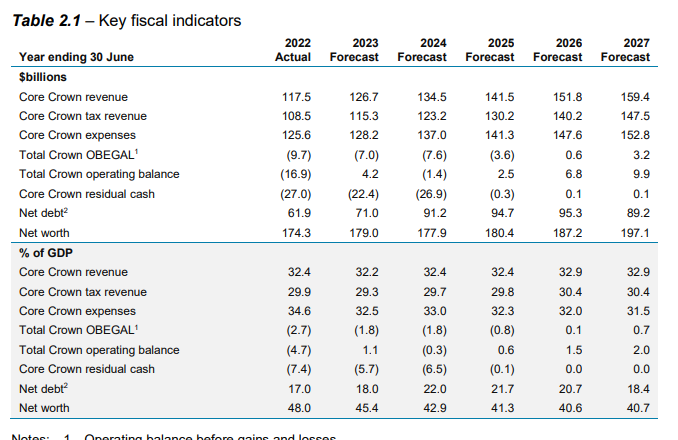
At BEFU 2019, Treasury forecast that the government’s policy programme would have Core Crown tax revenue and Core Crown expenses at 28.8% of GDP in 2023.

At BEFU 2023, Treasury forecast that the actual 2023 figures would be Core Crown tax revenue at 29.3% of GDP and Core Crown expenses at 32.5% of GDP.

PREFU will very likely show a worse track for tax revenue (weakening corporate tax take; weakening GDP forecasts in part on milk prices; finally correcting the error that Treasury made at BEFU in tobacco excise forecasting) but, in the absence of signaled policy changes, a worsening track for expenditures. GDP will be lower than forecast so the denominator gets lower. A worsening economy means more spending on the automatic bits that kick in: benefit payments, hardship grants and the like. So the numerator’s going to be higher.

I haven’t checked Westpac’s numbers but haven’t reason to second-guess them.

If we compare what Labour’s policy package had lined up, as of 2019, for 2023, it’s obvious that the problem isn’t on the revenue side. Revenue is up on the 2019 forecast. It’s spending that’s blown out. Debt and spending had to be part of the Covid response. But Michael Reddell’s shown that NZ’s fiscal response has been huge compared to other countries

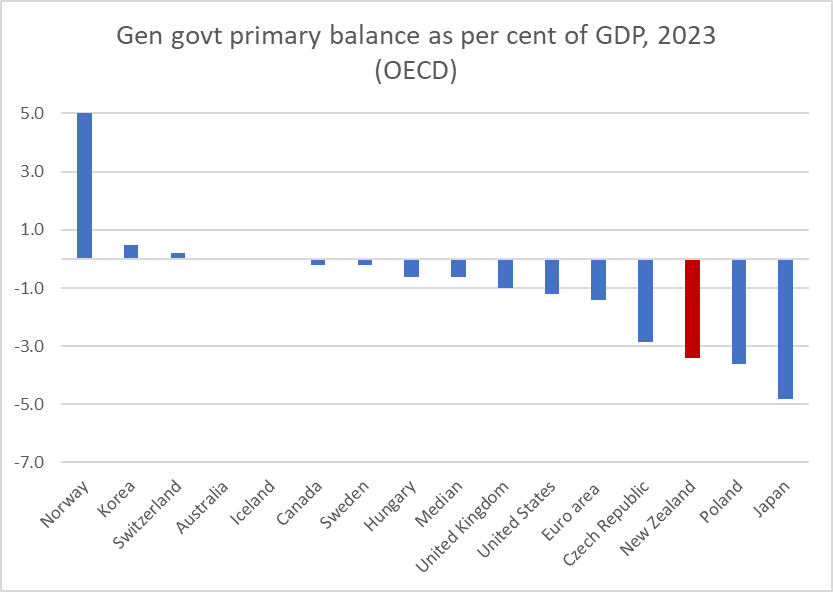
I’ve copied two of Michael’s charts below.


NZ started with a low net debt to GDP ratio. And still has a relatively low net debt to GDP ratio. But our increase in net debt was very large as compared to other countries, and the current general government primary balance is awful. Deficits that large might make sense in a recession, when tax revenues are down and spending on benefits is high. But doing this while the Reserve Bank is meant to be trying to get inflation back down is simply irresponsible.

The OBEGAL path presented at BEFU was not credible.

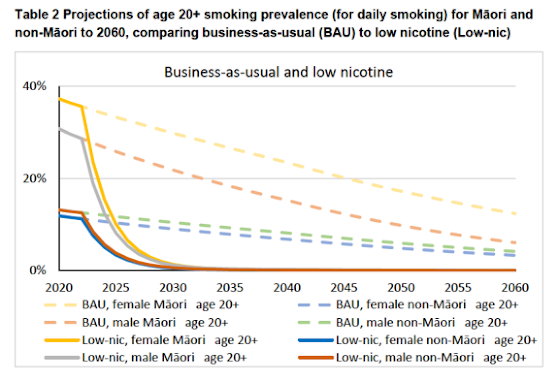
Treasury forgot that the government passed legislation banning the sale of cigarettes with nicotine in them from 1 April 2025; it projected a tobacco excise path that did not change with what amounts to tobacco prohibition. Recall that tobacco excise revenues are on the order of $1.7-$1.8 billion per year, and that the government’s projected surplus for 2026 was on the order of $0.6 billion. The VLNC rules bring forward the sharp drop in tobacco excise revenues that would otherwise have been expected further down the track. Annual tobacco excise revenues after 2026 are likely to be about a billion dollars lower than had been forecast at BEFU, on this single item, unless an incoming government eases the VLNC rules.

At the same time, large spending items like the food in schools programme were forecast to end at the end of 2024. It may be politically challenging for any incoming government to end that spending line in 2024. Treasury has to forecast based on what the government has legislated (barring its amnesia about the effect of tobacco prohibition on tobacco excise revenue). But expenditure paths that depend on decisions that are unlikely to be made may not be all that credible.

On the revenue side, inflation’s pressure on household after-tax disposable income is becoming intolerable. Had the income tax brackets been inflation-adjusted to 2017 levels, the median wage and salary earner’s after-tax income would be almost $1600 higher this year. Inflation-indexing only the bottom tax bracket would give $210 to everyone earning at least $17,000, and even the Job-Seeker benefit is now above that level. Coincidentally, that’s about as much as the government thinks its GST move on fruit and vegetables might save the average household.

At some point, the tax brackets will have to adjust to account for inflation. Failure to do so means more and more people on lower incomes wind up in higher tax brackets. But when it happens, tax revenue will drop.


Tuesday, 8 August 2023

Canadian cautionary tales

My column in the weekend Dom went through Canada's messes in trying to make Google and Facebook subsidise Canadian newspapers. 

The Canadian Government passed Bill C-18, the Online News Act. And now, Canadians wanting to link to a news story on Facebook see this notice instead.

Earlier this week, I interviewed the University of Ottawa’s Professor Michael Geist about the problem. He’s the Canada Research Chair in Internet and E-Commerce Law and has been following C-18 more closely than anyone.

Bill C-18 requires Facebook to pay whenever a user puts up a link to a news site. It is not a cost that Facebook can easily control or predict. It brings potentially unbounded liability.

News links are not particularly valuable to Facebook. If anything, links to news stories encourage users to click away from Facebook rather than stay on the site scrolling through pictures of relatives’ pets and children, and seeing ads delivered through Facebook while they’re there.

Facebook provided plenty of warning that they'd sooner stop allowing user links to news on their platform than be subject to unpredictable and potentially very large payments for allowing such links. 

Willie Jackson says the NZ government will have legislation in the background in case Google and Facebook don't fork over enough money to NZ media companies. It would go to arbitration. 

Listen to his interview, above-linked, and tell me this isn't a tin-pot shake-down. There can be defensible public-goods arguments for subsidising news production, but I just can't see why that ought to be funded by some tax or shake-down of tech companies.  

It sounded like he figures that Google fronting up $50 million might cover it. Who knows. 

But threat of going to arbitration with unknowable potential liability is what's had Meta pull news links in Canada. Listen to my chat with Michael Geist on it, or read his substacks. 

From my column again:

Finally, on August 1, Facebook began pulling the plug. Canadian Facebook users will no longer see news links and content. It affects not just Canadian news sites but also international news for Canadian readers, because the Online News Act can also be read as requiring payment for links to international sites too.

The big newspapers are getting exactly what they asked for. They thought that Facebook was stealing from them by linking. It’s always been nonsense – even the report commissioned by New Zealand’s Ministry of Culture and Heritage found that “digital platforms provide considerable commercial benefits to news firms”.

But, like Trump, they’d convinced themselves that they could have something for nothing. They could have media funding and make Big Tech pay for it. And it’s worked out about as well as Trumps’s wall.

Professor Geist explained that some of the biggest losers from Bill C-18 have been small independent news sites that have relied on links from Facebook for traffic.

I hope that our Minister for Broadcasting and Media, Willie Jackson, is paying attention to Canada’s cautionary tale.

Extorting payments from platforms to meet the Government’s news funding objectives isn’t just thuggish. It also doesn’t work.

 Will look forward to seeing the eventual legislation...

Leave GST alone

New Zealand's Finance Minister keeps sending signals that Labour's preparing to break GST. 

Vernon Small pointed to the GST guff as evidence that we're now deeply into the silly season, where no policy can be expected to make a lick of sense and everything is targeted at the election. 

In any case, I tilted at it in Newsroom last week, just walking again through the reasons that this is an extraordinarily bad idea. 

Stupidity here doesn’t just mean something I don’t like, or something economists in general don’t like. A policy is stupid if it is a terrible way of trying to achieve any reasonable objective, if it is incredibly costly relative to other available alternatives, and if it wrecks other important objectives along the way.

Taking GST off food generally, or from fruit and vegetables, is stupid.

Yes, other countries do not impose GST on food or have other exemptions for worthy-sounding goods or services. But those kinds of holes in GST come at substantial cost. They make it harder for the government to raise revenue for the things voters want, while imposing insane administrative costs.

And remember the excellent old post by Stephen Gordon over at Worthwhile Canadian Initiative on the Nigel Tufnel approach to tax economics

No matter how thoroughly you explain that a consumption tax can be partnered with other taxes and transfers to achieve whatever tax system progressivity someone might want, the idiots will just keep saying, "But GST is regressive." 

The NDP has never been a fan of the GST, and persuading Canadian progressives of its merits is a never-ending variation on the theme of "but these go to eleven:"

Progressive Person: How do we raise the tax revenues we need for the social programs we want to implement without tanking the economy?

Economist: Consumption taxes. Theory says that consumption taxes such as the GST are the least-disruptive way of generating tax revenue, and available evidence appears to be consistent with the theory.

PP: But consumption taxes are regressive!

E: Yes, but we can correct for that using targeted transfers to low-income households so that they aren't worse off; that's what the GST rebate is for. And there will still be lots left over to fund those social programs.

PP: But consumption taxes are regressive!

E: I know. But they introduce fewer distortions than the alternatives, and we can recompense low-income households for their lost buying power.

PP: But consumption taxes are regressive!

E: I'm not disputing that point, but there's more to the analysis than that. Okay, let me explain the effects of the various forms of taxes...

<15 years later>

E: ...and so we see that a consumption tax accompanied by direct transfers to low-income households is the most effective way of generating the tax revenues you want.

PP: But consumption taxes are regressive!

Clearly, that's a dramatisation: in real life, it would never have occurred to a progressive to ask an economist how to finance social programs without tanking the economy. But below the fold, I'll try to summarise once again why the NDP should abandon its traditional antipathy to the GST and start to view it as an important instrument in advancing its agenda.

These kinds of debates ought to remind us just how lucky we are that tax decisions are generally delegated to experts and kept far away from voters. Policy could be so much worse than it actually is. As bad as things are, it could always be far far worse.  

Friday, 19 May 2023

A cigarette burn in the Crown Accounts

Late last year, the government passed legislation intended to sharply reduce the sale and consumption of legal tobacco. 

It is also intended to reduce smoking rates; how good a job it will do with that will depend on how efficient the smugglers get. But it will definitely reduce the sale of legal tobacco that draws excise. 

From 1 April 2025, Very Low Nicotine Concentration rules will be in force. Only authorised tobacco products will be allowed to be sold, and only tobacco products with less than 0.8 mg/g nicotine content will be allowed. That's section 57I of the revised Smokefree Environments and Regulated Products Act.

How much is 0.8 mg/g? 

Sources vary a bit. But this CDC study had mean nicotine concentrations in cigarettes of 19.2 mg/g

So the rules reduce nicotine concentration by over 95%. 

Or to put it a different way, if a normal beer has 5% alcohol, this is like reducing the maximum alcohol content to 0.21%.

The level is low enough that it simply isn't plausible that people would start smoking a lot more, or smoking more heavily, to try to get those last bits of nicotine. It would be like trying to get drunk on 0.21% beer. It just isn't going to happen. As my most favourite footnote in a tax review put it, you'd die of water poisoning well before you ever hit alcohol poisoning at those kinds of concentrations. [I've snipped the bit from the Henry Review as footnote because it's just so good.]

Ok. So we're all on the same page here right? The intended and near-certain effect of the legislation is to cause a very sharp reduction in the number of legally purchased cigarettes that draw excise.

How big will be the effect? Your thumb-suck is as good as mine, and better than mine if you're a smoker. 

But let's think it through.

In the month or two before the new rule comes in, I expect massive stockpiling of real cigarettes. It will give a surge in excise returns for FY 2024/5. Smokers who can afford to will buy however months' supply is plausible to store. An unopened pack probably stays fresh for at least a year, maybe two? 

I do not think it crazy to expect this. Remember that, when government used to do big increases in excise, it would do them on very short notice specifically with intention of avoiding stockpiling of cheap pre-hike cigs. We have two years to prepare for this one. I expect everyone will be fully responding to incentives: there will be ample supply to meet stockpiling needs ahead of the rule change. 

Households will stockpile their own cigs. Many households that smoke will be unable to afford to do so. Others will stockpile real cigarettes on their behalf, and sell them illicitly afterwards - a greyish market competition to the black market that will be out there. 

So FY 2024 will see a surge in tobacco excise returns, much of which will be a bringing forward of excise returns that would have obtained in FY 2025. 

Cigarette sales will plummet in April 2025. 

Some who'd been completely unaware that the change was coming will buy the new cigarettes and learn whether they want to keep buying them. 

As others work through their stockpiles, they'll do the same thing: buy a pack of the new cigarettes, then decide whether to flip to something else or try another pack; try that next pack, decide whether to stick with them or flip to something else. And so on. There'll be incoming new-tryers and a decay function. 

Say that stockpiles are largely run-down by October 2025. We're likely to be at steady state or close to it by April 2026. Some proportion of current smokers will have quit; some will have shifted to vapes; some will have shifted to the black market; and, some will continue to smoke VLNC cigarettes. 

A VLNC cigarette is like a 0.2% beer. What do you think steady state looks like?

Well, MoH gave what it thought the answer was. It's in the 2021 RIS. They expect that it would take two years for smoking rates to drop by 73%. 


If half of that drop is in the first year, then they're expecting the sale of excised cigarettes to drop by about 36% in the first year.

So the Ministry of Health's Regulatory Impact Statement on its SmokeFree intentions had VLNC rules reducing smoking rates by about that amount. We can safely leave aside arguments about black market or whatever else. This is just the Ministry's projections assuming no shifts to the black market, which doesn't pay excise anyway so doesn't matter.

What do you think happens to collected tobacco excise if the legislation works in the way that the Ministry of Health intended and projected?

I think it's safest to assume that tobacco excise revenues, in 2026, after we've gotten through whatever surge and trough was due to stockpiling, are going to be a lot lower. 1 April 2026 is one year after the law comes in. Sales of excised tobacco should be 36% lower at the start of the year and decline by another 36% over the course of the year. 

That means excise will be about half of what it otherwise would have been, for 2026, and much lower after that. 

Recall that Minister Robertson promises a return to fiscal surplus in 2026. OBEGAL of $600 million. 


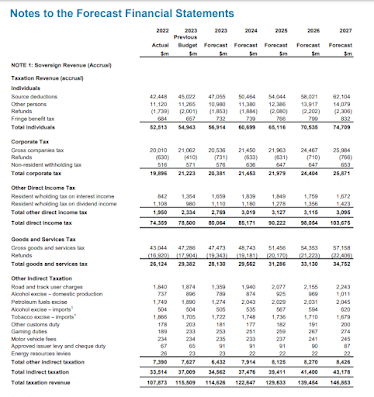
But let's have a look over in the notes. It's always good to look in the notes. And there we see Treasury figuring that the government will collect $1.710 billion in tobacco excise. They've projected a slow and steady decline in tobacco excise revenues, in line with overall declines in smoking rates. They've obviously not factored the VLNC rules into their workings yet. 


And fair enough. It can take a while to run the figures. This has taken me about 20 minutes, but it's very thumb-suck. 

As a rough cut, I expect tobacco excise in 2026 to be about half of what it otherwise would have been. So a drop in revenue of $855 million as compared to forecast. 

So a $600 million 2026 surplus becomes a $255 million deficit. 

This isn't a criticism of the SmokeFree policy. It's the just working through the implications of the policy as promised.

The government is trying to have it both ways here. It wants the reductions in smoking, but wants to pretend there won't be any effects on revenues. It cannot have both. It's one or the other. 

I've called it the cigarette burn in the Crown Accounts.

What really really does puzzle me is why Treasury didn't bother including it as a substantial fiscal risk in BEFU. It's a lot more than the $100 million threshold for inclusion. 

Had a short column over in The Dom on it

Update: ASH had had serious critique of the modelling work on the reductions in smoking with VLNC. The critique makes sense. But then you'd have wanted both the smaller numbers on expected tobacco decline, and commensurate figures on excise, in support of the legislation. Can't pass the legislation claiming massive effects on smoking, then backtrack when running the excise implications, right?

FOOTNOTE

Finally, the bit from the Henry Review. So fun. 


Friday, 17 March 2023

Fringe Benefit Follies

I like the Fringe Benefit Tax.

Other places wind up in all kinds of nonsense by putting tax-preference on things if they're employer provided. It's one reason health care is messier than it should be in the US.

And New Zealand also used to have a similar problem in the era of very high income tax rates and very nice tax-free employer-provided cars. 

Tax reforms in the 80s tidied all that up. If the employer provided you with something valuable, the employer would be liable for paying tax on it as though the employer had paid you salary. 

And what exceptions there have been, as best I'm aware, have been where things get just too messy. 

Employer-provided car parks can be messy.

Suppose you have a commercial office tower with a parking level. You lease out floors to different companies. Some of the leases come with car parks; some don't. Whether you work the price of the carpark directly into the lease charge or as a separate line-item doesn't much matter. Some tenants will put a lot more value on a space than other tenants; you might want to keep things a bit opaque just to be able to better bargain on those margins. 

If a company gives one of those parking spaces to an employee, what's its value for FBT purposes? Tough to say. If you require that the commercial building put separate line items for parking so that you can make it FBTable, all the tenants with car parks will want a higher rate for their floor space lease and a lowballed car park space. Sorting it out would not be simple. What would IRD do: force each commercial building to auction off the spaces among tenants each year? If it's a small building, you're likely to hit collusion issues. 

And what do you do about spaces in places where the market clearing price is plausibly zero? 

Anyway - not straightforward. You could do something like a deemed-value charge on it. It would be a bit messy because a space right in your building might be more valuable than one you'd have to walk some distance to access, but spaces in commercial buildings can also have a lot of disamenities that make them less valuable than others - they're spaces in buildings not designed to be parking garages and so they're even worse to navigate than commercial car parks. 

So far, it's all been in the too-hard basket. I generally expect that when IRD declines to tax something, it's because it's actually hard rather than because they don't like taking peoples' money. 

And at least in principle, the FBT-exemption for employer-provided car parks creates a distortion. Imagine someone who's close to indifferent between driving in to work and taking the bus. If they have to pay for the bus out of after-tax income, but get to pay for the parking spot out of before-tax income (through a bargain with the employer that they'll have a slightly lower salary than otherwise and have a car park), that worker might choose to drive rather than take the bus just because of the tax advantage provided to parking. 

It never seemed likely to be that big of a distortion. In places where parking isn't scarce, the cost of a carpark is so close to zero that it can't matter. In places where parking is scarce, are there really that many people who receive an employer-provided car park? Among those, are there many who would have forgone a company-provided car park if they had to take a bigger salary cut to get one? What's the real effect at the margin here?

The government passed legislation this week exempting a pile of driving-substitutes from FBT. Employer-provided transit passes, e-scooters, scooters, bikes and e-bikes will all be FBT-exempt.

That feels like a fairly substantial inframarginal transfer. How many people use transit to get to work as compared to having an employer-provided car-park in places where car parks are scarce? How many people who walk to work would like to have an e-bike or e-scooter for recreational purposes and will claim that it's for getting to work? 

Remember that the higher-end e-bikes and e-scooters aren't cheap. An employer-provided one will come at a hefty tax discount for higher-earners. And where employer-provided parking is naturally limited by the number of spaces that can be found in a crowded downtown, pretty much anyone on a higher salary who'd be keen on an e-bike could enjoy the discount. 

Suppose you're on the 39% tax rate. An $11,500 e-bike contains $1,500 in GST. You have to purchase it out of after-tax income. So you have to earn an extra $18,850, at the margin, to get the $11,500 to pay for the e-bike. But your employer could give you the same e-bike for $10,000, assuming that the employer can wipe the GST as a business expense (while charging GST on the firm's final output). 

The legislation has provision for setting maximum allowable costs or for setting requirements on the FBT-exempt vehicles. Depending on how this gets set, I'd expect a whole lot of recreational e-bikes purchased for higher-earning employees rather than cash raises - regardless of whether the things get used in commuting. Who's going to monitor? 

And remember that the distortion is greatest for those on the highest incomes. They'll have strongest incentive to request e-bikes out of before-tax earnings. 

It all has me wondering whether it's better to use some deemed rate for employer provided parking, and ditch the new subsidies for employer-provided bikes. 

Or maybe we should get FBT-exemptions for shoes for those who walk to work. I've worn out a hell of a lot of shoes going up and down the Kaiwharawhara bridle path to make the trek into town. 

Thursday, 23 February 2023

Paying for cyclones

Step back in time with me. Six months ago or thereabouts, there was a lot of discussion about the size of the tax cut in the coming budget. Or, rather, the long-overdue inflation adjustment to the tax brackets. Tax bracket creep has been enormous since the brackets were last adjusted over a decade ago. It would be a cut in taxes relative to the large inflation tax increases that otherwise would continue to bake in.

What seemed most likely, at least to me, was that Labour would undo some of the bracket creep in the lower bands, perhaps taking things back to where they were in 2020 before the Big Inflation. But they would hold the 39% rate at $180k. And I expected that National would criticise them for not taking it all the way back to 2017 (ignoring the more minor bracket creep that they allowed to happen after 2011). And I hoped very much that National would pressure for indexing the bands going forward so that this sort of thing wouldn't keep happening. And in some best of all possible worlds, there'd be agreement to index the tax thresholds so the adjustments happen automatically (5% chance?).

Remember that the forecast path for tax revenues was based on no adjustment. It always has to take current policy as being the forward policy. That path continued to have a lot of inflation-driven tax increases built into it. Remember that this isn't just "well, everyone pays 7% more in tax but everything costs the government more". It's that people get pushed into higher marginal tax brackets, resulting in tax increases that outpace inflation - and considerably if you let them accumulate.

This substantial tax increase since 2011 was not voted for by anyone. It was not legislated. It had no democratic deliberation. It just happened, and especially from 2020 when RBNZ went off the hook.

And it will keep happening in the absence of changes.

Flip to the spending side.

As of six months ago, government was only slowly retrenching from continued ludicrous levels of 'Covid' spend. Government issued tons of debt to deal with Covid, and spent it very liberally on non-Covid things. It added to inflationary pressures that the Reserve Bank has to lean against. 

So where did that leave us? A Labour-led government seemed most likely to want to entrench a higher ongoing government-spend proportion of GDP. They'd package a minor inflation adjustment to the indices as a tax cut but maintain things at a level well beyond 2017. They'd cut some of the more ridiculous Covid spend and present a reasonable path back to surpluses but at a higher level of government spend and tax relative to the overall economy. And that's fair enough so long as there's long-term balanced budgets. 

Now what does this have to do with cyclones?

Let's remember standard drill. Here's what I said after the Christchurch earthquakes. And it's the same thing that Paul Krugman said about other similar spend. This is mainline econ stuff. I'll pull-quote Krugman again:
Now suppose a disaster strikes. What this does is raise the marginal benefit of spending on disaster relief. The appropriate response is to move all the marginals to get them in line: spend less on everything else, and also raise more in taxes. So even there it shouldn’t be all offsetting spending cuts.

But wait: even more important, the government can borrow (or, in principle, lend, if it pays off all its debt). So it should balance its budget in present discounted value terms, not year by year. This means that the tradeoffs should include future spending and taxes as well as this year’s spending and taxes. And a natural disaster, like a war, is a temporary event; it should be met largely through higher taxes and lower spending in the future rather than right away, which is another way of saying that it should be paid for in large part by a temporary increase in the deficit.

This isn’t some novel idea, by the way — it’s the standard theory of public finance during war, going all the way back to Ricardo. And the logic of wartime finance applies equally to natural disasters. [emphasis added]
This is the case against temporary levies and surcharges. Unless a government is debt constrained, you want to spread the cost over time. And you want to cover that cost through a combination of higher taxes than you otherwise would have had and lower spending on other stuff than you otherwise would have had

So if it had been the case that Labour was going to inflation-adjust brackets back to 2020, indexing them only going forward would be a tax increase relative to the path we would have had. If it had been the case that Labour was going to have locked in a permanent increase in the relative size of government on non-cyclone stuff, then a reallocation from whatever that stuff would have been toward cyclone is a spending cut. 

The case for an actual tax increase looks awfully weak given the massive increase in real government takings in the leadup to the cyclone. Thomas Coughlan pointed to the numbers yesterday. Core Crown revenues increased from 27.5% of GDP in 2017 to 30.2% of GDP in 2022. 

Core Crown revenues will have to be above the levels we'd had in the mid-2010s for a while - there's Covid debt to pay off. 

But the forecast expenditure track in HYFU had core crown expenses rising from $126 billion in 2022 to $150 billion in 2027. Surely there's room for greater reprioritisation in there, combined with slightly smaller inflation adjustments to tax bands than we otherwise might have had. 

We're still using borrowed money to fund over a billion dollars in discounted road user charges - when there are piles of roads to fix. It's nuts to consider a deadweight-cost-ridden income tax increase when government is using general tax revenue (in the end - it's what pays off debt) to avoid charging road-users for the use of the roads. That subsidy induces a deadweight loss! You're putting thorns in the heart of Baby Pareto! Can't you hear him crying?

Anyway - bottom line:
  1. You spread the cost of this kind of thing over time with higher taxes than you otherwise would have had and less spending on other stuff than you would have had. You don't try to do it with a large temporary tax increase. Unless you're debt constrained. Maintaining low steady-state debt levels matters so that there's room to use debt for these kinds of shocks. 
  2. Views on counterfactual taxation and spending paths will really matter in deciding what's here appropriate. If you think that it is right and proper that government take 30% of GDP as Core Crown revenue forever for regular spend or some amount higher than that, then you'd want a higher tax path to accommodate this spend. But everyone was expecting that government was going to be reversing at least some of the inflation bracket creep. Have views on appropriate size of government changed, or is this opportunistic? Or we all just crazy to expect that there'd have been an inflation adjustment to the tax brackets in May?
  3. A smaller inflation adjustment to the tax thresholds really ought to be able to get the job done. Core crown revenue is about 2.5 percentage points higher, as fraction of GDP, than it was in 2017. If they can't use that increase to get this job done, you've gotta wonder how much work they're actually putting into reprioritising spend. 

Friday, 2 September 2022

Inflation and profits

Stuff's Daniel Smith asked me for comment on profits and inflation, and the case for a windfall tax. I'll copy below what I'd sent through as there wasn't room for all of it in the story. 

A temporary boost to profits is a consequence of high inflation, rather than a cause of it. High inflation, caused by the combination of global and local monetary responses to the pandemic, supply shocks, and high levels of government spending, pushed up consumer prices first. A lot more money was chasing a reduced quantity of goods. Firms responded to that increase in demand by raising their prices and hiring more workers. Consumer prices were bid up first. During that interval, firms earned higher profits in part because real wages had fallen: wages moved up more slowly than the prices of goods and services. Now, firms competing for workers are bidding wages up. As real wages return to normal levels, company profits will return to normal levels. 

It makes no more sense to claim that high profits cause inflation than to claim that low profits cause recessions. They’re linked, but not in that way.

A windfall tax on company profits is an exceptionally bad idea. It is not an appropriate response to high inflation. It would not help consumers. And it would further erode stability in expectations around the policy environment. 

A windfall profits tax winds up hitting exactly the firms that should be expanding. Remember that high current profits, driven in part by continued fiscal and monetary stimulus, will not be uniformly distributed. Companies seeing smaller increases in demand for their goods and services will not be seeing those higher profits. High profits in some sectors give those sectors incentive and ability to expand. They do this, in part, by bidding workers and materials away from other sectors where demand is lower. Their doing so is a good thing – it shifts workers and materials over to areas where their services are far more valuable. The profits provide the signal about where greater output is needed, and the incentive to provide it. A windfall tax blunts that signal while reducing those firms’ ability to bid workers away from areas where their services are less valuable. 

Perhaps more importantly, a surprise windfall tax on company profits would undermine institutional stability and credibility. Companies invest based on expectations about how policy works. Tax policy in particular tries to provide stability by sticking to a principled approach, with any changes being very well signalled through the Generic Tax Policy Process. Whenever that process is undermined, we wind up with bad tax policy and an erosion in institutional stability. If companies expect tax changes at random if they invest here, and particularly expect to be hammered simply for having had higher profits than expected, the burden does not just fall on those companies. It falls on all of us. New Zealand becomes a risker place to do business, so investors will demand a higher return to reflect that higher risk. Capital becomes even more scarce in a capital-poor country, which hits long-term productivity and wages. 

It is a terrible idea.

There is one area where government could and should consider redistribution of excess profits, however. 

For years, the New Zealand Initiative has advocated for a Carbon Dividend, following Canada’s example. There, the vast majority of government revenues from its carbon tax are sent back to Canadian households as a carbon dividend, to help them to make their own adjustments to a higher carbon-price world. The Initiative has advocate that the government similarly direct all of the revenues that the government earns when it auctions ETS credits into a carbon dividend. The government is likely to earn on the order of $1.7 billion dollars this year when it auctions carbon credits. Sent back to households as a carbon dividend, it could provide a family of four with about $1300. We have also recommended that, whenever the government earns higher than normal profits from its 51% stake in the power companies, for example if higher ETS prices wind up feeding through into higher electricity prices overall, those excess dividends should also be put into the pot to provide a higher carbon dividend.

I suppose that I should also have noted that companies already pay higher company taxes when profits are high, that it's particularly odd to look at for New Zealand's oil and gas sectors. Sure, anyone pulling oil out of Taranaki is now getting higher prices for it. But that all falls under a royalty regime. You could argue that that regime should have provision in it for different royalty rates depending on what happens with prices, but that ought to be set out before companies put in their bids for exploration permits. Not ex post. 

Oh - the $1.7b is just the current ETS price multiplied by the number of units to be auctioned this year. It's a thumb-suck and will vary with what happens at the next auctions.