- The UK's drinking guidelines aren't particularly evidence-based.
- Ann Brower's reflections on earthquakes, dangerous buildings, and policy at the Herald is very good.
- John Kay's defence of Beveridge-style targeted social insurance over universal transfers covers the bases well. Maybe I just like it because it's about what I say on the same topic.
- You might like my piece over at NBR on this year's economics Nobel.
- Making sure schools are effective is important. But they aren't miracle workers. The arguments there tie into broader debate around meritocracy and heredity, the subject of a great BBC radio 4 programme earlier this year but that I only just caught.
- Ex National Party comms guy Gwynn Compton is skeptical that Labour will be able to square its coalition promises and its election promises with fiscal realities. It'll be interesting.
Showing posts with label IQ. Show all posts
Showing posts with label IQ. Show all posts
Monday, 30 October 2017
Afternoon roundup
A few worthies from some accumulated closing of the browser tabs:


Friday, 11 November 2016
Fundamental causes
There's a well-known income-health gradient: people who earn more tend also to be healthier and to live longer.
Parts of this could be causal from income to health, as being less able to afford the best medical care can matter, and overcrowded housing is associated with the lower tail of the income distribution. Other parts can be causal from health to income, where poor health means you can't work.
But still other parts could be due to common underlying causes for both health and income. Linda Gottfredson pointed to IQ as a fundamental underlying cause: correcting for IQ knocks back the association between health and income. Higher IQ people know how to follow doctors' orders and also earn more.
Here's the latest from Current Biology:
Parts of this could be causal from income to health, as being less able to afford the best medical care can matter, and overcrowded housing is associated with the lower tail of the income distribution. Other parts can be causal from health to income, where poor health means you can't work.
But still other parts could be due to common underlying causes for both health and income. Linda Gottfredson pointed to IQ as a fundamental underlying cause: correcting for IQ knocks back the association between health and income. Higher IQ people know how to follow doctors' orders and also earn more.
Here's the latest from Current Biology:
Individuals with lower socio-economic status (SES) are at increased risk of physical and mental illnesses and tend to die at an earlier age [1, 2, 3]. Explanations for the association between SES and health typically focus on factors that are environmental in origin [4]. However, common SNPs have been found collectively to explain around 18% of the phenotypic variance of an area-based social deprivation measure of SES [5]. Molecular genetic studies have also shown that common physical and psychiatric diseases are partly heritable [6]. It is possible that phenotypic associations between SES and health arise partly due to a shared genetic etiology. We conducted a genome-wide association study (GWAS) on social deprivation and on household income using 112,151 participants of UK Biobank. We find that common SNPs explain 21% of the variation in social deprivation and 11% of household income. Two independent loci attained genome-wide significance for household income, with the most significant SNP in each of these loci being rs187848990 on chromosome 2 and rs8100891 on chromosome 19. Genes in the regions of these SNPs have been associated with intellectual disabilities, schizophrenia, and synaptic plasticity. Extensive genetic correlations were found between both measures of SES and illnesses, anthropometric variables, psychiatric disorders, and cognitive ability. These findings suggest that some SNPs associated with SES are involved in the brain and central nervous system. The genetic associations with SES obviously do not reflect direct causal effects and are probably mediated via other partly heritable variables, including cognitive ability, personality, and health.
Friday, 26 February 2016
Genetic performance
Identical twins have school test scores that are more closely correlated than scores from fraternal twins.
de Zeeuw et al look at data from the Netherlands Twin Register.
Common environmental effects refer to parts of the environment that are shared by twin pairs. So: home environment, classroom environment (where they're in the same classroom), neighbourhood and the like. Unique environmental effects are things unique to the individual and not shared with the twin.
Results?
de Zeeuw et al look at data from the Netherlands Twin Register.
Even children attending the same primary school and taught by the same teacher differ greatly in their performance. In the Netherlands, performance at the end of primary school determines the enrollment in a particular level of secondary education. Identifying the impact of genes and the environment on individual differences in educational achievement between children is important. The Netherlands Twin Register has collected data on scores of tests used in primary school (ages 6 to 12) to monitor a child's educational progress in four domains, i.e. arithmetic, word reading, reading comprehension and spelling (1058 MZ and 1734 DZ twin pairs), and of a final test (2451 MZ and 4569 DZ twin pairs) in a large Dutch cohort. In general, individual differences in educational achievement were to a large extent due to genes and the influence of the family environment was negligible. Moreover, there is no evidence for gender differences in the underlying etiology.Standard measures of trait heritability look at the variance of outcomes across identical twin pairs (monozygotic) and compares it to the variance of outcomes across fraternal twin pairs (dizygotic). Where identical twins are much closer together than fraternal twins, the trait is more heritable. Where identical and fraternal twins have more similar variances in outcomes, the trait is less heritable.
Common environmental effects refer to parts of the environment that are shared by twin pairs. So: home environment, classroom environment (where they're in the same classroom), neighbourhood and the like. Unique environmental effects are things unique to the individual and not shared with the twin.
Results?
Genetic effects were the most important contributor to individual differences in educational achievement in arithmetic (60–74%), word reading (72–82%) and reading comprehension (54–64%) and for most grades in spelling (33–70%). Common environmental effects had a negligible influence on arithmetic (0–8%), word reading (0–7%) and reading comprehension (1–12%) and a slightly larger influence on spelling (0–29%). Unique environmental effects explained the remaining variance in arithmetic (26–34%), word reading (11–29%), reading comprehension (32–35%) and spelling (30–39%). Genes were also the largest contributor to the variation in the educational achievement test (74%). The heritability differed somewhat between the educational domains measured with this test, i.e. arithmetic (68%), language (67%), study skills (60%) and science and social studies (56%). The common environmental effects were also small for the total score (8%), arithmetic (5%), language (10%), study skills (6%) and science and social studies (21%). Unique environmental effects explained the remaining variance (18–34%).And the necessary policy caveat:
Although the individual differences between children in their achievement across different educational domains are for a large part due to innate differences, one must keep in mind that this heritability does not equal determinism. First of all, the variance between children may be heritable, but the mean can be positively influenced by a school environment of good quality.That's true. But it's also true that if there are systematic differences in students across different schools, you can expect systematic differences in outcomes across schools.
Monday, 2 November 2015
Cooperative smarts
Intelligence can affect income through more than a few channels. Smarter people have better health-related behaviours, so what looks like an income gradient in health might in large part be an intelligence gradient. Smarter people are more likely to go to and complete university degrees, so what looks like a return to education might in large part be a return to intelligence.
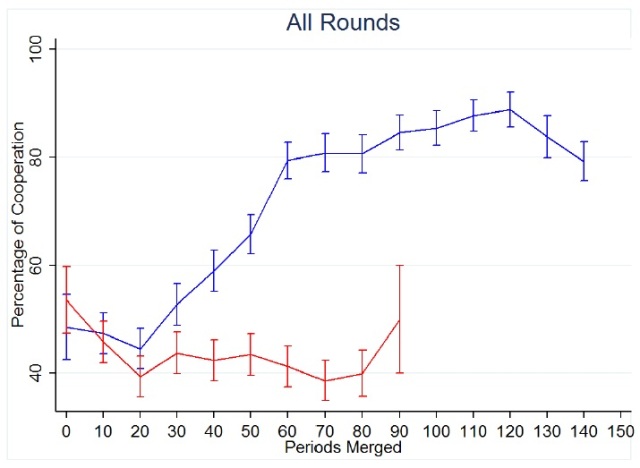
And smarter people are better at playing cooperate in prisoners' dilemma games. I'd had this hanging in my to-read file from a Marginal Revolution assorted-links post for a while and had missed the original paper when it came out. But here's the write-up from Pseudoerasmus:
The post also extols the merits of patience.Intelligence and CooperationIn the workhorse model of (non)cooperation — the prisoner’s dilemma — two players are faced with the decision to cooperate or defect based on a matrix of 4 possible payoff combinations.Suppose a sedentary peasant would end up with $4 (the loot + his own output), if he ambushed and robbed a passing horse-backed nomad, but only $3 if he traded goods with him. The nomad faces the identical decision: $4 with robbing, $3 with trading. If bothdecided to rob, then they would be left with $2 each.It’s set up so that each has a perfectly rational self-interest in robbing the other, but the trading world is clearly better than both-turn-to-robbery world.
It’s well known from simulations of “infinitely repeated” prisoner’s dilemma games that cooperation is best sustained when both players adopt some variety of conditional cooperation strategy: cooperate first, but then copy the other play’s earlier choice. [Axelrod] The gains to both parties are bigger in the long run if both parties behave like that. And, as we have already seen, real people do in practise show an instinct for conditional cooperation.But Proto, Rustichini & Sofianos (2014) demonstrates that in a multi-round Prisoners’ Dilemma experiment with actual human participants and real money, the intelligent are much more likely to practise conditional cooperation.In this experiment, subjects were first administered Raven’s Progressive Matrices, a test which measures fluid intelligence (i.e., not based on knowledge). They were also tested for risk attitudes and the Big Five personality traits. In the end, 130 participants were allocated to two groups — “high Raven” and “low Raven” — and the only statistically significant difference between the two groups was in fluid intelligence. The participants did not know how they were grouped. (Edit: Also relevant: “Participants in these non-economists sessions had not taken any game theory modules or classes.”)Then within each group, different pairs of participants repeatedly played the prisoner’s dilemma — the maximum number of rounds was 10 but a computer decided whether to terminate the session after each round with a fixed probability. There were multiple sessions of these rounds of games.[Blue: high Ravens group, Red: low Ravens group. X-axis: each period represents 10 rounds; Y-axis: the fraction of players cooperating.]The high Raven group not only diverged early from the low Ravens, but also sustained cooperation much longer. There actually wasn’t much difference between the two groups in the early rounds. The difference grew incrementally, in drips and drabs, but in the end, it was substantial. This suggests high Ravens learnt the optimal behaviour from the previous rounds better than the other group.Proto et al. sliced and diced the data in various ways and found that:
- reciprocation is much stronger with the smart: high Ravens are more likely than the low Ravens, to match prior cooperation with cooperation in kind, and punish prior defection with defection in kind;
- reaction times — the time it took to decide whether to cooperate or defect — were shorter and declined faster for the high Ravens;
- the only statistically significant difference in individual participant characteristics was fluid intelligence;
- when the monetary payoffs were manipulated to make cooperation less profitable in the long run, the high Ravens were no more cooperative than the low Ravens — if anything, the low Ravens were slightly more cooperative !
But the most amazing result has to be this: “Low Raven subjects play Always Defect with probability above 50 per cent, in stark contrast with high Raven subjects who play this strategy with probability statistically equal to 0. Instead, the probability for the high Raven to play more cooperative strategies (Grim and Tit for Tat) is about 67 per cent, while for the low Raven this is lower (around 45 per cent).”Understanding the benefits of working together in complex situations — which is what a repeated prisoner’s dilemma simulates — implicitly requires reasoning skills, the ability to learn from mistakes, the ability to anticipate, and accurate beliefs about other people’s motives.The ethical implication: the intelligent are more likely to practise the Golden Rule, and this actually breeds trust; and the less intelligent are more likely to think they can get away with it, and this breeds mistrust. You only need intelligence to generate this difference. You can immediately see where social and civic capital might come from, at least in part.The Proto et al. study replicates and extends a few earlier studies on intelligence and cooperation (Al-Ubaydli et al. 2014; Jones 2008). Moreover, it’s consistent with cross-cultural findings from Public Goods Games as described below.
Tuesday, 28 July 2015
Returns to education and the decline of the Marines
Oh, folks will have fun working out explanations for this one.

Brookings suggests that increasing college graduation rates could be behind it, where a college degree is required to become an officer. The drop in the IQ threshold for getting a college degree then is reflected in the chart above. But that can't be all of it, as the Marines could increase the GCT requirement for admission if the parchment no longer signals ability and if ability really matters more than parchment. It seems more likely that they're just not able to draw as well from higher ability cohorts.
Other plausible candidate explanations, though without data. They're all testable though:

Other plausible candidate explanations, though without data. They're all testable though:
- Higher opportunity costs for high IQ people since the 80s.
- Greater cultural disparaging of the military in elite circles, so it is not aspired to by those of higher ability.
- Decreasing trust in that military is a force for good or really much needed (see the decline as the Soviets turned friendlier under Gorbachev, the levelling off and rise around Gulf War I, and the resumed decline after that).
- Fewer smart but lower income kids needing to use ROTC to afford college with expansions in student aid.
I'd bet on the first and last being most important.
Friday, 5 July 2013
Underlying factors
Three more for the "underlying factors cause most observed correlations" files.
Item the first: Limited numerical ability predicts mortgage default for reasons not related to choice of mortgage contract. That is, those who are bad at maths are more likely to default even after correcting for sociodemographic characteristics and other measures of cognitive ability.
Item the second: Men in the control group who remembered to take their placebos had higher survival rates than those in the control group who forgot to take their placebos.
Item the third (via Jason Collins): those higher in conscientiousness (as measured by survey question answers) also report higher happiness and life satisfaction (also as measured by answers to survey questions).
The first suggests that banks weren't really putting the "can't do maths" clients onto contracts that would ensure default but rather that those who are bad at maths wind up more likely to screw up things like figuring out whether they can afford a given mortgage or structuring their affairs such that they can consistently make their mortgage payments. If banks weren't able to lay off mortgage risk on the government, and if they were legally allowed to do it, they might then wish to administer a maths test for prospective mortgage clients and provide a bit more hand-holding and advice for those who fail.
The second follows on nicely from Linda Gottfredson's work suggesting that IQ is the fundamental underlying health determinant. Sure, low-income predicts poor health. But that's mostly because low IQ predicts low income. And low IQ or low conscientiousness seems likely to predict forgetting to take the full course of prescribed medicines, as well as a pile of other health-relevant behaviours. It also suggests that the returns from quality nurses are higher than the returns from doctors: having better nurses who can help low IQ clients understand and follow doctor's orders seems a worthwhile investment. Or at least one more likely to yield reasonable returns than using income redistribution as health policy.
Remember how Van Halen would hide a line about M&M provision in their concert rider as a way of checking whether the venue had followed all of their stage direction instructions? I wonder whether doctors mightn't add some markers to their prescriptions that aren't themselves necessarily medically useful but that would show up on a patient's tests afterwards to indicate whether they're likely following doctor's orders.
The third perhaps tells us something about links between income and happiness. If conscientiousness drives both income and happiness, then perhaps it isn't low income that's the sole driver of low happiness among those on low income. I'm always a bit sceptical about these studies: questions about conscientiousness are pretty loaded with "how I want to see myself" and social desirability confounds. But there's a reasonably simple (albeit limited) test: if the link between before-tax-and-transfer income and happiness is stronger than the link between after-tax-and-transfer income and happiness, that's pretty consistent with underlying type driving things. We can't rule out underlying type if it goes the other way though as the effects of the change in income could dominate the effects of type.
Item the first: Limited numerical ability predicts mortgage default for reasons not related to choice of mortgage contract. That is, those who are bad at maths are more likely to default even after correcting for sociodemographic characteristics and other measures of cognitive ability.
Item the second: Men in the control group who remembered to take their placebos had higher survival rates than those in the control group who forgot to take their placebos.
Item the third (via Jason Collins): those higher in conscientiousness (as measured by survey question answers) also report higher happiness and life satisfaction (also as measured by answers to survey questions).
The first suggests that banks weren't really putting the "can't do maths" clients onto contracts that would ensure default but rather that those who are bad at maths wind up more likely to screw up things like figuring out whether they can afford a given mortgage or structuring their affairs such that they can consistently make their mortgage payments. If banks weren't able to lay off mortgage risk on the government, and if they were legally allowed to do it, they might then wish to administer a maths test for prospective mortgage clients and provide a bit more hand-holding and advice for those who fail.
The second follows on nicely from Linda Gottfredson's work suggesting that IQ is the fundamental underlying health determinant. Sure, low-income predicts poor health. But that's mostly because low IQ predicts low income. And low IQ or low conscientiousness seems likely to predict forgetting to take the full course of prescribed medicines, as well as a pile of other health-relevant behaviours. It also suggests that the returns from quality nurses are higher than the returns from doctors: having better nurses who can help low IQ clients understand and follow doctor's orders seems a worthwhile investment. Or at least one more likely to yield reasonable returns than using income redistribution as health policy.
Remember how Van Halen would hide a line about M&M provision in their concert rider as a way of checking whether the venue had followed all of their stage direction instructions? I wonder whether doctors mightn't add some markers to their prescriptions that aren't themselves necessarily medically useful but that would show up on a patient's tests afterwards to indicate whether they're likely following doctor's orders.
The third perhaps tells us something about links between income and happiness. If conscientiousness drives both income and happiness, then perhaps it isn't low income that's the sole driver of low happiness among those on low income. I'm always a bit sceptical about these studies: questions about conscientiousness are pretty loaded with "how I want to see myself" and social desirability confounds. But there's a reasonably simple (albeit limited) test: if the link between before-tax-and-transfer income and happiness is stronger than the link between after-tax-and-transfer income and happiness, that's pretty consistent with underlying type driving things. We can't rule out underlying type if it goes the other way though as the effects of the change in income could dominate the effects of type.
Friday, 18 January 2013
Marijuana snark
Ole Rogeberg produced a pretty thoughtful critique of the Dunedin Longitudinal Survey group's finding that marijuana use reduced IQ. And, he subsequently wrote a very nice summary of the dispute, along with some musings about whether scientific progress is helped or hindered by media sniping.
Rogeberg's critique wasn't based on replication of the Dunedin study. Indeed, Rogeberg couldn't even get some summary stats out of the Dunedin group. He writes:
I completely understand the Dunedin Longitudinal folks' unwillingness to share data given the rather high costs they've incurred in collecting it; it just seems off to critique somebody for having used simulations rather than data after you've refused to share the data.
Rogeberg's critique wasn't based on replication of the Dunedin study. Indeed, Rogeberg couldn't even get some summary stats out of the Dunedin group. He writes:
When I originally started looking into this last August, I sent an e-mail to the corresponding author asking for a couple of tables with information on “pre-treatment” differences between the exposure groups. I did not receive this. This is quite understandable, given that they were experiencing a media-blitz and most likely had their hands full. I therefore turned to past publications on the Dunedin cohort to see if I could find the relevant information there.Do read the whole thing. It has a whole lot of very substantial critique. But this bit above piqued my interest. Because he was criticized by Dunedin's Prof Poulton for, well, you read it:
I'm going to take this as Poulton offering to share his data with Rogeberg. Because it would be rather, well, gauche to criticize somebody for failing to use data you've refused to share.Rogeberg said the political approach to cannabis could change depending on whether there was a change in young smokers' IQ because of the drug itself, or because of living conditions.He said his study did not mean the results of the Dunedin study were discredited, but it was fair to say the New Zealand study's methodology was flawed and the results premature.But Professor Richie Poulton, co-author of the Dunedin research, said Rogeberg's data was not taken from real people."Rogeberg's challenge is based on simulations, but we used actual data on 1000 people to carry out the analyses he suggested," he said. [emphasis added]
I completely understand the Dunedin Longitudinal folks' unwillingness to share data given the rather high costs they've incurred in collecting it; it just seems off to critique somebody for having used simulations rather than data after you've refused to share the data.
Tuesday, 5 June 2012
Paternalism - for children, and for the lower orders
Will Wilkinson's excellent post at The Economist highlights the less-than-hidden classist underpinnings of New York's soda ban.
GIGANTIC sugared soft drinks are disgusting. Let's just get that out of the way. Can we also agree that the high-calorie drinks rich people like to consume—red wine, artisanal beer, caramel frappuccinos, mango smoothies with wheatgrass and a protein boost—aren't at all disgusting? At any rate, we yuppie pinot-drinkers know how to look after ourselves. In contrast, the wretched classless hordes, many of them being of dubious heritage, lack the refinement of taste necessary to make autonomy unobjectionable. Those who abuse their liberty, filling the sidewalks of our great cities with repulsive shuffling blimps, can't expect to keep it, can they?But should we really be surprised that paternalistic regulation would be so-targeted? When I work backwards from the set of paternalistic regulations to the most plausible underlying motives, I still wind up with the conclusion I'd reached a year ago:
The behaviours of the lower orders disgust me [the regulator]. They give in to base animalistic sensory pleasures. We need to fix them. Tax and regulate them until they stop being noticeably annoying. We'll say it's for their own good, but we'll really stick to the kinds of things that annoy us. So things like making sure everyone in low decile schools takes a course in basic personal finance so they understand how hire-purchase works and avoid making mistakes with loans, we'll not worry about that. But we'll tax fatty foods because obese people are unpleasant to look at and we'll tax the kinds of booze that the lower orders drink because few things are more unpleasant than poor drunk idiots.It's not implausible that poorer cohorts are more in need of paternalistic regulation than higher income cohorts, if only because of differences in intelligence across cohorts. Do flip back to the linked post and consider the stylized facts there presented:
It still looks to me as though paternalistic regulation is generally targeted at annoying behaviours exhibited by poor people, with sufficient route-arounds to keep the regulations from being too annoying for higher income cohorts. Bloomberg's soda restrictions were just a bit more blatant than most. Again, pulling from last year's post:
- The kinds of alcohol that poor people like get taxed far more heavily relative to overall price than do the kinds of alcohol that rich people like. That isn't unreasonable where the external costs of alcohol use are proportionate to the pure alcohol consumed, but when we start going for minimum price regulation and specific taxes on RTDs, it looks an awful lot more targeted.
- Official government agencies ignore the evidence on the J-curve and instead promote an abstinence only line. The only sense I can make of this is the noble lie: dumb people who'd otherwise be tempted to drink too much if they drink at all shouldn't drink; smart people can see through the official line.
- The war on drugs is more heavily enforced against poor people than against rich people.
- "Fat taxes" would disproportionately hit the poor. The tax will be a greater portion of the purchase price of hamburger meat compared to scotch fillet, even if the fat proportions are identical. And, the higher the proportion of ingredient cost in total price (as opposed to say the input of a high quality chef), the greater will be the the proportionate burden of an ingredient tax. Any bets on whether the price of a McDonald's burger goes up by more, percentage-wise, than a Ruth's Chris steak if we put in a fat tax?
- If the point of an "internality" tax like a fat tax is to force the individual to weigh the health costs to himself when purchasing, we'd need to scale those taxes by income if we think that rich people respond less to a small per unit increase in food prices than do poor people but suffer from similar behavioural anomalies; if we think that smart rich people are already weighing up those costs and compensating with increased exercise, then it doesn't matter that the per unit charge has less effect on the that group.
- There's all kinds of talk of mandating that fast food restaurants prominently display nutritional information and calorie counts. But folks tend to overestimate calorie counts at fast food places and underestimate them at the fancier restaurants where rich people eat. Because everybody expects fast food to have lots of calories.
- Finally, high IQ folks may be better able to route around whatever regulations are put in place.
One of the better critiques of policy prescriptions based on behavioural economics is that it requires the modeller to step out of the system and to assume that he and the regulator who implements his policies are less subject to the problems ascribed to the regulation's subjects. Public choice folks worry that the paternalistic regulators suffer from the same behavioural foibles as everyone else but have worse incentives than do individuals who have to suffer the consequences of their own decisions. But if the implicit model is that all of this behavioural stuff really only applies to those people over there - poor dumb people, then there's good reason to keep the modeller out of the system.Recall that Berggren found very few articles in behavioural economics advancing policy prescriptions consider the possibility that regulators might also be subject to behavioural anomalies; I think it's because of a general assumption that they do in fact sit above those they're regulating.
Friday, 4 May 2012
G determines everything
Ok, maybe not everything. But if you're stuck in prison, and you have a higher IQ, you're less likely to be involved in a violent incident. And, if you're lucky enough to be assigned to a higher-IQ cell-block, you're also safer. Here's the press release and here's the article now published in Intelligence.
This may also give us an alternative potential explanation for why some public schools fare badly on conduct measures.
There is a long tradition of theoretical and empirical research linking intelligence to criminal activity. At the same time, the extant literature has been slow to examine this relationship in other settings. One such setting in which this relationship may also manifest is the prison environment, where knowledge on the determinants of prison misconduct has important implications for prison management and security. Drawing from a representative sample of inmates from a large Southern state in the US, the current study presents the first assessment of the relationship between intelligence and prison misconduct. The effect of intelligence, measured via the WAIS-R, on violent prison misconduct is analyzed controlling for inmate and prison-level factors. Results indicated that the individual's IQ, as well as the average IQ of the prison unit, was significantly and negatively related to violent prison misconduct. Implications and directions for future research are highlighted.Here's the main result:
A one standard deviation increase in IQ score (as compared to other inmates within the same prison unit) was associated with a ten percent reduction in the odds of committing violent misconduct.
...average IQ of the prisoners within each of the 30 different prison units was found to have a significant effect on the likelihood of an inmate committing violent misconduct. Simply stated, individuals housed in a unit with a higher average IQ score were significantly less likely to engage in violent misconduct.Another fun fact from the study: mean IQ in the inmate sample is 90 as compared to 100 in the national sample. People who try to estimate the social costs of alcohol-related crime by extrapolating from non-inmate average wage rates are massively overstating the potential earnings of the prison cohort.
This may also give us an alternative potential explanation for why some public schools fare badly on conduct measures.
Tuesday, 6 March 2012
Grow for it!
New Zealand, population 15 million. That's the target for 2060 in a new NZIER working paper making the case for substantial New Zealand population growth.
New Zealand is shifting immigration priorities to de-emphasize the family route and pull in migrants from higher up the income ladder. TVHE reminds us of the harm we do to poor foreigners abroad by such moves; we also do harm to ourselves to the extent that lower skilled workers are complements to high skilled labour - I'd certainly appreciate lower-cost domestic help.
The best counterargument is that there are potential external costs from lower-skilled immigration if we expect that income correlates with intelligence, intelligence is heritable, and intelligence matters for the long-term quality of policy in a democratic system and for overall productivity. Here's Garett Jones on how IQ matters.
So it's not crazy on the face of it to try to encourage high skilled immigration to New Zealand if we care about outcomes here rather than overall global welfare (I care about the latter, but that's me). But I would note that income will be a poorer proxy for IQ or skill differences if we're looking at individuals in a pooled international cross-section than within countries. Moreover, there's no real "lump of migrants" beyond which we can't accept more people. Why not make it easier for high income, high skilled people to move here while keeping the current family immigration route?
Potential policy moves that encourage immigration, and especially higher-skilled immigration? First on my list would be immediate permanent residence for any foreign student completing a Bachelor's degree at one of the New Zealand universities. This will not only boost foreign student enrolments (helping to cross-subsidize domestic students) but also provide a nice selection mechanism for those who are most likely to really make a contribution. We could also draw in high skilled American migrants by not losing our comparative advantage in civil liberties and sane copyright legislation.
Complementary to increased immigration would be fixing local land use policy that forces up housing prices, but that's also well worth doing for its own sake.
There's an awfully good case to be made for growth. Ed Glaeser's recent book makes a compelling argument that ICT is far more a complement to than a substitute for density - it makes everything better, but it makes New York better faster than it improves New Zealand. Australia will continue to benefit from agglomeration effects; stagnation relative to Oz fuels out-migration and worsening outcomes. Bill Kaye-Blake says we're doing fine given our distance - and he's right.A population target of 15 million by 2060 (2.5 times that now projected) is not only “feasible”, it is also likely to be sufficient to achieve the benefits from scale. It would allow four main cities with a population of three million or more each. This would foster competition within New Zealand to create conditions amenable to building local firms that can foot it internationally. It would bring New Zealand’s population into close proximity of the Netherlands (but still nowhere near the population density of that country).
This changes the tone of the policy recommendations. It isn’t about claiming that the institutions (the tax system, the science system, the education system) are messed up and need to be fixed. Instead, it is about recognising that we’re pushing this economy uphill and asking what tools might help.I think increased immigration should be on the policy agenda as a tool that can help in that context.
New Zealand is shifting immigration priorities to de-emphasize the family route and pull in migrants from higher up the income ladder. TVHE reminds us of the harm we do to poor foreigners abroad by such moves; we also do harm to ourselves to the extent that lower skilled workers are complements to high skilled labour - I'd certainly appreciate lower-cost domestic help.
The best counterargument is that there are potential external costs from lower-skilled immigration if we expect that income correlates with intelligence, intelligence is heritable, and intelligence matters for the long-term quality of policy in a democratic system and for overall productivity. Here's Garett Jones on how IQ matters.
So it's not crazy on the face of it to try to encourage high skilled immigration to New Zealand if we care about outcomes here rather than overall global welfare (I care about the latter, but that's me). But I would note that income will be a poorer proxy for IQ or skill differences if we're looking at individuals in a pooled international cross-section than within countries. Moreover, there's no real "lump of migrants" beyond which we can't accept more people. Why not make it easier for high income, high skilled people to move here while keeping the current family immigration route?
Potential policy moves that encourage immigration, and especially higher-skilled immigration? First on my list would be immediate permanent residence for any foreign student completing a Bachelor's degree at one of the New Zealand universities. This will not only boost foreign student enrolments (helping to cross-subsidize domestic students) but also provide a nice selection mechanism for those who are most likely to really make a contribution. We could also draw in high skilled American migrants by not losing our comparative advantage in civil liberties and sane copyright legislation.
Complementary to increased immigration would be fixing local land use policy that forces up housing prices, but that's also well worth doing for its own sake.
Saturday, 3 March 2012
Genetics and investment
So, here are three results that demand reading as a set.
First, the new finding: there's a genetic basis for differences in investor behaviour when it comes to the standard behavioural biases that folks find in the lab. They use the Swedish Twin Registry combined with a whack of data that Scandinavian countries seem happy to provide to researchers on individual tax filings. They've eight years of data matching twins (mono and dizygotic) with portfolio characteristics and trading. The difference in the correlation between mono and dizygotic twin pair behaviours identifies the genetic component of trading biases - the standard way of identifying heritability in all kinds of twin studies. Conclusion?
Let's turn to the newly published, but not new to loyal readers, finding that IQ drives both stock market participation and portfolio characteristics. Smarter people are more likely to be in the stock market and are more likely to hold diversified portfolios correcting for education and income.
So, put it all together. Heritable intelligence drives education choices, stock market participation, and behaviour once in the stock market. Some of the heritability estimates that Cronqvist and Siegel are finding (the first paper) are probably working through the IQ channel that Grinblatt, Keloharju and Linnainmaa (the last paper) found. Surprisingly, Cronqvist and Siegel cite earlier work by Grinblatt & Keloharju but miss the more recent piece.
There are papers combining Swedish Twin data with IQ measures; I'd be more confident in findings of heritability of stock market trading characteristics if they were able to sort twins into IQ brackets and show stronger monozygotic than dizygotic inter-twin correlations on trading among those bracketed sets of twins (or otherwise control for IQ). Suppose that IQ predicts education (but with noise) and that IQ predicts trading behaviour (also with noise). The mono vs dizygotic correlation difference that's identifying the genetic component of stock market behaviour could be picking up how IQ is affecting stock market behaviour rather than necessarily picking up an independent additional effect of genetics on behavioural biases. I'm not sure that controlling for education does a fantastic job in fixing that. I sure wouldn't throw away the Conqvist results on the basis of this, but as the IQ data is there, it's worth checking. Education isn't mediating the effects of genetics, on this account, because education is caused by heritable IQ. My econometrics aren't strong enough to say that for sure, or at least I haven't written out the model to check it.
Thanks to Robin Harrison and Seamus for a quick chat on econometrics; errors all mine as always.
First, the new finding: there's a genetic basis for differences in investor behaviour when it comes to the standard behavioural biases that folks find in the lab. They use the Swedish Twin Registry combined with a whack of data that Scandinavian countries seem happy to provide to researchers on individual tax filings. They've eight years of data matching twins (mono and dizygotic) with portfolio characteristics and trading. The difference in the correlation between mono and dizygotic twin pair behaviours identifies the genetic component of trading biases - the standard way of identifying heritability in all kinds of twin studies. Conclusion?
We find that a long list of investment biases, e.g., the reluctance to realize losses, performance chasing, and the home bias, are "human," in the sense that we are born with them. We base this conclusion on empirical evidence that genetic factors explain up to 50% of the variation in these biases across individuals. The psychological mechanisms behind the investment biases have apparently survived natural selection over hundreds of thousands of years, presumably because they maximize (or in a hunter-gatherer society used to maximize) the likelihood of human survival and reproduction (e.g., Rayo and Becker (2007) and Brennan and Lo (2009)). But in our current society, and when applied in the domain of investments, they may not always be appropriate.They also find that education does little to attenuate the effects of genetics on observed biases. Now, why might that be? Their method looks at the difference between monozygotic and dizygotic twins. But intelligence is also strongly heritable - the second (very old) finding. The linked meta-study puts heritability of intelligence at around 0.8 and up from age 18 onwards. Now, does IQ have any effect on stock market behaviour?
Let's turn to the newly published, but not new to loyal readers, finding that IQ drives both stock market participation and portfolio characteristics. Smarter people are more likely to be in the stock market and are more likely to hold diversified portfolios correcting for education and income.
So, put it all together. Heritable intelligence drives education choices, stock market participation, and behaviour once in the stock market. Some of the heritability estimates that Cronqvist and Siegel are finding (the first paper) are probably working through the IQ channel that Grinblatt, Keloharju and Linnainmaa (the last paper) found. Surprisingly, Cronqvist and Siegel cite earlier work by Grinblatt & Keloharju but miss the more recent piece.
There are papers combining Swedish Twin data with IQ measures; I'd be more confident in findings of heritability of stock market trading characteristics if they were able to sort twins into IQ brackets and show stronger monozygotic than dizygotic inter-twin correlations on trading among those bracketed sets of twins (or otherwise control for IQ). Suppose that IQ predicts education (but with noise) and that IQ predicts trading behaviour (also with noise). The mono vs dizygotic correlation difference that's identifying the genetic component of stock market behaviour could be picking up how IQ is affecting stock market behaviour rather than necessarily picking up an independent additional effect of genetics on behavioural biases. I'm not sure that controlling for education does a fantastic job in fixing that. I sure wouldn't throw away the Conqvist results on the basis of this, but as the IQ data is there, it's worth checking. Education isn't mediating the effects of genetics, on this account, because education is caused by heritable IQ. My econometrics aren't strong enough to say that for sure, or at least I haven't written out the model to check it.
Thanks to Robin Harrison and Seamus for a quick chat on econometrics; errors all mine as always.
Thursday, 14 April 2011
Too many people?
Bryan Caplan's new book tries to convince middle to upper income folks to have more kids. The kind of folks who are holding back because they reckon that they can't afford the time investment. Caplan argues that kids don't need to be as big a time sink as folks think - since the marginal effect of parental effort on kid outcomes is very low, why not just have fun with your kids instead?
It's a reasonably convincing argument. It won't change the equilibrium size of our household as we don't think we can afford the additional childcare expenditures and we'd likely need a bigger house. And if your consumption bundle requires family trans-Pacific travel, additional kids are definitely not low marginal cost.
But I've been most surprised at one of the more common lines of critique he's been getting in comments. Here's a representative selection.
From NPR:
Even if you want to come down on the side of the folks freaking out about population, middle to upper class Americans having more kids is hardly the cause of any problems. It's far more likely rather to be a solution .
.
Caplan's talking to Trevor and Carol, the couple who hesitated too long and had no kids, not to Clevon, whose great great great grandkids wind up starring in "Ow My Balls!" It's mildly insane to think that his argument, directed as it is, does harm by contributing to overpopulation.
The more kids Bryan and Corina have, the better for everyone else.
Will Wilkinson's critique misses the mark as well, and more widely if you consider just how damned good he is on everything else.
tries to convince middle to upper income folks to have more kids. The kind of folks who are holding back because they reckon that they can't afford the time investment. Caplan argues that kids don't need to be as big a time sink as folks think - since the marginal effect of parental effort on kid outcomes is very low, why not just have fun with your kids instead? It's a reasonably convincing argument. It won't change the equilibrium size of our household as we don't think we can afford the additional childcare expenditures and we'd likely need a bigger house. And if your consumption bundle requires family trans-Pacific travel, additional kids are definitely not low marginal cost.
But I've been most surprised at one of the more common lines of critique he's been getting in comments. Here's a representative selection.
From NPR:
Boy, what an appropriately named book. I'm amazed that with dwindling natural resources your show would promote the selfish (and environmentally irresponsible) act of having more than two children in a family. That makes me one of a very significant minority, but I don't think it's something to brag about in the current environment. At some point, societies are going to have to address the spread of humans is having on the planet--not unlike a virus.128 people "recommended" this comment over at the New York Times:
There are great reasons to have fewer children, or none. Overpopulation, for one--and it's behind so many of the other social problems we have. ...I didn't see any such comments over at the Wall Street Journal.
Even if you want to come down on the side of the folks freaking out about population, middle to upper class Americans having more kids is hardly the cause of any problems. It's far more likely rather to be a solution
.Caplan's talking to Trevor and Carol, the couple who hesitated too long and had no kids, not to Clevon, whose great great great grandkids wind up starring in "Ow My Balls!" It's mildly insane to think that his argument, directed as it is, does harm by contributing to overpopulation.
The more kids Bryan and Corina have, the better for everyone else.
Will Wilkinson's critique misses the mark as well, and more widely if you consider just how damned good he is on everything else.
Economists generally begin from the assumption that we’re rational decision-makers who do the best we can to achieve our aims given the constraints we face. In Mr. Caplan’s previous book, “The Myth of the Rational Voter,” he lays out an elaborate theory of “rational irrationality” in order to explain how it is possible for voters to act on irrational beliefs about politics and policy without having to abandon the economist’s foundational rationality assumption. But Mr. Caplan offers us no analogous theory of the rationally irrational mother. He simply begins with the ad hoc hypothesis that mothers are forgoing body-reconfiguring pregnancy, excruciating childbirth and the massive time-cost of additional children (which women disproportionately shoulder) not because they are rational beings taking into full account the manifold considerations relevant to profoundly life-shaping choices, but because they are in error about the power of parenting to shape “adult outcomes.” I like it better when Mr. Caplan reasons like an economist.All that is required for Caplan's argument to hold is that parents largely misattribute good outcomes to high parental effort when high parental effort generally is confounded by good genes. The misattribution leads to overestimation of the amount of effort required for good outcomes and consequently leads parents to perceive the marginal effort cost of acceptable quality children as being higher than it really is. If the amount of effort needed for good outcomes is really lower than folks think, at least some of those people will be having fewer than their optimal number of children. Caplan's not trying to convince folks like Will to have children - best evidence suggests he sees them as a bad rather than a good; rather, he's trying to convince the folks who already like kids and are waivering about having one (another) because of the costs.
Monday, 4 April 2011
Genetic egalitarianism
Heritability of income-relevant traits is an argument for redistribution, says Karl Smith.
I'm reasonably convinced that genetics (and don't forget the epigenome either - please click the link, it is awesome) matters a whole lot in affecting outcomes. But I'm less convinced on the normative implications.
In Smith's world, behind the Veil we don't know whether we'll be born with good or bad genes, where good and bad are defined relative to their correlation with generalized good outcomes (income, success, happiness) for the eventual kid. Don't scoff: IQ is highly heritable and so too seem "Big 5" personality traits like conscientiousness and neuroticism (see here too); the three together are kinda important in affecting outcomes. Consequently we agree to some kind of redistribution that's ex ante a decent insurance deal for all the precorporeal spirits. Or at least that's how I parse his argument -- too much Rawls and Buchanan perhaps. Smith says that insuring against bad genetic outcomes doesn't work because they're "the ultimate pre-existing condition".
I'll quibble first, but only minorly, with the insurance argument. I can't see any particular reason why insurance markets couldn't exist in which prospective parents would buy policies providing big payouts in case of really bad genetic outcomes. But I can only see that working against bad random draw outcomes, not against bad "your parents both have low quality genes and so you're likely to too" outcomes.
My bigger worry is that if there's any kind of elasticity of childbirth with respect to income, the Veil argument becomes far more ambiguous. Behind the Veil, you get to choose between two worlds. In World A, you've a shorter wait to be born but you're more likely to be born with worse genes. In World B, you'll have to wait longer to be born but you're more likely to be born with better genes.
World A is Karl's with genetic egalitarian redistribution. Couples with good genes have fewer kids relative to World B - tax rates are high and these couples follow strategies of only having as many high-investment kids as they can afford. Couples with poor genes also follow strategies of only having as many kids as they can afford, but each child gets a rather smaller investment of parental resources. More kids are born into poor-gene families in World A.
World B has far less redistribution and consequently more kids born into good gene families.
Behind the veil, you get to choose whether you want to be in World A or B. I don't think the answer's as clear as Karl's story would make out, probably because he didn't frame it this way. But whenever we're considering policies that have potentially large effects on population composition, I have a hard time not putting things into a contractarian Veil framework. In the static one-shot world, Karl's right. But I don't think he is if we're in a more dynamic multi-generational game where population composition varies across states.
Our world is closer to A than it is to B. Were we in World B, my family's taxes would be lower and we could afford domestic help and a third child. Instead, the resources that would have funded a third child for us are transferred to pay for the fourth and fifth children of some other family whose optimal per-child investment is rather lower. Maybe that's optimal in some static sense. But the Flynn Effect is slowing. And the long term consequences of reversal aren't pretty.
Update: Eli Dourado reminds us that even absent the static case is less than certain: we can't be sure that the marginal utility of income is higher for lower income folks. While we normally are pretty safe in assuming declining marginal utility of income within persons, it's plausible that the characteristics that give rise to high earning ability also enable greater appreciation of the fruits of that income: in other words, there's the potential for increasing marginal utility of income when viewed in the cross section. I'd disagree if the low income person is around subsistence level and would be agnostic thereafter - I don't feel qualified to make interpersonal utility comparisons.
I'm reasonably convinced that genetics (and don't forget the epigenome either - please click the link, it is awesome) matters a whole lot in affecting outcomes. But I'm less convinced on the normative implications.
In Smith's world, behind the Veil we don't know whether we'll be born with good or bad genes, where good and bad are defined relative to their correlation with generalized good outcomes (income, success, happiness) for the eventual kid. Don't scoff: IQ is highly heritable and so too seem "Big 5" personality traits like conscientiousness and neuroticism (see here too); the three together are kinda important in affecting outcomes. Consequently we agree to some kind of redistribution that's ex ante a decent insurance deal for all the precorporeal spirits. Or at least that's how I parse his argument -- too much Rawls and Buchanan perhaps. Smith says that insuring against bad genetic outcomes doesn't work because they're "the ultimate pre-existing condition".
I'll quibble first, but only minorly, with the insurance argument. I can't see any particular reason why insurance markets couldn't exist in which prospective parents would buy policies providing big payouts in case of really bad genetic outcomes. But I can only see that working against bad random draw outcomes, not against bad "your parents both have low quality genes and so you're likely to too" outcomes.
My bigger worry is that if there's any kind of elasticity of childbirth with respect to income, the Veil argument becomes far more ambiguous. Behind the Veil, you get to choose between two worlds. In World A, you've a shorter wait to be born but you're more likely to be born with worse genes. In World B, you'll have to wait longer to be born but you're more likely to be born with better genes.
World A is Karl's with genetic egalitarian redistribution. Couples with good genes have fewer kids relative to World B - tax rates are high and these couples follow strategies of only having as many high-investment kids as they can afford. Couples with poor genes also follow strategies of only having as many kids as they can afford, but each child gets a rather smaller investment of parental resources. More kids are born into poor-gene families in World A.
World B has far less redistribution and consequently more kids born into good gene families.
Behind the veil, you get to choose whether you want to be in World A or B. I don't think the answer's as clear as Karl's story would make out, probably because he didn't frame it this way. But whenever we're considering policies that have potentially large effects on population composition, I have a hard time not putting things into a contractarian Veil framework. In the static one-shot world, Karl's right. But I don't think he is if we're in a more dynamic multi-generational game where population composition varies across states.
Our world is closer to A than it is to B. Were we in World B, my family's taxes would be lower and we could afford domestic help and a third child. Instead, the resources that would have funded a third child for us are transferred to pay for the fourth and fifth children of some other family whose optimal per-child investment is rather lower. Maybe that's optimal in some static sense. But the Flynn Effect is slowing. And the long term consequences of reversal aren't pretty.
Update: Eli Dourado reminds us that even absent the static case is less than certain: we can't be sure that the marginal utility of income is higher for lower income folks. While we normally are pretty safe in assuming declining marginal utility of income within persons, it's plausible that the characteristics that give rise to high earning ability also enable greater appreciation of the fruits of that income: in other words, there's the potential for increasing marginal utility of income when viewed in the cross section. I'd disagree if the low income person is around subsistence level and would be agnostic thereafter - I don't feel qualified to make interpersonal utility comparisons.
Thursday, 10 February 2011
The poor aren't like us
I enjoyed Caplan and Beaulier's paper when it first came out; I'm glad to see it now getting the attention it always deserved.
Their argument (my paraphrase: read the whole paper):
And, it seems that advocates of paternalism implicitly accept a lot of the Beaulier/Caplan argument. Think about the set of paternalistic interventions folks [not Beaulier/Caplan] currently advocate. Work backwards from the regulations to the premises underlying them. Would this summary be too far out?
If we're in that world, why not just run a national IQ test? Everyone who scores over some score, say 115, gets a card confirming that they're exempt from all the paternalistic regulations. Everyone who scores under a different score, say 70, gets a tattoo warning that they're forbidden from particular types of consumption and can't sign any contract without a state-appointed advocate's consent. And folks in the middle get nudged.
But that would be very impolitic. Instead, we get sets of regulations that achieve similar purpose but less efficiently. Please note that I endorse neither the regulation above nor the ones described below.
Beaulier replies to one of his critics, a fan of behavioural who didn't like his conclusion:
Their argument (my paraphrase: read the whole paper):
If we take behavioural economics seriously, we've good reason to believe that the anomalies it describes are found primarily among the poor and are exacerbated by the welfare system. Poor people are more likely to exhibit behaviours that reflect more than just high rates of time preference: they demonstrate little ability to foresee the consequences of actions. The poor (and less educated / lower IQ - the two go together) are more likely to be heavy drinkers, to be obese, to smoke, to buy lotto tickets, to take illegal drugs, and to commit even non-economically motivated crimes (theft would not be surprising, but violent crime isn't lucrative). Low IQ amplifies behavioural anomalies. And, the dole makes things worse. If you start out with big self-control problems, you're likely to overestimate your ability to motivate yourself to find work - "I'll go on the dole for now but will look hard for work tomorrow". Absent the income backstop, you'd have to look for work. Worse, if welfare payments are more comfortable than the first year of work, after which work is better as income rises, folks with high discount rates and self-control problems may decide never to leave even though it would be in their long run interest. Consequently, welfare payments may make welfare recipients worse off, contra neoclassical economics.I love this paper and the reactions to it. Not because I'm a fan of behavioural economics. But because it makes explicit some of the unstated motivations for paternalistic policies and takes the logic of behavioural economics to its necessary conclusion. I think it's hard to accept behavioural economics without also putting a lot of weight on the Beaulier/Caplan argument.
And, it seems that advocates of paternalism implicitly accept a lot of the Beaulier/Caplan argument. Think about the set of paternalistic interventions folks [not Beaulier/Caplan] currently advocate. Work backwards from the regulations to the premises underlying them. Would this summary be too far out?
The behaviours of the lower orders disgust me. They give in to base animalistic sensory pleasures. We need to fix them. Tax and regulate them until they stop being noticeably annoying. We'll say it's for their own good, but we'll really stick to the kinds of things that annoy us. So things like making sure everyone in low decile schools takes a course in basic personal finance so they understand how hire-purchase works and avoid making mistakes with loans, we'll not worry about that. But we'll tax fatty foods because obese people are unpleasant to look at and we'll tax the kinds of booze that the lower orders drink because there's fewer more unpleasant things than a poor idiot who's drunk.One of the better critiques of policy prescriptions based on behavioural economics is that it requires the modeller to step out of the system and to assume that he and the regulator who implements his policies are less subject to the problems ascribed to the regulation's subjects. Public choice folks worry that the paternalistic regulators suffer from the same behavioural foibles as everyone else but have worse incentives than do individuals who have to suffer the consequences of their own decisions. But if the implicit model is that all of this behavioural stuff really only applies to those people over there - poor dumb people, then there's good reason to keep the modeller out of the system.
If we're in that world, why not just run a national IQ test? Everyone who scores over some score, say 115, gets a card confirming that they're exempt from all the paternalistic regulations. Everyone who scores under a different score, say 70, gets a tattoo warning that they're forbidden from particular types of consumption and can't sign any contract without a state-appointed advocate's consent. And folks in the middle get nudged.
But that would be very impolitic. Instead, we get sets of regulations that achieve similar purpose but less efficiently. Please note that I endorse neither the regulation above nor the ones described below.
- The kinds of alcohol that poor people like get taxed far more heavily relative to overall price than do the kinds of alcohol that rich people like. That isn't unreasonable where the external costs of alcohol use are proportionate to the pure alcohol consumed, but when we start going for minimum price regulation and specific taxes on RTDs, it looks an awful lot more targeted.
- Official government agencies ignore the evidence on the J-curve and instead promote an abstinence only line. The only sense I can make of this is the noble lie: dumb people who'd otherwise be tempted to drink too much if they drink at all shouldn't drink; smart people can see through the official line.
- The war on drugs is more heavily enforced against poor people than against rich people.
- "Fat taxes" would disproportionately hit the poor. The tax will be a greater portion of the purchase price of hamburger meat compared to scotch fillet, even if the fat proportions are identical. And, the higher the proportion of ingredient cost in total price (as opposed to say the input of a high quality chef), the greater will be the the proportionate burden of an ingredient tax. Any bets on whether the price of a McDonald's burger goes up by more, percentage-wise, than a Ruth's Chris steak if we put in a fat tax?
- If the point of an "internality" tax like a fat tax is to force the individual to weigh the health costs to himself when purchasing, we'd need to scale those taxes by income if we think that rich people respond less to a small per unit increase in food prices than do poor people but suffer from similar behavioural anomalies; if we think that smart rich people are already weighing up those costs and compensating with increased exercise, then it doesn't matter that the per unit charge has less effect on the that group.
- There's all kinds of talk of mandating that fast food restaurants prominently display nutritional information and calorie counts. But folks tend to overestimate calorie counts at fast food places and underestimate them at the fancier restaurants where rich people eat. Because everybody expects fast food to have lots of calories.
- Finally, high IQ folks may be better able to route around whatever regulations are put in place.
Beaulier replies to one of his critics, a fan of behavioural who didn't like his conclusion:
It's all fine and good for people to have serious cognitive challenges and need nudges when the conclusions point towards more government. But, to dare say behavioral econ pushes us towards less welfare and anti-paternalism--in some cases--probably struck a nerve. (Nevermind that we fully embraced behavioral econ in our paper by also saying there may be a range of cases where more paternalism is needed!)I do think Beaulier and Caplan are right that the behavioural literature leads to the kinds of conclusions they're finding. I just don't go in for the behavioural lit: I'm not convinced that behavioural lab findings apply out in the real world where folks have recourse to all kinds of useful heuristics for making decent choices; I'm also exceedingly reluctant to call someone's behaviour irrational when it could well be fully rational in pursuit of a goal that isn't mine. I'm nervous enough about making interpersonal utility comparisons; interpersonal rationality comparisons seem even more of a problem.
Wednesday, 5 January 2011
The dangers of G: Chess edition
Spiegel interviews Magnus Carlsen, the world's top chess player, aged 19.
Tyler Cowen, a youth chess champ, gave it up:
Being terrible at chess, I never faced these sorts of choices.
SPIEGEL: Mr Carlsen, what is your IQ?The whole Carlsen interview is interesting - especially his notes on how technology has changed how young players train. HT: @crampell.
Carlsen: I have no idea. I wouldn’t want to know it anyway. It might turn out to be a nasty surprise.
SPIEGEL: Why? You are 19 years old and ranked the number one chess player in the world. You must be incredibly clever.
Carlsen: And that’s precisely what would be terrible. Of course it is important for a chess player to be able to concentrate well, but being too intelligent can also be a burden. It can get in your way. I am convinced that the reason the Englishman John Nunn never became world champion is that he is too clever for that.
SPIEGEL: How that?
Carlsen: At the age of 15, Nunn started studying mathematics in Oxford; he was the youngest student in the last 500 years, and at 23 he did a PhD in algebraic topology. He has so incredibly much in his head. Simply too much. His enormous powers of understanding and his constant thirst for knowledge distracted him from chess.
Tyler Cowen, a youth chess champ, gave it up:
“Chess is all or nothing, like an addiction” he said. He looks back at players he knew growing up and wonders what more they might have done with their talents if they had spent less time at the board. Meanwhile, those who moved on were able to achieve great things. He points to GM Kenneth Rogoff, Ph.D., for example, who is a leading economist and former director of research at the International Monetary Fund.I think Carlsen's conflating intelligence and focus.
Being terrible at chess, I never faced these sorts of choices.
Thursday, 9 December 2010
Signaling and GRE scores
Bryan Caplan writes:
Back in 1995, I attended an IHS seminar for graduate students. We heard some lectures, practiced our public speaking, and did mock interviews. The last activity was pretty traumatic. It's hard for a second-year grad student to role-play someone who's wrapping up his dissertation.I got exactly the same raking at the same IHS seminar, albeit five or six years later. If I recall correctly, I'd used Robin Hanson's CV as model. Now, his scores are instead on his personal page. So I'm not sure if my memory is wrong, or if Robin's taken the signal.
Part of the process was writing up a mock c.v. - which led to a moment I still remember. One of the students wrote his GRE scores on his c.v. During the denouement, the mock interviewers raked him over the coals:You don't put your GRE scores on your c.v. It's makes you look like a grad student! It doesn't matter how high your scores are. Schools want to hire creative assistant professors - not stellar grad students.Good advice, no doubt. But why is it good advice? As usual, the signaling model sheds a lot of light. If the average candidate who puts his GRE scores on his c.v. is professionally clueless even given impressive scores, it's a bad idea to include them. So only professionally clueless candidates do so, reinforcing the equilibrium.
Thursday, 4 November 2010
Cargo cult reading
Just a reminder that folks ought read with caution arguments of the form
 back to me, and that's cool. But thinking that moving from not-reading to reading to your kids will ensure outcomes commensurate with those of heavily reading kids is cargo cult thinking.
High IQ folks tend to have lots of books in the house and tend to read to their kids 'cause they enjoy it. They have high IQ kids because of assortative mating and intelligence's heritability. Even if they never read a word to their kids, those parents' kids would probably wind up with pretty decent outcomes just from innate IQ and hearing their parents talking: higher IQ folks have a vocabulary range maybe twice or three times the average. And I know I've seen studies suggesting that, if you control for number of books in the house, the amount of reading a parent does with his kid doesn't have much effect on the kid's outcomes.
So then vocabulary at 22 months may predict educational attainment because they've gotten a taste for reading from their parents, because they've inherited good genes from their parents, or a combination of both. Simply looking at differences in mean educational attainment by differences in mean vocabulary at 22 months doesn't tell you much at all about the effect of reading on educational attainment.
Similarly, sorting kids by income and vocabulary scores tells you little about the effect of income on kids' ability if IQ predicts income and if IQ is heritable. The report linked above contains this graph:
 The report notes that some of the effect is mean reversion, but also points to the different slopes as suggestive of the effects of income. An entirely plausible alternative reading is that it's reflecting mean reversion to different means. If it's more likely that high IQ parents have higher income, then a kid from high income parents who tests badly at age 3 is more likely to have had an off day than a kid who presents the same score but who comes from a lower income cohort.
Income may well be doing some of the work here, but ignoring IQ seems a bit odd. Especially since the Millennium Cohort Study included measures of parental educational achievement, as seen in the study of the effects of prenatal maternal drinking that was also based on MCS data. Sounds like there's fodder there for a future honours research project.
- Vocabulary at 22 months predicts educational attainment;
- Reading to kids can help vocabulary;
- Therefore, read to kids to help them in the long run.
back to me, and that's cool. But thinking that moving from not-reading to reading to your kids will ensure outcomes commensurate with those of heavily reading kids is cargo cult thinking.High IQ folks tend to have lots of books in the house and tend to read to their kids 'cause they enjoy it. They have high IQ kids because of assortative mating and intelligence's heritability. Even if they never read a word to their kids, those parents' kids would probably wind up with pretty decent outcomes just from innate IQ and hearing their parents talking: higher IQ folks have a vocabulary range maybe twice or three times the average. And I know I've seen studies suggesting that, if you control for number of books in the house, the amount of reading a parent does with his kid doesn't have much effect on the kid's outcomes.
So then vocabulary at 22 months may predict educational attainment because they've gotten a taste for reading from their parents, because they've inherited good genes from their parents, or a combination of both. Simply looking at differences in mean educational attainment by differences in mean vocabulary at 22 months doesn't tell you much at all about the effect of reading on educational attainment.
Similarly, sorting kids by income and vocabulary scores tells you little about the effect of income on kids' ability if IQ predicts income and if IQ is heritable. The report linked above contains this graph:

Income may well be doing some of the work here, but ignoring IQ seems a bit odd. Especially since the Millennium Cohort Study included measures of parental educational achievement, as seen in the study of the effects of prenatal maternal drinking that was also based on MCS data. Sounds like there's fodder there for a future honours research project.
Monday, 14 December 2009
Genetic distance in war and economics
It turns out that folks kinda hate their genetic neighbours.
Enrico Spolaore was one of the keynote speakers at the Australasian Public Choice Society Meetings in Melbourne last week. I'd not before seen his work on genetic distance, but it's rather interesting.
Genetic distance measures the number of generations back you have to go before two populations share common ancestors. So if two populations diverged only a very short time ago, like the Danes and the English, their measured genetic distance is short; if they diverged a very very long time ago, like the Australian aborigines and the Mbuti Pygmies of Africa, their measured distance is long. While this is related to geographical distance, it's far from perfectly correlated: Canada's Inuit are closer to Tibetans than they are to any of the other Amerindians; the English are closer to the northern Indians than they are to the Lapps (Finish); the Mongols are closer to the Japanese than they are to the Chinese; the Indians of south east India are closer to the Italians than they are to the Thai people or the South Chinese.
Spoloare and Wacziarg find that this measure of genetic distance predicts whether two populations will go to war, after controlling for the usual set of determinants of conflict like geographical proximity, shared borders, income differences, religion, language, and so on. All else equal, the more two populations are genetically proximate, the more likely they are to go to war and the less likely they are to vote together at the UN. If current patterns of war have affected measured genetic distance, then causality may be wrong, but they use genetic distance as of year 1500 as an instrument.
I'd worried that results might be drawn from a few places that have been strategically important going back well before 1500. For example, if the bridge from Africa to Asia Minor via Sinai and Israel has been strategically important for thousands of years and if similar populations have lived around there for a long time, then the correlation of genetic distance and conflict could have things the wrong way round: frequent conflicts in strategic regions bring genetic mixing, and if the regions' strategic importance continues from well prior to 1500 to present, then it wouldn't be that folks want to fight with their genetic neighbours, but folks who fight a lot become genetic neighbours. Controlling just for having a common border or just for geographical distance wouldn't quite cut it. But they find that the effect also holds for country pairs that do not share a border.
Why might we fight more with our nearer than our more distant cousins? Spolaore suggests that genetic closeness makes it more likely that we'd be in conflict over rivalrous resources. I wonder whether we couldn't imagine a pleistocene explanation: if there's a fertility advantage to outbreeding but not too far (the sweetspot between inbreeding depression and outbreeding depression), then our ancestors 90,000 generations back on the Savannah who raided more closely related neighbours would have had a slight advantage over those who raided groups too genetically distant. Run the mechanism for 90,000 generations, and you've a population that's keyed to want to raid folks who are more like them.
In the May QJE, Spolaore and Wacziarg found that genetic distance from the United States explains cross country income differences after correcting for geographical distance, climate, transportation costs, and measures of social distance (historical, religious, linguistic). Again, they argue that genetic distance may be the best measure of "slowly changing genealogically transmitted characteristics, including habits and customs" - the bits of culture we can't adequately otherwise measure. That's certainly possible, and cuts against my evolutionary biology explanation above, mostly because it's hard to come up with an ev bio explanation of why genetic distance from the US would correlate with income differences. The best explanation I'd have would be that it's proxying for differences in average IQ: also somewhat genetic, but at some of the more depressed ends of the scale almost certainly highly environmentally influenced). But that would be a bit of a wash: there are genetically distant places above the US (Hong Kong) and far below the US (Equatorial Guinea) in reported average national IQ. Spolaore's culture explanation seems the more plausible.
Spolaore gave one of the best plenary addresses I've ever seen. If you get a chance to see him give a talk, go.
Enrico Spolaore was one of the keynote speakers at the Australasian Public Choice Society Meetings in Melbourne last week. I'd not before seen his work on genetic distance, but it's rather interesting.
Genetic distance measures the number of generations back you have to go before two populations share common ancestors. So if two populations diverged only a very short time ago, like the Danes and the English, their measured genetic distance is short; if they diverged a very very long time ago, like the Australian aborigines and the Mbuti Pygmies of Africa, their measured distance is long. While this is related to geographical distance, it's far from perfectly correlated: Canada's Inuit are closer to Tibetans than they are to any of the other Amerindians; the English are closer to the northern Indians than they are to the Lapps (Finish); the Mongols are closer to the Japanese than they are to the Chinese; the Indians of south east India are closer to the Italians than they are to the Thai people or the South Chinese.
Spoloare and Wacziarg find that this measure of genetic distance predicts whether two populations will go to war, after controlling for the usual set of determinants of conflict like geographical proximity, shared borders, income differences, religion, language, and so on. All else equal, the more two populations are genetically proximate, the more likely they are to go to war and the less likely they are to vote together at the UN. If current patterns of war have affected measured genetic distance, then causality may be wrong, but they use genetic distance as of year 1500 as an instrument.
I'd worried that results might be drawn from a few places that have been strategically important going back well before 1500. For example, if the bridge from Africa to Asia Minor via Sinai and Israel has been strategically important for thousands of years and if similar populations have lived around there for a long time, then the correlation of genetic distance and conflict could have things the wrong way round: frequent conflicts in strategic regions bring genetic mixing, and if the regions' strategic importance continues from well prior to 1500 to present, then it wouldn't be that folks want to fight with their genetic neighbours, but folks who fight a lot become genetic neighbours. Controlling just for having a common border or just for geographical distance wouldn't quite cut it. But they find that the effect also holds for country pairs that do not share a border.
Why might we fight more with our nearer than our more distant cousins? Spolaore suggests that genetic closeness makes it more likely that we'd be in conflict over rivalrous resources. I wonder whether we couldn't imagine a pleistocene explanation: if there's a fertility advantage to outbreeding but not too far (the sweetspot between inbreeding depression and outbreeding depression), then our ancestors 90,000 generations back on the Savannah who raided more closely related neighbours would have had a slight advantage over those who raided groups too genetically distant. Run the mechanism for 90,000 generations, and you've a population that's keyed to want to raid folks who are more like them.
In the May QJE, Spolaore and Wacziarg found that genetic distance from the United States explains cross country income differences after correcting for geographical distance, climate, transportation costs, and measures of social distance (historical, religious, linguistic). Again, they argue that genetic distance may be the best measure of "slowly changing genealogically transmitted characteristics, including habits and customs" - the bits of culture we can't adequately otherwise measure. That's certainly possible, and cuts against my evolutionary biology explanation above, mostly because it's hard to come up with an ev bio explanation of why genetic distance from the US would correlate with income differences. The best explanation I'd have would be that it's proxying for differences in average IQ: also somewhat genetic, but at some of the more depressed ends of the scale almost certainly highly environmentally influenced). But that would be a bit of a wash: there are genetically distant places above the US (Hong Kong) and far below the US (Equatorial Guinea) in reported average national IQ. Spolaore's culture explanation seems the more plausible.
Spolaore gave one of the best plenary addresses I've ever seen. If you get a chance to see him give a talk, go.
Wednesday, 18 November 2009
Vitas
We're not hiring this year, but if we were, and if I were on the committee, and if I saw a vita that were the Econ equivalent of the one below, I would move heaven and earth to get the applicant an interview at the AEAs. I'd put high odds that one or two folks round the traps would see this kind of vita as being a reason to rule a candidate out. It would be highly interesting if some job market candidate next year were to do a randomized trial on whether this kind of vita or the generic sort landed more AEA interviews. Highly interesting 'cause the costs don't fall on me and I'd want to know the results. If there weren't so many veto players in hiring processes, the strategy would induce a nice separating equilibrium.
As a side note, I can imagine how I'd come up with scores on strength, dex, con, intelligence: get measures of strength, dexterity, stamina and IQ, get some population averages, then map them to the 3d6 distribution. I have no clue how wisdom could be measured in the real world; charisma would similarly be tough.
I don't buy the guy' scores if he's using a standard early edition set of D&D rules. 3d6 gives an average of 10.5 and sd is 3. So he's claiming to be >4sd above average - IQ 162.5 - in a part of the distribution you can't get by standard rolls. Of course, I'd expect any PhD-bearing candidate in Econ to score at least a 19 INT; I'd also expect to see some GRE scores to back that up. My GRE scores gave me a D&D INT score that rounds to 21, if 1998 GREs are still a reliable predictor. The rest of my scores would be much much worse.
Could be fun over Christmas...the D&D Vita. Publications and such as Inventory...
 I'd put high odds that one or two folks round the traps would see this kind of vita as being a reason to rule a candidate out. It would be highly interesting if some job market candidate next year were to do a randomized trial on whether this kind of vita or the generic sort landed more AEA interviews. Highly interesting 'cause the costs don't fall on me and I'd want to know the results. If there weren't so many veto players in hiring processes, the strategy would induce a nice separating equilibrium.
As a side note, I can imagine how I'd come up with scores on strength, dex, con, intelligence: get measures of strength, dexterity, stamina and IQ, get some population averages, then map them to the 3d6 distribution. I have no clue how wisdom could be measured in the real world; charisma would similarly be tough.
I don't buy the guy' scores if he's using a standard early edition set of D&D rules. 3d6 gives an average of 10.5 and sd is 3. So he's claiming to be >4sd above average - IQ 162.5 - in a part of the distribution you can't get by standard rolls. Of course, I'd expect any PhD-bearing candidate in Econ to score at least a 19 INT; I'd also expect to see some GRE scores to back that up. My GRE scores gave me a D&D INT score that rounds to 21, if 1998 GREs are still a reliable predictor. The rest of my scores would be much much worse.
Could be fun over Christmas...the D&D Vita. Publications and such as Inventory...
Friday, 6 November 2009
IQ and stock market participation
The Finnish army, compulsory service, tests all males' intelligence at age 19 or 20.
Grinblatt, Keloharju and Linnainmaa somehow got the individual test results from all exams from 1982 through 2001 inclusive. And tied it to Finnish tax administration data, an address data set, the Finnish Central Securities Depository Registry (which has records on all Finnish households' portfolios and trades), and census data to measure the effect of IQ on stock market participation, controlling for education and income.
They find a nice monotonic relationship between IQ and stock market participation. The effect of being in the lowest ten percent of the IQ distribution is fifty percent larger than the effect of being in the lowest income decile. Running some decompositions of the independent effect of IQ as compared to wealth (because IQ can operate directly on participation and indirectly by influencing wealth creation which then also prompts participation), they find that IQ also works substantially through wealth, income and education; consequently, prior studies that included these as independent variables without including IQ overestimate the effect of those variables.
And, low IQ correlates with a more poorly diversified portfolio.
Finally, they then run some IV using a sibling's IQ as instrument, which then lets them also say something about female stock market participation.
I'm amazed they were able to get this dataset together. Individual level data combining IQ, income tax records and all stock market activity...fodder for a dozen more papers in there at least. They conclude:
HT: Wayne Marr's Twitter feed.
Grinblatt, Keloharju and Linnainmaa somehow got the individual test results from all exams from 1982 through 2001 inclusive. And tied it to Finnish tax administration data, an address data set, the Finnish Central Securities Depository Registry (which has records on all Finnish households' portfolios and trades), and census data to measure the effect of IQ on stock market participation, controlling for education and income.
They find a nice monotonic relationship between IQ and stock market participation. The effect of being in the lowest ten percent of the IQ distribution is fifty percent larger than the effect of being in the lowest income decile. Running some decompositions of the independent effect of IQ as compared to wealth (because IQ can operate directly on participation and indirectly by influencing wealth creation which then also prompts participation), they find that IQ also works substantially through wealth, income and education; consequently, prior studies that included these as independent variables without including IQ overestimate the effect of those variables.
And, low IQ correlates with a more poorly diversified portfolio.
Finally, they then run some IV using a sibling's IQ as instrument, which then lets them also say something about female stock market participation.
I'm amazed they were able to get this dataset together. Individual level data combining IQ, income tax records and all stock market activity...fodder for a dozen more papers in there at least. They conclude:
Paradoxically, our finding that cognitive impairment leads to behavior that violates the principles of neoclassical economics helps justify recent neoclassical approaches to asset pricing theory. Neoclassically-inspired models that explain the equity risk premium puzzle from the consumption of stock market participants have been criticized for failing to explain what drives participation. For example, limited participation stemming from the costs of entering the stock market is either inconsistent with the pricing kernels of these models or represents a negligible fraction of wealth. Our finding that cognitive impairment prevents many of the wealthy from participating in the stock market renders these comments moot. Moreover, it suggests that the consumption of smarter individuals, rather than the wealthy, may be what drives the pricing kernel. This latter conclusion is not currently featured in formal neoclassical models of asset pricing. However, it is consistent with neoclassical folk wisdom—that economic behavior, divorced from utility optimization, is irrelevant for market efficiency because savvy investors determine asset prices.No way this paper lands outside the top tier.
HT: Wayne Marr's Twitter feed.
Subscribe to:
Posts (Atom)