Showing posts with label Reserve Bank of New Zealand. Show all posts

Wednesday, 24 April 2024

Afternoon roundup

A closing of some of the tabs

First, a set from closing a pile of the week's accumulated stories from the Stuff papers. I wonder whether the people who complain about the absence of real journalism bother reading what The Post and Sunday Star Times have been putting out lately. 

And the rest of the tabs. Or some of the rest. I'm drowning here but the computer needs to be rebooted.... 

Tuesday, 23 April 2024

Still no prudential regulation case around climate change

The Reserve Bank of New Zealand desperately wants to find reasons to have workstreams in climate change. 

It makes little sense. 

They've run another stress test on the banks looking to see if they could find a prudential regulation case. 

They couldn't. 

They found no systemic risk from a harsh scenario, just losses absorbed by shareholders of banks that don't respond adequately. And while that might make the banks less resilient against further shocks, that ought to just mean that the RBNZ's prudential side makes sure that bank capitalisation remains high enough. 

Here's their report on it

They conclude:

The Climate Stress Test, and preceding Risk Assessments, have shone a light on the potential effects climate-related risks can have on our large banks’ balance sheets. Climate-related risks, if not managed, could significantly reduce bank dividends, profitability and raise credit risk-weighted assets over the medium to long-term which would lessen the resilience of the system to other shocks.

I come to a different conclusion.

The Reserve Bank's prudential and monetary roles should be split across two separate agencies. A monetary authority with independence in the use of monetary policy to keep inflation within tight bounds. And a prudential side restricted to dealing with actual prudential risk.  


Thursday, 7 September 2023

Blackballing academics for the Monetary Policy Committee?

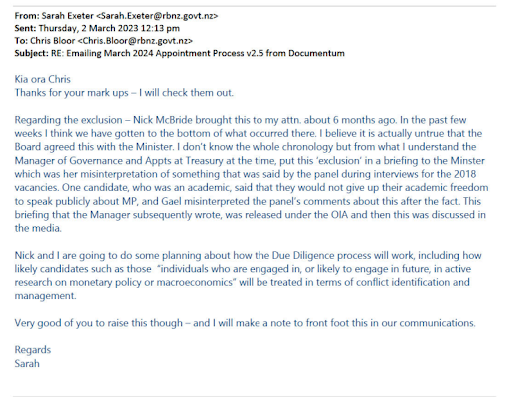
A few months ago, RBNZ and Treasury made some pretty extraordinary claims about the appointment process for external members of the Monetary Policy Committee. 

Treasury had, in notes released under OIA, said that academic economists with an ongoing research interest in the area were considered conflicted for the MPC.

Michael Reddell's written a lot more on it than I have, but it's something that worried us too. I had a column in the Herald on the problem, which included a survey that me and Dennis Wesselbaum ran of the country's macroeconomists on the next round of MPC appointments / reappointments. 

And it came up when I had a podcast with John Cochrane

More recently, RBNZ told Treasury that it had all been a big misunderstanding on Treasury's part and that there had never been such a blackballing. And Treasury officials seemed to just take it at face value rather than contest it and pick a fight with the Minister of Finance and RBNZ about it. 

Michael and I both separately sent through some OIAs trying to figure out just what the hell had happened. RBNZ repeatedly had made statements defending the blackballing, or consistent with there being a blackballing. It's great that there isn't a blackballing now, but memory-holing a prior one wouldn't be great. 

I received a reply from RBNZ earlier this week and passed it on to Michael because he's been watching the file more closely. Michael has the replies I received, along with his own, up at Croaking Cassandra now.

I keep trying to come up with a fog-of-war version that has nobody involved just outright lying. 

From the OIAs, it seems clear that Orr believed there had been a ban and was trying to figure out why there was one, since there didn’t seem to need to be one. 


In February, in response to queries from Jenée Tibshraeny, officials punted on it by saying "criteria unchanged" - so they didn't have to commit to what the underlying criteria were. 

So senior levels in the Bank didn't seem to know what had happened during the 2018 appointment round but everyone there seems to have believed that there had been a ban. 

And nobody involved there dropped a note to RBNZ Chair Neil Quigley asking about it, where he seems to have headed up the appointment process. 

Prof Quigley says there was no blackballing in 2018, despite the Governor having thought that there had been.

And then this account of what might have happened. 

That would then seem consistent with fog of war, but a pretty deep one.
  1. Only appointment committee knew what happened; Governor's team were not in the loop.
  2. One candidate was blackballed as conflicted, and Treasury interpreted that as being a broader thing.
  3. All of RBNZ who weren't in on that appointment process take their lead from the early OIAed excerpt from Treasury's notes, which said academics with a research interest were conflicted.
  4. Quigley figures that the noise from the usual malcontents (me, Reddell, Wesselbaum, others) is just noise from the usual malcontents and pays it no mind.
  5. Orr doesn't bother asking his Chair about the prior appointment process when he has his team checking whether there's any reason they'd have to be blackballing appointees. This may be the least plausible link in the chain here?
  6. Where RBNZ has been pretty quick to put critics straight in other cases, they didn't here because they thought, mistakenly, that there had been a general blackballing - and all of it was below Quigley's threshold of attention. 
  7. Robertson's 2019 comments were specific to an academic who did not want to forego free public commentary on monetary policy, rather than academics with a research interest more generally.
  8. Quigley finally notices and says there hadn't been a blackballing. 
That isn't great, but it isn't crazy. 

Except for this last bit that Reddell noticed in the OIAs.

The bit Reddell's circled suggests they expected any active researcher would likely be conflicted, as with (redacted, but presumably the academic who wanted maintain freedom to speak publicly on monetary policy). And the Chair signed off on these notes.


The consistent and nobody's lying version would be a bit Clintonesque - my attempt at it: 
There was never a general blackballing, just a ruling out of one particular academic and a general expectation that academic researchers active in the Bank's areas would likely be conflicted. Which led to Treasury mistakenly viewing it as ruling out perhaps rare cases that might not be considered conflicted, and all senior tiers at RBNZ relying on Treasury's notes and believing for years that there was, in fact, a general blackballing when there wasn't and never had been. 
I'm not so sure that Treasury's summary of the position was all that wrong? Perhaps it depends what the meaning of the word likely likely is?

Great that the Monetary Policy Committee will be considering appointing people with active research interest in macro/money henceforth though. 

Friday, 25 November 2022

Inflation accountability

Susan Edmunds at Stuff asked me whether the RBNZ is to blame for current inflation outcomes. 

She only had room for a shorter snip, so here's the full bit I'd sent through:

Economists say that the central bank moves last. That means, whatever else is going on that might affect inflation rates, the central bank gets to take it into account when deciding on monetary policy. So if a government runs imprudent deficits when the economy is overheated, an inflation-targeting central bank’s job is to undo the effect of that spending by increasing interest rates by more than it otherwise would have. Surprises can happen. But if a central bank is credible and everyone knows that the central bank will do what it takes to get inflation back within bounds, then that surprise does not much affect either inflation expectations or inflation. When credibility is eroded, everything becomes harder and more costly. 

So while many things contributed to the current inflation rate, including initial large and sustained monetary stimulus, Covid shocks, substantial and highly inappropriate fiscal stimulus, and war in Europe, inflation outcomes are the responsibility of the central bank and monetary policy. Remember as well that New Zealand has a floating exchange rate which provides a buffer between local inflation and international prices. If other countries run very loose monetary policy and New Zealand does not, the New Zealand dollar appreciates and international inflation does less to affect local prices in New Zealand dollars.

But it has not helped that the Remit of the Reserve Bank, which is the agreement between the Bank and the Minister of Finance about the objectives that the Bank will seek, has weakened considerably. When inflation targeting is only one of several parts of a Remit that also includes multiple references to other government policy objectives, it is easier for a central bank to stray from its core business in pursuit of other interests. And when the Reserve Bank and the Minister of Finance consider it a conflict of interest for academic economists with a specialist research interest in macroeconomics and monetary economics to serve as external members of the Monetary Policy Committee, external voices with expertise to break a misguided internal consensus are shut out. Responsibility for those lies jointly between the Reserve Bank and the Minister of Finance. And responsibility for the reappointment of a Governor who presided over these issues lies with the Minister of Finance and the Reserve Bank’s Board


Tuesday, 2 August 2022

LSAP Review?

Geoff Mortlock lays out what's needed for a review of what the RBNZ has been up to, in an open letter to Finance Minister Grant Robertson, cced broadly. 

Jenny Ruth reported on his first open letter at Business Desk:

Reserve Bank governor Adrian Orr is performing an increasingly political role, risking the credibility of the central bank and hurting rather than helping the New Zealand economy, according to former central banker Geof Mortlock. 

In an open letter to finance minister Grant Robertson and RBNZ chair Neil Quigley, Mortlock particularly takes issue with Orr’s “favourite theme of portraying the RBNZ as the Tāne Mahuta of the financial landscape”. 

Mortlock, who spent 24 years at RBNZ through to 2007 and five years at the Australian Prudential Regulation Authority through to 2013, and who has consulted for the World Bank, International Monetary Fund and KPMG Australia, said Orr’s continued prominent references to Tāne Mahuta “have become a source of considerable embarrassment”.

I copy Mortlock's most recent missive here, with his permission:

Dear Mr Robertson,

In a recent open email to you, I made a number of criticisms of the Reserve Bank's performance, governance and management. As you are aware, I am not alone in making these criticisms. Many people with deep knowledge of central banking, economics and financial sector policy have made similar criticisms. The focal points of these criticisms have included:

-  the inadequate quality of governance and management at the RBNZ by reference to relevant foreign benchmarks (e.g. Reserve Bank of Australia, Bank of England, Bank of Canada);

-  the extraordinary preoccupation of the governor with largely irrelevant maori cultural issues, as opposed to doing the job of governor to pursue an effective approach to monetary policy and financial sector regulation;

-  the very costly LSAP program, with a growing taxpayer burden via the government indemnity of the RBNZ;

-  the highly questionable use of macro-prudential policy and the distortions it is creating in bank lending to the housing market when compared to the alternative of using more granular (but less distortionary) risk-weighted capital ratios;

-  the lack of robust cost/benefit assessments of RBNZ policy initiatives, including the major increase in bank capital ratios to levels not seen in comparable countries and which will inevitably exacerbate recessionary pressures next year and possibly beyond; 

-  the extraordinary loss of highly qualified and experienced staff from the RBNZ and the resultant erosion of its intellectual capacity; and

-  the lack of robust performance metrics and independent performance monitoring of the RBNZ.

In this open email, I want to put forward some suggestions for how these failings can be addressed.

LSAP review

In the case of the LSAP, there should be an independent review to assess the matter. It should not be left to an internal RBNZ assessment, given that this would lack sufficient objectivity and independence. My suggestion is for the Minister to appoint one or two persons, suitably qualified and non-conflicted, in consultation with the Opposition parties, to evaluate the efficacy and cost-effectiveness of the LSAP. This should be done in a constructive way to draw out key lessons to guide future policy. Such a review would sensibly include an assessment of the following matters:

-  Were the rationale for and objectives of the LSAP sufficiently thought through and precisely specified at the point of its conception?

-  Was the proposal for the LSAP subject to sufficient independent cost/benefit assessment (external to the RBNZ) before a decision was made to implement it?

-  Was the LSAP sufficiently targeted at reducing interest rates at specific time horizons on the yield curve (e.g. as per the RBA version of the LSAP), as opposed to the broader-based asset purchase pursued by the RBNZ?

-  Could the desired interest rate reductions have been achieved more cost-effectively (at much lower cost to the taxpayer) by simply reducing the OCR further than the RBNZ did reduce it, rather than through the LSAP?

-  What is the estimated impact of the LSAP on economic activity relative to what would have prevailed had the LSAP not been used and the OCR reduced further?

-  Were the potential externalities associated with the LSAP adequately assessed - e.g. the potential for the LSAP to contribute to house price inflation to a greater degree than might have occurred had the RBNZ solely relied on the OCR as the monetary policy lever?

-  Would the RBNZ have embarked on the LSAP, and if so, by as much, in the absence of a government indemnity? In that regard, did the indemnity reduce appropriate disciplines on the RBNZ in the design and implementation of the LSAP?

-  Did the Treasury undertake a cost/benefit analysis of the indemnity before a decision was made to implement it, including taking into account the extent to which the indemnity might have reduced RBNZ incentives for appropriate caution in the use of the LSAP?

-  To what extent did the non-executive members of the Monetary Policy Committee engage on the LSAP, and did they raise concerns?

-  Is the proposed exit from the LSAP the most cost-effective strategy, given the alternatives?  Would it have been better for the RBNZ to begin the sale process at an earlier point, such as when the information available to it suggested that there would be a need to raise interest rates?

These are the kind of issues that need to be properly assessed by an independent, objective and transparent review process, overseen by the FEC.

Review of the functioning of the Monetary Policy Committee

It would be timely to review the functioning of the MPC given the experience of the last two years or so. Again, this should be done by an independent review process and not within the RBNZ. The issues that need to be assessed include:

-  Is the composition of the MPC appropriate in terms of executive versus non-executive members?  Would it be more effective if a majority of its members were non-executive (as in several advanced countries with MPCs)?

-  Do the non-executive members of the MPC have sufficient knowledge, experience and capacity for judgement to be effective in their role? It is worth noting that, while the three non-executive members are all able people in their own right, not one of them had significant experience, in-depth knowledge or standing in monetary policy issues upon their appointment. In contrast, non-executive members of the MPCs in other comparable countries are generally selected on the basis of their specific knowledge, skills, experience and capacity for discerning judgement on monetary policy and macroeconomics.

-  Should the qualifications for appointment of non-executive persons to the MPC be lifted to a higher standard, and better anchored to the role that the MPC performs?

-  Is the level of transparency of the MPC sufficient by reference to international standards? It is striking that there is very little information that is publicly released on the views expressed by the members of the MPC and no speeches are given by any of the non-executive MPC members. By comparison with other comparable countries, the MPC lacks transparency and accountability.

-  To what extent do non-executive members of the MPC constructively challenge the views of executive members of the MPC in their deliberations on monetary policy?  To what extent do they seek to avail themselves of supplementary information and views from parties outside the RBNZ to better equip them to perform their duties?

-  What performance assessment framework is applied by the RBNZ Board and by the NZ Treasury, respectively, in assessing the performance of the MPC, including in respect of the performance of the MPC itself, assessments of forecasting accuracy (relatuive to forecasts made by other entities at the same time), model dependency, and the weights accorded to price stability versus employment considerations?

Board membership

I and many other observers have expressed concern at the lack of sufficient skills, knowledge and experience on the RBNZ Board given its new responsibilities. In particular, it is remarkably lacking in persons with the expected level of knowledge, experience and capacity for discerning judgement in banking, insurance (other than the one director with a limited level insurance connection, who is arguably conflicted), financial markets, and macroeconomics.

By comparison to the boards of functional equivalence in central banks in comparable countries, the RBNZ Board appears to have a remarkably shallow pool of the relevant experience.  This is concerning.  It is also ironic, given that the RBNZ has made much (rightly) of high quality governance in banks and insurers, and yet has failed to lead by example.

I recommend that additional directors be added to the Board to lift its capacity to the required level, with a particular need for suitably experienced persons in banking, insurance, financial markets and macroeconomics. In addition, there needs to be much stronger focus on the structure of its board committees (including risk management, remuneration, audit and prudential policy) and the frameworks they will use to help the Board perform its governance role. Greater transparency and accountability are needed in these areas.

I also recommend that consideration be given to the establishment of a Prudential Policy Committee as an advisory committee to the Board, comprising non-executive persons with expertise in prudential policy and regulatory issues, who are not conflicted, with therse persons being appointed by the Minister of Finance.  (Why an equivalent of the MPC for financial sector policy was not incorporated into the RBNZ Act is also a question that should be addressed when the Act is reviewed.)

Performance assessment of the RBNZ

For many years the RBNZ has operated largely as a self-contained domain. There has been very little meaningful external monitoring and assessment of the RBNZ Board, senior management, and RBNZ performance of its functions. Treasury has done very little in this area. Successive finance ministers (including yourself) have also been content to leave the RBNZ to do its own thing, with little in the way of structured scrutiny and performance assessment. In this regard, there has been a worrying lack of recognition of the fact that, with operational independence comes the need for robust external performance assessment, transparency and accountability. The greater the operational independence a government agency has, the greater is the need for robust independent performance assessment and associated accountability. There has been plenty of operational independence but very little in the way of effective independent performance assessment, meaningful transparency, and accountability.

What is needed now is a much more focused role by the Treasury in assessing the performance of the RBNZ across all of its functions, including the effectiveness of the Board, the governor and the senior management team. This needs to be done on the basis of transparent performance metrics that are set by the Minister (not by the RBNZ), in consultation with the RBNZ. The performance metrics should be comprehensive and cover in meaningful detail all of the functional areas of the RBNZ and should be anchored to the statutory and policy objectives for each functional area. The performance assessments should be transparent, being tabled in Parliament and subject to robust scrutiny by the FEC.

The work being undertaken in Australia, through the Financial Regulator Assessment Authority, provides a good example of how regulatory agencies (APRA and ASIC in Australia's case) are subject to regular, independent performance assessments. Other good examples of central bank and regulatory agency performance assessment can be found in many other countries, including the United Kingdom, United States, Canada and several EU and Asian countries.

New Zealand needs to lift its game in this area - not solely in the case of the RBNZ, but also in respect of other key agencies, including the Financial Markets Authority and the Commerce Commission. More generally, performance metrics and performance audits need to strengthened across the public sector. There is a woeful lack of rigour in this area, with the consequence that New Zealanders continue to suffer from under-performing government agencies and public sector inefficiency.

I urge you and colleagues to take note of the points raised in this email and take appropriate actions to address the concerns I have raised.

Regards

Geof Mortlock

International Financial Sector Consultant

Wellington


Friday, 29 July 2022

"Our economic response"

This morning's Politik newsletter covers some of the increasing disquiet over whether the Reserve Bank has been doing its job.

This bit of a Parliamentary exchange could be a worry, depending on how inclusively one should read the "our". 
Parker rejected the assumption in the question, but he did so with what appeared to be a concession that the Bank may have been preoccupied with employment. 

“This was a time of considerable uncertainty, with unemployment forecast to reach significant levels,” he said. 

“I consider our economic response has been instrumental in the record low levels of unemployment we now have. 

“If we did not provide that support, the economic consequences for New Zealanders were dire.”
If 'our' is read as meaning the Labour government and the fiscal response, then all's fine. The Bank used monetary policy in response to end-times economic forecasts. The Government used fiscal policy to get things to record low levels of unemployment.

Now it's still bad in an important sense - the last Monetary Policy Statement had a 2.5% output gap, meaning an overheated economy. Government should not be providing continued fiscal stimulus into a positive output gap. 

But it's not bad-bad.

If 'our economic response' means the combination of the monetary and fiscal response, he's then lauding the Reserve Bank for delivering a positive output gap. And that would be bad-bad. 

Lauding the Bank for avoiding 10% unemployment would be defensible. People can argue about whether those forecasts were way out in the first place, but it isn't prima facie crazy. Lauding it for overshooting so far that we've wound up with very high inflation and a substantial positive output gap - that's dangerous for the credibility of the Remit. 

So I really hope 'our' is a narrow 'our' here.

Thursday, 28 July 2022

A distracted Reserve Bank

Been a busy week here, and presumably also over at RBNZ.

Former RBNZ Governor Graeme Wheeler coauthored a report with our Bryce Wilkinson on global monetary responses to the pandemic, arguing that most of them took their eye off the ball. It took too long for them to flip from a GFC playbook to recognising that they were dealing with a real shock. They noted distractions from other political objectives, like climate change.

Their piece drew a fair bit of attention, including internationally. The piece wasn't about the RBNZ in particular, but they were subject to the same kinds of errors as others. 

Governor Orr put out a release claiming the Bank hasn't been distracted and that climate change, Te Ao Māori, and financial inclusion, "remain highly relevant to the Reserve Bank in achieving our legislative purpose of increasing economic prosperity and well-being for all New Zealanders."

Susan Edmunds over at Stuff asked me for comment.

But NZ Initiative chief economist Eric Crampton said the critics were driven by deeper concerns.

He said, if the Reserve Bank was not focused on its core jobs of monetary policy and prudential regulation, there was no one else who could pick it up.

He said the Reserve Bank had shed expertise in core economics in recent years.

“Friends in economics departments emailed me the Reserve Bank’s latest advertisement for summer interns, where the Reserve Bank seemed to want every diverse skill other than macroeconomics. The bank seemed to have stopped caring about core economic research, and had started pursuing other highly politicised agendas instead,” he said.

“Under governor Orr, the bank strayed considerably from its core mandate. While inflation was hitting the highest levels since inflation targeting began, the governor of the Reserve Bank was making international speeches on how the inclusion of a te ao Māori view encourages the bank to think holistically.

“It seemed, at best, tokenistic. At worst, it signalled to the international central banking community that the bank was no longer serious about its main job: that it had become too distracted from core business.”

Crampton said a bank that was seriously focused on targeting inflation should think about the implications of high inflation, or high unemployment, for Māori.

“Maintaining stable inflation rates is the best long-term way of ensuring maximum sustainable employment. But if their modelling showed that moves necessary for maintaining price stability would hurt lower income groups, or Māori in particular, knowing that would be important. It could then inform Parliament, so that Parliament could use its fiscal authority to ensure that maintaining price stability did not have unwanted distributional consequences.

“But that has not been the bank’s approach under this governor.”

Orr and the Bank have liked to paint critics as racists. It seemed to work - back when the Bank had clearly forgotten its One Big Job That No One Else Can Do, but inflation hadn't yet broken out. 

I don't think that play's going to keep working, now that failure's more obvious.

Orr's term comes due early next year. 

If they reappoint Orr, and National wins the election, things could get uncomfortable. 

I'd hope that there would just be a resignation. 

Reserve Bank appointments should be apolitical. Monetary policy should be apolitical. But Orr politicised the Bank. 

I'd hope that there can be cross-party agreement on a suitable appointment so someone is ready to take up the position when Orr's term comes due.

Arthur Grimes is also worth listening to.

Thursday, 7 July 2022

Afternoon roundup

The morning's worthies:

Thursday, 17 February 2022

For a better Monetary Policy Committee

The terms of two of the three external members of the Monetary Policy Committee are due for renewal this year. 

My column in yesterday's New Zealand Herald (ungated here) suggests that the Board of the Reserve Bank of New Zealand might want to make sure that subject experts are welcomed, this time through.

A snippet:

In 2019, the Bank appointed its first Monetary Policy Committee. Previously, decisions were made by the Governor. The move to a committee structure made sense. Appointments to the Committee are made by the Minister of Finance on the recommendation of the Board of the Reserve Bank.

But Treasury warned at the time that the Bank’s view on conflicts of interest could have some strange effects. The Bank viewed an active research interest in monetary policy or macroeconomics as being a conflict of interest. That view meant that every serious macroeconomist and monetary policy specialist working at the country’s universities was excluded from consideration.

It was a bizarre view.

The United States Federal Reserve has some of the country’s most eminent macroeconomic researchers helping in setting monetary policy. The RBNZ considered them to be too conflicted to be appointed.

Monetary policy, to the standard necessary for high stakes monetary policy decisions, is a highly specialised discipline. Even a doctorate in economics is not sufficient on its own. Macroeconomics is its own specialised field. Few microeconomists are able to stay current in the latest research in macroeconomics. And macroeconomics has its own specialised domains.

Being able to keep up to date with the latest research papers in macroeconomics and monetary policy requires staying on top of the latest methods. It requires people who are active in the field.

The Committee currently includes three Reserve Bank officials: Governor Adrian Orr, Deputy Governor Christian Hawkesby, and outgoing Chief Economist Yuong Ha.

It also includes three external members, the terms of two of which come due this year.

Treasury recommended that, “in future appointments to the MPC, looser criteria could be adopted that would allow for a broader field of potential nominees from the Board, if desired.”

It seems a good idea.

Dennis Wesselbaum and I surveyed the country's academic macroeconomists and asked them to rank-order each other for the impending vacancies; the two MPC members whose terms are coming due were also surveyed. Our response rate was a bit less than half; not too bad. I set each candidate in a pairwise race against each other candidate in a Condorcet process. 

Bob Buckle lost to no one. Good pick for a reappointment, if he'd be willing to serve. 

Arthur Grimes, John McDermott, Prasanna Gai, Viv Hall, Dennis Wesselbaum and Mark Holmes came in next. 

Peter Harris came in 13th, losing a pairwise contest to each of Bob Buckle, Arthur Grimes, John McDermott, Prasanna Gai, Viv Hall, Dennis Wesselbaum, Mark Holmes, and five others.

Good appointments will matter where there are worries about in-house capabilities. 

Monday, 6 December 2021

A politicised central bank

Politik this morning reports that the Reserve Bank Governor has lost the support of the National and ACT Parties. Or, at least, they would not be keen on his being reappointed.

Now that Simon Bridges is National’s finance spokesperson, the future of Reserve Bank Governor Adrian Orr will be an issue.

Orr’s contract as Governor expires in March 2023, outside the three months prior to an election when Governments normally defer significant appointments.

But with the election expected in September that year, a move in March to reappoint him would be bound to be an election-year issue.

If the decision were to be left to ACT and National, Orr would go. Both ACT Leader David Seymour and Bridges confirmed that on a podcast last week, and Bridges has confirmed again to POLITIK that was his position.

But at the same time, Bridges has to be careful.

The Bank is supposed to be independent, and one of National’s criticisms of Orr is that he has allowed it to become a little less so under Labour and Finance Minister Grant Robertson.
And this is why Reserve Bank Governors ought to stick to monetary policy and why prudential regulation colonising other policy areas far outside of their proper domain without any evidential basis is risky.

Last week, we hosted John Cochrane to talk about central bank independence and the problems they can get themselves into. 

The video is here:


My column in our Insights newsletter summed it up:
PRUDENTIAL CLIMATE RESERVATIONS

Central bank independence matters.

The grand bargain struck between governments and their central banks, coming out of the turmoil of the 1970s, and led by New Zealand in the late 1980s, was simple.

Governments stopped meddling in monetary policy. Central banks were given operational independence to pursue low and stable inflation. It was a difficult bargain for governments who preferred to avoid interest rate hikes as elections loomed.

That independence required Banks stay within limited bounds.

Monetary policy and prudential bank regulation are powerful tools with economy-wide consequences. They need to be used only toward the core ends of central banking: low and stable inflation, and the stability of the financial system.

Straying to pursue other objectives, regardless of whether they match the goals of the government of the day, is dangerous.

On Thursday, the Initiative hosted a webinar with John Cochrane – one of the world’s leading experts working at the intersection of macroeconomics and monetary policy and financial regulation. That he has a stronger record of published work in this area than the entirety of the Reserve Bank of New Zealand is a safe bet. Whether he has three times the work in the area might depend on how you weigh pages in different journals.

John has been increasingly critical of worldwide moves by reserve banks to consider climate change as a risk to financial stability. While it is very clear that temperatures are rising and that sea levels will rise with them, with obvious consequences for storms and beachfront properties, evidence of risks to the financial system is wanting.

Not everything that is a globally consequential risk is also a risk to the financial system. Systemic financial risk requires a particular kind of fragility. And the financial system, here and abroad, simply appears to be robust to the kinds of shocks that climate change will bring.

Indeed, earlier this month, the Federal Reserve Bank of New York published work showing that storms increase, rather than reduce, bank profits. People take out loans for rebuilding. Storms are bad, but they are not a risk to the financial system.

Using prudential regulation to address political concerns takes the regulator’s eye off the ball. More substantial risks can be missed. But, more importantly, doing so politicises their operations, putting their independence at risk.

And that may yet be the biggest systematic risk of them all.

Shortly after the webinar, one of the RBNZ's board members decided to weigh in. Draw your own conclusions about the adequacy and rigor of governance at the Bank. 

Thursday, 11 November 2021

Afternoon roundup

Another long-belated closing of the browser tabs:

Wednesday, 10 November 2021

RBNZ and climate risk

If climate change poses sufficient risk to the financial system to justify central banks having broad remit over anything in banking and insurance that relates to it, then you might as well conclude that the Reserve Bank should just get to run everything. 

Pandemics, worse pandemics, war between China and Taiwan - there's a lot of risks out there, and those risks could affect asset markets and companies' financial positions. 

Maybe banks should be required to disclose their exposure to things that could go south if there's a trade war with China, because of the risks there, and the Reserve Bank should start producing reports on global security and take over national defence and signals intelligence. 

It's all crazy. But there is no risk to the financial system from climate change that's likely to exceed the risks to the financial system from those other risks. You need to show that there is a real and substantial risk to financial stability. Not just that the problem is big and important in its own right. 

My colleague Matt Burgess released a report yesterday showing just how long a bow the Reserve Bank is drawing. They have not provided any evidence of risks that would warrant their regulatory expeditions into climate change. 

Over at Newsroom, I worry that the Bank is almost begging for an incoming government to sack the Governor, because of the overreach into areas of Parliamentary prerogative, and that it's not always easy to tell if those kinds of moves wind up restoring or ending Bank independence. 

Jenny Ruth, over at Business Desk, reports on the Reserve Bank's moves to hide its lack of evidence in support of its Governor's sweeping claims for regulatory mandate around climate risks. 

The Reserve Bank tried to bury its own research that found climate change is not a threat to financial stability. 

That research contradicts many statements by Reserve Bank of New Zealand (RBNZ) governor Adrian Orr that climate change is an existential threat to the economy and that the central bank needs to be at the centre of New Zealand's climate change response. 

For example, Orr said in a speech last month that "the financial stability risks associated with climate change are significant, necessitating an urgent and collaborative response". The RBNZ has a section of its website dedicated to climate change on which it says: "Climate change poses a direct challenge to financial stability." 

In this, Orr is not alone. Central banks around the world are expressing concerns about the impact of climate change on financial stability, and courting controversy in doing so. 

The 2018 paper said: "Our preliminary assessment is that the risks associated with climate change should not, in and of themselves, create a significant issue for the soundness and efficiency of the financial system." 

My colleague, Bryce Wilkinson, had been OIAing to get that material. RBNZ buried the paper they'd done showing there was no risk. Ian Harrison dug it up later. Sometimes, you have to know the exact name of the thing that you don't know exists in order to summon it up by OIA, when the officials really want to hide the cheese.

Ruth concludes:

Orr's claims to the contrary are an overreaction and "motivated more by attention-seeking than the science and sound economics", said Harrison. 

The RBNZ "deliberately hid their report for months and misled people seeking it under the OIA to promote its new, more catastrophist narrative", he claims. 

Looking at the timeline from the first request, and the long delay in publishing the 2018 paper, two years after it was written and only under threat of a complaint to the ombudsman, and its relatively obscure positioning on RBNZ's website, it's difficult to reach any other conclusion.

Saying that the Reserve Bank shouldn't have jurisdiction over foreign policy, or over trade agreements with Taiwan, or mandate to require Banks to disclose every possible risk on their balance sheets around war between China and Taiwan isn't saying that war between China and Taiwan would be a good thing, or that we shouldn't care about it.  

It's saying that some things are so tenuously linked to financial stability that it's incredible overreach for a central bank to try to take a leading role in it, even if it is really important in the bigger picture.

Tuesday, 26 October 2021

Core business for a central bank

Inflation hit 2.2% in the most recent quarter. Not the annual rate - the rate for the quarter.

Arguably, Reserve Banks shouldn't be making statements about inflation outside of the scheduled monetary policy schedule. 

But it seemed a bit odd that the Bank put out a release on establishing the Māori Bankers Rōpū to coincide with the release of the inflation statistics. 

They came out within minutes of each other, as though the Bank were saying "Yes, the CPI numbers are out today, but here's what we're really interested in." 


New Zealand has an Emissions Trading Scheme that caps net emissions.

The ETS is nowhere mentioned in the report. 

The Executive Summary tells us that "Climate Change is part of our core business". 


It simultaneously tells us that the Reserve Bank has forgotten what its core business is. 

Its core business is keeping inflation between 1 and 3 percent over the medium term while maximising sustainable employment outcomes (which really means just maintaining stable inflation between 1 and 3 percent because the rest is out of the Bank's hands). 

If climate change is core Bank business, because it affects financial stability, is there *anything* that is not part of the Reserve Bank's remit? Housing policy would be the obvious starting point, but why stop there? Freshwater regulation may have financial stability implications. 

The question is whether the ECB, other central banks, and international institutions such as the IMF, BIS, and OECD should appoint themselves to take on climate policy, or other important social, environmental or political causes, without a clear mandate to do so from politically accountable leaders.

Moreover, the ECB and others are not just embarking on climate policy in general. They are embarking on the enforcement of one particular set of climate policies — policies to force banks and private companies to de-fund fossil fuel industries, even while alternatives are not available at scale, and to provide subsidized funding to an ill-defined set of “green” projects.

To be concrete, I quote from Executive Board Member Isabel Schnabel’s recent speech. I don’t mean to pick on her, but she expresses the climate agenda very well, and her speech bears the ECB imprimatur. She recommends
First, as prudential supervisor, we have an obligation to protect the safety and soundness of the banking sector. This includes making sure that banks properly assess the risks from carbon-intensive exposures…
Let me speak out loud the unclothed emperor fact: Climate change does not pose any financial risk, at the 1, 5 or even 10 year horizon at which one can conceivably assess the risk to bank assets.

“Risk” means variance, unforeseen events. We know exactly where the climate is going in the next 5 to 10 years. Hurricanes and floods, though influenced by climate change, are well modeled for the next 5 to 10 years. Advanced economies and financial systems are remarkably impervious to weather. Relative market demand for fossil vs. alternative energy is as easy or hard to forecast as anything else in the economy. Exxon bonds are factually safer, financially, than Tesla bonds, and easier to value. The main risk to fossil fuel companies is that regulators will destroy them, as the ECB proposes to do, a risk regulators themselves control. And political risk is a standard part of bond valuation.

That banks are risky because of exposure to carbon-emitting companies, that carbon-emitting company debt is financially risky because of unexpected changes in climate, in ways that conventional risk measures do not capture, that banks need to be regulated away from that exposure because of risk to the financial system is nonsense. (And if it were not nonsense, >regulating bank liabilities away from short term debt and towards more equity would be a more effective solution to the financial problem.)

...Now you may say, “climate is a crisis. Central banks must pitch in and help the cause. They should just tell banks to stop lending to the evil fossil fuel companies, and print money and hand it out to worthy green projects.”

But central banks are not allowed to do this, and for very good reasons. A central bank in a democracy is not an all-purpose do-good agency, with authority to subsidize what it decides to be worthy, de-fund what it dislikes, and to force banks and companies to do the same. A central bank, whose leaders do not regularly face voters, lives by an iron contract: freedom and independence so long as it stays within its limited and mandated powers.

The ECB in particular lives by a particularly delineated and limited mandate. For very good reasons the ECB was not set up to decide what industries or regions need subsidizing and which should be scaled back, accordingly to direct bank investment across Europe, to set the price of bonds, and and to print money to subsidize direct lending. These are intensely political acts. In a democracy only elected representatives can take or commission such intensely political activities. If I take out the words “green,” you, EU member states, and EU voters would properly react with shock and outrage at this proposal.

That’s why this movement goes through the convolutions of pretending that defunding fossil fuels and subsidizing green projects — however desirable — has something to do with systemic risk, which it patently does not.

That’s why one must pretend to diagnose “market failures” to justify buying bonds at too high prices. By what objective measure are green bonds “mispriced” and markets “failing?” Why only green bonds? The ECB does not scan all asset markets for “mispriced” securities to buy and sell after determining the “right” prices.
But the Bank makes it even more obvious that they have no clue what they are doing when they talk about the need to calculate and reduce the Bank's emissions profile. 

The only emissions from the Bank that are not covered by the ETS will be those coming from international travel, and maybe if they're getting bank notes shipped in from Canada. The latter will be trivial. Both could easily be offset if the Bank were so inclined. 

The only thing that happens if the Bank decides to take costly effort to reduce its emissions within the cap, efforts above and beyond what would be consistent with basic optimisation that accounts for an expected rising carbon price path, is that ETS credits are freed up for someone else to use. It doesn't make sense to spend $100 to avoid buying a carbon credit that costs $60. Someone else will just buy it instead. But it totally makes sense to spend up to that $60 to avoid buying the credit. 

The Bank calculates its revised carbon footprint at 10,014 tonnes. At $60/tonne, that's just over $600k in carbon charges. I wonder whether they spent $600,000 on reports calculating their carbon footprint. 

A future government that cares about having a Reserve Bank that knows its core business, and sticks to it, will have a bit of a job ahead of it.

Monday, 28 June 2021

Another case for Cat Bonds

This week's column in the Dom draws on the joint RBNZ-Treasury workshop on post-Covid macroeconomic policy that preceded last week's Covid-truncated NZ Association of Economists conference. 

A snippet:

Overall, the workshop felt designed to warm the economic policy community to higher public debt levels for a longer period. The risks of the approach were noted: interest rates can rise, and there will be problems if they do.

And the approach only makes sense if projects funded by that debt really do pass cost-benefit assessment. That conventional cost-benefit assessment processes ensuring value for money seem out of fashion was not noted as any substantial constraint.

Higher levels of government debt bring risk not only in case of interest rate increases, but also in case of natural disaster. Maintaining headroom to take on a lot of debt in a crisis has been important. If public debt is higher for longer, and global credit conditions become less friendly, the Alpine Fault becomes even riskier.

If the public sector is determined to encourage politicians’ imprudent pursuit of higher debt levels, it should encourage that some of that debt be funded more prudently: through catastrophe bonds.

Catastrophe bonds pay investors more during normal times but void most or all of the bond if a triggering event happens. If an earthquake required substantial government funding, existing catastrophe bonds would void and would provide some necessary headroom.

They may be a more prudent approach in imprudent times.

Nightmare scenarios do still exist

There were other interesting bits on the day. One presentation went through some simulations of different paths for fiscal consolidation (getting debt back down); the least costly approach, which also yielded long-run benefits, was through increased consumption tax - GST - and/or reduced transfer spending. The worst approaches were increased taxes on capital, and/or reduced government investment spending (on the assumption that that investment spending is on stuff with positive BCRs, which is a bit heroic). 

One option put up by that paper's discussant, which hadn't come up in the paper, was to use migration settings. You can drive down net debt to GDP by increasing population size - though you'd have to be careful on how the necessary infrastructure were financed.  

Michael Reddell has a good run-down on the macro session

Monday, 9 December 2019

One policy instrument for each target, and every agency in its place

My column in today's Fairfax papers argues that central banks really don't have any business playing in climate change policy. It isn't that climate change isn't important; it's rather that central banks have one big job - two if they're also responsible for prudential regulation. 

A snip:
In October, the Reserve Bank's general manager for governance, strategy and corporate relations highlighted the bank's growing focus on climate change. As part of the same press release, governor Adrian Orr noted the bank's role in "greening the financial system" and managing environment and climate-related risks.

Some of this makes sense as part of the Reserve Bank's role in prudential regulation. If a bank's capital stock includes a lot of farm mortgages that would be underwater with a change in emissions policy, then those risks should be considered when weighing that bank's overall position.

Of course, there are policy risks across many different sectors - just think about how Trump's tweets can affect different portfolios.

But the Reserve Bank seems to wish to go further than that, noting the importance of integrating sustainability factors into portfolio management, and recently purchasing US$100 million of green bonds. The current remit of the Monetary Policy Committee includes a preamble noting the government's economic objective of moving towards a low-carbon economy.

And there we start worrying about whether the instruments are suited to the targets, and whether the bank may be over-reaching.

Getting policy around climate change right is incredibly important. But it is not a job to which a central bank is well suited. We would not ask the Reserve Bank to help ensure that vaccination rates are high enough to prevent outbreaks of contagious disease, and we should raise an eyebrow if it started volunteering to do the job. It is a job better suited to others. And climate change policy is better left with the Climate Change Commission. The Emissions Trading Scheme is the best instrument for mitigating New Zealand's emissions.

If prudential regulation reaches beyond considering climate change risk as one of many factors affecting the soundness of a portfolio, to instead start nudging companies into changing their practices around climate risk, we start getting into Tinbergen's problem. Making prudential regulation more about climate change makes it less about the soundness and efficiency of the financial system. We then risk doing poorly for both.

This weakening of focus on core central banking business is hardly unique to New Zealand. Traditionally, central banks have sought to be sectorally neutral in their market operations: if a reserve bank must purchase bonds as part of monetary policy, it tries to do so without skewing the pitch in favour of one sector or issuer or another.

If pitch-skewing is appropriate, that is for democratically accountable parliaments to decide rather than central banks. But Christine Lagarde, the recently appointed president of the European Central Bank, is reviewing whether its bond portfolio should shift from market neutrality to preferring green investments.

These kinds of policies do not just violate Tinbergen's warnings. They also risk the independence of monetary policy if parliaments object to reserve banks taking actions going beyond monetary policy and normal prudential regulation.

And there are dangers too if markets come to expect that central banks might not pursue purely monetary goals in any crisis requiring quantitative easing.
This stuff shouldn't be hard, and it shouldn't be part of the RBNZ's remit.

Make sure that the ETS is working properly. Have a binding cap. Share the burden of getting the cap down to where it needs to be through a declining allocation to grandparented emitters and crown buyback and retirement of emission permits. Keep an eye on the ETS prices to make sure that they don't run ahead of prices in places that also take this stuff seriously. And set a regime, in concert with the OECD, for running carbon-equivalent tariffs for imports from places without a carbon price, and for exemptions of carbon charges on exports to places where the product would compete with products without a carbon charge.

None of that needs a greening or re-jigging of the financial system. It all works better if the financial system is working well, but that's about it.

Reserve Bank independence depends on strong cross-party consensus that the matters over which the Bank is independent are matters that require that independence, and that the Bank isn't straying from its wheelhouse.

Meanwhile, Rod Oram argues that ACC and other government investment funds should divest themselves of anything relating to oil, but with broader implications of course.
ACC’s role, though, goes far beyond a fiduciary responsibility. By being less than world class in its investment policies and practices on carbon, it is exacerbating climate change. That in turn only adds to our health burdens which ACC is meant to help alleviate.
I suppose that sort of thing sends a moral signal and stuff, but it just doesn't make much sense. If you want folks to use less stuff that generates GHG emissions, put a price on GHG emissions.

Imagine that there are two companies on the stock market, a dirty one and a clean one. There's no carbon tax. Ex ante, expected returns to investment in both stocks must be equivalent or funds would shift from one to the other until they were equivalent.

Then, the great awokening happens and a large investor decides it doesn't want to invest in the dirty one anymore. So it sells off its shares and uses the funds to buy shares in the clean company. If the large investor is large, then that action starts pushing down the share price in dirty and increasing the share price in clean. But there's no carbon tax - remember. The expected return on dirty starts going up - nothing in the fundamentals has changed. Investors who just care about return on investment will sell their shares in clean at over-the-mark prices to buy the bargain dirty stocks.

If the large investor is not large enough to buy up all the shares in clean, then we just wind up with the large investor owning nothing but clean, and other investors holding more dirty in their portfolios.

If it is large enough to buy up all those shares and still have cash left over, then things start getting more interesting. It can signal a desire to put more capital into clean, so clean can fund its next project which it otherwise couldn't have funded because the return on that project was (expectationally) lower than the going rate. So the large investor can start reducing the cost of capital for clean, but only at the expense of lower returns for its investors. So it cannot simultaneously be true that the clean investor both affects the real world, and earns expectationally higher returns on its investment.

So the ethical investing push does nothing unless it winds up having those investors forgo returns.

But putting a price on carbon would reduce the return to investing in dirty and increase the return to investing in clean.

And if we wind up in a spot where the government's various funds are pursuing investments based on the ethical views of those funds' directors rather than based on what makes most sense given their risk appetite and time horizons, then again we get into messes. There is risk of these things turning into government slush funds. Bright lines on this stuff are valuable - the funds should be pursuing the strongest possible returns rather than seeking to achieve other objectives.

Wednesday, 4 September 2019

NZIER Economics Award - and an implicit critique? [Updated]

Last night, Motu's John McDermott was named as this year's recipient of the NZIER Economics Award. 

My former colleague Les Oxley read out the citation, which I copy below:
Dr John McDermott has been the foremost macro-economist in New Zealand policy circles for at least the past decade. He was Chief Economist and Assistant Governor at the Reserve Bank of New Zealand from 2007 to 2019. Over this period, John has been a beacon in ensuring that economic rigour is brought to bear on policy formulation. He showed similar qualities in his prior roles in the private sector (the National Bank of New Zealand) and at the IMF.

John began his senior role at the Reserve Bank of New Zealand just prior to the onset of the Global Financial Crisis. It is difficult at times such as this to draw on experience of prior crises because, by nature, crises are rare and each differs from the one before. It is at times such as this when a combination of a deep understanding of economic forces plus common sense is required. The team at the Reserve Bank, led by Dr Alan Bollard and supported by the macroeconomic expertise of John McDermott and his colleagues, ensured that the GFC impinged only marginally on New Zealand (relative to most other countries).

John’s contributions have shone through not just in his direct contributions to policy-making (such as during the GFC) but also through his championing of economic rigour amongst his colleagues within the department that he led at the Bank. Policy-relevant research from experienced colleagues such as Ozer Karagedikli and Christie Smith are relevant examples. So too is the work that John undertook with Michelle Lewis. With Michelle, and subsequently with Ozer, John showed the importance of the specification of the official inflation target for inflation expectations and thence for inflation outcomes. These papers are important examples of the need to design appropriate institutional constructs when making public policy.

John has also contributed in a very major way – together with Prof Viv Hall – in documenting and understanding New Zealand’s business cycles. Macroeconomics has always had a major focus on the control of business cycles. However, prior to control is the need for understanding. The important work that John and Viv have done has been to identify when and why certain business cycles occurred in New Zealand – both at the macroeconomic and regional levels.

John’s academic credentials are undisputed. What sets him apart from many of his highly trained academic colleagues is his ability to bring those academic credentials to play in shedding light on real world problems facing central bankers and other macroeconomic policy-makers. His expertise in this regard has been recognised across the Tasman through his role since 2016 on the Australian Treasury Expert Panel on Forecasting Methodologies.

Since leaving the Reserve Bank of New Zealand in early 2019, John has maintained his connection both to policy and to research through his two key roles: as Executive Director of Motu Economic and Public Policy Research, and as Senior Consultant, Wigram Capital Advisors Limited. The latter role involves significant interaction with developments in the Chinese economy.

John has set an example to colleagues and institutions alike: top class economists can make very important contributions to real world policy-making, while good economic policy requires the input of rigorous thinking from excellent economists. John has set a very high standard over an extended period showing how this match can work for all concerned.
Ozer Karagedikli is now with the South East Asian Central Banks (SEACEN) Research and Training Centrre.

Christie Smith left RBNZ in May 2019 and is now with the Electricity Authority.

Michelle Lewis is now with the Reserve Bank of Australia.

John has a PhD from Yale.

The RBNZ's current Chief Economist, Yuong Ha, has a Bachelor of Commerce (Honours) from Auckland.

The citation's noting of the importance of rigorous thinking from excellent economists for good economic policy, and the noting of those who have left the RBNZ since Orr came in, seems a bit pointed.

Update: A correspondent emails me to note that the serious researchers at RBNZ were on the way out prior to John's departure, and that the research culture there was in decline over a longer period. The problem, according to the correspondent, goes back over a couple of Governors and is not new to Orr. I have every confidence that my correspondent knows far more about it than I do, and so I have updated my views.

Part of the implicit pay packet for serious macro/money people at reserve banks is getting to do research that interests them, but that might not have obvious or immediate application in local policy.

Keeping around the folks who are able to quickly understand the point of leading edge technical papers in macro/money means giving them scope to play. But that always makes for a tension in smaller central banks in getting that balance right.

It seems the RBNZ over the past few years has set the balance such that a lot of the serious macro researchers have left. That might not matter over the short to medium term, but having folks around and on call when heavy lifting needs to happen in a hurry can matter, and it can matter suddenly, and you can't know in advance when it will matter.

And it especially matters in a small country where it is hard to point to academic macroeconomists who pay much attention at all to anything relating to macro/money policy in New Zealand. Hard to name more than a handful. There isn't a big reserve army of those researchers sitting in the universities on-call if needed.

Monday, 5 August 2019

Quote of the day: Draghi edition

ECB governor Mario Draghi raised concerns over the appointment of the new Central Bank governor, Gabriel Makhlouf, directly with the Minister for Finance Paschal Donohoe, the Sunday Independent reports. The paper says the concerns centre on the fact Makhlouf has no experience working in a central bank and is not an economist.
From the Irish Times

And is not an economist.

Isn't it nice that there are central banks out there who think that expertise in monetary and macroeconomics is important in Central Banks? By contrast...