Showing posts with label academia. Show all posts

Wednesday, 29 May 2024

Campus speech

Victoria University's panel on free speech at universities seemed designed to be tedious, providing the smallest target for criticisms of the university. 

Rather than any discussion among panelists, we heard a series of statements in response to less-than-useful questions from Corin Dann. 

Because of Dann's framing, a pile of discussion was around who should be allowed to speak on campus.

Dann could not be expected to know that there has been a standard solution to this. Or at least there was for the period I was on campus at Canterbury. It worked well. Michael Johnston briefly alluded to that standard solution, but that didn't stop the 'but who should be allowed to speak on campus' bit. Or "Should someone be allowed on campus to debate cutting off Corin Dann's head" - as one of the panelists put it. 

Someone can speak on campus if they have been invited to do so by a member of the academic community

An academic can invite guest speakers to present to their class. 

Departments invite guest speakers to present working papers in regular workshops. Ours were on Friday afternoons, followed by excellent beer at the Staff Club. 

If an academic wants to host a guest speaker for a more public event, they need to get a room booking. At one point that was done through the Department because we controlled a couple of our own lecture theatres; later, that required centralised room booking. But the academic's name was on the booking; the academic had thought the speaker worth hearing out.

If a student group wanted to host a guest speaker, they could do it at the student union, or they could ask a member of faculty to book one of the lecture theatres. I think the student union restricted that to recognised student groups - but there was a broad set of recognised student groups, from ACT On Campus to Maoists. 

In any case, the guest was there because a member of the academic community thought they were worth hearing. 

For plenary speakers where there might be resourcing issues, or if it were part of a University named lecture series, that would need sign-off from whoever ran that series. Not getting signoff didn't mean the person couldn't speak on campus. It just meant they wouldn't speak in that slot. If other ways of financing a visit could be worked out, the academic could just book a room. 

The test shouldn't be some big public discourse about who is or isn't worth hearing, or who is or isn't presenting misinformation. 

There was useless, tedious discussion of whether Julian Bachelor (an activist favouring one reading of the implications of the Treaty of Waitangi) should be allowed to talk on campus. 

The only test should be whether a member of the academic community thinks he is worth hearing. Not whether his views are respected in, say, the Faculty of Law. I expect they think he's nuts, and they could well be right. It isn't my field. 

But I know that the Accounting Department regularly hosted speakers that folks in econ/finance thought were barking mad. And one fine Accounting colleague would often send all-college emails about how all of economics is wrong, as proven by their guest speaker who didn't have a clue about the content of intermediate micro, just that it was 'neoliberal'. 

The test wasn't whether we thought the speaker was an idiot, or wrong, or providing misinformation. Some of the Accounting guests were all three - at least in the view of the econ tea room. 

The test was whether the people in Accounting thought that the speaker was worth hearing. 

An equilibrium where we would have gotten to veto speakers that we thought were idiots and they got to veto speakers that they thought were idiots would have been terrible. 

So there's a simple answer on the Bachelor, or anyone else, question. They should be allowed to speak on campus if a member of the academic community has asked them to do so. 

That raises a separate question: would faculty still feel safe in inviting speakers that they think are very much worth hearing, but that might draw complaint?

Update:

After the session, I walked back toward the train station with a couple of Vic academics that I ran into outside the event. 

They noted that they’d been approached by a journo for their views.

They said they’d politely declined.

They also said that they hadn’t told the journo the reason for declining. Namely, that Vic is not a safe place for freely airing one’s views on such matters. They did not expect the Uni to have their backs if there were pushback, and they were surprised how many of their colleagues in the audience appeared supportive of restricting speech on campus. 

Monday, 13 May 2024

Afternoon roundup

The closing of the tabs...

Friday, 8 March 2024

Afternoon roundup

The afternoon's worthies:

Thursday, 16 November 2023

Afternoon roundup

The tabs!

Thursday, 26 October 2023

Morning roundup

The morning's worthies.

Tuesday, 3 October 2023

Afternoon roundup

The tabs...

Tuesday, 26 September 2023

Afternoon roundup

The tabs. There are too many.

Monday, 15 May 2023

Evening roundup

The accumulated worthies:

Wednesday, 15 March 2023

Afternoon roundup

It's been a while since last posting. The tabs...


Wednesday, 14 December 2022

Raising rivals' costs - research edition

Leave aside for the moment noble intentions and think through effects. 

Academics have discretion over what research questions get pursued, and over approaches for answering them. Some questions are general and could find useful data anywhere. Others are more specific.

Suppose you substantially increase the cost of pursuing quantitative work on a subset of the population in a country that has only ever been of peripheral research interest to the major journals in any field. 

What are the likely effects?

Academics with discretion shift from topics that can only be answered using data on that population subset to questions that can be answered using other groups, and from using data involving those groups for answering more general questions to using data from other groups.

And research focused on that group is left to qualitative researchers, and those quantitative researchers with the strongest idiosyncratic interest in that subgroup. 

So

Colonial approaches to data by universities are harming Indigenous communities throughout the world.

That’s a finding from the 10th International Indigenous Research Conference, hosted in Aotearoa last month and attended by more than 600 researchers from across the globe.

Now, a collaboration of academics from the conference are urging universities to fundamentally shift the way they collect, analyse, store and distribute indigenous data.

AUT Professor Jacquie Kidd (Ngāpuhi) was part of that collaboration and said a key problem for universities was a lack of involvement in the research process.

“So we know that ethics committees are really interested in how indigenous data is collected and managed and made available,” she said.

“Increasingly, they're looking at the principles of data sovereignty, but universities tend to step outside of that.”

If this goes ahead, expect fewer research projects that answer questions relating to outcomes among indigenous peoples, that research in those areas becomes less quantitative, and that any findings in the area become less open to being examined and contested by external views. 

If you don't want those outcomes, you're going to need substantial funding boosts for research in these areas if you want to encourage quantitative researchers to front those costs. 

Wednesday, 5 October 2022

Afternoon roundup

Minor notes on the closing of the browser tabs:

Thursday, 19 May 2022

Morning roundup

The computer begs to be rebooted. But the tabs...

  • There's an underlying demand-side problem to misinformation. You can't con an honest man...

  • Some days, I love our Environment Minister. Here's David Parker giving Auckland Council a deserved slap for nonsense around character designations. People who want to protect character are "entitled to do that in respect to their own property. But in other parts of their suburb, there will be areas where more intensive housing will and should be built." EXACTLY!! If only central government would fix the incentives that encourage councils to do this...

  • New Zealand regime around medicinal cannabis remains a broken mess. I think it was allowed to fall into disrepair on expectation that legalisation would be coming and make it redundant. It has to be very frustrating for anyone who needs cannabis as treatment, and anyone who wants to supply it. The Newsroom column is gated today, but I think will ungate tomorrow if you pull out the /pro from the link. In addition to all the other problems, medicinal cannabis suppliers have a tough time finding banking or insurance. 

  • Kate MacNamara keeps digging on the messes around Covid testing regulation. Just impossibly frustrating. You can use a LAMP test to meet the testing requirements to fly to NZ. It's way more accurate than a RAT. But they're banned in NZ. If you try begging permission to use one here just to give some added assurance before going to visit a vulnerable relative, the Government just doesn't answer. Vogons would give the MoH an award for being more Vogon than anything they'd ever come up with. 

  • One problem for all the "let's base policy on happiness" people at Treasury and elsewhere: the measures are crap and you can't do anything with them. Here's Bond & Lang, JPE 2019:
    "The necessary conditions for nonparametric identification are strong and unlikely to ever be satisfied. Standard parametric approaches cannot identify this ranking unless the variances are exactly equal. If not, ordered probit findings can be reversed by lognormal transformations. For nine prominent happiness research areas, conditions for nonparametric identification are rejected and standard parametric results are reversed using plausible transformations."
    If you can just run a plausible transformation on the dependent variable to reverse a result, you've got another degree of freedom to justify whatever policy you'd wanted to rationalise. 

  • National Party leader Chris Luxon says he doesn't like corporate welfare in the climate response. Good! But the ETS revenues are hypothecated. Does he support putting them back into general revenues? Or, better, would he support a carbon dividend? I like National's emphasis on an ETS led approach, but that's harder if you don't rebate ETS revenues back to households. If he's not going to, he should promise to end the hypothecation that's let Robertson have a slush fund. 

  • Princeton no longer supports academic freedom.

  • Regulatory regimes can embed fragility against shocks. NZ building materials supply, US baby formula...
Ok. I think I can reboot now. 

Wednesday, 13 April 2022

Afternoon roundup

A closing of some the browser tabs brings a few worthies:

Friday, 8 April 2022

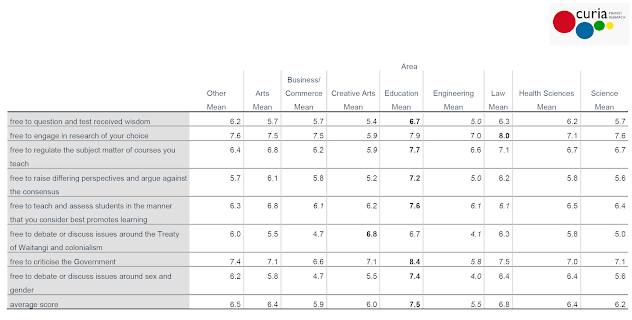
Academic freedom - survey says

The Free Speech Union was kind enough to share the data from their survey of NZ academics on academic freedom. 

Their survey compared means across different questions, between universities, across academic ranks, and among academics of different age and gender.


I threw it into Stata.

The questions seemed to load onto a single factor - one factor had an Eigenvalue around 5 with the rest below 1. 

So I stuck it into a principal component model to get scores for each respondent for that factor. 

The nice bit with a PCF is that the predicted values on the factor are mean zero, standard-deviation 1 by construction. So the coefficients on all the different dummy variables can quickly be understood. A 0.5 coefficient on something means that something is associated with a half a standard deviation increase in the dependent variable. 

Higher scores here mean higher academic freedom.

Here are the results from a straightforward OLS with the principal component from the factor analysis over on the left hand side, and the kitchen sink on the right hand side. T-stats below coefficients; stars mean their usual thing.
 
Principal Component
Institution
Victoria University of Wellington
(Reference category)
Otago University-0.335
(3.42)**
AUT-0.516
(4.12)**
Massey University-0.380
(3.81)**
University of Canterbury-0.141
(1.33)
Auckland University-0.262
(2.51)*
University of Waikato-0.336
(2.74)**
Gender
Male
(Reference Category)
Female-0.103
(1.61)
Gender Diverse0.542
(1.90)
Field of Study
Arts
(Reference category)
Business-0.256
(2.33)*
Creative Arts-0.272
(1.36)
Education0.384
(2.63)**
Engineering-0.487
(3.51)**
Health Sciences0.104
(0.97)
Laws0.002
(0.01)
Science -0.123
(1.23)
Other Area -0.060
(0.48)
Rank
Lecturer 0.192
(1.78)
Senior Lecturer
(Reference Category)
Ass. Prof -0.099
(1.15)
Prof 0.160
(1.93)
Senior Management 0.145
(1.01)
Other -0.091
(0.82)
Age
Under 30 0.314
(1.77)
31-45
(Reference Category)
46-64 -0.315
(4.27)**
65+ -0.171
(1.89)
Constant 0.504
(4.27)**
R2 0.10
N 1178

Just a bit of fun - a quick and dirty run through the thing. 

Vic Uni comes out well. 

Rank doesn't do much controlling for age. Gender doesn't do much. 

Folks in Education seem to feel relatively unconstrained; whether that's due to academic freedom or to constraints that match their ideological preferences and so are non-binding is harder to tell. 


The Free Speech Union could do well in academia, given what other views there on academic freedom look like. 

Tuesday, 23 November 2021

International Ed

Australia's reopening to international students.

New Zealand isn't. 

This is just getting crazy. 

There are safe protocols that can be run here. 

New Zealand could allow travel from safer countries, with a pile of testing and vaccination requirements. 

Start by requiring up-to-date full Covid vaccination for getting a student visa. That's pretty simple. Vaccination requirements have been part of international student visa requirements all over the place long before Covid. 

Then add in some testing. Require the standard PCR test a couple days before travel. Add a requirement that travelers pass a rapid antigen test administered at the gate before boarding, with Covid-positive students denied boarding. Add another RAT on arrival, with any remaining positive cases shunted into isolation. Remember that this is the protocol that was used in a trial for travel between the US and Italy late last year through early this year. There were just under 10,000 travelers. The RATs caught 4 positive cases at the airport before boarding and one more on arrival - among a group of people who'd all recently passed a PCR test. The folks running the trial concluded the RATs were pointless because 5/10,000 wasn't that risky. But we could do it. We could require it for airlines departing for New Zealand. 

And we could make it even safer. Take a saliva sample on arrival for PCR testing, require everyone to get the Covid tracer app, and require them to provide contact details. Add in a requirement to present for a Covid test a few days after arrival. 

Sequences of tests make it increasingly less likely that anyone passing all the tests are infected. There's just no way that someone coming in on that regimen is more risky than the random-draw person in Auckland currently. 

Or do all that and have the universities run a few days of MIQ, as they proposed doing back at the start of all this. It's far less risky now that vaccination is available. 

The borders are looking increasingly absurd. There are safe ways of doing all this. 

Thursday, 18 November 2021

From TEU to FSU

Jack Heinemann's take on academic freedom in New Zealand provides an excellent on-campus recruitment opportunity for New Zealand's Free Speech Union. 

The Free Speech Union, as a registered union, has rights to enter workplaces to talk to workers. They should plan a round of campus visits.

Here's Jack:

Making conscience central in all activities of a critic and conscience of society might avoid some future clashes in Aotearoa. Academic freedom is the right to bring forth unpopular or controversial opinions, not to promote opinions popular with those who have social or financial privileges.

For example, white/Pākehā academics making comment on mātauranga Māori in defence of “science” don’t need to use academic freedom because the westernized institution of science already has disproportionate power and influence in any clash with indigenous knowledge systems. So when a university takes a neutral position, treating the academic protagonists and academic responders equally based on narrow ideas of a right to free speech, the institution stumbles as critic and conscience of society. Moreover, it fails to both preserve and enhance academic freedom.

Other examples include attempts to use university campuses as platforms for racially or genderised “forums”. Those without power or privilege don’t need tertiary institutions to criticize them, turn their backs on criticisms of them, or to host it. The desire of majority members of white paternalistic societies to have their ideas spoken on campus is not equal to the right of minority ethnic and non-binary groups to feel accepted and safe there.

Privilege is an asymmetry of power that marginalizes and excludes others. No history of academic freedom is consistent with the notion that it speaks privilege to power.

So. If your research shows that claims of oppression in the case you're studying are overstated, or that an institution isn't as colonialist and evil as others have suggested, you should probably shut up about it because that doesn't count under critic and conscience. Because it reinforces power or something. 

If you haven't joined the Free Speech Union yet, and you're a New Zealand academic, they may be more likely to have your back than the TEU, if it comes to it.  

Friday, 5 November 2021

Affirmative action in NZ academia

David Farrar points to some changes coming for PBRF

Evidence portfolios submitted by Māori (and Pacific) staff will have a 2.5 (2.0) funding weighting applied. 

The subject area weighting for Evidence Portfolios assessed by the Māori Knowledge and Development panel (the Pacific Research peer-review panel) will increase from 1 to 3 (2.5).

I get the problem they're trying to solve here. I'm not sure this is the right way of going about things. 

I'd emailed a friend about it a while back, when news of this first made the rounds. A mildly edited version of that is copied below:

Here is my attempt to steelman the policy. Parts of it I disagree with, and overall I still don’t like the policy. But this would be an argument in favour:

PBRF weighs heavily research contributions. That’s its job. But assessment panels always have an easier time dealing with contributions that fit the international mold. And the top international journals in important disciplines simply do not care about issues that matter in New Zealand policy.

In economics, papers based on New Zealand data addressing New Zealand policy issues would make a top journal in the unlikely event that the issue accidentally creates a nice natural experiment that speaks to broader theoretical or methodological issues that economists publishing in the top journals care about. Otherwise, it will wind up in New Zealand Economic Papers, a third-tier journal. And PBRF rates top contributions highly.

International academic reputation already depends heavily on publishing in top journals. Combine that with a PBRF system that amplifies the already-huge rewards for publishing in top journals, and you have a recipe for discouraging NZ academics from doing any work at all that’s of relevance to NZ.

Māori academic staff who may be more naturally inclined to pursue research of direct interest to their home communities will be punished for doing so in their international academic standing, in their journal placements, in their PBRF rankings, and consequently in their promotion prospects. And similarly for Pacifica. A thumb on the scales offsets that effect.

But even more brutally, academia is an international game. The best in the world get their training in the US, and the best of those then get jobs at top US universities. Kiwis are a small proportion of the world's potential profs, and presumably an even smaller proportion of those who've gotten decent degrees in the US. And an even smaller number will either be Māori or Pacifica. If they come out of one of those schools with a doctorate, and they’re able to publish in top journals, they’d be a bit crazy to come back to New Zealand (or have strong preferences, which is kinda the same thing). A thumb on the PBRF scales encourages those who want to do this kind of work to come home to do it. 

Now why do I not like the policy anyway? It turns NZ academia into a niche play that’s outside of the global academic conversation. It sets too hard a division between the incentives in the local game, and the game that the rest of the world is in. It risks making NZ an insular academic backwater. 

If the government wants to fund more research on NZ-specific policy areas, particularly with a focus on Māori and Pacifica issues, it could boost Marsden for a dedicated funding line in it. Or set its own dedicated fund. And remember that PBRF also weighs external research grants.

The current set-up would more than double-weight the research portfolios of Māori academics doing work in theoretical physics, or abstract higher-order maths, or a host of other areas where there really isn't any relevant local-penalty. The local penalty applies for work in locally relevant social science questions that aren't quite aligned with questions of interest in the top international journals. I can see the problem in encouraging research in locally relevant stuff, and can see how that would particularly apply for Māori and Pacifica research. But I would have thought that just setting better contestable research funding in those areas would have made more sense.