Thursday, 5 November 2015

Exit and reform

Countries from which it is easier to exit saw stronger improvement in economic freedom: voting with your feet matters. Here's Josh Hall's abstract:
There is a small but growing literature on the determinants of economic freedom. In this paper I contribute to this literature in two ways. First, I empirically show that β-convergence in economic freedom occurred from 1980 to 2010. Countries with low levels of economic freedom in 1980 “catch up” at a rate of 0.7 percent a year on average, ceteris paribus. Second, I document the structural characteristics that contribute to this institutional convergence. My conditional convergence estimates suggest democratic institutions do not contribute to conditional convergence. Exitability, a variable that captures how easy it is for citizens to “vote with their feet” is related to the change in economic freedom from 1980 to 2010 in a statistically significant manner across all specifications. This provides some to the importance of “exit” versus “voice” with respect to the question of institutional change. 
This will be a weak force among relatively free countries: libertarians don't seem to vote with their feet, and only those with strong preferences will much notice the differences within the top tier.

But policy pressure caused by threat of exit by your more productive citizens can induce better performance in weaker countries.

Wednesday, 4 November 2015

Another licensing regime

The Law Commission's report on death recommended shifting funeral directors to a stricter form of occupational licensing.

Currently, funeral directors need to be registered, but registration is pretty simple: adding your name to a list. LawComm recommends barring from registration those with certain criminal convictions or disqualifying circumstances (undischarged bankrupts, for example), and requiring that registered funeral directors hold a relevant qualification or pass a knowledge examination.

A few years ago, Martin Jenkins put together a report on the extent of occupational licensing in New Zealand. They there reckoned that around 20% of workers in NZ were subject to licensing requirements. These kinds of requirements often sound nice, but act as a barrier to entry into particular professions - in doing so, they can restrict employment opportunities.

Here's Law Comm on that point:
This knowledge could be demonstrated by holding a relevant qualification prescribed by regulations made under the statute. As noted previously, qualifications are currently available in both funeral directing and embalming. Currently, there is no formal qualification specifically for operating a cremator, although NZQA-accredited training units in cremator operation are in development. When the cremation training units become available, they could be included in regulations.

However, we have some concern that, because the current qualifications for funeral directing and embalming require applicants to be employed in the industry already, making those qualifications compulsory for registration will give some control to existing industry participants over new participants in the industry. That is an undesirable situation because it may encourage anti-competitive behaviour and stymie innovation or alternative methods of providing funeral services.

The purpose of the qualification prerequisite condition is to ensure that industry participants have the requisite levels of knowledge (or are operating under the supervision of someone with that knowledge). One alternative option to demonstrate that knowledge would be to sit an examination (similar to a person passing the theory test before being permitted to learn to drive a car). This option would enable people to enter the industry without first having to be employed by an existing participant.

We have considered who would be best placed to set this examination. The existing training provider would have the expertise but also a conflict of interest. Alternatively, the registration authority could administer the examination, but that would require some expenditure and a different set of skills than is required merely for the registration process. It may be that the most effective solution is for the examination to be provided by the existing training provider under the registration authority’s supervision to ensure that there are adequate protections against the conflict of interest.
It would be ...interesting... to see whether it's possible to set up a practical knowledge test overseen by the licensing agency that doesn't just turn into a limitation of entry to protect existing funeral directors.

What would happen if you weren't registered?
We think that the potential for a conviction and fine would provide the appropriate level of incentive to comply with the requirement to be registered, and so the new statute should provide an offence of carrying on the business of providing funeral services without being registered or without acting under the direct supervision of a registered person. This should be a strict liability offence—that is, the prosecution does not have to prove a mens rea element of the offence (for example, that the person knowingly, recklessly or intentionally did the action). However, the accused person has a defence if he or she can show total absence of fault on the balance of probabilities. 
On a quick look through the Law Commission's paper, it's hard to see what particular problem necessitates the new requirement.

The main issue they cite is that some people think the current registration regime provides quality assurance where it doesn't. But surely that's an issue for the funeral sector industry organisations to be pushing in their marketing rather than the basis for a new licensing regime. It isn't hard to imagine funeral homes advertising on the basis that their directors are all members of an industry association that requires training: "All our members have trained and certified directors on-site to ensure that your loved ones are treated with the respect they deserve, unlike those other funeral homes."

We really shouldn't be proliferating mandatory licensing regimes.

Tuesday, 3 November 2015

Starting school

In New Zealand, every kid can begin school on the child's fifth birthday. There is then no particular birthday cut-off for schools, other than that kids might be stuck in Year 0 a little bit longer.

In much of the rest of the world, school starts on a particular date: if you turned 5 before some cut-off date, you're in; if not, it's another year of daycare, but you'll be one of the older kids in your class. This has consequences for timing of births.

New Zealand may be considering flipping to the "everyone starts on the same date" regime. And so you have the potential for a rather nice difference-in-difference study: none of the kids in the current cohort would have been born with parents anticipating school-start timing effects around a set start date, but if the regime changes, they will - in a few years. In the transition, there will be kids in one year who started on their birthday and others just starting on the set date.

If it happens, I wonder whether anybody will pick this up as a neat identification strategy.

Manitoba taprooms

Things are improving in Manitoba:
It may be late to the party, but craft breweries are on the verge of exploding in Winnipeg.
Once a smaller market with just two local craft breweries (Half Pints Brewing Co. and Fort Garry Brewing Co.), the city is set to quadruple that number by the end of next year when at least six breweries or brew pubs are scheduled to open.
From the opening of Nicole Barry's Peg Beer Co. brew pub this winter to Tim Hudek's One Great City Brewing brew pub opening in April, Manitoba will go from being the only province without a brew pub to hosting two.
Executives from Calgary-based Big Rock Brewery were here this week, scoping out Winnipeg as a possible location for one of their new urban brew pubs.
Local veterans of craft breweries are embracing the competition.
...
The province began trying to expand the local market for craft beer last year by introducing growlers, a refillable beer container that sells Fort Garry and Half Pints beer at participating Liquor Marts. It plans to expand the program.
In May, the province announced it would allow for taprooms at these breweries, with a maximum of about 50 patrons, to sample beer. The brewery only has to provide small snacks.
The decision in May to allow taprooms and tasting rooms helped convince Tyler Birch to get involved in craft brewing. He hopes to have his brewery, Barn Hammer Brewing, opened by late April.
"There weren't enough breweries in Winnipeg and Manitoba," Birch said, while on break at the Brewers Association meeting.
"Craft beer in Manitoba is definitely going to change. Everywhere else you go, there are so many breweries, and everyone drinks local beer. We don't have that here, and I think as people start to see what we're doing, that will all change," Birch said.
So far, only Half Pints has expressed interest in opening a taproom, but Ron Lemieux, the minister responsible for MLL, hopes these new breweries will pounce on it.
Winnipeg, about 700,000 people, in a province of a bit over million people, is about to expand to 8 breweries.

NZ, population 4.6 million, has about 80 brewers as members of the Brewers' Guild.

It's only recently (well, 2011) that the regulations smartened up a bit (but not entirely). I'm not sure what's up with the restrictions on taproom serving capacity.

HT: Mom

Previously:

Monday, 2 November 2015

Cooperative smarts

Intelligence can affect income through more than a few channels. Smarter people have better health-related behaviours, so what looks like an income gradient in health might in large part be an intelligence gradient. Smarter people are more likely to go to and complete university degrees, so what looks like a return to education might in large part be a return to intelligence.

And smarter people are better at playing cooperate in prisoners' dilemma games. I'd had this hanging in my to-read file from a Marginal Revolution assorted-links post for a while and had missed the original paper when it came out. But here's the write-up from Pseudoerasmus:
Intelligence and Cooperation
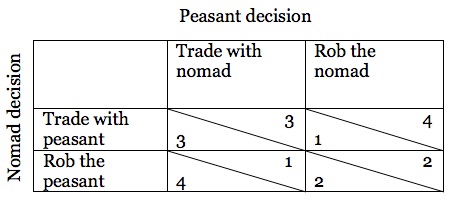
In the workhorse model of (non)cooperation — the prisoner’s dilemma — two players are faced with the decision to cooperate or defect based on a matrix of 4 possible payoff combinations.
Suppose a sedentary peasant would end up with $4 (the loot + his own output), if he ambushed and robbed a passing horse-backed nomad, but only $3 if he traded goods with him. The nomad faces the identical decision: $4 with robbing, $3 with trading. If bothdecided to rob, then they would be left with $2 each.
PDIt’s set up so that each has a perfectly rational self-interest in robbing the other, but the trading world is clearly better than both-turn-to-robbery world.
It’s well known from simulations of “infinitely repeated” prisoner’s dilemma games that cooperation is best sustained when both players adopt some variety of conditional cooperation strategy: cooperate first, but then copy the other play’s earlier choice. [Axelrod] The gains to both parties are bigger in the long run if both parties behave like that. And, as we have already seen, real people do in practise show an instinct for conditional cooperation.
But Proto, Rustichini & Sofianos (2014) demonstrates that in a multi-round Prisoners’ Dilemma experiment with actual human participants and real money, the intelligent are much more likely to practise conditional cooperation.
In this experiment, subjects were first administered Raven’s Progressive Matrices, a test which measures fluid intelligence (i.e., not based on knowledge). They were also tested for risk attitudes and the Big Five personality traits. In the end, 130 participants were allocated to two groups — “high Raven” and “low Raven” — and the only statistically significant difference between the two groups was in fluid intelligence. The participants did not know how they were grouped. (Edit: Also relevant: “Participants in these non-economists sessions had not taken any game theory modules or classes.”)
Then within each group, different pairs of participants repeatedly played the prisoner’s dilemma — the maximum number of rounds was 10 but a computer decided whether to terminate the session after each round with a fixed probability. There were multiple sessions of these rounds of games.
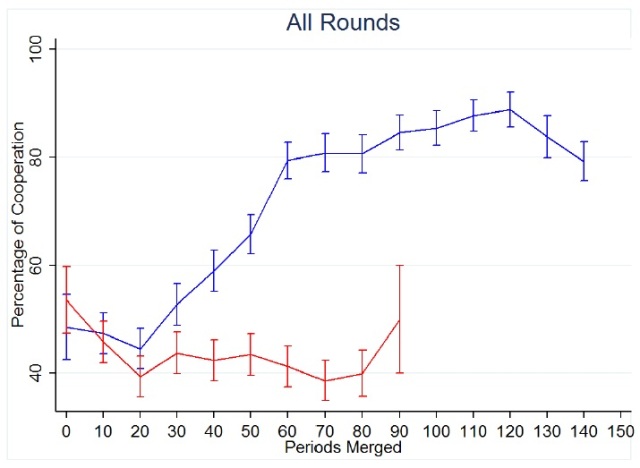
fig2b
[Blue: high Ravens group, Red: low Ravens group. X-axis: each period represents 10 rounds; Y-axis: the fraction of players cooperating.]
The high Raven group not only diverged early from the low Ravens, but also sustained cooperation much longer. There actually wasn’t much difference between the two groups in the early rounds. The difference grew incrementally, in drips and drabs, but in the end, it was substantial. This suggests high Ravens learnt the optimal behaviour from the previous rounds better than the other group.
Proto et al. sliced and diced the data in various ways and found that:
  • reciprocation is much stronger with the smart: high Ravens are more likely than the low Ravens, to match prior cooperation with cooperation in kind, and punish prior defection with defection in kind;
  • reaction times — the time it took to decide whether to cooperate or defect — were shorter and declined faster for the high Ravens;
  • the only statistically significant difference in individual participant characteristics was fluid intelligence;
  • when the monetary payoffs were manipulated to make cooperation less profitable in the long run, the high Ravens were no more cooperative than the low Ravens — if anything, the low Ravens were slightly more cooperative !
But the most amazing result has to be this: “Low Raven subjects play Always Defect with probability above 50 per cent, in stark contrast with high Raven subjects who play this strategy with probability statistically equal to 0. Instead, the probability for the high Raven to play more cooperative strategies (Grim and Tit for Tat) is about 67 per cent, while for the low Raven this is lower (around 45 per cent).”
Understanding the benefits of working together in complex situations — which is what a repeated prisoner’s dilemma simulates — implicitly requires reasoning skills, the ability to learn from mistakes, the ability to anticipate, and accurate beliefs about other people’s motives.
The ethical implication: the intelligent are more likely to practise the Golden Rule, and this actually breeds trust; and the less intelligent are more likely to think they can get away with it, and this breeds mistrust. You only need intelligence to generate this difference. You can immediately see where social and civic capital might come from, at least in part.
The Proto et al. study replicates and extends a few earlier studies on intelligence and cooperation (Al-Ubaydli et al. 2014; Jones 2008). Moreover, it’s consistent with cross-cultural findings from Public Goods Games as described below.
The post also extols the merits of patience.

Risky tenants

Would landlords be like this if it were easy to kick out problem tenants?
Private landlords are shying away from renting to homeless youth even though the Christchurch City Council is promising to underwrite their rent.
Earlier this year, the council decided it would allocate $130,000 from its housing fund to underwrite the leasing of private rental properties for the homeless.
...
CMM executive director Jill Hawkey said despite the financial guarantees offered to landlords in regards to rent and repairs, many declined to allow them to rent properties that would be subletted to youth because they worried they would be noisy and annoy neighbouring tenants.
About 50 landlords had to be approached to get the two tenancies for young people.
...
Council housing taskforce chairman Cr Glenn Livingstone said some of the people helped by the project had been struggling on the streets for years.
"Because of this, moving into a permanent home is literally a life-changing event for them, opening up new opportunities for the future."
Rental housing was usually not an option for homeless people because of their credit rating, tenancy history, or lack of income to pay for bonds or rent in advance.
"From a landlord's point of view, there's just too much risk there," Livingstone said.
"But with the help of the project and the significant support provided by Youth and Cultural Development, the Methodist Mission has been able to help a number of young people and families to overcome these barriers and get a foothold in warm, secure and affordable rental housing."
Barriers to exit are barriers to entry: if you can't get out of a bad situation, you take a lot of care not to enter into one in the first place. The regulations that look really nice to protect people against bad landlords help to ensure the riskier tenants have a hard time getting a tenancy in the first place.

Evolved phobias, modern solutions

Clare Lehman points to data on Americans' phobias. Not so much the things that kill people today, but things our ancestors a hundred thousand years ago would have had to worry about:
Fortunately, Zach Weinersmith has the solution:

If you're interested, and you should be, SMBC's best-of religion and science comics are up on Kickstarter.