Monday, 20 February 2023

Managed retreat - some basic principles

EDS has put up a lengthy paper on managed retreat.

I have an alternative, shorter proposal. Or at least a starter.
  1. People should be able to build where they want.

  2. Insurers should be able to set premiums to reflect risk. EQC could make that safer for private insurers by leading the way. They have decades of claims history. 

  3. Councils should reserve the right to discontinue services in places that are too expensive or difficult to maintain. In such cases they could offer existing residents a choice:

    1. Special ratings district that imposes a differential higher levy reflecting higher costs of providing council services in those areas, and a promise that there will be no cross-subsidies from safer places, reminding that that means that if their road washes out and they want it reinstated, the levy will have to go up;

    2. Setting of a special purpose local board that becomes the owner of local infrastructure, governed by its residents, and able to set its own levy on properties for service. Councils would need to sharply reduce rates for those properties to reflect that council is no longer providing those services.

  4. Ability to set those special purpose local boards should be extended more broadly, such that a group of farmers could set one to take on the debt that funds flood protection works and finances that debt through a levy on protected properties, on approval of those properties’ owners.

  5. EQC to recognise mitigation works when setting premiums. Private insurers would do similarly so long as that market is sufficiently competitive.

  6. Make damned sure that there aren’t regulatory barriers unduly hindering insurance entry, including provision of parametric insurance products.

  7. Land values in high-risk places no longer cross-subsidised by low-risk places would drop. If government worries about the equity implications of that, it could provide a one-off payment in compensation. Ideally it would set a cap on such compensation because it will disproportionately go to rich people living in unsafe places who have been cross-subsidised by poorer people living in safer places for ages. 
We find that the northern regions of both islands are the source of most claims, that only a handful of weather events caused a large proportion of EQC’s weather-related pay-outs, that the average property lodging a weather-related claim is located twice as close to the coast as the national average, and that properties with claims usually are cited on much steeper land than the typical property in New Zealand.

We also explore their relation between claims and socio-economic characteristics, finding that higher income neighbourhoods appear to be those most benefiting from the EQC coverage for weather events. 

The usual complaint about abolishing implicit subsidies is around equity issues. But normal equity considerations here run opposite to what you might have thought. It wouldn't stop those concerns from being raised as reason not to do this, but do look behind the curtain. 

Seems simple enough. No need for government or council to decide who's allowed to live where. If you want to live in a risky place at your own expense, that should be up to you. 

Wednesday, 15 February 2023

Large gatherings and Covid

I do love a good natural experiment. And this is a neat one
Social distancing is important to slow the community spread of infectious disease, but it creates enormous economic and social cost. Thus, it is important to quantify the benefits of different measures. We study the ban of mass gatherings, an intervention with comparably low cost. We exploit exogenous variation in the number of National Basketball Association and National Hockey League games, which arises due to the leagues' predetermined schedules, and the sudden suspension of the 2019–2020 seasons. We find that, among clusters of counties that are adjacent to sports venues, each additional mass gathering increased the cumulative number of COVID-19 deaths by 10.3%.

Some places had games scheduled between 1 March and 11 March, other places didn't. Play was suspended 12 March. So they compare places that happened to have scheduled games in early March with places that didn't. 


Tuesday, 14 February 2023

Tobacco maps

A little while back, the Ministry of Health put up some indicative maps of where licensed tobacco retailers might be allowed to operate.

The government has decided that rather than being available at some 6000 outlets, cigarettes will only be allowed at 600 outlets across the country.

Lots of things will enter into Ministry considerations of which outlets might be allowed to continue functioning, and which dairies might go bankrupt if they rely heavily on tobacco sales. 

They write:
If there are too many applicants in one area, the following criteria could be useful to distinguish between retail applications (Appendix 3 provides further detail). These criteria may be defined in Regulations.
  • Business related criteria: criteria like security, sales systems and training, could be used to rank applicants. For example, in terms of sales systems, the business needs to have considered factors such as their supply chain – ensuring that they will have the right amount of stock to service demand. We propose that detailed proposals would be acceptable within an application, to avoid retailers’ incurring costs prior to approval of an application.
  • Proximity and location: certain criteria may relate to the location of the retail premise or specific community needs. For example, distance from schools or sports grounds may be relevant.  Communities may feel that there are areas where it is less appropriate for smoked tobacco retail premises to operate (such as near schools or marae). Additionally, ensuring that the premises are spread across each area may be important.
  • A history of compliance with the Smokefree Environments and Regulated Products Act, by the applicant (the entity or individual) and any responsible people over the previous 5 years may be relevant.
  • The nature of the business may be relevant – for example, retail premises selling alcohol, convenience goods and/or groceries might rank lower on this criterion while stores only selling smoked tobacco products may score higher, because we are of the view that selling tobacco products alongside everyday grocery items normalises these products.
  • A ‘specialist outlet’ category could allow for a certain number of retail premises specialising in smoked tobacco products that are not cigarettes (eg, cigars) to score higher.
The Director-General may weight the criteria or give them an equal consideration. We are interested in feedback about what criteria is of most importance, or least importance

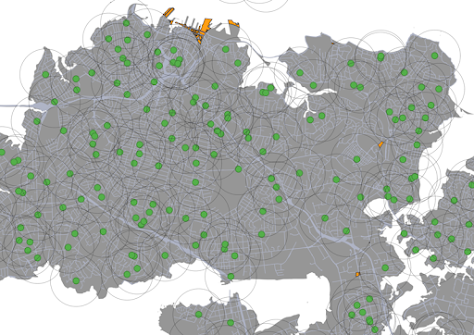
Proximity to schools is a fun one. It reminds me of a map that City Beautiful had put up last year. They were looking at the proximity rules for vape shops, when the Asthma Foundation was trying to ban them within a kilometre of schools. 

On this map of Auckland, every green dot is a school. Every circle draws a one-kilometre radius around a school. And the orange bits? Those are the only places that are outside of the circles and that are zoned for shops. 


So if the government took a hard line on proximity to schools, well, there aren't many places in Auckland where one could run a shop. And in small towns, it'll be tough to find somewhere that's farther than a kilometre from the school. 


Monday, 13 February 2023

Afternoon roundup

The worthies from the tabs:

Revisionist Uber histories

Uber drivers have initiated collective bargaining in NZ.

BusinessDesk reports on it, along with a bit of revisionist history from the union:

"Uber muscled into our country in 2014 without a second thought about employment law or the rights of the people working for them, and drivers are long overdue some agency in their lives."

Recall that Uber 'muscled in' on NZ's archaic taxicab regulations, not on our labour laws. Before Uber, drivers had had to sign up with one of the small number of companies providing 24-hour dispatch. Not exactly a scenario that's friendly to drivers. 

Remember too that Uber has to compete for driver-partners with other ride-share companies, and with existing cab companies. 

Bill Rama, an Uber driver and First Union delegate, said drivers were paid on average less than the minimum wage, and only for about 50% of the hours they work. He said the company also took no responsibility for the safety of its drivers or its passengers.

We've had an incredibly overheated labour market. Does it seem likely that Uber's forcing people into sub-minimum-wage work? 

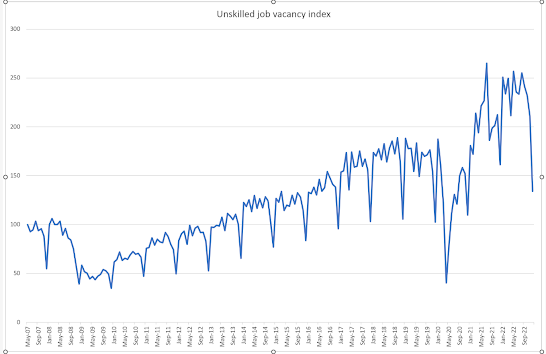
Here's MBIE's job vacancy index for unskilled work.


If Uber was able to keep driver-partners through the 2021-22 period when the thing was hotter than it had ever been, doesn't that kinda suggest that those drivers weren't being exploited?

Thursday, 9 February 2023

Insufficient biofuels

This is closer to right than most pronouncements on it but it's still deeply wrong.
Climate Change Minister James Shaw said he supported the move, and he and Woods had now been tasked with quickly finding a way to fill the big hole in the budget.
“This is why we have a carbon budget right, is to say, when we make these choices, actually, we've got to plug the gap somewhere else,” he said.
"The most straightforward thing that we could do is to tighten up the ETS [emissions trading scheme] unit supply, so you simply take it out that way. But there may be other policy interventions that we could make as well.”
A biofuel mandate is neither necessary nor sufficient for a reduction in net national emissions. 

If you ran the mandate without cutting the cap, you'd just shift where emissions happen. If you ran the mandate while cutting the cap, you would reduce net emissions while also shifting where emissions happen. But it's the cutting of the cap that's both necessary and sufficient, all on its own. A biofuels mandate just shifts the location of emissions, regardless of whether you cut the cap.

So yeah, Shaw's right that you could cut the cap to reduce emissions. But there's no 'hole' created in anything by cutting a biofuels mandate. Compared to a counterfactual in which we'd have had a mandate, we get a few more emissions in transport, a few fewer emissions everywhere else, and a lower overall cost of getting down to net zero. 

Any 'hole' from not having a biofuels mandate is like the hole you make in a T-1000 if you shoot it. The thing fills itself in all on its own. More emissions in transport? There'll have to be fewer emissions somewhere else. That's how the ETS works. 


Want to stop T-1000? You don't do it by shooting at transport, or shooting at power generation. You do it by cutting the cap steadily over time to hit net zero. 


Wednesday, 1 February 2023

Cost of living absurdities

Peaches come from a can.

They were put there by a man.

In some factory in Greece.

When they made their little way

out to brighten a Kiwi’s day,

they got hit with a 34% punitive anti-dumping duty.

Prime Minister Hipkins made the cost of living the government’s number one priority. So I checked which anti-dumping duties are still in place.

Anti-dumping duties rarely make sense. The theory is that a foreign company will sell here, below cost, for long enough to drive Kiwi competitors out of business, and then jack up prices. 

It’s more than a bit bonkers. Consider coated steel from Korea – a kind of steel used in roofing. From 1 January this year, imports from one Korean company were hit with a renewed 12.6% punitive tariff, and two other Korean companies are subject to smaller tariffs. 

Under anti-dumping theory, they were selling steel here below cost to drive the Kiwis out of the market, so they could profit when those Kiwi competitors went under. But a quick Google search finds 998 suppliers of the stuff across 55 countries. The 997 other suppliers would be the ones to benefit. 


And, of course, if it really were being sold here below cost, anyone, including Kiwi steel producers, could put up a shed and store tonnes of it for later resale. 

Inflation is high and the government says we’re in a cost-of-living crisis, with groceries and building materials front and centre. But those Korean companies’ roofing steel, along with galvanised wire from Malaysia and China, are hit with anti-dumping duties. So you’re protected from affordable building products. Doesn’t it warm your heart? Tariffs are love. 

And consider the peaches. Everyone loves canned peaches. The '90s band The Presidents of the United States of America even wrote a song about them. I ripped it off to lead this post. 

In May last year, the Government reimposed antidumping duties on preserved peaches from Spain. In December, they started investigating Chinese peaches. And the peaches from Greece? 34% duty

Meanwhile, the Commerce Commission’s been investigating why groceries and building materials are so expensive. And the government is subsidising petrol while taxing peaches. 

So I’ll end with another bit of theft from the Presidents. 

Government lingered last in line for brains

And the one that it got was sorta rotten and insane.