Showing posts with label Treasury. Show all posts

Friday, 6 November 2026

Excise fantasies

Zombie stats. You just can't kill 'em. 

It's particularly frustrating when NZ Treasury helps birth one of the things and then does nothing to help kill it. 

Recall that Treasury relied on MoH's shonky reckons on uptake of heated tobacco when the government halved excise on reduced-harm heated-tobacco. 

At BEFU 2025, Treasury put up its estimates.

Excise on heated tobacco not made from reconstituted tobacco currently sits at $818.53 per kilo.

If you think that halving excise on heated tobacco results in $11m in lost excise for year to June 2025, then you must believe that you will collect $11m in excise from heated tobacco for that year (assuming no change in consumption). $11 million per year when excise over that fiscal year (as simple average between the 2024 and 2025 rates) is $789 per kg means you expect 13,900 kg of heated tobacco will be consumed in FY 2025. 

And if you think it will total $44m in FY 2026 at an excise rate of $807 per kg (again averaging the two rates), you're banking on imports of 54,500 kg. 

Infoshare has heated tobacco imports in the detailed overseas trade tables. Go there, select imports, and expand code 24 to get to 2404110200 and 2404110600. One gives volumes of tobacco intended for heating using reconstituted tobacco, the other without reconstituted tobacco. The latter is what is used. 

For the fiscal year ended 30 June 2025, imports totalled 2,374 kg - slightly below the expected 13,900 kg. For the year to June 2026, imports were 4,207 kg - again, just a bit out from the expected 54,500 kg. 


At BEFU 2026, Treasury recognised that they'd botched this. 

But they refrained from putting up comprehensible alternative figures. Instead, they published a revised overall outlook for tobacco excise where smaller reductions in excise revenue from shifts to heated tobacco melded with sharp reductions in overall expected tobacco excise revenue (with Treasury remaining agnostic about how much is due to people smoking less overall, and how much is due to shifts to the illicit market). It's all mushed together. You can't tell what is the correction to the HTP figures and what is the decline in expected consumption of excised tobacco. 


"Furthermore, subsequent research suggests that future HTP uptake will not be as large as was previously assumed." Indeed. 

A few weeks ago, while I was out of town, Farrar pointed to Labour's fiscal plan. They were relying on getting some $82 million per year from "Reverse Tobacco Tax Cut". 

That... that's just not going to happen. You'd need to expect about a hundred thousand kilograms of heated tobacco being consumed for a doubling of excise from its current $818.53/kg to get you $82 million dollars. 

For the year to September 2026, only 4,309 kg were consumed. 

So you're betting that doubling excise will result in heated tobacco consumption going up by about 23x. Demand curves don't slope that way. 

Labour ought to have known better than to use those numbers. But Treasury really should have put up corrected ones, and especially where Treasury's imprimatur on shonky stats led to the years-long attack on the government for its purported 'giveaway to Big Tobacco'. 

Monday, 24 August 2026

Around the traps

A few bits I've neglected to blog.

Thursday, 2 April 2026

Thank a migrant

Combine a points-based migration system that welcomes higher-earning younger people with progressive tax systems and you get a result like this, from Tim Hughes at Treasury:

The central finding of this paper is the simplest. In aggregate, the foreign-born are becoming increasingly important for the country’s tax base. Foreign-born people made up 24% of the population in 2000, also paying 24% of individual tax on market income. Since then, the foreign-born’s share of the population has grown, and their share of tax paid has grown even faster. In the tax year ending March 2024, the foreign-born made up 32% of the population, and paid 38% of the tax.

As Lewis Holden put it on Twitter: 'Goddam immigrants coming to our country, paying all OUR taxes'.


Thursday, 23 October 2025

The Ring: discount rates edition

Locked at the bottom of a dark well is a beautiful-looking idea. 

"Set discount rates to very low levels when thinking about intergenerational issues."

It is a beautiful looking idea. We don't discount utilities. Future people matter. Conventional discount rates mean that far-off benefits or costs count for next to nil. Don't we care about future people?

Let the beautiful idea out of the well. 

Surely it will be used only for very long-term lovely environmental projects with century-long returns. 

Who locked it in the well anyway? It had to have been bad people for bad reasons.

Let the beautiful idea out of the well. Free it!


A couple of decades ago, Treasury was the place that warned about public choice considerations. About how this sort of thing might be a bad idea, and the reasons it would be a bad idea, and the safeguards that might be needed if you wanted to let the thing out of the well. 

Lately, Treasury's been drinking from the well instead. 

I was pretty sceptical of the initiative, figuring that the proposed dual discount regime would lead to shenanigans. 

An earlier version of this stuff had a 5% discount rate for social investment projects. Tauranga's business case for the Te Manawataki o Te Papa civic redevelopment consequently claimed that the thing was a social investment project that could get the 5% discount rate. Of course this stuff was going to encourage shenanigans. 


And again without and decent definitions or guardrails - just hopeful suggestions about considerations that might affect whether something is commercial or non-commercial. Or any explanation of what enforces mandatory sensitivity tests in a world where zero other Ministries or Agencies respect Treasury as enforcer on anything any longer. 

Updating the discounting regime to use SRTP as the default for proposals with mainly non-commercial costs and benefits makes the CBA settings more technically robust, especially in a policy environment where there is increasing focus on long-term impacts of policy. 
They let it out of the well. 

And it's going about as well as expected.

NZTA in January decided that "most transport activities undertaken by the public sector" are non-commercial. And, in fairness, there's no commercial case for most stuff NZTA now does. So it's 'non-commercial' in that sense. 


It's terrible of course. 

But there's a poetry to it. 

Folks wanted to let her out of the well to justify environmental projects. 

And instead we get more motorways.


Treasury is a fallen place that has forgotten the faces of its fathers. 

Monday, 15 April 2024

Net tax

Stuff's Federico Magrin does a whip-round on the updated Treasury estimates of net fiscal impact by income decile. 

An early version of that paper had been presented at a workshop last year January or February, but for whatever reason wasn't able to be released until after the election. Bit of a shame where there were a lot of claims floating around about who was paying how much. 

The work uses 2018/19 tax and income data. Key charts:

Households below the sixth equivalised disposable income decile receive more in transfers than they pay in tax. The sixth decile is a wash. The top four deciles pay net tax, with the bulk of the burden on decile 10 households who each contribute about $75,000 per household more in tax than they receive in transfers and government-provided services. 

The tax and transfer system sharply reduces the Gini inequality measure. If you're hearing someone citing market Ginis in arguments for higher transfers, know that they either do not know what they are talking about, or are hoping that you won't understand what they're doing. Inequality in final income is much lower than inequality in market income.


There wasn't space in Federico's column for everything that I'd sent through in response to his questions, so I'll include the full answers here (nothing wrong or misleading in how he presented anything; just like keeping track of what I've said about things). 

Treasury’s work really helps us understand that tax and transfer have to be viewed together. It would be easy to damn GST or income tax for not being progressive enough, in isolation, for those who support a lot of redistribution. But where other countries rely heavily on a lot of tax exemptions or preferred tax status for particular groups to achieve redistributive outcomes, New Zealand largely does it through transfers and government-funded programmes. Tax and transfer, put together, sharply reduce income inequality as compared to inequality before taxes and transfers. And the work clearly shows that households in the top ten percent of earners bear a very heavy proportion of the cost of our tax and transfer system.

Treasury’s work relies on data from 2018/19. Since then, a new top marginal tax rate of 39% was introduced for earnings above $180,000, which will have increased the amount of net tax paid by top-earning households. However, inflation will have pushed a lot of lower-earning households into higher tax brackets, reducing progressivity at that end of the distribution. Finally, overall government spending on transfers increased substantially. In 2018/19, government was not in massive structural deficit. In 2024, we are. Far fewer households will now be net taxpayers, because far more government spending is being covered by debt that will fall on future taxpayers.

The tax and transfer system is redistributive by design. Households that are outside of the workforce or that are on lower earnings receive direct transfers to increase their income, and government provides a lot of services in-kind that those households would not be able to afford on their own if they had to pay for them. We all have different views on fairness, and mine is no better than anyone else’s. But what I don’t think is fair is commentary around tax that points to differences in before-tax income as reason to increase taxes and redistribution, while forgetting just how much work the tax and transfer system already does to reduce inequality and poverty.

[And, in response to request for clarification:] You will often hear commentators point to the amount of income earned by the top 10%, and use that as justification for higher tax rates. But that ignores the effects of taxes and transfers that are already in place. Treasury’s work provides that better context. People can come to different views on how much redistribution is enough, but they should at least start by understanding the extent of existing redistribution from the current tax and transfer system.


Monday, 19 February 2024

Higgsean worlds

I was a panelist after Treasury Secretary McLiesh's talk at the Waikato Economics Forum on Friday morning.

I'd made a few notes to myself for my opening 5 minutes. I never quite say what I'd written down. But this is what I'd written down.
Fiscal consolidation and ratchet effects

Covid has taught us two awful lessons.

First, when Parliament gives government a loose rein to deal with a crisis as it sees necessary, trusting that fiscal capacity will be used to necessary purposes, that flexibility will be abused. Core agencies may provide veiled, and sometimes not-so-veiled, warnings that spending is difficult to justify. But ultimately neither they, nor the Public Finance Act, provide discipline. 

Second, New Zealand may well sit in a Bob Higgs world. And I certainly hope we aren’t.

Let’s take the latter first before looking back to the former.

In the late 1980s, Robert Higgs argued, in Crisis & Leviathan, that public spending exhibits a ratchet effect. It is easy for spending to go up in a crisis. Much of it may even be justified for dealing with the crisis. But fiscal consolidation after the crisis maintains a larger government share of overall economic activity than before the crisis: a one-way ratchet effect.

That isn’t a very good world to be in. If you’re in that world, it is harder to get agreement on giving the government the flexibility it might need in dealing with a crisis. There are always tradeoffs between speed and oversight. If you can trust the government to do its best honest job and to retrench after the crisis, then you can afford to cut the government a lot of slack – and get closer to a first best. If you can’t, then those who do not want a permanent expansion in the size and scope of the state have to trade off losses from an inadequate crisis response against losses after the crisis from the permanent part of that increase.

Treasury’s charts in the BIM showed that we might not have been crazy, ex ante, to think we weren’t in a Higgs world. After the Asian currency crisis, Core Crown expenses retrenched, under a Labour government to almost 28% of GDP. The GFC and then Christchurch earthquakes saw them hitting 34% of GDP before retrenching to below 28% of GDP by 2017. 

And the Great Wellbeing Budget promised that every social problem in the world could be solved, with Core Crown Spend projected at 28.8% of GDP by 2023.

In early 2020, there was phenomenal agreement that the government needed to be given the room it needed for dealing with the crisis. It had authorisation to issue the debt necessary for dealing with it. And it had widespread support across the business community. Few atheists in that foxhole. Core Crown spend topped 35% of GDP. 

During the 2023 election campaign, the National Party’s aspirational goal was to get Core Crown spending down to 30% of GDP – above what Ardern’s wellbeing budget had promised. 

And Treasury’s briefing to the government suggested a mix of spending cuts and tax increases would be needed to fill the gap. Inflation, all on its own, increased Crown revenue through fiscal drag by perhaps a billion dollars from Q1 2021 to Q2 2022 – if we can trust Treasury’s tax calculator for changes that large.

Those who prefer a larger size of government have painted normal fiscal consolidation after a crisis as being terrible austerity, and that that austerity’s purpose is to deliver tax cuts. 

It is a dangerous partisan game. 

If returning Core Crown spending, after a crisis, to a level higher than it was before the crisis is going to be painted as austerity, good luck getting social licence for government to have the flexibility it needs to deal with the next crisis. 

Worse, in the crisis, our institutions proved unable to constrain the government against diverting debt raised for dealing with Covid into party-preference spending, like school lunches, and into destructive measures like Envirojobs. 

When New Zealand was running a substantially positive output gap and the country’s lowest unemployment rates on record, the government was running make-work schemes. 

While Treasury did provide some warnings against misguided spending, it also provided the Finance Minister with substantial cover for his initiatives. Measures of fiscal impulse in budget documents seemed designed not to enlighten, but to provide the Minister with a way to claim that massive deficits fuelled by non-Covid spending were, in fact, fiscally responsible – because he was spending slightly less than the year before.

It is hard to avoid the conclusion that the only real fiscal discipline that our institutions provide is the need for vote allocations to compete with each other for a limited pool of resources. When a strong focus on value for money drives Cabinet decisions, Ministries will provide evidence in support of that. When other drivers determine allocations, Ministries will target those other drivers. And when budget constraints disappear because government has taken on tens of billions of dollars in debt, there simply is no restraint. 
Because Secretary McLiesh's opening pointed to the Treasury's view on the criteria for successful fiscal stimulus, with some emphasis on the need to get spending now back down (the limited party), I quoted back what she'd said at the June 2021 workshop Treasury and the Reserve Bank ran on the lessons of Covid. The first sentence is pretty much word for word what the Secretary said this time. The second bolded sentence, well, I wonder whether they've reconsidered that part.
"The well-accepted objectives for effective fiscal stimulus are that it is timely, temporary, and targeted. Overall, New Zealand's fiscal response is meeting those objectives perhaps better than most."

My Twitter thread on the full conference is here.

After my session, I was reminded by an attendee that previous large structural deficits meant the end of two careers in politics for those who had to clean up the mess. That attendee wondered where the hell Treasury was when the structural deficits were being locked in, this time. 

I wonder that too. 

It's like Treasury entirely forgot that regardless of whether one accepts the economic merits of Keynesian fiscal stimulus, the political economy of it just doesn't work. Government has a much harder time scaling back spending in the upswing than it has in scaling up spending in the downturn. And so it just doesn't work. 

Monday, 13 November 2023

Preparing for the new government

Tova O'Brien at Stuff reports on leaked emails at MBIE that point to preparations for downsizings.

In a statement, MBIE said the cuts were in response to the savings targets imposed by the outgoing Labour government and being mindful of the cost of living crisis.

“This work to date has been based on the targets and expectations set by the current Government. We will have conversations with the new Government when it is formed on how we have worked to date to achieve the fiscal savings target,” Tremain told Stuff.

In late August, just ahead of the election campaign, Labour’s Finance Minister Grant Robertson announced $4b in public service savings including cutting back on contractors and consultants and trimming agencies’ baselines by 1 and 2% of which MBIE faced the largest cut at $110.8m

But further changes being considered may be in anticipation of the new government making good on its “cut the waste” campaign rhetoric; in the email, Tremain says “we are preparing for change” and that “this is inevitable as we get ready to support a new government and new Ministers”.

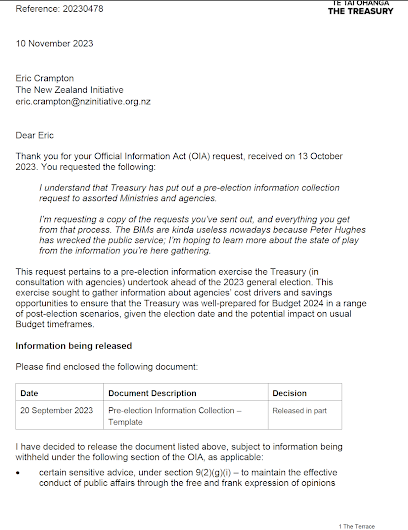
I was curious where some of this might be going and had put in an OIA a while back. 

Treasury had started a pre-election information exercise to help them prep for Budget 2024. I figured that whatever they got back from the Ministries would be a heck of a lot more informative than what's served up in Briefings to the Incoming Ministers. 

Because it would be a lot more informative, Treasury withheld all of it. And fair enough. 

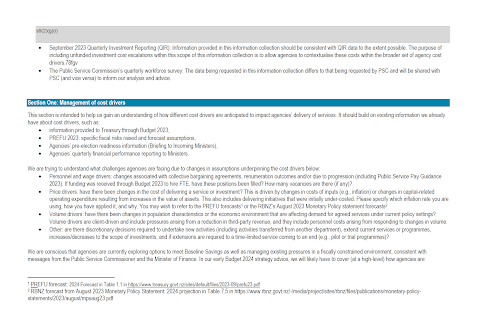
But they did give me the questions they'd asked. I'll copy it all here. 

It's relevant to today's story from O'Brien because a lot of this process started before the election, and there was a Baseline Savings Proposal that was underway. 

But Treasury was also asking for substantive changes to stop or scale down current services or activities - as it ought to be. 

Also interesting - Treasury was asking what projects hadn't yet been started, presumably so they could be cut if needed. I wonder if any agencies started scrambling to start spending on projects to lock them in.


I wonder what all showed up as savings options in Section Two.

Friday, 13 October 2023

Afternoon roundup

Eight browser windows each full of tabs. Something's gotta give.

Friday, 19 May 2023

A cigarette burn in the Crown Accounts

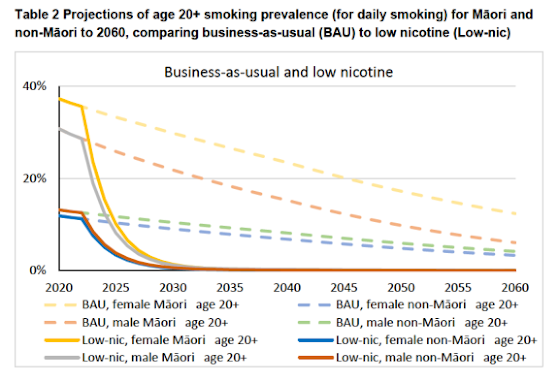
Late last year, the government passed legislation intended to sharply reduce the sale and consumption of legal tobacco. 

It is also intended to reduce smoking rates; how good a job it will do with that will depend on how efficient the smugglers get. But it will definitely reduce the sale of legal tobacco that draws excise. 

From 1 April 2025, Very Low Nicotine Concentration rules will be in force. Only authorised tobacco products will be allowed to be sold, and only tobacco products with less than 0.8 mg/g nicotine content will be allowed. That's section 57I of the revised Smokefree Environments and Regulated Products Act.

How much is 0.8 mg/g? 

Sources vary a bit. But this CDC study had mean nicotine concentrations in cigarettes of 19.2 mg/g. 

So the rules reduce nicotine concentration by over 95%. 

Or to put it a different way, if a normal beer has 5% alcohol, this is like reducing the maximum alcohol content to 0.21%.

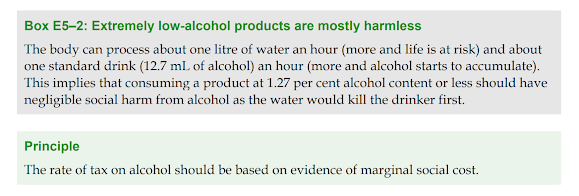
The level is low enough that it simply isn't plausible that people would start smoking a lot more, or smoking more heavily, to try to get those last bits of nicotine. It would be like trying to get drunk on 0.21% beer. It just isn't going to happen. As my most favourite footnote in a tax review put it, you'd die of water poisoning well before you ever hit alcohol poisoning at those kinds of concentrations. [I've snipped the bit from the Henry Review as footnote because it's just so good.]

Ok. So we're all on the same page here right? The intended and near-certain effect of the legislation is to cause a very sharp reduction in the number of legally purchased cigarettes that draw excise.

How big will be the effect? Your thumb-suck is as good as mine, and better than mine if you're a smoker. 

But let's think it through.

In the month or two before the new rule comes in, I expect massive stockpiling of real cigarettes. It will give a surge in excise returns for FY 2024/5. Smokers who can afford to will buy however months' supply is plausible to store. An unopened pack probably stays fresh for at least a year, maybe two? 

I do not think it crazy to expect this. Remember that, when government used to do big increases in excise, it would do them on very short notice specifically with intention of avoiding stockpiling of cheap pre-hike cigs. We have two years to prepare for this one. I expect everyone will be fully responding to incentives: there will be ample supply to meet stockpiling needs ahead of the rule change. 

Households will stockpile their own cigs. Many households that smoke will be unable to afford to do so. Others will stockpile real cigarettes on their behalf, and sell them illicitly afterwards - a greyish market competition to the black market that will be out there. 

So FY 2024 will see a surge in tobacco excise returns, much of which will be a bringing forward of excise returns that would have obtained in FY 2025. 

Cigarette sales will plummet in April 2025. 

Some who'd been completely unaware that the change was coming will buy the new cigarettes and learn whether they want to keep buying them. 

As others work through their stockpiles, they'll do the same thing: buy a pack of the new cigarettes, then decide whether to flip to something else or try another pack; try that next pack, decide whether to stick with them or flip to something else. And so on. There'll be incoming new-tryers and a decay function. 

Say that stockpiles are largely run-down by October 2025. We're likely to be at steady state or close to it by April 2026. Some proportion of current smokers will have quit; some will have shifted to vapes; some will have shifted to the black market; and, some will continue to smoke VLNC cigarettes. 

A VLNC cigarette is like a 0.2% beer. What do you think steady state looks like?

Well, MoH gave what it thought the answer was. It's in the 2021 RIS. They expect that it would take two years for smoking rates to drop by 73%. 


If half of that drop is in the first year, then they're expecting the sale of excised cigarettes to drop by about 36% in the first year.

So the Ministry of Health's Regulatory Impact Statement on its SmokeFree intentions had VLNC rules reducing smoking rates by about that amount. We can safely leave aside arguments about black market or whatever else. This is just the Ministry's projections assuming no shifts to the black market, which doesn't pay excise anyway so doesn't matter.

What do you think happens to collected tobacco excise if the legislation works in the way that the Ministry of Health intended and projected?

I think it's safest to assume that tobacco excise revenues, in 2026, after we've gotten through whatever surge and trough was due to stockpiling, are going to be a lot lower. 1 April 2026 is one year after the law comes in. Sales of excised tobacco should be 36% lower at the start of the year and decline by another 36% over the course of the year. 

That means excise will be about half of what it otherwise would have been, for 2026, and much lower after that. 

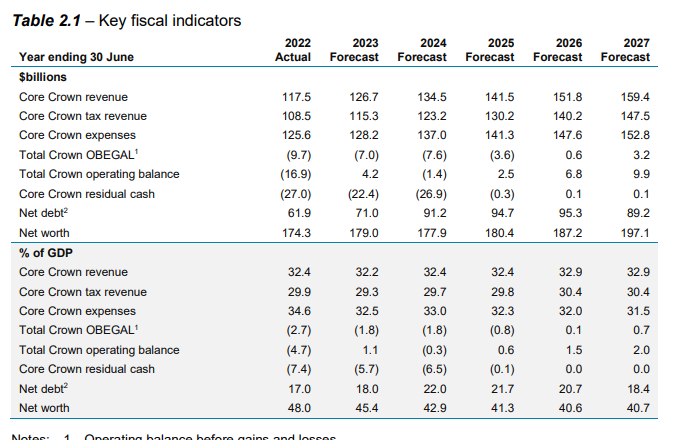
Recall that Minister Robertson promises a return to fiscal surplus in 2026. OBEGAL of $600 million. 


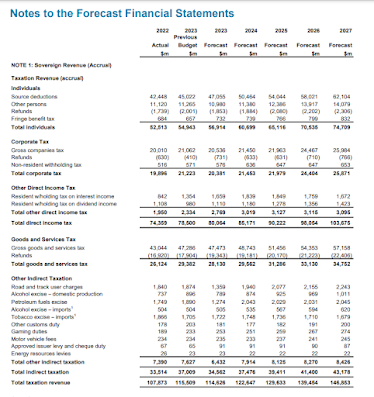
But let's have a look over in the notes. It's always good to look in the notes. And there we see Treasury figuring that the government will collect $1.710 billion in tobacco excise. They've projected a slow and steady decline in tobacco excise revenues, in line with overall declines in smoking rates. They've obviously not factored the VLNC rules into their workings yet. 


And fair enough. It can take a while to run the figures. This has taken me about 20 minutes, but it's very thumb-suck. 

As a rough cut, I expect tobacco excise in 2026 to be about half of what it otherwise would have been. So a drop in revenue of $855 million as compared to forecast. 

So a $600 million 2026 surplus becomes a $255 million deficit. 

This isn't a criticism of the SmokeFree policy. It's the just working through the implications of the policy as promised.

The government is trying to have it both ways here. It wants the reductions in smoking, but wants to pretend there won't be any effects on revenues. It cannot have both. It's one or the other. 

I've called it the cigarette burn in the Crown Accounts.

What really really does puzzle me is why Treasury didn't bother including it as a substantial fiscal risk in BEFU. It's a lot more than the $100 million threshold for inclusion. 

Had a short column over in The Dom on it. 

Update: ASH had had serious critique of the modelling work on the reductions in smoking with VLNC. The critique makes sense. But then you'd have wanted both the smaller numbers on expected tobacco decline, and commensurate figures on excise, in support of the legislation. Can't pass the legislation claiming massive effects on smoking, then backtrack when running the excise implications, right?

FOOTNOTE

Finally, the bit from the Henry Review. So fun. 


Monday, 13 February 2023

Afternoon roundup

The worthies from the tabs:

Thursday, 22 December 2022

To be rescued from the Wellness Regime

TVNZ's "Creamerie" series was excellent. In it, a virus has killed off all the men. The surviving women implement a dictatorship of wellness. 

I wonder if its writers spent too much time dealing with the New Zealand public service. 

Josie Pagani skewers some dripping work out of Treasury.

The Treasury has released a new report to accompany its Living Standards Framework.

The framework is a salad of abstract concepts like ‘’knowledge’’, ‘’voice’’ and ‘’subjective wellbeing’’ attractively arranged in columns and bubbles with no development of logical relationships between them. Nor any use of old-fashioned analytic tools such as whole sentences.

...

I expect policy advice to highlight the costs and benefits of alternatives, to strip bare tradeoffs, and present practical menus of options. I expect sophisticated evaluation of whether policies are achieving what they are meant to.

When advice instead hides choices behind wellbeing mush, no political constituency is ever built for underlying ideas. If no-one can disagree with ‘’wellbeing’’ then no-one can ever win an argument for it either.

The idea of ‘’wellbeing’’ as a political project has emerged from the takeover of our social institutions by an educated middle class that thinks it's being progressive. Instead it signals its elite status.

Treasury is meant to be the government's lead economic advisor. Parts of it seem unfit for purpose. 

Tuesday, 18 October 2022

A confusion of National Policy Statements

When Alice tried to recite one of her lessons while down the rabbit-hole in Wonderland, she thought only a few words had come out wrong. The Caterpillar corrected her bluntly: “It is wrong from beginning to end.”

By contrast, the Cabinet Paper on the National Policy Statement protecting sensitive soils is not wrong from beginning to end.

Paragraphs 90, 91 and 92 contain sound advice from Treasury.

Otherwise, the paper has a few problems.

From my 2019 column on the then-draft National Policy Statement on Highly Productive Land.

Treasury's advice on the NPS was appropriately scathing. The CBA in support of it was incompetently produced. There was no market failure to be solved by the policy. The policy was wrong from beginning to end. 

Even within the constraint of "Voters are just terribly, terribly mistaken so we have to be seen to be doing something to prevent building houses, which are scarce, on agricultural land, which is not," the policy fails. It could have chosen to protect only the top two land use categories, covering about 5% of the country's land (urban land is about 1%). Instead it added in LUC3 land - piles of paddocks mainly - and in so doing locked up another 10% of the country against housing. 

I was curious about Treasury's advice on the revised NPS. They provided it last week, so it formed this week's column for the Stuff papers. Treasury still sees the policy as too restrictive, backed by far too weak of analysis, and as conflicting with the National Policy Statement on Urban Development.

The OIA documents from Treasury are here. 

Bottom line?

Treasury Recommendation: Do not support, defer until the paper includes robust analysis of the costs and benefits of the policy choice to include or exclude LUC 3 land from the default definition of HPL under the NPS-HPL. This could also include recommendations for improved implementation of the NPS-UD. 

And they warned that the CBA MPI had commissioned is still too shonky to rely on.

There's still a potential way through the mess. The coming Resource Management legislation could direct that priority be given to housing in the National Planning Framework. It'll take fairly sharp direction: councils looking for excuses to obstruct housing development will find plenty of them in NPS-HPL. 

Tuesday, 2 August 2022

Stadium co-governance

Oliver Lewis over at BusinessDesk had a look through Treasury documents on the Christchurch Stadium.

Treasury suggested a Council-led approach, both to reduce the fiscal risks to the Crown, and to avoid the challenges of a co-governance approach with Council.

As for a co-led approach (like the city rail link project in Auckland, with the council and the crown both holding shares of City Rail Link Ltd), the Treasury recommended against it, especially if the council had a majority shareholding in the jointly held special purpose vehicle.  

The crown would be assuming risk, officials said, but may not have sufficient influence. 

"Experience working with council to date indicates that a co-governance approach is likely to continue to be challenging and could result in time delays and cost overruns,” the briefing said. 

Later in the year, following meetings between Woods and council officials, the Treasury was tasked with providing advice on two options: a collaborative approach between the council and crown delivered via an autonomous vehicle, or a locally-led option. 

In an October 2019 briefing, the Treasury again affirmed its preference for local leadership on the project and referred obliquely to potential relationship issues should ministers opt for the co-led approach.

There may be some parallels to water.

Under the Three Waters proposal, the Crown takes on enormous backstop risk. They're effectively guaranteeing debt issued by the new entities. 

Treasury warned that Crown-Council co-governance over a stadium may be fraught. 

“For this approach to succeed, crown and council would need to reach alignment on the investment objectives, prioritisation of time, cost and quality, and the best path forward for the project,” officials said. 

“This has not been achieved to date and has proved challenging.”

I'm not sure why co-governance in waters would prove simpler. 

Friday, 20 May 2022

Budget 2022

I have a hard time seeing how Budget 2022 is consistent with the new fiscal rules.

In shifting from a net debt target to a net debt ceiling, they added a requirement that budgets normally provide surpluses. It's the old Keynesean fiscal macro kind of idea: run small surpluses in normal times to build up padding for large deficits in bad times.

And it has the same political economy problem that this kind of thing has always had. Government prefers to ratchet up spending. The old net debt target helped to constrain against that. The new debt ceiling won't, until we hit it. 

So Treasury warned that the new setup required greater focus on fiscal discipline to make sure that dollars provide value for money. A "things must at least pass CBA" rule could take the place of a net debt target in preventing budgets from blowing out.

And yet.

We get hundreds of millions for cash for clunkers and piles of other climate initiatives and subsidies to corporates targeting emissions already covered by the ETS cap. 

We get an extension of the road user subsidy which makes no kind of sense. 

Instead of inflation-indexing the tax thresholds, the government gives a handout to lower-income households equivalent to the extra tax that was stolen from them through inflation pushing about $5000 in earnings from the 10.5% band into the 17.5% band - and packaged as government largesse rather than compensation for a small bit of the accumulated inflation theft. 

Government is running a substantial deficit while the economy is overheated. There's a strong positive output gap. Even on old Keynesean approaches, you're not supposed to do that. 

And think about some of the other ratchets that they've now set up.

They've adjusted one benefit setting that has been a bugbear for child poverty advocates for a long time. If you're on a sole parent benefit, child support payments from the non-custodial parent mean your benefit is clawed back. 

Why would they do that? Sounds mean right? 

The idea underlying it is that the government wants to target support, as much as possible, to those who don't have other means of support. So say that one uninsured parent dies in a car wreck and the other parent, who wasn't in the labour force before, winds up in a hard spot. The government wants to provide more support for that child than for a child where there's additional support coming in from a non-custodial parent. 

So they claw back some government support in the case where the non-custodial parent is able to provide support. That means government can afford to provide a higher baseline level of assistance, before clawbacks.

Now there can be arguments around administrative messes - if the government is not good at enforcing child support payments, or about ensuring that those payments get reported, then the system can encourage informal payments, or discourage all child support payments.

But in-principle, the setup isn't crazy. It at least tries to make sure that more money goes to kids in worse situations when there's a fixed pool of money available for support. And even if your political position is that that pool should be doubled or tripled, you would still do better with that kind of targeting if you wanted to make sure that the money went to where need was greatest.

They got rid of that.

So what's the predictable effect in a couple of years? A John Campbell special that will highlight the grave disparities facing sole parents who have no support as compared to those sole parents who receive child support payments? Is it fair that the kid whose parent died, or whose non-custodial parent has no income, has such worse circumstances than the kid whose non-custodial parent provides a lot of support? And then we run the ratchet again. Someone will recommend supplementary payments where there isn't that support, which will require monitoring and abatement when there is support, and then complaints about how that system runs and demands that the supplementary payments go to all parents, and we get to play the cycle again. 

The Dom wanted a short piece from me yesterday afternoon. I didn't attend the embargo this year, but pulled this together shortly after the embargo lifted. I hit on some of this. 

I wonder if there's anyone left in Treasury who would regret the new fiscal rules or whether all of that cohort left a decade ago. They should regret the new fiscal rules. The only real problem the rules work to solve is ensuring that debt targets don't unduly hinder infrastructure spending that does pass cost-benefit - and that problem would better have been solved through revenue bonds financed from fees or charges on the beneficiaries of the infrastructure, and separated from Council and Crown main balance sheets. 

Thursday, 19 May 2022

Morning roundup

The computer begs to be rebooted. But the tabs...

  • There's an underlying demand-side problem to misinformation. You can't con an honest man...

  • Some days, I love our Environment Minister. Here's David Parker giving Auckland Council a deserved slap for nonsense around character designations. People who want to protect character are "entitled to do that in respect to their own property. But in other parts of their suburb, there will be areas where more intensive housing will and should be built." EXACTLY!! If only central government would fix the incentives that encourage councils to do this...

  • New Zealand regime around medicinal cannabis remains a broken mess. I think it was allowed to fall into disrepair on expectation that legalisation would be coming and make it redundant. It has to be very frustrating for anyone who needs cannabis as treatment, and anyone who wants to supply it. The Newsroom column is gated today, but I think will ungate tomorrow if you pull out the /pro from the link. In addition to all the other problems, medicinal cannabis suppliers have a tough time finding banking or insurance. 

  • Kate MacNamara keeps digging on the messes around Covid testing regulation. Just impossibly frustrating. You can use a LAMP test to meet the testing requirements to fly to NZ. It's way more accurate than a RAT. But they're banned in NZ. If you try begging permission to use one here just to give some added assurance before going to visit a vulnerable relative, the Government just doesn't answer. Vogons would give the MoH an award for being more Vogon than anything they'd ever come up with. 

  • One problem for all the "let's base policy on happiness" people at Treasury and elsewhere: the measures are crap and you can't do anything with them. Here's Bond & Lang, JPE 2019:
    "The necessary conditions for nonparametric identification are strong and unlikely to ever be satisfied. Standard parametric approaches cannot identify this ranking unless the variances are exactly equal. If not, ordered probit findings can be reversed by lognormal transformations. For nine prominent happiness research areas, conditions for nonparametric identification are rejected and standard parametric results are reversed using plausible transformations."
    If you can just run a plausible transformation on the dependent variable to reverse a result, you've got another degree of freedom to justify whatever policy you'd wanted to rationalise. 

  • National Party leader Chris Luxon says he doesn't like corporate welfare in the climate response. Good! But the ETS revenues are hypothecated. Does he support putting them back into general revenues? Or, better, would he support a carbon dividend? I like National's emphasis on an ETS led approach, but that's harder if you don't rebate ETS revenues back to households. If he's not going to, he should promise to end the hypothecation that's let Robertson have a slush fund. 

  • Princeton no longer supports academic freedom.

  • Regulatory regimes can embed fragility against shocks. NZ building materials supply, US baby formula...
Ok. I think I can reboot now. 

Friday, 6 May 2022

Afternoon roundup

The afternoon's worthies

Wednesday, 4 May 2022

The Wellness Regime

The excellent NZ series Creamerie imagined a future New Zealand in which the Wellness People had truly taken over. It was more than a little dystopic.

The Wellness People really have taken over policy though. Sadly, Treasury led the corruption here. And, as cancers do, it spread.

Wellington Council has, time and again, proven to be among the more incompetent of the country's councils. The water pipes keep breaking. The Mayor participates in protests against building housing, in the middle of a giant housing shortage. Let's Get Wellington Moving seems to be about everything other than enabling transport. They say it's about reducing transport emissions, but transport is in the ETS. It can't affect the country's greenhouse gas emissions. 

Wellington Council put up its own economic wellbeing strategy. Because of course it did. 

It's about as good as you'd expect. 

They want central government to provide more subsidies to the local film industry. Wellness demands it. I wonder whether Treasury could find a way of supporting film subsidies under its rather flexible Living Standards Framework. 

My column for the Dom this week. A bottom line:

Until Wellington is able to get things right in the core traditional areas of council responsibility, improving economic wellbeing is going to be a tough job.

I'd also put in a submission on the blasted thing.  

In summary, we submit:

  • Council should focus first on ensuring it is competently and cost-effectively delivering core council services before expanding into other policy areas that are more traditionally handled by central government;

  • Council must fundamentally reconsider how it thinks about carbon emissions. Urban emissions are covered by the Emissions Trading Scheme. Council action in seeking to limit local emissions may have no effect at all on national-level emissions. But Council has a critical role in facilitating its residents’ responses to rising carbon prices in the Emissions Trading Scheme;

  • Rather than lobby central government for measures like subsidies for the local film industry, it should lobby central government to provide Council with the tools it needs to enable urban growth. In particular, better infrastructure financing options would let Council do a lot to improve the whole city – but require central government’s assistance. Housing and the infrastructure required to support it are far too central to wellbeing to see so little attention in this plan.

Monday, 12 July 2021

Afternoon roundup

The browser tabs...

Monday, 28 June 2021

Another case for Cat Bonds

This week's column in the Dom draws on the joint RBNZ-Treasury workshop on post-Covid macroeconomic policy that preceded last week's Covid-truncated NZ Association of Economists conference. 

A snippet:

Overall, the workshop felt designed to warm the economic policy community to higher public debt levels for a longer period. The risks of the approach were noted: interest rates can rise, and there will be problems if they do.

And the approach only makes sense if projects funded by that debt really do pass cost-benefit assessment. That conventional cost-benefit assessment processes ensuring value for money seem out of fashion was not noted as any substantial constraint.

Higher levels of government debt bring risk not only in case of interest rate increases, but also in case of natural disaster. Maintaining headroom to take on a lot of debt in a crisis has been important. If public debt is higher for longer, and global credit conditions become less friendly, the Alpine Fault becomes even riskier.

If the public sector is determined to encourage politicians’ imprudent pursuit of higher debt levels, it should encourage that some of that debt be funded more prudently: through catastrophe bonds.

Catastrophe bonds pay investors more during normal times but void most or all of the bond if a triggering event happens. If an earthquake required substantial government funding, existing catastrophe bonds would void and would provide some necessary headroom.

They may be a more prudent approach in imprudent times.

Nightmare scenarios do still exist. 

There were other interesting bits on the day. One presentation went through some simulations of different paths for fiscal consolidation (getting debt back down); the least costly approach, which also yielded long-run benefits, was through increased consumption tax - GST - and/or reduced transfer spending. The worst approaches were increased taxes on capital, and/or reduced government investment spending (on the assumption that that investment spending is on stuff with positive BCRs, which is a bit heroic). 

One option put up by that paper's discussant, which hadn't come up in the paper, was to use migration settings. You can drive down net debt to GDP by increasing population size - though you'd have to be careful on how the necessary infrastructure were financed.  

Michael Reddell has a good run-down on the macro session.